Robert Vernon Estes (1931-1951): MIA, POW, Military Records – 52 Ancestors #239

When I first discovered that my father’s nephew, Robert Vernon Estes, was a prisoner of war in North Korea and died, probably of starvation, in their hands during his captivity, I was determined to discover as much as possible about Robert’s short life – and death. Maybe after all of these years more information would be available, although many of his records burned in the Records Center fire in St Louis in 1973.

I asked a research firm to find and obtain as many of his military records as possible, from as many sources as possible.

I felt that this is the very least I could do for Robert, known as Bobby in the family, 68 years after he was robbed of life by an inhumane enemy.

Killed in warfare is one thing – but starvation is another. I just don’t understand how humans WITH food could deprive other starving humans – to the point of death. How could they not only observe that horrific suffering, but be responsible for inflicting it willfully upon the miserable and dying who were probably begging for any morsel of food?

That’s not war – it’s torture, pure and simple.

Bobby’s Records

The packet of information arrived in an e-mail while I was speaking at a conference last week. I was almost afraid to open the document for fear of what might be inside, but I had to know.

The first record reveals the date that Bobby’s Missing in Action (MIA) status was communicated to his family. He became MIA and was taken prisoner on November 30th, 1950 but the family wasn’t notified until January 4th, 1951 using message “68.”

Robert Vernon Estes record 1

MyHeritage shows that Bobby was a truck driver.

Robert Vernon Estes record 2

I was hopeful that the MyHeritage yearbook collection would include Bobby’s photo, but neither Bobby nor his brother Charles is shown in any yearbook from their collection. I called the local Monon library as well, and while there are some years missing in the Monon yearbook collection, there are also years present where Bobby should have been included. Perhaps the Estes boys attended a different school system, or maybe they dropped out early to farm. In any case, sadly, there is no known photo of Bobby.

Joseph Dode Estes in WWI.jpg

The closest I can get is a photo of Joseph “Dode” Estes, Bobby’s father, taken during WWI. Bobby probably looked something like Joe.

Bobby was an Army Corporal, promoted during his captivity. His address was given as Route 1 in Monon, Indiana, which indicates that he lived in the country.

Robert Vernon Estes record 3.png

Bobby’s mother, Lucille Latta, had remarried to Harry Stockdale in 1941. She died at age 45 of a stroke on August 18, 1952 where her obituary states that Robert is MIA and had been since November 30, 1950.

Robert Vernon Estes record 4

Lucille was not notified in person that Bobby was missing, but by an impersonal letter, even after a several weeks delay.

Robert Vernon Estes record 5

Robert Vernon Estes record 6Robert Vernon Estes record 7Robert Vernon Estes record 8

My heart aches to think about Lucille opening this letter. Did she know as soon as she saw the envelope in the mailbox, standing on that country road that cold January day?

By the time the military sent the letter, Bobby had been missing for all of December and into January. By the time his mother received it, another week or so.

Did Lucille wonder why she hadn’t received any mail from Bobby, especially given the Christmas holiday? Or was mail so scarce from the front that no mail was normal?

Unbeknownst to the family, Bobby had probably been starving since his capture, was laboring in a mining camp, and may have already died by the time this letter reached his mother.

Did her mother’s sixth sense tell her that her son was in trouble and was being tortured?

All Lucille could do was wait half a world away.

Robert Vernon Estes record 9

By June, even though Lucille wasn’t aware, the military was requesting dental information which suggests that they had no information that he was alive. They probably had no information at all.

1952

In June of 1952, Lucille was apparently very frustrated with the lack of response from the military and engaged her elected representatives for assistance.

Robert Vernon Estes record 10

Based on dates, letters seemed to have crossed in the mail.

Robert Vernon Estes record 11Robert Vernon Estes record 12

Lucille just wanted Bobby’s things, whatever remained with the military. He certainly couldn’t use them whether he was missing, dead or in captivity.

At this point, Lucille didn’t know if he had been captured or killed. What she did know was that he didn’t reappear after being considered MIA, so he wasn’t just lost, injured or displaced.

Robert Vernon Estes record 13Robert Vernon Estes record 14

Bobby’s personal items were going to come home. Lucille, as a mother, would have been hopeful that Bobby would return home too, eventually.

Robert Vernon Estes record 15Robert Vernon Estes record 16

The letter to Lucille’s Congressman was written by the Army a few days before the letter to her.

Robert Vernon Estes record 17Robert Vernon Estes record 18

“Period of anxiety.” That’s an incredible understatement.

Robert Vernon Estes record 19Robert Vernon Estes record 20

Finally!

Robert Vernon Estes record 21

It’s interesting to note that Lucille’s Congressional inquiry did serve to expedite things.

Robert Vernon Estes record 22

Dirty towels and worn, torn socks. Lucille probably cherished them since they carried part of Bobby.

Apparently, these items had been sitting someplace since April.

Robert Vernon Estes record 23

The shipment inventory of effects is dated May 16, 1952.

Robert Vernon Estes record 24

These few items were sent to Bobby’s mother. The bottom items appear to have been sent in July, but the top 2 were sent in a second, later, shipment.

In October of 1952, the Army requested his dental information, again.

Robert Vernon Estes record 25

Lucille died in August 1952. When I made that discovery, I wondered if the stress of Bobby’s captivity in any way contributed to her early death of a stroke.

Bobby’s Bible and “misc brass” weren’t returned until after Lucille had passed away.

Robert Vernon Estes record 26Robert Vernon Estes record 27

Given that Lucille had died, Harry wrote to the military on her behalf.

Robert Vernon Estes record 28Robert Vernon Estes record 29Robert Vernon Estes record 30

Where’s Joseph “Dode” Estes?

Reading this letter from Harry, I realized that no-place in Bobby’s records is his father, Joseph “Dode” Estes either mentioned or communicated with. In fact, it’s Bobby’s step-father who wrote this letter, which leads me to wonder about the absence of Dode.

Where was Bobby’s father and why was he not involved at some level? One would think the military would communicate with a father before a step-father, although Harry married Lucille when Bobby was 10 years old.

The Estes family knew, at least eventually, that Bobby had died. Somehow, someplace, Joe had been told. I noticed in one of my father’s records that the authorities in Lafayette, Indiana in 1938 were asking my father if he had seen Joe. My father stated that he had not seen Joe since the previous Christmas at their mother’s house in Chicago.

This makes me wonder if Joe was in some sort of legal trouble.

Regardless, it tells us that by 1938, Joe was not in the area, assuming my father was truthful, which might not be a valid assumption.

Joe Estes 1940

This September 1940 newspaper clipping tells us that Lucille and Joe were getting divorced and had been separated for a decade. In fact, their separation date is in September 1930 and Bobby’s birth date is March 27, 1931, telling us that they separated when Lucille was 3 months pregnant. Joe may never have been involved much in Bobby’s life.

This might, just might, have something to do with the fact that Lucille wanted to marry Harry Stockdale. Joe seemed to be chronically in trouble and clearly failed to provide for his family.

In 1926, Joe had been in trouble for stealing a car, although he wasn’t convicted because the prosecution’s witness failed to appear.

However, in February 1930, Joe was jailed due to intoxication.

Joe Estes 1930

The State Penal Farm isn’t the local jail, so this sentence must have been non-trivial, although we know he had been released by late June 1930 when Bobby was conceived.

On September 27, 1930, Joe went to jail once again for stealing chickens.

Joe Estes chicken thief

This date coincides with the separation date in Lucille’s divorce pleading. She had had enough, pregnant or not. Joe was still in jail, unless he accrued “good time,” when Bobby was born.

Apparently, in 1930, Joe escaped and returned home. He was obviously caught and returned to prison.

The daughter of Bobby’s brother, Charles, told me years ago that Charles remembered that, as a child, between the ages of 8-10, a group of men with guns came and took Joe away in a vehicle. If Charles’ memory is accurate, that would put that event between 1935 and 1937. The family was shrouded in secrets, and Charles, born in 1927, didn’t see Joe again until he was an adult and somehow found his father.

I’d wager that the event between 1935 and 1937 was yet another jail episode. If the White County newspapers are ever indexed, maybe we’ll find out.

Aunt Margaret sent a photo of Joe in San Pedro, California in 1942.

Estes, Joe Dode 1942 Dan Pedro Ca..jpg

Joe’s location in 1950/51 is a mystery but Aunt Margaret’s letter says that prior to her mother’s death in 1955, she had been sending Joe money to help with his medical bills. He had reportedly been hit by a car in Indiana or near Chicago. My father thought Joe had died, either then or eventually, as did the rest of the family. Joe didn’t pass away until 1988 in Fairfield, Illinois. More secrets.

Another of Margaret’s letters places Joe in Claiborne County, Tennessee in 1957.

“I also chewed him out in 57 when Ed and I visited Eppersons and Dode was working in the cain patch after telling me he was down and couldn’t get up. We went after him and when Aunt Corny Epperson told me Joe had come there splurging money received from his son’s death in the armed service – yet crying hard luck to me, I flipped my lid and really laid him out flat with a good lecture.”

Unfortunately, there are no records regarding payment of any funds related to Bobby’s death.

1953

Robert Vernon Estes record 31Robert Vernon Estes record 32

Bobby’s Bible wasn’t returned until after Lucille died. $1.47 and a Bible – all the makings of an appropriately sad country song.

Robert Vernon Estes record 33

The Bible was worn from usage. I hope Bobby found solace and comfort there.

Robert Vernon Estes record 34

The months must have dragged on for Harry after Lucille’s death and the interminable waiting on word about Bobby’s whereabouts.

Hopefully, Bobby was just a prisoner of war and would be released or exchanged after the war ended. If Harry was a praying man, that would have been his daily prayer.

The Korean conflict ended in 1953. Other men who were missing and actually POWs were released, but still nothing about Bobby.

1954

Then the inevitable…

Robert Vernon Estes record 35

Word had come that Bobby was dead, not informed by the Koreans diplomatically, but from a friend of another soldier who had direct knowledge of Bobby’s death. The soldier grapevine.

And then this entry in Bobby’s file.

Robert Vernon Estes record 36Another antiseptic letter. You’d think a personal visit would have been much more respectful to deliver this type of devastating news.

Robert Vernon Estes record 37Robert Vernon Estes record 38

Word came, albeit through the grapevine, that Bobby had died of dysentery and pneumonia. I have to wonder if this was secondary to starvation, or his body was unable to heal due to lack of food. We know that other men died of starvation in these camps days on either side of Bobby’s death.

Clearly, the North Koreans were not interested in the health and welfare of their captives – or even basic human decency.

The money that Joe was spending that he received from Bobby’s death was likely Bobby’s pay for the time that he was captured in November 1950 until he was declared dead in January 1954. Bobby’s pay would have been $83.20 per month, plus $8 for foreign duty pay as a private, and slightly more as a corporal. That promotion was actually posthumous.

Three years and a couple months pay was certainly a windfall to Bobby’s father, equivalent to about $30,500 today. One family member said Joe purchased a restaurant in Tazewell, Tennessee, but I found no documentation of that rumor.

This card in Bobby’s file documents the source of the determination that he had died.

Robert Vernon Estes record 39Robert Vernon Estes record 40Robert Vernon Estes record 41

“The Letter,” direct, to the point, short and final.

Robert Vernon Estes record 42Robert Vernon Estes record 43

Pneumonia – not starvation directly – although other men did starve at this camp during this time.

I wonder if the family actually accepted this letter as final. If one wanted to continue to hope, there is enough ambiguity with the notification being a friend of a friend that one could possibly refuse to abandon hope. Lucille was gone, Harry as a step-parent might have been more accepting, but I wonder about Bobby’s brother, Charles.

Robert Vernon Estes record 44Robert Vernon Estes record 45Robert Vernon Estes record 46

An identical letter was sent to Charles, Bobby’s brother, but nothing was sent to Bobby’s father. The military may have had no information about Joe. Joe was known to drink and was reported to have been hit by a car, incurring amnesia. Joe could also have been in jail someplace. The Estes men of Joe’s generation were not known for their good behavior.

1956

January 1956 brought this letter.

Robert Vernon Estes record 47Robert Vernon Estes record 48Robert Vernon Estes record 49Robert Vernon Estes record 50

Nonrecoverable.

Such a final verdict.

Bobby was held in North Korea, not in the DMZ. The Koreans never tracked their prisoners, never informed anyone of their capture, and never kept records of their location, treatment, deaths or burials. Bobby may be in a mass grave someplace with the other men that died each day.

In short, the Koreans never had any intention of these men surviving to release.

Bobby’s remains would never leave Korean soil. He is literally buried at the feet of his tortuous captors.

The only saving grace is that Lucille had joined Bobby and she already knew. She no longer cared about bodies.

Mining Camps

I narrowed the possible POW camps based on the description of the camp where Bobby was held as a mining camp which helped immensely. I found the following candidates.

  • Pukchin Mining Camp – between Kunu-ri and Pyoktong – (aka. Death Valley Camp).
  • Suan Mining Camp – P’yong-yang
  • Koksan Mining Camp

Based on the location, near Kunu-ri where Bobby was captured, he was most likely at the Pukchin Camp, also known as the Death Valley Camp.

I wish Bobby’s records had said specifically where he was held and died. Surely Eugene Inman, the soldier who provided the death information, knew.

Eugene provided the following description of the Death Valley Camp in the book, American POWs in Korea, Sixteen Personal Accounts.

Robert Vernon Estes Death Valley Camp

Eugene Inman, POW

Eugene Inman was the soldier and fellow POW who informed the military that Bobby had died. Eugene and Bobby were in the same unit when they were captured.

Eugene Inman is honored as a veteran and former Korean POW on this page. I want to thank Mr. Inman, now deceased, for his sacrifices and for telling the story of his capture and subsequent POW experience – which is also Bobby’s story.

I am quoting the full portions of Eugene’s biography relevant to Bobby, below, because Bobby can’t tell his own story:

I served with the Army’s 2nd Infantry Division, 9th Infantry Ret. I saw action in various parts of Korea from the Naktong River Line in last of July-Aug. 1950 as a member of an RCT plugging holes here and there under highly stressed and traumatic scenes until Chongchon River Line in November 1950.

The early activities in July were struggles to beat back probing and breakthrough efforts of the Koreans. Then my capture running the gauntlet at the pass in the Kunu-ri-Sunchon roadblock of the Kuni-ri area November 30, 1950, when the Chinese entered the conflict. Years of torment and abuse followed, thinking only of survival. Finally my freedom when I was repatriated at “Big Switch,” crossing “Freedom Bridge” Aug. 30, 1953.

The last week or so before capture was very difficult and dangerous. The extreme cold and confusion of the ambushes at roadblocks had cut us off from our own lines. At the time of capture we were separated from the main company, and my outfit was cut off by the enemy forces. Resultant conditions forced our surrender by ones, twos and small handfuls. Broken up into small groups we were to seek our own way out. We were out of ammunition and supplies, and the way to our lines was totally blocked. As the battle of Kunu-ri receded, there were many wounded and dead lying on all sides of us on the hillsides, on the road and in the ditches. The pass was blocked with all kinds of equipment, a mass of destroyed junk.

We were gathered up and placed into a holding area of animal sheds and vacant huts without any protection from the cold. The chill factor drove the cold deep into our bodies to the point that it was debilitating pain and restricted movement, thinking and reaction. The weather was at its worst, for the area was mountainous and it was bitter cold. The temperature was well below zero, in the 30- below-or-more area.

We lost all our warm clothing we had to the enemy who took off of us whatever they wanted. I was left with only light clothing, a field jacket being the heaviest article with a fatigue cap and a tattered scarf. I used the scarf, which was very long, to wrap around my face and neck covering all the exposed area I could. My breath caused a layer of ice to form from my jaw down to my waist. It acted somewhat as an insulator in the area it formed. There was no real protection from the extreme cold, even the equipment, rifles, machine guns, trucks, jeeps and most things with oil turned to glue in the punishing cold refusing to function.

We were forced to march under these frightening conditions for 15 or so days from sundown to sunup. We walked without food, and as we passed civilians they would stone us. Many of the stones found their mark and caused serious injuries. The police and home guard were especially brutal. The wounded and the exhausted among us began to suffer. It was unbelievable. If they fell out and could not go on they were indiscriminately shot, bayoneted, or clubbed to death. During the march we truly had no shelter from the elements, and food, as such was provided, only on irregular intervals of days. It consisted of cracked corn and sometimes was mixed with soybeans. This kind of food did two things to me on each intake; (1) a case of dysentery, fever, bowel discharge of mucus and blood. I was always thirsty, that never really stopped, (2) abdominal cramps and rectal pain. No time of the day or night freed one from the constant urge to purge oneself.

In what I believe was the month December in 1950 we arrived in a deserted mining town in the Pukchin area. The place was called “Death Valley.” We faced the inclement weather, lack of shelter, food, death, and the attempts to indoctrinate us, with “Marxism” given in small groups. It was here that various conditions of fear, beatings and death of many from lack of proper food, potable water and bowel discharge of mucus and blood increased. It took a large toll in lives.

The huts and animal shelters were made from mud, stones and thatched roofs. The room was made of dried mud and the floors were large flat rocks and mud. The rooms were extremely small and we were packed into them in such a manner as to have no room to rest. It seemed that every time a guard wanted to express his anger at the world in general and me in particular he would strike, shove or kick me in the same areas and I never seemed to completely heal. The favorite areas for the guards on the march and/or in the camps seemed to be the arms, shoulders, leg joints and back area.

These areas always seemed to be re-injured by the repeated hits and falls when carrying heavy wood products in the slippery ice and snow.

We left the “Valley” and marched to Camp Five at Pyoktong, arriving Dec 25,1950. I stayed there until Aug 12, 1952. The cold in the marches and food of poorest quality of whole kernel corn, sometimes mixed with soybeans, given every 24 to 72 hours didn’t help matters either. There was little change in food to corn and millet with a little rice on special days. But still men died of starvation.

Then the camp authorities added bean curd and seaweed, which helped those not too weak to make a recovery. Malnutrition was very ghastly in the period from Jan. 1951 to August 1952. I experienced profound changes in the condition of my body. My ankles and legs swelled, and the pain in time became acute. This “bone ache” pain was not in the swelling but seemed to center in the very bones that no rubbing or any other efforts could relieve.

This condition never seemed to let up. It acted up through the day and at night followed up by leg cramps. Then the work details began with long trips to carry wood back on my person over ice and snow causing many slips and falls causing much pain to my extremities. The pain drove me with the insanity of it, to argue and/or resist the camp authorities. It was at this time a guard knocked out some of my teeth when I failed to satisfy him. I was made to stand at the proper figure of attention in the cold and snow, without shoes until the guard was satisfied that I learned to be humble and obedient after knocking me around.

I could barely read these words, dreading each next one, because I knew that Bobby’s experience was even worse. He died. It would have been better, more humane, had Bobby been killed outright.

The Korean War Legacy Foundation provides additional information on the Korean War, including interviews with former POWs, here. I will tell you that I cannot watch these at this point. If any of you watch the videos, please tell me if by some remote possibility, Bobby is mentioned, which video, and where.

Honoring Corporal Robert Vernon Estes

The American Battle Monuments Commission maintains a page honoring each missing soldier in addition to operating and maintaining military cemeteries.

Robert Vernon Estes memorial page.png

Bobby’s page lists his service and military awards. I wonder if anyone in the family ever received those.

Robert Vernon Estes memorial.png

Family can print Memorial Certificates.

Robert Vernon Estes wall.jpg

Photo of Bobby’s name, along with others in “Court 4” of the missing.

I’m glad his service to his country is memorialized.

Epilogue

I believe I have all of Bobby’s extant records from the military now. Anything else will have to be accomplished using DNA on recovered remains, if we would be that fortunate.

More than 7,800 men were lost who remain unrecovered in North Korea. Eugene’s story explains why, given the conditions. Many POWs were probably not buried in “graves,” per se, but along roads and wherever was expeditious at the time to dispose of a body.

I’m still hopeful, in spite of seemingly insurmountable odds, that Bobby’s remains will be found, identified and brought home. He did reportedly die in a “camp,” although North Korea never acknowledged that soldiers were held at Pukchin, shown below. In an effort to conceal the site, bodies were removed from the camp known as “Death Valley” and were reburied or sealed up in nearly abandoned mine shafts.

Robert Vernon Estes Pukchin location

Bobby’s remains, such as they are, are probably someplace in this photo in North Korea, far, far from home.

Robert Vernon Estes North Korea Pukchin

Pukchin is located about 40 mountainous miles south of the North Korean border with China as the crow flies, in an inhospitable region. Access is only via roads following rivers and valleys.

I don’t carry Bobby’s mitochondrial DNA, typically used to identify the remains of soldiers, but I assuredly would match him autosomally if enough DNA could be recovered for that type of comparison.

I stand ready to claim Bobby, for whom I was named after the family was notified of his death.

Ready to welcome Bobby home and watch his flag covered coffin roll off of the airplane into a waiting Honor Guard.

Ready to thank Bobby for his service and ultimate sacrifice, as tardy and insignificant as that might be.

Ready to proudly stand at his grave site as Taps is played and Bobby is truly laid to rest, a hero, on American soil.

I will remain ready all the days of my life.

I still pray for the return of Corporal Robert Vernon Estes.

Robert Vernon Estes name wall.jpg

______________________________________________________________

Disclosure

I receive a small contribution when you click on some (but not all) of the links to vendors in my articles. This does NOT increase the price you pay but helps me to keep the lights on and this informational blog free for everyone. Please click on the links in the articles or to the vendors below if you are purchasing products or DNA testing.

Thank you so much.

DNA Purchases and Free Transfers

Genealogy Services

Genealogy Research

Mother’s Day and the White Cross – 52 Ancestors #238

This Mother’s Day morning I woke up half way home from St. Louis. I had been speaking at the 2019 NGS Conference in St. Charles, Missouri and drove part way yesterday after my luncheon session.

The rain has been incessant not for hours, not days, but weeks. The rivers aren’t just swollen, they have crested and then crested their crests. Entire farms are underwater, half way up grain silos and barns.

Those farmers won’t recover.

I anticipated a difficult drive in the rain, which is why I stopped as dusk fell – outside Indianapolis last evening.

Indy is about an hour from where I grew up – and I was NOT driving through my hometown.

Mother’s Day is difficult enough without that on top of the fact that the only thing left there to visit is Mother’s grave. I made that stop on my way to St. Louis, taking Mom flowers and rocks from her ancestors’ land.

Barbara Ferverda grave 2019

Mother

I didn’t immediately remember that it was Mother’s Day when I woke up in my roadside hotel this morning but was quickly reminded at the first place I stopped for coffee. I needed coffee to stay awake in the four and a half hours of grey drizzle.

Of course, I immediately began thinking about mother. It IS Mother’s Day, after all.

Barbara Jean Ferverda high school photo 1940

Mom’s high school graduation photo in 1940. You’ll pardon me if I say that she was beautiful and reminds me so much of my daughter.

I pondered memories of the farm, my kids spending summers there with Mom – and when my son dropped his pop upside down in Mom’s purse. Such fun but all memories since she is gone.

Just over 4 hours to home, now.

The rain increased, the sun hiding forever. Boring grey windshield time.

I remembered earlier Mother’s Days; ones that mother celebrated with us.

Often, we drove to Fort Wayne or Auburn, Indiana, about 3 hours each way to meet Mom for lunch on Mother’s Day. We generally met at the Ponderosa in Auburn. Ponderosa had a buffet AND a senior discount. Never mind that Mom wasn’t paying – that’s where she wanted to go.

I also recalled the miserable Mother’s Day, also raining, that I loaded the last of the items from her apartment into a rental truck, a couple weeks after her death. I do believe that was literally the worst Mother’s Day I ever had. I tried not to think about that today – actively having to put those thoughts out of my mind as they snuck in from time to time.

I drove past State Road 18, the road that if I turned west would take me past the cemetery where Mom is buried and another 20 miles or so on down that road, to the farm that I loved so much. Such wonderful memories there.

Yes, State Road 18 had always been the road home – but not today. In fact, not for the past many years. My mind wandered down 18, reliving memories, regardless of whether I wanted it to or not.

Mother’s Day tribute songs were playing on the radio.

I decided that I needed a bathroom break near Auburn, but there are too many memories there, so I decided to bypass that exit and stop at the rest stop up the road.

As I drove past the Ponderosa at the Auburn exit, I noticed the sign on the building that said “Available.” The Ponderosa had closed – just one more thing that connects me to Mom gone.

I cried and pulled in at the rest area, needing a break and a walk. The rain wasn’t the only difficult part of this drive today.

State of Indiana seal

Inside the rest area was the seal of the State of Indiana, laid into the tile floor.

I smiled, realizing that I was literally driving through a lifetime of memories – from my birth to this very day.

On the road again, I remembered little things.

Like when I made my own clothes and Mom marked the hems while I stood on a kitchen chair. She would tell me to stand still. I don’t think those hems were ever straight!

Or when a date would arrive to pick me up – he had to come to the door and converse with my mother before we could leave. The date always looked incredibly uncomfortable. That just might have been the idea.

One certainly did NOT go outside and just get into the car. And if any young man would have had the bad judgement to honk the horn, I wasn’t going anyplace with him then or ever.

Thank goodness the boys all had more common sense than that.

I had to smile as I remember Mom shaking her finger and lecturing one young man about something as he repeated “Yes Ma’am” over and over. I don’t think he ever asked me out again. That too was probably the idea:)

I passed by tractors with their plows attached, abandoned in the fields, and I knew the farmers had started plowing and couldn’t go further. I also know what that means – they’re probably stuck, and stuck or not – they aren’t doing anything until the land has an opportunity to dry. Every day lost in the spring can’t be recovered and the farmers try not to show their worry or emotion – but you can hear it in their voices.

I crossed the state line into Michigan, glad to leave Indiana and her memories behind.

Just 2 and a half hours to go now.

Crossing the Line

No one tells you when your mother dies that you never “get over” the grief. No one explains that while you may be a mother yourself, and you cherish your own children recognizing Mother’s Day and spending time with you, that your smile is hiding the tears you shed earlier for your own mother.

No, it’s never over and it never ends.

I try very hard to salve the grief with the good memories, but good memories are gateways to the tears – because there are no new good memories.

I had to focus on the road construction and the rain. Maybe that was a good thing.

I passed Lansing where I moved when I left Indiana. Mom visited often and we set out on new adventures. She loved antique shops and there were lots to explore in Michigan.

Now, half an hour east of Lansing, the grey rain continued as did the construction. However, there seemed to be a problem.

The Cross

Across the median I noticed a car pulled over with its doors open as if someone exited hurriedly. I slowed, immediately thinking that someone might need help. I saw people in the median.

Glancing back and forth between the median and the road with the orange barrels, I caught a quick glimpse of the scene – now seared into my memory in those brief seconds.

First, I saw two dark grey shapes, silhouettes of people, along with bright colors, which confused me.

Then, I realized that one person was on their knees, on the ground in the rain, their back towards me, with the other person bent over them from the right, hand on their shoulder. What looked like flowers were on both sides of the person on the ground.

Flowers?

What is someone doing on their knees in the rain?

Was someone or something hurt?

Had someone been hit?

Was there also a car in the median someplace?

Did I need to call 911?

Did I need to stop and help?

I slowed, preparing to stop, when I saw it…

A white cross in front of the person on their knees.

A few months ago, there was a horrific accident in that stretch of highway involving many cars and semis which resulted in 3 fatalities.

That white cross was not there before.

Those people get to spend this Mother’s Day remembering – in the rain, in the median, on their knees, head bowed, in front of the white cross, planting colorful flowers.

They can’t take their mother flowers anymore.

Or, is the person kneeling the mother who is marking the location of her child’s death? Two young people died that terrible day.

I don’t have the answer, and it only matters to them. Grief is grief regardless.

I wished I could have taken a quick photo in the cold rain. Nothing could ever be more effective or poignant in promoting safe driving, but I would never have intruded into such a private space.

I realized in that soul searing moment that the sadness I carry about my mother’s death – and will for the rest of my life – can’t be compared to the agonizing grief these people must surely feel. In the median of an expressway, alone but at the same time, on public display.

Mother passed over at 83, she wasn’t ripped from me, from the prime of her life, in a horrific pileup accident that took nearly a day to clear.

I’m suddenly grateful for my flavor of grief.

I’m fortunate that I can grieve softly, and slowly, knowing that mother completed her life. Realizing that missing her and wanting more goodness is normal. I’m not grieving for what could have and should have been but that I was robbed of by someone else’s negligence. Her life was not cut short – it just wasn’t long enough for me.

Not everyone celebrates this or other holidays which surface painful memories, or sometimes lack of them. Those who cannot bear children or have lost children or parents tragically. I need to be more cognizant of this situation, my words and what silence might mean.

I hold those people in the median into the light along with all others who suffer in a river of unrelenting grief.

______________________________________________________________

Disclosure

I receive a small contribution when you click on some (but not all) of the links to vendors in my articles. This does NOT increase the price you pay but helps me to keep the lights on and this informational blog free for everyone. Please click on the links in the articles or to the vendors below if you are purchasing products or DNA testing.

Thank you so much.

DNA Purchases and Free Transfers

Genealogy Services

Genealogy Research

The Fervida (Ferwerda, Ferverda) Farm – 52 Ancestors #237

I never write my 52 Ancestor stories from the road, but this is an exception because of the incredible series of events that happened over the past couple days. So, be warned, nothing you are seeing is “cleaned up,”

My Jewish friend, Moishe, shared with me the Yiddish phrase, “bashert” – destined to be. I’ll let you decide.

I’ll just simply say that once again, I had to call my husband and begin the conversation with, “Well, you’re never going to believe this…”

I swear, I think our ancestors reach out and help us from time to time – that is, when they aren’t stubbornly hiding😊

One key to accurately remembering people, places and events is to record things when they happen. We all think we are going to remember, but we don’t. Consider this my “journal” and you’re coming along on my great adventure!

The Best Laid Plans

This week marks the 13th anniversary of mother’s passing over.

Barbara Jean Ferverda

Mom and I set out on ancestor search adventures from time to time. I did the genealogy and research part, but we traveled together to discover our ancestral locations. What fun we had, and how I miss her.

My plan this week was to visit Warsaw, Indiana to obtain deeds, wills and court information for Hiram B. Ferverda (1854-1925) my great-grandfather – mother’s grandfather – who died when she was a toddler. She knew of him, but doesn’t remember him, although she knew her grandmother who lived another 14 years well. How I wish I could ask mother to show me exactly where they lived, but alas, I can’t so I went searching through genealogical means.

I thought that finding mother’s grandmother’s house, where she played as a child, was fitting on the day of that 13th anniversary. Not only would it honor mother, it might take some of the sting out of the day, and I would wind up in the cemetery where Mom is buried at days end, sharing my discoveries with her. Who knows, maybe she would even answer a few questions!

But that wasn’t at all what happened – and I’m blaming mother. It was her influence, pure and simple!

Warsaw – Finding My Way

My goal was to determine which lot in the very small town of Leesburg, Indiana that Hiram owned and drive by. Does the house still remain today?

Seems pretty simple – right?

While I was in Warsaw, the Kosciusko County seat, I also wanted to obtain Hiram’s will and take a look in the court indexes.

That sounds a lot easier than it turned out to be – not the least of which was because the several hours drive was undertaken in the midst of spring rains that had lasted for days. Everything was entirely sodden and the sky hadn’t seen any color other than grey for days.

The good news was that I managed to arrive at the Kosciusko County courthouse before noon. The bad news was that while the deed was easy to obtain and the recorder’s staff was quite helpful, the clerk’s office wasn’t nearly as accommodating. When I told them I needed copies of 3 wills, they informed me that they normally didn’t “just stop work to take care of people.” I explained my situation and asked what my options were, given that a preliminary call hadn’t been helpful either and I drove from out of state.

The person stated that she was leaving for the day and I could look in the will index myself. Hurray! That’s what I wanted to do in the first place. However, after that, I didn’t feel I should press my luck and ask for court records too. Besides that, time was running short and I still wanted to drive to Leesburg as well as on to Elkhart County before ending the day at Mom’s grave.

Suffice it to say that on my way out the door, I asked the Kosciusko County surveyor, who had been extremely helpful by plotting the lots in Leesburg for me, if he happened to know which road on the neighboring Elkhart County Union Township plat map abutted Kosciusko County. Hiram Ferverda grew up on his father’s farm in Union Township and I was having trouble correlating the old plat map with the current roads.

Roads change names from county to county, the old names aren’t the current names and new roads are constructed, which makes everything more confusing.

The surveyor was kind enough to tell me the names of the Kosciusko County roads I’d need to turn onto in order to be on the right road when I crossed the county line into Elkhart County.

Fervida plat map

My chicken scratches and the surveyor’s directions to the intersection of sections 35 and 36 in Union Township, Elkhart County from Kosciusko County. I hand drew State Road 6, in red, built since this 1929 plat map and cutting across section 35 where I believed Bauke’s land was located.

Union Township, Elkhart County

After locating Hiram’s land in Leesburg, I was planning to drive by what I believed to have been the land of Hiram’s father, Bauke Hendrik Ferwerda, known as Baker here in the US. Both Hiram and Bauke were immigrants from the Netherlands and settled in Elkhart County in 1868. Bauke proceeded to both farm and teach.

At the time that Bauke immigrated, he was married to his second wife, Minke Van der Kooi, known at Minnie. Names tended to be Anglicized, probably based on pronunciation.

Minke and Bauke had 2 daughters when they left the Netherlands, but only one would survive the passage. The youngest child, about a year old, learned to walk on the ship according to family stories passed through the generations.

Bauke had been married previously to Geertje Harmens de Jong who died in 1860. She and Bauke had 3 children, a daughter who died, Hiram whose Dutch name was Harmens Bauke and Henry, whose Dutch name was Hendrik.

Hiram and Henry Ferverda (2)

Both boys, above, ages 14 and 11 in 1868 when they immigrated helped their father homestead.

The Ferwerda’s were a Dutch Mennonite family in the US who spoke neither English nor German. They settled among the German Brethren in Elkhart County along with some of the other Dutch families who sailed on the same ship. The Mennonite and Brethren religions are more similar than different and Bauke and family soon became Brethren – if not immediately.

I haven’t yet written Bauke’s story, and this is certainly a part of the larger picture, but this adventure is deserving of its own individual article because it’s just so doggone amazing!

Horses and Buggies

After a few wrong turns, I found myself on the back roads of Kosciusko County. Turning north onto Kosciusko County road 300 West, I quickly found myself crossing over the county line where I was on Elkhart County Road 15, not to be confused with Indiana State Route 15 which runs parallel about 2 or 3 miles east.

I told you it was confusing!

It’s no wonder I couldn’t put these pieces together from maps alone.

I pulled to the side of the road to photograph two beautiful horses in a green field. Emphasis on green. In Michigan it is still very cold and nothing is green. Indiana is about 3 weeks ahead of Michigan.

Fervida horses

While I was trying to encourage the horses to meander closer to the fence for a better picture, an Amish horse-drawn buggy passed me.

Fervida Amish buggy on hills

How many people in a Jeep can say they’ve been passed by an Amish buggy?

This land is very hilly, and the last thing I wanted to do was spook the horse, so I stayed quite a ways back until after we finished in the hilly section, including the railroad tracks which parallel the county line a few feet away.

The children in the back of the buggy were packed in snugly and coyly waved.

Fervida Amish buggy

After we crossed the bridge spanning Turkey Creek, the buggy moved to the right and I very slowly passed on the left where the bridge widened.

I drove on past, looking for the first road, which I thought was the road on the north side of Bauke’s land. Google maps wouldn’t let me “drive” down that road, because it was dirt, but it looked from the aerial to have an older house that might, just might, be Bauke’s original home. I wanted to take a look.

Fervida-plat-map-section-35-36.jpg

On the plat map, you can see that the land was owned by William O. Ferverda, Bauke’s son, in 1929. Bauke had died in 1911.

In section 35, there’s a divit with an arrow that looks like it was owned by someone else.

It had begun to rain again, as I turned down the road.

Not to be deterred, I found the house that looked to be older, but of course I had no way of knowing if that house was Bauke’s old home. It was located where it could be the divit.

I continued driving down the road, when I became a bit hesitant. The road was dirt and it was VERY muddy.

Fervida-footprints.jpg

So muddy, in fact, that I was seriously concerned about becoming stuck. Looking down the road, I realized that there was too much water, and although the road wasn’t entirely flooded, it was certainly uncomfortably water-logged. Jeep or not, stuck is stuck.

Fervida road photo

Not only that, but I didn’t have enough room to turn around and I could feel the road “squishing” under my tires.

Nope, no turning around. I needed to back straight out of there, very slowly. One false move and I’d be there until the road hardened enough that a tractor could get to me. Translate – days.

I began backing, fully intending to turn into the driveway of the house I had passed near the corner.

I backed for nearly half a mile.

Looking in the rear-view mirror – I saw it. That same buggy.

I slowed once again and was going to tell them that the road was in bad shape if not impassable, when they turned into the farmhouse where I was going to turn around.

I still needed to turn around.

I pulled into their driveway when I decided that I’d have to overcome my shyness and pull on up to the barn and ask if they knew any of the Ferverda family. That old plat map was from 90 years ago, so I was sure the land was sold out of the family generations before, but perhaps they knew some local history. Maybe they knew if it was the Fervida farm at one time. Memories in farm country are long and farmers tend to know the history of their land – but almost 100 years might be hoping for too much.

Approaching the buggy, I realized that the oldest person was a female, perhaps in her 30s, so I wasn’t very hopeful. She was understandably reserved, but after petting her dog, chatting for a few minutes, showing her the plat map with the Ferverda name and asking if a specific plat across the road from William Ferverda’s land was her land – she acknowledged that it was and told me that yes, she did know some Ferverdas and I might want to stop at the house across the road.

The House Across the Road

When you’re on a corner, the house across the road can be multiple houses. There were 2 within view. Both houses in question were newer, so I was fairly sure that neither was the house I was looking for. I was disappointed, but given that the road was flooded, I had no other options. I pulled slowly down the road, hoping someone might be outside – but it was raining so that was unlikely.

As I approached the first, smaller house, with grain bins and barns behind the home, I noticed a large rock out front.

Then, I saw it. My brain didn’t believe what my eyes were registering.

Fervida farm me

What???

I sure am glad I didn’t just drive on. Between the horse, buggy, corner, rain and mud, I had never looked at the rock. Yes, I had driven by it before but since the house was modern, I hadn’t paid much attention.

I pulled into the driveway, just as a pickup was pulling out of the driveway on the other side of the house. I frantically waived for him to stop.

The man pulled down to my driveway and I asked if he was a Ferverda. “No,” he said, “I work for Scott Fervida and he’s home with a sick child.” I asked if this was still the Ferverda farm and he confirmed that it was – then told me to go on over to the house across the road where Scott lived.

I was extremely hesitant to just walk up to someone’s door and knock. They are going to be justifiably suspicious and I’m actually rather shy. Plus – farm dogs can be pretty intimidating.

The man in the truck did me the favor of calling Scott and warning him, then offered to take my photo with the Fervida farm stone.

Meeting Scott

I summoned my courage and walked up to Scott’s door. He graciously asked me inside. The nice young man in the truck had told him that I was “related somehow.” I had the plat map in hand and explained that my mother was a Ferverda and that Hiram had been Bauke’s son.

Scott said that he had the immigration papers of Bauke in his office. By this time, he could have been Jeffrey Dahmer because I would follow him willingly to my death to see Bauke’s naturalization papers – with the original seal no less!!!

Fervida naturalization

Scott’s lovely wife and children were home too, and we all began chattering and talking like magpies.

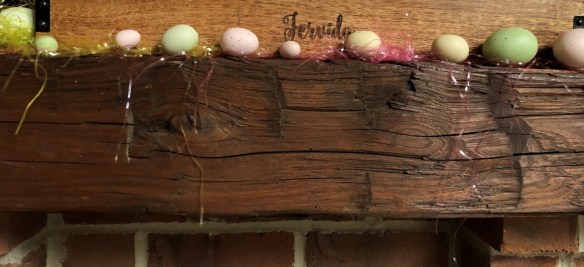
Fervida mantle

Scott mentioned that their fireplace mantle, above, and one beam, above the window, below, was from Bauke’s old barn. Those logs were hand stripped of bark with an adze.

Fervida beam

A few minutes later, Scott mentioned that his parents lived just down the road on the next farm. His wife called them, and they arrived in short order.

How exciting, an impromptu family reunion!

Scott went to the safe and retrieved a file folder of goodies. We looked through the old envelopes and papers, most of which were from the late 19-teens, the 1920s and later.

Scott is the 5th generation Ferwerda, then spelled Ferverda, now Fervida, to own this land.

Ferwerda, Ferverda or Fervida?

The answer is yes, all 3. In the Netherlands and in Bauke’s naturalization papers, the name is spelled Ferwerda. In short order, here, the w became a v. On the 1929 plat map, William’s name is spelled Ferverda. In a 1940 newspaper article, it’s Fervida.

In the cemetery, Bauke’s name is spelled Fervida, as is William’s. I suspect Bauke’s stone was set later, not when he died in 1911.

By the time Hiram was found in the records, his surname was spelled Ferverda.

So yes, all 3 and now the descendants of the two sons of Bauke spell their surnames Ferverda (through Hiram) and Fervida (through William.)

Bauke’s House

Scott’s father, Don, told me that Bauke’s original house was a small cabin. Most early cabins were about 10X12 or maybe 12X16 – amazingly small for a family – but what every family began with.

By at least 1920, a new house had been built, and probably long before.

Fervida house

I mention this because in the 1910 census, Bauke is living with son William and family who is listed as the head of household, beside Cletus Miller, as shown on the 1929 plat map. It’s likely that the new house is shown in this photo above, with the old cabin right next door to the right.

Don showed me where the old house stood, not terribly far from the Fervida rock, and then he pointed out where the cornerstones for the original cabin had remained, long after the cabin was gone.

Fervida silo cabin

Eventually, the cornerstones had to go when a new grain silo needed to be installed where the cabin once stood.

Bauke’s Barn

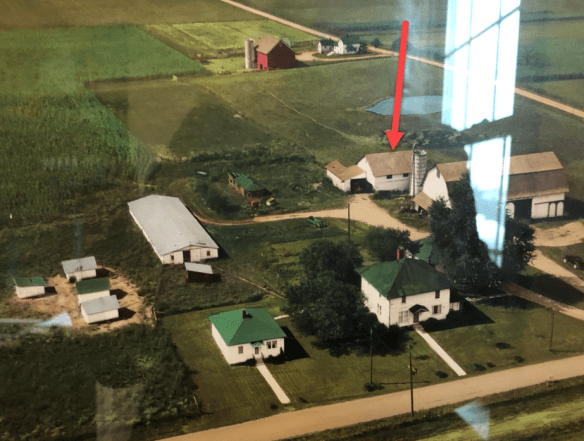
Another item in Scott’s office was a framed aerial photo of the property that included the original barn, now torn down.

Fervida old barn

There’s a lot of glare on the glass from the window, but you can see the barn.

We know that the barn immediately in front of the original barn is 40X80 because of this article detailing the barn raising in 1920.

Fervida article

I laughed at the mention of how many automobiles were there. Apparently the horse and buggy had been replaced in the Brethren families, but most women never drove.

The barn wall of the original barn was incorporated into the “new” barn as a cost savings measure. Farmers were always frugal.

I grew up on a farm and love barns. Don took me inside the barn and showed me the original studs remaining and how they “shored up” old wall and retrussed it to be part of the new wall.

Fervida barn

You can see that the studs have been reused as there are notches for connecting beams no longer present.

Fervida-old-barn-wall.jpg

Pinch me, here I was standing in Bauke’s barn.

A day ago, I didn’t even know it existed.

Fervida-old-barn-wall-2.jpg

Surreal doesn’t even begin to touch this.

Don grew up on this farm, helping his father, Eldon, who was William’s son. William didn’t pass away until 1960, so Don knew him well.

Fervida tractor

This early International Harvester tractor looked much like the one I learned to drive.

Of course, now its dwarfed by contemporary monstrous tractors and modern equipment.

Fervida rock tree

I tool this photo for the rock, but it shows the current “new” barn and other out-buildings in relation to the grain silo with the conical shaped bottom, to the right behind the tree and barn.

William Fervida and Family

Unfortunately, we don’t have a photo of Bauke, although Don is checking with his sister to be sure.

We do have a lovely photo of William and family.

Fervida, William

Fervida, William back

Thank goodness someone wrote on the back!

Bauke’s Furniture

When the Fervida family had to tear William’s house down, they salvaged the remaining original furniture.

Scott was kind enough to show me both pieces, lovingly integrated into his home.

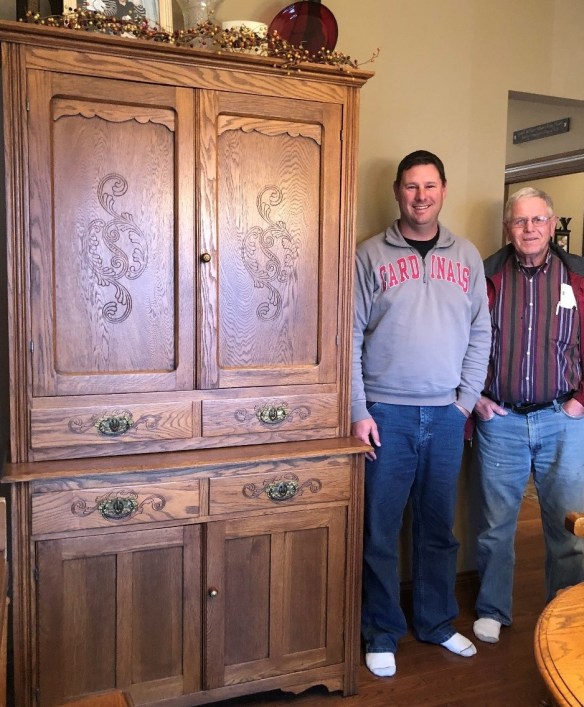
Fervida Don and Scott Hoosier cupboard

Here, Scott and Don stand beside Bauke’s cupboard. My mother called these pieces “Hoosier cupboards.” One of the reasons I think Bauke built the larger house before his death, as opposed to William later, is because a piece of furniture this size would take a disproportionate part of a log cabin. It simply wouldn’t fit.

Scott said that this piece, and the one below were both refinished by an Amish craftsman because they were literally black with age and wear.

Fervida dresser

This dresser lives in the spare bedroom. That’s me, very happily taking the picture and framed in the mirror, like a mirror into the past. That was Scott’s lovely daughter’s suggestion! I told her she needs to study genetics😊

Notice the candlestands beside the mirrors.

The corners of the drawers are beautifully dovetailed.

Fervida dovetail

Saved the Best for Last

After returning downstairs, I mentioned my Mom’s Bible in the context of my article last week. Scott said, “well, maybe you’d like to see this,” walked into his office again, and pulled this off of his shelf.

Fervida Bible

“What’s this?”, I asked.

Don told me that before his grandfather, William, died, William told him to be sure this Bible didn’t leave the family.

The Bible always sat on the dresser in William’s house, in the center. That’s the same dresser with me in the mirror.

Fervida Bible spine

This beautiful Bible is worn.

Fervida Bible page

The first thing Scott’s mother and I did was to look for names, births, deaths and marriages. Not one thing was recorded.

On the front page, we noted that the Bible was published by Mennonite Publishing Company.

It’s interesting because the oral family history on my side stated that the brother, William, who lived near Nappanee was Mennonite. However, Don indicated that the family was always Brethren to the best of his knowledge.

Clearly, William felt this was a heirloom when he passed away.

The Mennonite Publishing Company published from 1875-1908 but of course this doesn’t necessarily mean that’s when the Ferverda family obtained the Bible.

Fervida Bible 1884

There was no copyright, per se, but we did find that this had been registered in the Library of Congress in 1884 which at that time seemed to function in essentially the same way. It’s likely that this Bible was purchased originally sometime after 1884 and before 1908, meaning before Bauke’s death.

Unfortunately, there were no dates recorded in the Bible, but a lot of political newspaper clippings from later years.

That was torture!

These large “Big Bibles” or “Great Bibles” as they were called weren’t carried to church, but were used in home readings and study.

Judging from the wear on the cover, this Bible was well-used. It’s in amazingly good condition given that it’s someplace between 110 and 135 years old.

We know unquestionably that it was Williams. Was it Bauke’s?

Dinner

As the afternoon turned into early evening, I realized I really needed to get on the road as I had miles to go before reaching my destination for the evening. Furthermore, I was probably standing between these people and their dinner.

Scott’s wife asked me if I would join them for dinner, but I felt I had already intruded enough. I had literally been there for hours.

I declined, mentioning that I wanted to visit my grandparent’s graves in Silver Lake yet that day, winding up in Peru an hour and a half further south near where Mom was buried, preferably before nightfall.

As Scott’s parents exited through the garage, I left with them, saying my goodbyes. Don asked me once more if I wouldn’t join them in town, Nappanee, for dinner. I really, really wanted to, but I needed to visit Mom’s grave yet and had planned to be another 90 minutes south before morning when I would drive on to St. Louis. It was already going to be a long day. If I stayed for dinner, I wouldn’t make it any further south. And I wouldn’t see Mom on the 13th anniversary of her passing.

What to do?

Don’s wife suggested a couple hotels in Nappanee, and I decided to call my husband and see if he could book me in someplace. While that was taking place, I would indeed join Don and his wife for dinner. Fingers crossed.

As we drove the few miles into town, the rain became torrential, meaning that we were soaked to the skin in the 10 feet from the vehicles to the door of the restaurant. I was VERY glad I had opted not to drive further and very much enjoyed visiting with my Fervida cousins.

As our meal was delivered to our table, Don said grace, a practice long lost in most places, but not in the Fervida family in Indiana. I added my own special thank you for finding my Fervida family, thanks to a buggy and a flooded road.

I so enjoyed absorbing everything Don had to say. I wish I had more time to spend.

The Hotel

Fervida round barn

I spent the night in the “red hotel” as the locals call it, just down the road from this round Amish barn on Amish Acres. I grew up with round barns nearby and hadn’t seen one in years.

As I tucked myself in for the evening, in a room with quilts and handmade curtains, the rain poured relentlessly. I looked outside to see torrents of water running and inches everyplace. There was too much rain and no place for it to go.

The morning light would reveal floods, including flash floods that washed across roads, stripping the fertile topsoil in the fields away. These are the days that try farmers’ souls. I wondered if Bauke saw floods like this.

Floods

My morning began with water in the lower level of the hotel. Fortunately, my room was on the second floor.

The rains had lulled, at least momentarily, but every time I woke up during the night, the rain was still pounding on the roof.

Fervida morning

The sun tried to peek through the clouds, but soon gave up and retreated.

Fervida Amish buggies

The first thing I needed to do was find a grocery store or someplace to purchase a bouquet of flowers to divide between the graves of my grandparents, my Mom and step-father and my two step-siblings. All stores in Amish country have special areas for parking horses and buggies.

I realized that in my excitement the previous day that I had forgotten to ask Scott if I could have a rock for my garden from Bauke’s farm. I often collect a rock to take home, something permanent and tangible from the land that once belonged to my ancestors. I particularly like rocks plowed from their fields, and no farmer ever says, “No, I want all those rocks to hit with the plow.”

Scott indicated that he wasn’t home, but that he’d call Don and see if he was available. I told Scott I could easily find a rock along the edge of a field, I just needed permission, not assistance.

Fervida flooded land

As I drove down State Road 6, I looked to the right to see Bauke’s land entirely covered with water. Turkey Creek had not only overflowed its banks, it had over-washed the road and covered the fields. You can see the grain silos in the distance in the location of Bauke’s original home.

I was sick at heart for Don and Scott, because as a farm girl, I knew exactly what this meant.

Rocks

I went the “long way round,” avoiding the floodwaters and pulled into the driveway of the barn.

I saw a rock that someone had thrown out of the field and that was waiting for me to rescue it, sitting patiently in the roots of a nearby tree.

Fervida rock for John

As I carried the rock to the car, Don pulled in the driveway too. I quickly explained that Scott had given permission for me to rock shop, and I explained to Don that I add ancestor rocks to my garden as a way of bringing a little bit of them home with me. As it turned out, Scott had called Don and Don had found me a wonderful rock, in addition to the one I picked up.

As we talked, I mentioned that I’d like to pick up a couple small stones to take to my grandfather’s grave and my mom’s. He offered to help, and we drove across the road to a culvert where Don had installed catch basins the year before.

Fervida catch basin

The road was full of corn cobs, meaning that during the night, the water had over-washed the road, taking with it soil and anything else it could carry away as it raced towards Turkey Creek. Not just flash flood warnings, but flash floods indeed.

Don helped me select and clean the mud off the rocks to take to the cemeteries.

Fervida pretty rock

As we drove back to my vehicle, I noticed yet another rock, about half the size of a small car. We opined that this one was a bit too large for the Jeep. What a beautiful stone that Bauke didn’t even know he had. Don found it plowing and decided it was too beautiful to bury. I wondered what kind of stone it was, and Don replied that it was “just a stone of some kind,” an answer very similar to one my beloved step-father gave my kids decades ago when asked the same question about one of his field rocks.

Fervida-Don-with-rock.jpg

I asked Don if I could take his picture in front of the Fervida Farm rock that he and his wife had engraved for Scott’s birthday. The farm equipment in the background is just so appropos. Wouldn’t Bauke be amazed at the changes in farming since he plowed this ground, probably using a mule and standing on the plow.

I thanked Don again, for everything, but in particular for being such a wonderful steward of our ancestor’s farm. I’m so glad that Scott loves it as much as Don.

Turkey Creek

Fervida Turkey Creek across field

Turkey Creek snakes its way through Bauke’s farm, swollen and flooded.

Fervida Turkey Creek flooded

No driving down the road today. The creek has overflowed everyplace!

Fervida Turkey Creek flood

Skeletal irrigation equipment looks strangely out of place.

Fervida bridge

As I drove away, I turned back one last time to take a final, lingering look and say goodbye.

I crossed the bridge where less than a day earlier, I had passed that Amish buggy.

Today, on my way out, I was stopping at the church that had once been Turkey Creek Brethren Church. Don said that to the best of his knowledge, the Ferverda family had always been Brethren in the US. Bauke and family were members of Turkey Creek Church.

I asked why they were buried at Union Center Church cemetery if they had attended Turkey Creek, and Don said that there was no cemetery at Turkey Creek – even though it was an older church. All Brethren were buried at Union Center. I never thought of that.

Turkey Creek Church

Turkey Creek Brethren church ceased operation in 2012 and the building has since been purchased by another congregation.

Fervida Turkey Creek church

The church remains the same, with the original structure incorporated into the current building.

Fervida Turkey Creek 2

The old trees were probably here when Hiram drove his horse and buggy up this same pathway to the church.

Fervida Turkey Creek sign

A sign commemorates the original church.

I pulled into the parking lot to take a closer look. I was hoping to see some part that I could identify of the original building, but no dice.

Fervida Turkey Creek cross

Even the cross is much more contemporary that it appears from a distance.

Fervida Turkey Creek church 3

As I walked towards the rear of the church, I realized something very important.

That grain elevator in the distance is Bauke’s land, a mile away.

Fervida plat map churches

You can see the church on the 1929 plat map, at left. I’ve marked it as well as the location of the barns and grain bins today with red arrows. A section is a mile wide.

Fervida land from Turkey Creek church

The flooded fields between the church and the grain silos are Bauke’s. It’s no wonder that Bauke and family attended Turkey Creek Church – it was literally right next door, within sight. The next generations of Ferverda/Fervida men would also attend Turkey Creek Church. Understanding the history of Turkey Creek Church and Union Center explained why the Fervidas were members in one place and buried in another. Previously, I had presumed membership at Union Center because that’s where they were buried.

My Grandfather, Pawpaw

Leaving Turkey Creek church behind, I headed for Silver Lake, 45 minutes away where John Ferverda, my grandfather, Bauke’s grandson is buried.

John Ferverda stone

I arranged the flowers in a milk jug I had brought along for the occasion, placing the rocks lovingly at John’s end of the stone. The larger rock from Bauke’s farm and the smaller one from Hiram’s. John grew up on Hiram’s farm, of course, but he assuredly visited his grandfather. Bauke didn’t pass away until John was 29 years old. John probably played in Bauke’s fields and along the banks of Turkey Creek.

Fervida stones John Ferverda

Mom

My next stop was the cemetery in Galveston, Indiana where Mom is buried. I feel like I’ve traveled the Ferverda Cemetery trail these past few days.

Barbara Jean Ferverda stone

Mom’s married surname at her death was Long, but my brother and I had her birth surname inscribed on the front as well, along with his and mine on the back. Once a genealogist, always a genealogist.

Fervida stones Barbara Ferverda

I placed the stone from Hiram’s farm where Mom’s father grew up beside the stone from Bauke’s farm – the one Don had so graciously washed for the journey.

I wonder how long those stones, a small piece of her ancestor’s lives, will remain. I hope that they will survive to greet a future generation who will stand where I stood and wonder why someone placed those stones on Mom’s grave.

One might say that Mom wanted these stones. She certainly sent me on quite the round-about adventure on the way to visit her grave – and it made me a day late.

What an incredible gift.

Thanks Mom!

______________________________________________________________

Disclosure

I receive a small contribution when you click on some (but not all) of the links to vendors in my articles. This does NOT increase the price you pay but helps me to keep the lights on and this informational blog free for everyone. Please click on the links in the articles or to the vendors below if you are purchasing products or DNA testing.

Thank you so much.

DNA Purchases and Free Transfers

Genealogy Services

Genealogy Research

Mom’s Secretary and the Hidden Gift – 52 Ancestors #236

April 29th marks the 13th anniversary of Mom’s “passing over.” Of course I think about this, because I can’t NOT think about it.

Part of the grief is still fresh, especially when I’m somehow caught by surprise, but many rough edges have been softened into cherished memories by time.

Mom’s lovely secretary, one of my favorite things, sits in my living room now. I am the steward.

Mom's secretary.jpg

Mom always referred to it as “Mother’s Secretary,” which is, not surprisingly, what I call it too. But now, it’s mine and someday maybe someone else in the family will eventually call it “Mother’s Secretary.”

A secretary is a type of desk with a drop-down front that is used as the writing surface. Mom’s had some secret cubbyholes inside after you lowered the front, and a couple of shelves below as well.

After Mom passed, I installed a few of her Avon award statues. She was extremely proud of her accomplishments, as was I, especially as a 3rd career that stretched well into her 80s. I know she would approve.

Books!

The lower shelves, at home, always held vintage books. Margaret Mitchell’s classic, “Gone with the Wind,” one of my all-time favorites always lived there as did Elizabeth Barrett Browning’s poetry which I don’t think I’ve read even yet today.

Mom's secretary poems.jpg

The book of poetry was bound in soft painted leather and was simply beautiful to behold – it didn’t matter what was inside.

Books were an expensive luxury, so sometimes we bought discarded books from the classroom “library” at Lincoln School.

School books.jpg

Most of those were sold at Mom’s estate auction or rummage sale years ago, but the rattiest, which means my favorites, didn’t sell. They still have the price tags on the front.

Bobsey Twins.jpg

Other books on the shelf included several Bobbsey Twin books – some that had been Mother’s and a few newer ones, now 50+ years old, that were mine. Only two remain. I should give them to my granddaughters. I sure loved the Bobbsey twins and read those books several times each.

Gone with the Wind.jpg

I devoured Gone with the Wind so many times that the book began to fall apart.  Later, seeing the movie in color with Clark Gable and Vivian Leigh was a treat to die for. I loved the movie as much as the book, if that was possible. I learned so much about romance, handsome men and strong women! I also internalized lessons about slavery, freedom and alcoholism along with right and wrong. I’m not at all sure Mom meant for me to absorb ANY of those lessons with the veracity that I did.

A Sacred Space

In my childhood home, the secretary always stood in the living room, nestled in a corner beside the fireplace. For years I felt very grown-up having the privilege of sitting there doing my homework. I actually enjoyed homework, which was much better done at the special secretary instead of at the much-too-sterile Formica kitchen table.

Besides, the kitchen was busy, the living room wasn’t.

One day when I was about 10, I was absolutely horrified to discover that I had pressed so hard that my writing had gone through the paper and had marred the finish inside the desk. I never felt right again about doing homework at Mom’s secretary.

However, I would occasionally sit there to write “special” things. I seemed to connect with inspiration in that sheltered space.

Mom's secretary open.jpg

I began reclusively writing poetry. Mom’s secretary seemed so embracing and safe, with its secret-compartment-like essence. Some of my poems were bright and sunny, but most reflected the darkness of grief, loss and heartache. The loss a child feels when they lose too many loved ones too quickly and are left lonely and alone.

As time moved on, so did the secretary. Mom remarried and moved to my step-father’s farm, taking the secretary along of course.

There too it always had its own reassuring secure place. Mom always kept certain items there, and today, in my home, it still has the same things in the same locations. I wonder if it was the same when it belonged to my grandmother. I’d bet so.

It always made me feel good to see the secretary although I didn’t really think about it at the time. I don’t recall that the thought ever occurred to me that someday it might be mine. The secretary was just always a warm friend greeting me as I walked into the living room, sometimes on an errand to retrieve something for mother.

Twenty-plus years later, after my step-father passed away, Mom moved to an apartment in town. The secretary, which had long before reached the antique stage, looked strangely out of place in the white-washed walls of mother’s new city apartment. By this time, the secretary, along with a table and mother’s bedroom furniture, were the only antiques among the upholstered chairs and carpet.

The secretary may have looked out of place, but as a silent sentinel, it was still welcoming and reassuring. Mom still used it as a desk as well as storage for its familiar stamps, envelopes and paper, along with her crossword puzzle books, a deck of cards, pens and pencils and some dice from the Yahtzee game so we could find them.

It was always beautiful with its carved and raised front. I remember tracing those beautiful wooden swirls so many times with my finger.

From there, Mom moved to another apartment near where my brother lived for the last nine months of her life. It was in this apartment that I first realized that my brother, sister-in-law and I would have to figure out what to do with mother’s things eventually.

While there wasn’t much of a physical nature that I wanted, I did want the secretary which had been such a quiet part of my life for so many years – nearly half a century.

By then I could open the desk and look at the homework marks and smile. Mom never mentioned them to me, but she couldn’t have missed them. Maybe she knew how badly I felt.

A New Home

After Mom’s passing, I brought the secretary home in a rented truck on one very sad Mother’s Day and installed it in the dining room in a little nook that seems to be made just for Mom’s secretary. For the longest time, I’d glance in that direction and be a little startled while reflexively thinking to myself “what’s Mom’s secretary doing here”?

Slowly, the startle went away, and now it’s just a warm presence in the corner, near me as I iron and quilt and sew. Keeping me company, surrounding me with something of Mom’s essence. My old friend, beckoning, saying hello, reminding me of happy times that Mom and I spent together across so many years and miles.

Sometimes I walk by and caress Mom’s secretary, smiling a little sadly and remembering. I open it from time to time and take out things that were hers, Avon notes and receipts in her increasingly shaky handwriting that mean absolutely nothing, but I can’t bring myself to throw away.

Mom's receipts.jpg

Mom’s Bibles, the one her mother gave her for Christmas in 1951, now much worn.

Mom's Bible.jpg

The one we got her when my kids were young when she asked for a new Bible for Christmas, and the one my father gave her. Her old one is my favorite, by far, with her handwriting throughout her life, holding obituaries and birth announcements inside the cover.

Mom's BIble inside.jpg

I imagine what Mom was thinking as she inscribed those important family dates; births, marriages and deaths. I can close my eyes and see her at the secretary, writing. It’s almost as if I could just reach out…

I think of her. I touch her things and smile, sometimes through tears as the ghostly memories transport me back to her.

The trinkets of her life still live in the little cubbies. I’ve added a few items of my own, like boxes of cards that I send with care quilts as they leave for their lives with their new owners. It’s kind of like Mom is with me a bit as I open the secretary to write an uplifting note. That only seems right, given that I make the quilts sitting at the table beside the secretary.

The 13th Anniversary

This year’s anniversary of Mom’s passing is a bit different. As fate would have it, I’ll be leaving the day before to speak about DNA at the NGS conference in St. Charles, Missouri and passing not terribly far from her grave. “Not far,” as in marked by hours.

Mom isn’t buried “near” to anyplace I travel with any regularity. I think I’ve only been to her grave 2 or 3 times, but this year, I’ll be visiting to say hello, on the same day I said goodbye 13 years ago. How’s that for irony.

I’ll chat with Mom, saying whatever comes to mind, as if she can hear me.

Perhaps I’ll sit on a quilt in the grass by her stone and tell her where I’m headed and what I’m doing. She encouraged me to “tell people’s stories” revealed by their DNA. She would be very surprised not only that I’ve done exactly that, but how the fledgling genetics industry she knew has prospered and grown. If she was still with me, I’d have her DNA in the newer databases too.

The Gift

Mom gifted me a few days ago, in a very odd way, reminding me of her presence. I felt her near.

I was dusting the secretary, something I’ve done hundreds of times now. Mom collected toothpick holders. At the auction, a few either didn’t sell or perhaps she held them out because she particularly liked them. I remember her crying as the entire box sold for an obscenely low price, but by then, it was too late. I so desperately wish I had bought them.

In any case, as I moved a toothpick with a metal lid, I heard a faint “clink.” As I put the toothpick back on the secretary, I heard it again. Odd, I had NEVER heard that before.

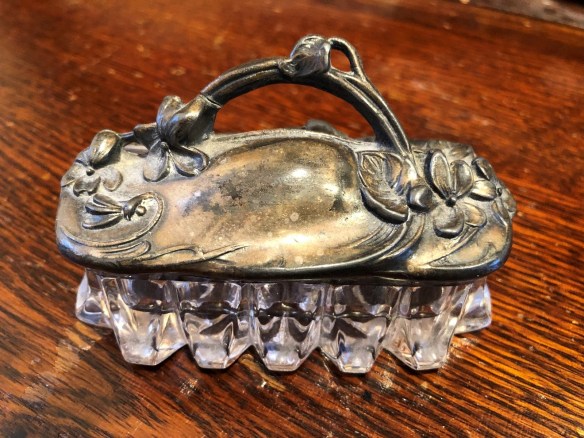
Mom's toothpick.jpg

I picked the toothpick up and opened the lid to discover my Mom’s cross that I had given her many years before. I wondered after she passed away what happened to the cross, but I presumed that another family member was cherishing the cross and never thought more about it.

Mom's cross.jpg

Imagine my surprise. I couldn’t help but wonder why Mom put it in a toothpick holder, of all places.

The last few months of her life, mother was having multiple small undiagnosed strokes, which makes me wonder if she took the cross off for some reason, putting it in the little toothpick holder which probably was sitting near her chair, for safekeeping. Perhaps she forgot where she put it, and it’s clearly not someplace one would randomly stumble across looking for a piece of jewelry.

Odder still, there was no chain, just the cross. It had a chain when I gave it to her.

I cried when I realized that somehow, Mom had managed to gift me with her cross so many years later. A gift that had been waiting for me all that time – in her secretary.

Now I’m even more grateful to be the steward of her secretary, my silent forever friend – spanning 5 decades of our lives together across two states. The secretary has been in our family for parts of two or three centuries and at least three generations, if not more. I don’t know how, when or where my grandmother acquired it.

I still miss Mom. Perhaps more than ever as the years slowly increase, marking the cavernous time from the last time I heard her voice and held her hand. I remember both events clearly. I was driving home, talking to her, the evening before her “big stroke” and had to stop to remove a family of geese from the road. She was laughing at me, admonishing me to be careful. Just days later, I held her hand as she died.

Even her last message on my phone, which I replayed for years, disappeared one day.

Wearing Mom’s cross eases the pain of her passing a bit, that bottomless hole that will never even begin to fill, for a few minutes anyway, until it doesn’t anymore.

See you Tuesday, Mom.

Mom's cross with my helix.jpg

______________________________________________________________

Disclosure

I receive a small contribution when you click on some (but not all) of the links to vendors in my articles. This does NOT increase the price you pay but helps me to keep the lights on and this informational blog free for everyone. Please click on the links in the articles or to the vendors below if you are purchasing products or DNA testing.

Thank you so much.

DNA Purchases and Free Transfers

Genealogy Services

Genealogy Research

Notre Dame and Me – 52 Ancestors #235

Not only is the week preceding Easter a religiously significant week for Christianity, it is as well for Jews who celebrate Passover, the root of Christendom’s Good Friday. The Sunni sect of Islam also fasts in observance of Passover. These religions all have their roots in the same place, just as we are all related to each other.

If Easter, Passover and their associated rites in the various religions that mark these days as Holy are emotion-filled in their own right, this past week has been exponentially so.

Notre Dame fire

By LeLaisserPasserA38 – Own work, CC BY-SA 4.0, https://commons.wikimedia.org/w/index.php?curid=78064310

A few days ago, on April 15th, Notre Dame Cathedral in Paris burned, not quite to the ground, but was extremely damaged in the inferno. The attic of the cathedral, known as “the forest” because of the extremely long old-growth oak trees that were harvested about the year 1160 for beams went up like tinder. The walls and towers remain, along with the famous medieval rose stained-glass windows.

Notre Dame rose windows

By Julie Anne Workman – Own work, CC BY-SA 3.0, https://commons.wikimedia.org/w/index.php?curid=11590000

As fate would have it, many of the statues on the roof and spire had been removed due to ongoing renovation. The treasures inside were passed, hand to hand, through a human chain to remove them as the fire burned through the roof and before the flames engulfed the upper reaches of the cathedral.

A stunned world watched Notre Dame burn for hours, staring breathlessly as night fell and the fire moved along the roofline, consuming everything in its path, like a hungry monster. The spire flamed dramatically, like a torch, then toppled, falling through the roof into the church, leaving skeletal scaffolding surrounding a black hole.

The fire photo above is the only one that I’m sure is copyright-free, being found on Wikipedia, but the images below are the result of a Google search.

Notre Dame google fire.png

One of the images, the third row from the top, third photo from the left, is horribly beautiful. God, Mother Nature or whatever name you call the Deity, created fire, and man created Notre Dame. The fire illuminated the cathedral and backlit the oldest Rose Window, the one without stained glass. Later images show the fire burning through the round window, licking the stones above.

Je Suis Dévastée

I spent the summer of 1970 traveling and living in Switzerland, studying French and culminating with a trip to Paris where we took up residence in a youth hostel for a week or two. We enjoyed a combination of student and tourist activities.

The midwestern city where I grew up supported a large Catholic church and school along with many smaller Protestant churches, but I never realized the differences between Catholicism and the Methodist and Baptist churches that I attended. The extent of my consciousness was that every church had their own “rules.” My perception was that “God” was entirely the same regardless and only man’s “church rules” varied. Therefore, I paid little mind to those differences.

I mention this because it sets the stage for my visit to Notre Dame.

Paris

Paris in August is stiflingly hot. Air conditioning in Europe is rare and was nonexistent in 1970. That didn’t matter, because nothing was air-conditioned in Indiana either.

As students, we noticed the heat, but it didn’t slow us down.

We spent our days on foot, exploring beautiful Paris and her architectural wonders. I distinctly remember feeling immediately at home in Paris, as if I had been there before – long before. I seemed to remember my way along streets that hadn’t changed much since Medieval times to places I’d never been.

I had no way of knowing that my ancestor, Jacques de Bonnevie, was born in Paris about 1660 and was probably baptized in Notre Dame.

I made my way to the Eiffel Tower, the L’Eglise de Sacre Coeur, Montmartre, the Church at Les Invalides and many parks and historic buildings.

As had been my practice during my trip, I found a local church of some description and slipped into the back row on Sunday mornings. Generally, I managed to slip out again, unnoticed, just as the services ended. My interest was as much cultural as religious, but I enjoyed the wide variety of experiences that were beyond what could be found at home.

My time in Paris was drawing to a close. I had one day left. I decided to go on one final walk-about in the city, knowing with certainty that some wonderful adventure awaited. Not one student in my group was interested in accompanying me, but another young man also staying in the hostel, Jon, wanted to go.

Jon and I set out, walking the streets of Paris in the early morning mist, before the city was quite awake. We marveled at wrought iron gates and old limestone buildings with their guardian gargoyles. If there had been selfies back then, we would have taken several as we laughed, talked and walked.

Eventually, we held hands, not as lovers but as fast friends, enjoying a once-in-a-lifetime bonding experience that no one else in the world would ever have. Just the two of us on that last, wonderful, day in Paris.

We walked towards the oldest, most historic part of town with the intention of strolling along the Seine River, land of artists, students, peace, love and happiness. The next day, we would forever be parted, so today would be filled with nothing but joy.

Mesmerized

As Jon and I approached the Seine and began to cross the bridge, Pont de la Tournelle, I stopped dead in my tracks. There was Notre Dame, “Our Lady,” standing sentry on Île de la Cité, an island in the middle of the Seine which is also the middle of both historical and contemporary Paris.

1970 Paris Notre Dame

As we stood on the bridge, I took this photo. I didn’t realize at that point in time that the building I was staring at intently was indeed the famous Notre Dame. Jon knew.

What I did know beyond a doubt was that I absolutely HAD to go inside that building. Jon mentioned that it probably wasn’t free, so he and I began counting our money to see how much we had between us.

My status as a student meant that anything requiring an entrance fee was beyond my means. Furthermore, I had spent every last dime of discretionary funds, given that it was my last day in Europe and the money I brought had been rationed across months, day by day.

Jon and I enjoyed our walk along the Seine, from the bridge to Notre Dame, drinking in the ambiance of the lovely day. The sun was high in the sky and the heat was oppressive, but we didn’t care. We found shade along the banks of the river, sitting and talking about our dreams for the future amid the background chatter of others.

Notre Dame is massive and has the effect of making one feel minuscule and inconsequential. I hadn’t yet learned that the cathedral was 800 years old, give or take a few years, but it was obviously enormous, exquisite in every detail and wonderfully historic.

Notre Dame buttresses.jpg

The flying buttresses were fascinating and incredible. I knew nothing of architecture or engineering, but I knew enough to appreciate the uniqueness of Notre Dame. At that time, I had no idea just how extraordinary the cathedral actually was.

I had developed an affinity for gargoyles during my stay in Europe, which I retain to this day.

Notre Dame strix.jpg

Jon and I enjoyed spying the gargoyles and other stone carved figures, making up stories about what they were thinking or doing, then laughing at our silliness.

Notre Dame gargoyles.jpg

That day could have lasted forever.

Finally, we approached the gargantuan doors of the cathedral, our tone becoming a bit more somber.

Notre Dame cathedral

By GuidoR – Own work, CC BY-SA 3.0, https://commons.wikimedia.org/w/index.php?curid=5284809

We were relieved to discover that admission to the cathedral itself was free although access to some features required payment.

Grateful, we crossed the threshold, leaving the hubbub of the city behind as we entered a cool, tranquil sanctum. The stone walls absorbed any noise and the cavernous interior transported us back in time before the era of cars and horns. We left 1970 behind.

Our eyes needed time to adjust to the darkness. It seemed that in those moments, we had entered another world and found ourselves transported to the past when our vision cleared.

I remember the opulence of the interior, and that Notre Dame was unquestionably the largest church I’d ever seen or been inside of – staggering in its enormity.

I didn’t understand the significance of the Catholic symbols, icons or relics, but I certainly understood the historical importance and unparalleled beauty of the building.

I understood, felt in my bones, the deep silence and peace – the respite within those ancient sheltering walls.

As my vision adapted to the darkness, the light entering through the rose window at the end of the nave was what my eye was immediately drawn towards.

Notre Dame nave.jpg

The people here did not seem like tourists, or at least not like the tourists I was used to. They were quiet, subdued and respectful, and I think of them as my co-pilgrims on a journey of discovery and enlightenment.

It’s just that many of us had no idea we were on any such journey.

While the rose windows were not the only stained-glass windows, their position, centered in the distance meant that your eye, and in my case, my body was drawn intensely towards them.

Like a moth to a flame.

As I walked towards the windows, I passed a small table where pilgrims could purchase a candle. Not the votive candles of today, but a tall, thin hand-dipped imperfect candle, maybe 10 or 12 inches long.

The candles weren’t free. I purchased one for a few coins and started to walk, with my unlit candle, towards the rose window, entirely mesmerized. A priest who was selling the candles and helping the pilgrims light them with another candle motioned me to do the same.

I looked confused, and then the Priest looked confused too. Not being Catholic, I didn’t understand the meaning of prayer candles. I did, however, comprehend the fact that a ritual was taking place, and I very much wanted to be a part of the community of ritual in this sacred space.

It didn’t seem as much religious as it did spiritual and inclusive. A human experience.

I lit my candle, but I didn’t cross myself which also served to confuse the Priest. Apparently, he wasn’t used to unschooled non-Catholic teenagers purchasing and lighting candles.

However, even though I lit my candle, I still wanted a candle as my souvenir, so I purchased a second one. Now the Priest was thoroughly confused, especially as I left the group surrounding the candle altars and began walking, alone, carrying my candle, transfixed, towards the rose window.

Notre Dame rose window.jpg

There are no words to describe what I felt.

The window transported my spirit to another time and place, not of this world. I was entranced, hypnotically drawn into the surreal beauty that seemed ethereal.

The darkness of the church seemed to allow the window, the light and the color to illuminate my soul, opening it like a flower, a rose, to the wonder of beauty, contrast and color that would endure for the rest of my life. A divine seed was being sewn in fertile soil that I didn’t understand existed.

Even today, this window has a trance-like spellbinding effect on me, as do other mandalas, including the labyrinth I constructed in my yard.

This life-defining experience initiated a chain reaction of events that won’t end until I “walk on” at the end of my life.

I don’t know how long I spent in Notre Dame that day. I have very little recollection of anything inside except for the transformative experience with the candle and the window. I kept looking for and at the rose window, from every angle, as if it were an ever-present peaceful anchor beckoning in a sea of turmoil.

If you’re lost, just look for the orienting window to find your way. It’s always there.

Jon and I left when the cathedral closed and they shooed us out.

That candle remained among my possessions for many years and life-chapters, even though it broke and cracked. Eventually, life’s events consumed the candle itself, but never the effects of Notre Dame on my life. Notre Dame infused me with my love of history, and more, much more.

Far beyond a building or a church and having nothing to do with a specific religion, Notre Dame was, to me, a place of transition or metamorphosis, a portal from this world finding passage into the infinite beauty of the eternal soul.

My experience in Notre Dame was more a nearly-invisible signal than an epiphany. I had no idea at the time what was so subtly occurring and would only connect the dots, slowly, decades later – in part as I watched Notre Dame burn. Many times a well-placed pebble sets us on our life-path.

So yes, as I sat, horrified, watching the flames consume Notre Dame, I truly was devastated. A little part of me died too as I desperately sought to see my beloved rose window in the footage as the fire burned.

I, along with the rest of the digitally-connected world watched helplessly, and to some extent, hopelessly.

Torn

I was torn between the stark contrast of devastating loss and the surreal beauty of the fire itself. Torn between agonizing loss and hope that not all would be lost. Torn between knowing that Notre Dame is just a building, and that it’s much more.

These are the thoughts that, in no particular order, raced through my mind at various times as I watched throughout the day, and night:

Icon

Coronation

Sanctuary

Witness to history

Survivor

Pope

Grief

National symbol

Accident

Disaster

Ave Maria

Mystical

Catastrophic

Jon

What happened to Jon?

Rose windows

Shared sorrow

World history

Beauty

Ancient

Hymns

Monument

Prayer

Mourn

Slow agony

Renovation

Burn

Church

Hope

Fire

Heartbreak

Museum

Aflame

Can’t rebuild the past

Unity

Reconstruction

Medieval

Respite

Devastation

Emblem

Salvation

Epic

Treasure

Tragic

Holy Week

Revolution

Peace

Crown of Thorns

Relics

Catholic

Beyond Catholic

Religious

Beyond Religious

800 years

32 lifetimes

Ancestor

Baptism

Loss

Anguish

Bonding

Rebuild

Respite

Disbelief

Paris

Agony

Transformation

Human chain

Stab in our collective hearts

Building

Metaphor

Everyone’s past

Permanent

Not permanent

World heritage

UNESCO

Cherish

Cross

Candles

Transcendent

Vessel

Passover

This too shall pass

And there I stopped, because I realized that yes, this too shall pass. Just like Passover in the Jewish faith and Good Friday with the story of the Resurrection in the Christian faith. The end is not necessarily the end. There can be hope, resurrection and salvation even after torturous trials. Notre Dame is metaphorical for all of humanities’ struggles.

Notre Dame is but a building, albeit an incredibly iconic historic one. Buildings can be restored and rebuilt. The heart and soul of Notre Dame is the heights that she inspires people to achieve, the good that she invests in the human condition and the light she shines on the future. Her value is not the building itself, but what she represents, the values she embodies and the inspiration she provides.

Indeed, this dark chapter too shall pass, perhaps uniting and unifying disparate people. Maybe there is a larger lesson in her destruction and rebirth – one for all of humanity. Perhaps this too is a seed of renewal. I hope we comprehend and internalize the message in our current generation and ones that follow.

If so, the hope, inspiration and beauty that Notre Dame infused in me and the seeds she yet holds to plant will live on immortally to guide others and cradle them eternally in her rose-colored, transcendent, illuminating light.

______________________________________________________________

Disclosure

I receive a small contribution when you click on some (but not all) of the links to vendors in my articles. This does NOT increase the price you pay but helps me to keep the lights on and this informational blog free for everyone. Please click on the links in the articles or to the vendors below if you are purchasing products or DNA testing.

Thank you so much.

DNA Purchases and Free Transfers

Genealogy Services

Genealogy Research

Nicholas Speaks (1782-1852), Founder of Speaks Chapel United Methodist Church – 52 Ancestors #234

Nicholas Speak, Speake or Speaks, depending on who was spelling it when, was an ancestor who reunited a family some 200 years after his birth on March 3, 1782 in Charles County, Maryland.

In the 1980s, when I first connected to the Speak line, I found my wonderful cousins, Dolores Ham and Lola-Margaret Hall.

Lola Margaret at church door cropped

Lola-Margaret assembled a great deal of research in order to portray Sarah Faires, Nicholas’s wife. Lola-Margaret above and shown here presenting “Sarah’s likeness” in the very church established by Nicholas.

Nicholas Speaks Dolores Ham.jpg

When I began researching Nicholas, cousin Dolores had already been on his trail for years. I am greatly indebted to both of my cousins for their diligent research and for sharing so freely. Nicholas has not been an easy ancestor to research.

Thank you.

Nicholas’s Birth

Nicholas was born to Charles Beckworth or Beckwith Speak and his wife whose identity remains unknown, in Charles County Maryland.

Nicholas Speaks birth.png

You’d never guess by the fact that Nicholas eventually established a Methodist Church in Lee County, Virginia, but Nicholas was born Catholic. Someplace between Charles County, Maryland and Lee County, Virginia about 1820, Nicholas not only converted, he became a minister in the Methodist faith.

We don’t know much about Nicholas’s young years, but we do know that by 1787, his father, Charles, appears on a tax list in Rowan County, NC. Nicholas would have been about 5. Nicholas probably remembered little, if anything, about Maryland. We don’t know how long the family had lived in North Carolina prior to 1787.

Nicholas’s mother died sometime between his birth and July 16, 1789 when his father remarried to Jane or Jean Conners in Rowan County. If I had to guess, and I do, I would surmise that Nicholas’s mother died in North Carolina not terribly long before his father remarried, because raising children alone for a father in frontier North Carolina would have been next to impossible.

In 1789, Nicholas would have been 7 years old.

By 1793, Charles had purchased land in Iredell County, NC, which is located just east of the Appalachian mountain range.

Nicholas Speaks Iredell County.png

We don’t know exactly what, but something unfortunate happened, and Charles died before September 1794 when his estate was sold.

At this time, Nicholas would have been all of 12 years old, an orphan in a location with little family.

In May of 1795, guardianship of Nicholas and his siblings, Joseph, Thomas, John and James was assigned to one Richard Speaks for the boys and one Elizabeth Speaks for Nicholas’s sister, Elizabeth Speaks. Who are Richard and Elizabeth Speaks? How are they related to each other? We have no idea, but they were clearly kin of some description. We also have no idea what happened to any of Nicholas’s siblings.

What became of Nicholas’s step-mother, Jane or Jean? We don’t have the answer to that either – however – given the fact that the guardianship was not made until probably nearly a year after Charles death, I wonder if the children were living with Jane/Jean and something happened to her too during this time period.

Nicholas and his 4 brothers went to live with Richard who apparently lived in Rowan County on Bear Creek which intersects with the Yadkin River through the South Yadkin.

Nicholas Speaks Bear Creek.png

Bear Creek originates about 15 miles north of the Yadkin in a lake near 398 Log Cabin Road today.

Nicholas Speaks Bear Creek length.png

Nicholas lived someplace along this wooded creek which essentially parallels the road, above.

Nicholas Speaks Bear Creek near mountains.png

By 1797, Richard Speaks sold land in Rowan County on Bear Creek as a resident of Washington County, Tennessee – so apparently Nicholas, now 15, moved with his guardian, because that’s where we find Nicholas first appearing in the records a few years later.

Nicholas Speaks Washington County.png

It would be here that Nicholas met Sarah Faires or Farris whose father, Gideon, is noted in Survey Book I in 1781 as being entitled to 250 acres and stating that actual settlement was made in 1768. Sarah grew up on the frontier.

Washington County was the land of land and opportunity. Nicholas was probably relieved to stay in one place for a few years. His journey from Zachia Manor in Maryland to Rowan County, to Iredell County, back to Rowan and then to Washington County, Virginia, combined with the deaths of his mother, father and step-mother had to be unnerving for a young man. Perhaps they would have destroyed a lesser man, but they may have served to forge Nicholas’s personality and steel him for the future.

Nicholas Speaks Maryland to Washington Co.png

Yes, Nicholas needed to settle down for awhile and stay put.

Wedding Bells

Seven years after arriving in Washington County, Virginia, on August 12, 1804, at the age of 22, Nicholas Speaks married Sarah Faires.

NIcholas Speaks marriage.jpg

The marriage was performed by the Rev. Charles Cummings, a Presbyterian minister reflecting the faith of Sarah’s family. Rev. Cummings is buried at Sinking Springs, one of the churches where he preached.

Sarah and Nicholas probably attended either the Ebbing Springs Church (now the Glade Spring Church), or Sinking Springs Presbyterian church in Abington, Washington County, both of which were served by the fiery Reverend Cummings.

Let’s face it, even if Charles Speak and his wife were both practicing Catholics, there were no Catholic churches in the wilderness of the frontier. By the time Nicholas arrived in Washington County with his guardian, the family would have worshiped at whatever local churches existed.

As one of my minister friends so succinctly put it years ago, people attended the “church of opportunity” where they lived. Worshiping God was more important to them than the trappings and specific sect rules put in place by different versions of Christianity.

By 1804, Nicholas was a practicing Presbyterian.

The First Hint of Methodism

The first hint of how Nicholas might have become Methodist is held in the journal of Methodist Bishop Francis Asbury stating that he had visited in the home of Gideon Faires.

Asbury was one of the first Methodist Bishops in America, volunteering to travel the colonies, then the frontier, on horseback serving in essence as a horseback-riding missionary.

This suggests that it’s likely that Gideon embraced the faith of this new religion of Methodism, probably sometime after his daughter married in 1804, and possibly after Reverend Cummings death in 1816. Perhaps Sarah and Nicholas were also inspired by this new faith as Methodist circuit riders traveled the area evangelizing the new settlers.

The Revival of 1800, a series of evangelical “Camp Meetings” in Kentucky and Tennessee combined both Presbyterian and Methodist communion observances and impressed Asbury deeply. The Camp Meetings in which settlers’ entire families would travel sometimes for days by wagon to “camp” at a meeting house (church) or even in a field to hear evangelical preachers became a staple of the frontier social and religious life. These meetings continued into the 1900s in the area of Virginia and Tennessee where Nicholas established the Speaks Methodist Church.

Wikipedia tells us that Asbury preached in myriad places: courthouses, public houses, tobacco houses, fields, public squares, wherever a crowd assembled to hear him. Beginning in 1784 with his ordination and for the remainder of his life he rode an average of 6,000 miles each year, preaching virtually every day and conducting meetings and conferences. Under his direction, the Methodist church grew from 1,200 to 214,000 members and 700 ordained preachers. Nicholas would become be one of them.

According to cousin Dolores:

Nicholas Speak and his family participated in the camp meetings held at the Jonesville Campground, today the site of the Jonesville Campground Methodist Church. The first Camp Meeting was held about 1810, under a brush arbor. In 1827, a shed or tabernacle was constructed in the center of the grounds and covered with clapboards. The original camps were mostly built of logs inside the enclosure of the rock wall. Crude beds, tables and seats were built and left with the camp from year to year. These camps were burned during the Civil War when the Confederate troops camping there left hurriedly without extinguishing their fires.

“In the early days the people came from far and near, by wagon drawn by oxen or horses, by horseback, or walked to worship at the annual camp meeting. They brought with them enough food, bedding, and cooking utensils for their families and friends, also feed for their livestock, to last the duration of the meeting, a week or ten days.” (Early Settlers of Lee County, VA and Adjacent Areas, Volume I, 1977, Anne W. Laningham, pp. 9-10).

Our ancestor, Nicholas Speak, is listed as a participant in the early church minutes pertaining to this campground. In another reference to the camp meeting held at the Jonesville Camp Ground beginning Aug. 13, 1836 (also the time of a “Quarterly Conference”), Nicholas Speak is listed as a L.E. (local elder) and John Speak (son of Nicholas) is listed as a Classleader. (Ibid., pp. 9-10)

Dola Queener, then of Jacksboro, TN, sent me this explanation of Local Elder, since I am not familiar with Methodism. “Elders are ministers who have completed their formal preparation for the ministry of word, sacrament and order; have been elected itinerant members in full connection with an annual conference; and have been ordained elders in accordance with the order and discipline of the Methodist Church.” This comes from “The Book of Discipline 1984, page 219, Article 432-1.”

Elsewhere, I found reference to Nicholas as a “located minister,” which leads me to believe that Nicholas was the pastor of Speaks Chapel Church and did not preach at other churches on a regular basis.

Nicholas Speaks Jonesville campground.jpg

Photo courtesy Dolores Ham.

Life in Washington County, VA

Like Francis Asbury, Nicholas may have traveled to attend Camp Meetings in Tennessee and Kentucky, but he and Sarah lived in Washington County, VA where 9 of their children were born between 1804 and 1822. The last two children were born after the family moved to Lee County, VA about 1823.

Nicholas and Sarah owned land in Washington County, VA. In deed book 4, pages 231-232, we find that on October 17, 1809 William Brown and Elizabeth his wife of Washington County conveyed 60 acres lying on the south side of the Holston River. Unfortunately, the Holston has three branches in present day Washington County, so without running the deeds forward in time, it’s impossible to know which of the three branches hosted Nicholas’s land.

Then, on December 18, 1810, on page 396 of the same book, Nicholas Speak purchased 28 acres from Robert and Jane Caldwell lying on the north side of Little Stone Mountain, adjacent to William Hickenbottom’s land and also to the corner of Mifflin’s land, also in Washington County.

Little Stone Mountain is on the Powell River in present day Wise County, VA, bordering the Jefferson National Forest. This is rough terrain, and no place close to the Holston River. It’s possible that I’ve misidentified this location, but I don’t find another Little Stone Mountain and Wise County was taken from Washington County.

Nicholas Speaks Little Stone Mountain.png

Then, in deed book 5, pages 61 and 170, on February 16, 1813, Nicholas and Sarah sold both tracts to Christopher Ketring of Washington County, Virginia.

Where they lived from 1813 until 1822 when their last child was born in Virginia is a mystery.

Regardless of where they lived, the War of 1812 interrupted their lives.

War of 1812

Nicholas was drafted to served in the War of 1812 on August 15, 1814 and served in the 7th Regiment of the Virginia Militia in the Company of Abram Fulkerson, serving at Fort Barbour at Norfolk, VA.

Fort Barbour

Nicholas was honorably discharged from Fort Barbour (above) on February 22, 1815, making his way the 380+ miles to home, crossing a mountain range, probably on foot.

NIcholas Speaks Norfolk to Washington Co.png

Nicholas’s military file indicates that he was drafted in Virginia August 15, 1814 and served for 6 months and was honorably discharged at Fort Barbour on February 22, 1815.

Thankfully, even though Nicholas had lost his original discharge papers, in 1850, he petitioned for bounty land.

Nicholas Speaks War of 1812 petition.jpg

Nicholas’s petition from the National Archives packet carries his original signature!

Nicholas Speaks War of 1812 petition Sarah.jpg

Following Nicholas’s death in 1852, in May of 1855, Sarah petitioned for another bounty land grant, adding more information. Sarah and says Nicholas was discharged at Norfolk, VA and that he was drafted in Washington Co., VA She also states that they were married in Washington Co., VA in 1803 by Rev. Cummings, the Presbyterian minister. She provides Nicholas death date as well, June 2, 1852. Sarah signed with her mark.

The Move to Lee County, VA

In the 1820 census, Nicholas and family are living in Washington County, VA, but they moved to Lee County before the 1830 census.

Nicholas Speaks is in the 1830 Lee. Co. Va. census age 40-50, wife 30-40, 2 males 5-10, 1 male 10-15, 2 males 15-20, 1 female under 5, 1 female 5-10, 1 female 10-15. Three people were participating in agriculture.

We know the family moved about 1823 when the first land transaction occurred listing Nicholas as living in Washington County. Since the land was purchased in November 1823, did they move yet that winter, or did they wait until warmer weather?

Nicholas Speaks from Robert Cumings, November 29, 1823 – Lee County Deed book 5, page 145.

Nicholas bought another piece of land in 1837.

Nicholas Speaks from Samuel Ewing April 11, 1837 – Lee County Deed book 7, page 302.

We don’t know what motivated the move to Lee County. It appears that Nicholas and Sarah did not own land in Washington County, so the move to Lee County would not have been complicated by land ownership.

By 1824, Nicholas was on the Lee County, VA tax list, photo courtesy either Dolores or Lola-Margaret.

nicholas land entry

The Early Settlers of Lee County, Virginia book features Nicholas Speak on page 947, providing the following information:

Nicholas Speak of Washington Co., VA, on 29 Nov. 1823, purchased a tract of land lying in Lee, Virginia, USA on the head of a small east branch of Martins Creek (now known as Speaks Branch) containing 520 acres, from Robert E. &Mary Cummings of Washington Co. for $780 (DBK 5, 145).

After the purchase of this land, Nicholas Speak removed with his family to Lee Co., and settled on his newly acquired land where he became a well-known citizen and a leader in the County and the community. Nicholas Speak was a minister of the Methodist Episcopal Church, was the founder and a piller of the Church bearing his name–Speaks Chapel.

In deed book 8, p. 216A, Nicholas Speak conveyed the land for the Methodist Episcopal Church to Tandy Welch, William Morgan, Adam Yeary, of Claiborne Co., TN, and Charles Speak and Nathan Hobbs of Lee, Virginia, USA, for one dollar, and specifies that it shall be used for the said church.

Martin’s Creek, Now Speaks Branch

Over time, Martin’s Creek became known as Speak’s Branch.

Nicholas Speaks Speaks Branch.jpg

Speaks Branch, the beautiful little spring that sustained Nicholas and family.

Today, this property is located on Speaks Branch Road.

Nicholas Speaks Speaks Branch Rd.jpg

Speaks Methodist Church

In 1839, Nicholas insured his legacy, and his church, would last what I’m sure he hoped was forever.

Again, from the Early Settlers book under the title of “A Brief History of Speaks Chapel Methodist Episcopal Church:”

In the year 1839, Nicholas SPEAK, Sr., deed to the members of the Methodist Episcopal Church for their use, a tract of land or lot of land, as shown by deed DBK 8, p. 216A, recorded in Lee, Virginia, USA. The deed is the only written evidence I have been able to find in regard to the church. There is no written evidence in existence telling when the church was organized or by whom.

The original building was a large log structure, with seats made by split logs, with holes bored in them with pins inserted for legs. The heating equipment was made by two box like frames about 5 by 5 feet square, and 12 inches high, which were placed on the floor and filled with earth. In the center of these squares was heaped large piles of charcoal, which served as fuel and heated the building nicely, the smoke passing out through the roof as there was no overhead ceiling. The original building was used to teach school in for many years. I attended my first school there 75 years ago. (M. M. SPEAK) (Note by writer: No date is given for the compilation).

After the Civil War when the “division” came in the church, both branches of the Church used this building for worship for many years. Finally a misunderstanding arose in regard to who was the legal owners of the property. Most of the M.E’s withdrew their membership, and built a church over by Powell River. The church is known as the Fairview M.E. Church. This upheaval became near being the undoing of the two branches of the church in this community as neither has been very prosperous since, but, thankful to a ‘faithful few,’ Speaks Chapel is still functioning.

I am not a member of the Methodist Church but I have always been interested in Speaks Chapel and always will be. My parents and all their people were members of this church. “My sincere hope and prayer is: That God in his mercy and wisdom will help the church at Speaks Chapel to become strong again and once again become a ‘Power for God,’ as it was when I was a boy.

Names of some of the original members: Nicholas Speak, Sr. and wife; Jonathan Haynes & wife; James Bartley and wife; John Speak, Sr. and wife; Tandy Welsh; William Morgan; Adam Yeary; Charles Speak; Nathan Hobbs; Fanny Speak Rosenbaum; Rebecca Speak Rosenbaum; Henderson Rosenbaum; Samuel Speak & wife; William Hardee (Hardy) & wife.

Names of some of the present members now living near Speaks Chapel: Lillie Davis, Susie Levins, Mary Fee, James Rosenbaum, Charlie Ball, J. A. Rosenbaum, Vola King, Charlie Rosenbaum, John Ball, Mrs. Robert Saylor,Emma Edds, Roy DeBusk, Mae DeBusk, Sheffie Rosenbaum.” (Note: Mr. Robert L. Rosenbaum, a descendant of the Speak family, contributed the History of Speaks Chapel by M. M. Speak.)

This account given on pp. 951-952 of “Early Settlers of Lee, Virginia, USA”, as was the following deed. “Deed Book 17, p. 215, 30 May 1874: Samuel Speak, John Speak, James A. Speak, Fanny J. Rosenbalm; to John Speak, Stokely Dagley, Tilman T. Ball, John Botner, William H. Speak, James A. Speak, James Bartley, George Baumgardner, Jonathan Haynes, Fi[e]lding Speak, trustees, grant trustees and their successors…west side of Glade Branch, for the benefit of the Methodist Episcopal Church and Methodist Episcopal Church South joingly…free from ourselves, heirs….William A. Speak a justice acknowledged deed, etc.

In a letter to his daughter, Fannie Speak Parrott, Marion Mitchell Speak (b 1866) says, “It was the first church I attended preaching and Sunday School at.” Also, “I attended my first school at the old church house – as there was no school house in the neighborhood when I became school age.

Today, an old school or church bell is installed beside the church although the provenance is unknown.

nicholas church bell

Nicholas assuredly wanted to guarantee that the church would remain viable, which prompted him to deed the acre of land where the church stood to the church trustees, which included his son, Charles Speak.

Cousin Dolores transcribed the deed:

To Tandy Welch, Trustee of Speaks Chapel Methodist Episcopal Church

This Indenture made this ____ day of ____ in the year of our Lord one thousand eight hundred and thirty nine Between Nicholas Speak of Lee County and State of Virginia of one part and Tandy Welch, William Morgan, Adam Yeary, Charles Speak and Nathan Hobbs, trustees in trust for the use and purpose herein after mentioned all of the County of Lee and State aforesaid (Morgan, Welch and Yeary of Claiborne County and State of Tennessee) Witnesseth that the said Nicholas Speak for and in consideration of the sum of one dollar in specie to him in hand paid the receipt whereof is hereby acknowledged hath given granted bargained and sold and by these presents doth grant bargain and sell unto the said Tandy Welch, William Morgan, Adam Yeary, Charles Speak and Nathan Hobbs and their successors (trustees) a certain lot or parcel of land containing one acre and 9 poles lying and being in the county and State aforesaid and bounded as follows Beginning at a white oak on the west side of Glade branch S 150 W 13 poles crossing the branch to a white oak near rocks N700 E 13 poles to a double dogwood & white oak N 150 E 13 poles to a white oak thence a strait line to the Beginning to have and to hold the said tract of land with all appurtenances, and privileges thereunto belonging, or in any ways appertaining unto the said Tandy Welch, William Morgan, Adam Yeary, Charles Speak and Nathan Hobbs and their successors in office forever for the use of the members of the Methodist Episcopal Church in the United States according to the rules and disciplin which from time to time may be agreed upon and adopted by the ministers and preachers of the said Church, at their general Conference in the United States. And in further trust and confidence that they shall at all times permit such ministers and preachers, belonging to said M. E. Church to preach and expound the word of God therein. And the said Nicholas Speak doth by these presents warrant and forever defend the before mentioned piece of land with the appurtenances thereto belong unto the before mentioned trustees and their successors in office forever against the claim of all persons whomsoever. In testimony whereof the said Nicholas Speak has hereunto set his hand and seal the day and year aforesaid.

Nicholas Speak {Seal}

At a court of quarter sessions continued and held for Lee County at the courthouse thereof on the 19th day of June 1839 This Indenture of bargain and sale for land between Nicholas Speak of the one part, and Tandy Welch, William Morgan, Adam Yeary, Charles Speak and Nathan Hobbs of the other part, was acknowledged in open court and ordered to be recorded.

During this time, people came from a significant distance to attend church. Both Tandy Welch and Charles Speak lived in the 4 Mile Creek/Slanting Misery area of Claiborne (now Hancock) County, Tennessee on the Powell River, yet they were obviously faithful members.

Nicholas Speaks Speaks Chapel Slanting Misery.png

The earliest known picture of the Speaks Methodist Church is this one taken about 1910. I wonder if the bell was housed in the little steeple structure on top of the church.

Speaks chapel 1910

Another view, judging from the ladder, taken at the same time, photo provided by Dolores Ham.

Nicholas Speaks church 1910.png

The church is small and one room. This photo would have been taken 50 years after the “division” occurred. I can’t help but wonder if the division was precipitated by the Civil War.

This entire region was terribly torn, some fighting and dying for the South, and some for the North. Emotions ran high, not just during the war but for the following half century. Just about everyone had a family member who died in service and some families had members who died fighting for opposite sides. No one was ambivalent.

Nicholas’s son-in-law, William Rosenbalm, died in a Northern Prison Camp and Nicholas’s granddaughter’s husband, Samuel Claxton, died as a result of fighting for the Union. Those are only two examples. These families were ripped apart during and the generation following the Civil War.

Within the family, there is also a persistent rumor of a fire burning the church at one time, but no one seems to have any further information.

speaks chapel 1 cropped

The current church building is this same structure, with a couple of additions, so if a fire occurred, it would have been before roughly 1910. The building in the 1910 photo does not look new, so probably before 1900 if it happened at all. It could possibly have occurred during the Civil War when much unrest occurred in this region and troops from both sides moved through.

Nicholas Speaks church interior 2009

The interior of the church today probably doesn’t look much like the original. You can see more photos by reading the article about when I was baptized in this very church. What a special way to bond with Nicholas with my wonderful cousins in attendance. I felt Nicholas’s presence that day.

For many years, there were less than a dozen church members with a wonderful volunteer minister who could only preach every few weeks. Today many of those members have passed away and the minister is no longer regularly available for the few who are left. I believe the congregation has been combined with another church, and Speaks Chapel is now vacant – which pains my heart terribly.

The future of this historic church and building is uncertain. Currently the Speaks Family Association (SFA) provides some funding for maintenance and upkeep, but without a minister and members, the future may not be as a church.

Nicholas Speaks church commemorative stone.jpg

The Speaks Family Association erected this marker to commemorate the church.

The Cabin

Speaks old cabin cropped

Nicholas’s cabin was abandoned and in grave disrepair in the 1970s. In fact, the family today thought it had simply fallen down and disintegrated, but that wasn’t the case.

Nicholas Speaks cabin 1970s.jpg

The color photo was taken just before what was left of the cabin was disassembled and removed.

Seeing how tiny this cabin actually is, consider that Nicholas and Sarah raised 11 children here, along with several grandchildren.

This is the “mansion house,” Nicholas left in his will for his daughters, Fanny and Rebecca who were not married at the time of his death, which they were to receive after the death of Sarah. “Mansion house” at that time doesn’t have the same connotation that it does today. Mansion house was the primary home on a property. Many mansion houses were referenced as being about 12 by 16 feet, similar to what we see, above.

In the 1970s, a history teacher purchased Nicholas Speak’s cabin for the wood and subsequently, lovingly, integrated it with another cabin left to him by his grandfather.

Nicholas Speaks cabin reconstruction.jpg

The cabin was under re-construction, above.

Nicholas Speaks cabin dovetail corner.jpg

This beautiful building still stands today a few miles away, near Cumberland Gap.

NIcholas Speaks cabin porch.jpg

Not only were the owners extremely gracious and welcoming, inviting us to visit, the view of the Appalachian mountain woodlands is stunning. I could live right here on the porch. I can see myself quilting forever.

NIcholas Speaks cabin welcome.jpg

The owner was extremely generous, inviting me, Lola-Margaret and Dolores to visit and offering us a tour several years ago.

Nicholas Speaks cabin Dolores on porch.jpg

Actually, truth be told, I kidnapped both Lola-Margaret and Dolores and in essence, told them that they both urgently needed to come with me, “right now.” This was literally a once-in-a-lifetime opportunity and it was a now-or-never situation. They hurriedly told their spouses they were leaving the hotel with me, leaving the spouses quite befuddled, and we excitedly got into the car, with me explaining on the way. That conversation started out with, “Well, you’re never going to believe this, but….”

To say this visit seemed surreal is an understatement.

Nicholas Speaks cabin winter.jpg

This little cabin is stunningly beautiful. The downstairs is living area, with a contemporary kitchen added, out of sight in the rear. The owners sleep upstairs in a loft.

Nicholas Speaks cabin fall.jpg

Nicholas would love that Christmas is still celebrated inside his cabin with children’s voices echoing through the years .

Nicholas Speaks cabin Christmas.jpg

The boards on the rear wall are Nicholas’s. The owner cataloged each board, so he knows which sections are his grandfather’s and which are Nicholas’s.

NIcholas Speaks cabin hearth.jpg

The hearth and chimney stones were salvaged as well, although don’t recall if this hearth was either partly or totally from Nicholas’s cabin. I do know the current owner salvaged everything outside and inside, so if there were stones, they are here now.

NIcholas Speaks cabin Dolores Ham.jpg

Dolores sitting in the corner by the fireplace which is certainly the main focus of the room.

Nicholas Speaks cabin open door.jpg

It’s dark inside the cabin, even when it’s bright outside. The photo of Dolores and the one above were taken just minutes apart.

Nicholas Speaks cabin corner.jpg

The opposite corner. The doors to the right lead to a contemporary adjoined kitchen.

Nicholas Speaks cabin window.jpg

The cabin is actually very small.

Nicholas Speaks cabin Lola-Margaret Hall.jpg

This is a terribly out-of-focus photo, but it’s Lola-Margaret in a corner of Nicholas’s cabin just the same and smiling like crazy.

Not only did this wonderful man salvage Nicholas’s cabin, barely saving it in the nick of time, he also saved Nicholas’s stepping stone from the front door into the cabin. He told me he just couldn’t leave it behind, abandoned.

NIcholas Speaks cabin step garden.jpg

He put the front step stone in his garden, until I visited when he asked me if I wanted the stone.

DO I WANT THE STONE????

Are you kidding me?

The stone several of my ancestors trod, and some every single day of their lives?

Of course I want the stone!!!

We hoisted the stone into the back of my Jeep with much effort. That one rock made that entire trip worthwhile.

Nicholas Speaks cabin step here.jpg

The stone today that Nicholas’s descendants continue to utilize on a daily basis.

Nicholas Speaks cabin step my door.jpg

Outside my door. Eight generations and counting!

I was also gifted with these metal fireplace frames that came out of the cabin, but weren’t original to Nicholas’s time.

NIcholas Speaks cabin fireplace frame.jpg

I gave this to a descendant whose ancestors lived there during the time when this grate would have been in use. She and her husband made it into a beautiful “fireplace” in their home, with the flames painted by a talented friend. The items on the mantel also descend from this family line. It warms my heart to see this keepsake back where it belongs – with a loving family member.

The Barn

Nicholas clearly farmed in addition to preaching. Many preachers, especially of small churches were never paid. In the 1840 census, Nicholas still had 3 people participating in agriculture. He had 3 males plus himself. Two were older males. The identity of the second man aged between 60-69 is a mystery, but Nicholas and the two younger males were probably the ones engaged in farming.

An old barn remaining on what was the original property, near the church, retains the notches of yesteryear.

Nicholas Speaks barn.jpg

Did Nicholas hew these boards and strip the bark with an adze? They are clearly not milled, as you can see the individual adze marks.

This could well have been the barn that accompanied Nicholas’s cabin. In many of the earliest mountain homes, the barn was larger than the house. That was true on the farm I grew up on more than a hundred years later.

As we’ll see in a minute that Nicholas had lots of livestock.

The 1850 Agricultural Census

I expected with a small cabin, a large family and being a minister that the family struggled. In 1850, Nicholas is shown on the regular census as age 68, Sarah age 64, two unmarried daughters and a laborer living with them. At that age, Nicholas surely needed help with the farm.

Nicholas Speaks 1850 census.png

I thought they would have probably been poor, and that everyone in that geography was probably equally as poor. However, Nicholas listed the value of his real estate as $4000, substantially more than many of his neighbors.

Looking at the 1850 agricultural census for Lee County, VA shows something surprising. Compared to other families, Nicholas was doing quite well, by comparison to his neighbors.

Category Nicholas’s Answer
Improved acres of land 150
Unimproved acres of land 463 (can’t read the middle number well)
Cash value 4000
Value of farming implements and machinery 150
Horses 14
Asses and mules 0
Milk cows 18
Working oxen 0
Sheep 80
Swine 80
Value of livestock 800
Wheat bushels 150
Rye bushels 0
Indian corn bushels 2000
Oats bushels 700
Rice, pounds 0
Tobacco, pounds 10
Finned colon bales of 400 0
Wool, pounds 160
Peas and beans, bushels 15
Irish Potatoes (white), bushels 5
Sweet potatoes, bushels 100
Barley, bushels 0
Buckwheat, bushels 0
Value or orchard products 0
Wine, gallons 0
Value of produce in market gardens 0
Butter, pounds 100 (or 600, can’t read)
Cheese, pounds 0
Hay, tons 1
Clover seed, bushels 5
Other grass seeds 0
Hops 0
Hemp, dew rotted 0
Hemp, water rotted 0
Flax, pounds 200
Flaxseed, pounds 25
Silk cocoons 0
Maple sugar, pounds 15
Cane sugar 0
Molasses 0
Beeswax and honey, pounds 30
Value of home-made manufactures 150
Value of animas slaughtered 300

What can we take away from this? Nicholas had a lot of livestock, which probably explains the large barn, or maybe he even built more than one barn. Perhaps his children and their families were helping him farm. That’s likely, because James, John and Joseph Speaks were all neighbors and none of them owned property. They were probably all living in cabins on Nicholas’s land and the family shared the farm’s produce.

One thing seems to be assured – no one was going hungry.

Somebody was weaving and churning butter. I’d guessing that would have been the two unmarried daughters who were 23 and 25. In a farm economy, everyone worked from as soon as they were big enough until they died or became disabled.

Nicholas’s Will

According to Sarah, Nicholas died on June 2, 1852. He apparently knew he was gravely ill, because he wrote his will on April 22nd, and the will was subsequently probated on June 21, 1852. Men during that time didn’t write their will until it seemed a foregone conclusion that they were going to need one – and soon. That’s why there are so many intestate deaths.

Given the date the will was executed provides us some hint as to how long Nicholas was ill before he died. By late April, the handwriting was on the wall, so to speak, and 6 weeks later, Nicholas was gone.

I can’t help but wonder, given that he was a minister, if Nicholas was looking forward to passing over to what he perceived was his just reward. He would joyfully reunite with the people who had gone on before and wait for the people who would follow. Death might not have been frightening at all – at least not to Nicholas. But Sarah, who probably sat by his side as be became gravely ill, then held his hand as he passed over, was probably devastated, lonely and wondered how she was ever going to manage that farm alone, with only two daughters left at home to help. As Lola-Margaret says when she “channels” Sarah – she was surely grateful for her grown sons who lived close by.

I, Nicholas Speak a citizen of Lee County, in the State of Virginia being of sound mind and memory, do make, ordain, and publish this, as, and for my last will and testament hereby all former wills by me made.

Firstly, I give and bequeath to my beloved wife, Sarah Speak all my estate, both real and personal, during her natural life, if she during that period remain a widow, but if she marry then it is my will that my said wife be endowed of my estate as though I had made no will.

Secondly, it is my will that, at the death of my said wife Sarah Speak, one hundred fifty acres of land be laid off so as to include the mansion house, outbuildings and spring of the tract on which I now reside for my daughters Fanny Speak and Rebecca Speak and give and bequeath the said one hundred fifty acres of land to my said daughters Fanny and Rebecca and to their heirs forever a moiety to each.

Thirdly, at the termination of the estate of my wife Sarah in my land as herein before provided I give and bequeath to each of my sons Samuel Speak, John Speak and James A. Speak and to their several heirs one hundred fifty acres not herein before disposed of, to Jesse C. Speak (my son) I give and bequeath ninety three acres of my land to him and his heirs forever.

It is my will that, if my before mentioned sons Samuel, John, James A. and Jesse cannot agree upon lines of division between them as regards the lands I have herein bequeathed to them then I desire the Court of Lee County to appoint three Commissioners to lay off the said lands in lots as nearly equal in value as may be, quality and quantity being considered and then for my sons to decide the ownership of the several tracts by lots.

The condition upon which I give and bequeath the herein before mentioned lands to my sons Samuel Speak, Johns Speak, James A. Speak and Jesse C. Speak and their several heirs, is that my sons pay jointly and in proportion of the value of their respective lots of lands the sum of seven hundred and fifty dollars as follows, to wit, one hundred fifty dollars to Sarah Bartlet, the like sum of one hundred fifty dollars to my daughter Jane Ball, and the like sum of one hundred fifty dollars to the six children of my deceased son Charles Speak to be equally divided between them the said children, the like sum of one hundred fifty dollars to the eight children of my decd son Joseph to be equally divided between them, and the remaining one hundred fifty dollars to the five children of my decd son Thomas, to be equally divided between them the said children and I direct that the herein before mentioned payments of money to be made by my said sons Samuel, John, James A. and Jesse C. shall be made at the expiration of one year after the death of my wife Sarah Speak to such of the children herein indicated as shall then be of the age of twenty one years or more and then to all the other children as they respectively arrive at the age of twenty one years.

I also give and bequeath to each of my daughters Fanny and Rebecca a horse worth sixty dollars to be delivered to them at the death of my wife Sarah Speak. It is my will that the remaining portion of my estate not otherwise disposed of by my wife at her death, be equally distributed among my heirs at law.

I hereby constitute and appoint my son John Speak Executor of this my last will and testament of which I have hereunto set my hand and seal this 22nd day of April in the year 1852.

Nicholas Speak (SEAL)

The foregoing instrument of writing was signed and acknowledged _in our presence by Nicholas Speak and declared by him as his last will and Testament, and we have subscribed our names thereto at his request as witnesses. Emuel Stafford, John M. Crockett

Nicholas seems to have forgotten about a land warrant, because he added a codicil on My 25th.

Whereas I, Nicholas Speak of the County of Lee and State of Virginia have made my last will and testament in writing bearing the date 22nd day of April eighteen hundred fifty two and have hereby made a disposition of all my land and personal property as will be seen by Reference thereto except my land warrant, which land warrant, now I do by this my writing which I declare to be codicil to my said will to be part thereof will and direct that said land warrant be given to the heirs of Joseph Speak they be eight in number four neffues and four nieces with all its appurtenances as theirs to have and to hold forever and lastly it is my desire that this my present codicil be annexed to and made a part of my last will and testament to all intents and purposes in witness whereof I have hereunto set my hand and seal this the 25th day of May in the year of our Lord eighteen hundred fifty two.

Nicholas Speak (SEAL)

The above instrument of one sheet was at the date thereof …to us by the testator Nicholas Speak to be a codicil to be annexed to his last will and testament and he achnowledged to each of us that he had subscribed the same and we at his request sign our names hereto as witnesses

Emuel Stafford (SEAL)

Samuel Speak (SEAL)Virginia

At a court of quarter sessions begun and held for Lee County at the Courthouse on Monday the 21st day of June 1852.

The last will and testament of Nicholas Speak deed was proved by the oaths of Emanuel Stafford and John M. Crockett witnesses thereto…and the codicil to the last will was proved by Emanuel Stafford and Samuel Speak and on motion of John Speak Executor therein named together with Cavender N. Robinson, William Collin and William S. Ely his security entered into bond in the penalty of $1000….

Then:

Will Book No. 2, Page 209 – Sale Bill of property sold by Robert M. Bales Committee for Sarah Speaks on the 12th day of February 1859.

Admitted to record Monday 20th June 1859 – H.J. Morgan CC

From time to time property of Sarah Speak was sold by Robert M. Bales, Committee.

Sarah Faires Speaks died February 20, 1865.

April 1, 1865 – We the undersigned after being duly sworn have appraised or valued the following articles or species of property belonging to the Estate of Sarah Speak deceased (to wit) Stephen X. Bales Vincent Bales Appraisers Jos. A. Hardy

Admitted to record 28th March 1866

Dolores Ham tells us:

In Sept. 1866, John Speak filed suit for the sale of lands of Nicholas Speak and a division of proceeds or if that cannot be done, then a division of lands. The land was ultimately divided. Many descendants are mentioned in this document, including several who lived out of state.

Children of Sarah Faires and Nicholas Speak

It’s likely that Nicholas and Sarah had one child that that did not survive. They were married in August 1804, and their first child was born in November 1805. Children arrived every 18 months to two years, except for a 3 year span between Samuel and John, both born during the month of January in 1809 and 1812, respectively. A child likely arrived and died about mid-1810. Given the high infant mortality rate at that time, Nicholas and Sarah probably felt God was watching over them and considered themselves lucky to have lost “only one.”

  • Charles Speak, b. November 19, 1805 in Washington County, VA, married 27 Feb. 1823 to Ann McKee in Washington County, Va., died in Lee County, VA between 1840 and 1850.
  • Sarah Jane Speak, b. May 23, 1807 in Washington County, VA. married 1829 in Lee County, VA to James Bartley and died in 1859.
  • Samuel Patton Speak, b. January 29, 1809 in Washington Co. VA; married in Lee County, VA about 1827 to Sarah Hardy. He died March 20, 1861.
  • John Speak, b January 2, 1812 in Washington County, VA; m. Mary Dean and second to Susannah Callahan in 1870. He died after that but before February 27, 1896.
  • Joseph Speak, b. July 20, 1813 in Washington County, VA, died after the 1850 census and before his father wrote his will in April 1852. He was married to Leah Carnes in 1832 by his father.
  • Thomas Speak, b. November 26, 1815 in Washington County, VA, died possibly in 1843, but assuredly before his father wrote his will in April 1852, married Mary “Polly” possibly Ball.
  • Jane V. Speak, b. February 12. 1818 in Washington County, VA; m. January 15. 1855 to George W. Ball, II and died in 1878.
  • Jesse C. Speak, b. 3 July 1820 in Washington County, VA; m. in 1842 to Mary Haynes and died on July 26, 1878 in Laurel Co. KY.
  • James Allen Speak, b. June 15. 1822 in Washington County, VA; d. 9 January 1894 in Lee County, VA. m. about 1844 to Mary Jane Kelly.
  • Fanny J. Speak, b. June 25, 1824 in Lee County, VA, d. May 11, 1906.  Married 2 Nov. 1859 to William Henderson Rosenbaum, as his second wife. Fanny’s sister, Rebecca was his first wife. Rosenbaum died September 26 1864 at Camp Douglas, IL as a prisoner during the Civil War.
  • Rebecca Speak, b. July 12, 1826 in Lee County, VA, d. February 9, 1859, m.  February 9, 1854 William Henderson Rosenbaum as his first wife.

The Cemetery

Across the road from the Speaks Methodist Church is the family cemetery. Based on Nicholas’s will, there were probably at least three sons buried there before he joined them.

NIcholas Speaks cemetery door.jpg

In fact, you can see the cemetery as you look out the door of the church. Did Nicholas think about his departed children as he preached?

Assuredly, Nicholas had preached their funerals and probably laid them to rest as well as several unknown grandchildren.

Did Nicholas think about this every time he saw the cemetery, or did the cemetery provide him comfort to feel that in some way, they were still close?

Nicholas Speaks church from cemetery.jpg

The view of the church from the cemetery. This little white church in the wildwood, at the base of the mountain feels so soul-soothing to me. They ghosts of my ancestors embrace their descendants who visit.

Nicholas and Sarah are assuredly buried here, but their graves, along with many others are unmarked or marked only with now-anonymous field stones. Of course, during the lifetimes of his children and grandchildren, no one needed to mark the location of graves. Everyone simply knew, but that knowledge was lost over time.

Nicholas Speaks cemetery stones.jpg

Several years ago, the Speaks Family Association purchased a memorial stone and placed it in the cemetery.

Nicholas Speaks stone.jpg

The back lists their children.

NIcholas Speaks stone back.jpg

The stone is clearly close to Nicholas and Sarah and many of their children, grandchildren and descendants. The cemetery is small, on a hill overlooking the church.

Nicholas Speaks church from stone.jpg

Perhaps Nicholas has listened to the sermons every Sunday for the past 167 years – over 8500 messages delivered to the faithful in the church left for posterity by Nicholas.

Have subsequent ministers felt his gentle hand and unknown influence?

Nicholas Speaks unmarked stones.jpg

Does Nicholas rest under one of these stones? Does his son, Charles, my ancestor, along with his wife, Ann McKee? Surely so.

They are here.

NIcholas Speaks cemetery 2.jpg

It’s difficult for me to walk away from these places so loaded with the history and bones of my ancestors. They draw me back, again and again.

I always have to take one last painful look backward as I leave, sometimes knowing I’ll never return.

This land is infused with their DNA, and mine.

Nicholas’s DNA

The Speaks Family Association funded several DNA tests for known Speaks direct male linear descendants several years ago. Men inherit the Y chromosome from their fathers intact, so the Y chromosome  would be passed from Nicholas to his sons, and them to their sons, to Speaks males today – intact. The goal was to confirm a connection to the Lancashire “Gisburn” Speaks line, which was successfully achieved.

The good news is that the Speaks Y DNA is rather rare, meaning that 8 out of 11 matches at 111 markers are to other Speaks men, some of which are from the Twiston and Gisburn area of Lancashire. There’s no question that the US Speaks line descends from a common ancestor with those gentlemen.

Unfortunately, many early records are missing and the best we can offer today are approximations as to when that common ancestor lived. We know for sure that it was before 1633 when our immigrant ancestor. Thomas Speake was born, and probably before 1600, but beyond that, we can’t say. In fact, trying to solve this mystery is why we engaged in DNA testing. Some questions have been answered, but not all.

NIcholas Speaks Y DNA.png

From the Speaks DNA Project, open to all descendants, Nicholas’s branch is haplogroup I-BY14004, which is separated slightly from the Twiston group whose haplogroup is I-BY14009.

Nicholas Speaks block tree.png

The Y DNA block tree shows these two brother branches side by side.

The potential intersection of these two branches could be as long ago as 800 years, which would put the common ancestor in the 1200s. Once the private variants are resolved and potentially placed upstream in the tree, the SNP generations could be reduced by 300 or 400 years, so the 1500s or 1600s which would place the common ancestor not long before the records end.

We do know that the surname exists before the records begin in the churches in the area, so the year 1200, give or take, might not be as far-fetched as we might think. On the other hand, if the average SNP generation is 80 years instead of 100, then we’re dealing with 640 years which is approximately the year 1360. Of course, we’re dealing with averages, and who is exactly average?

Other matching surnames on the Big Y test are Carey, Hutchinson, Holmes, Hudson and Ashby, but these men are not STR matches which means that they are more distantly related than the Speaks men are to each other, but still within about 1500 years.

Moving up the haplotree, the first SNP that shows a cluster is I-BY1183, confirming the rarity of the Speak Y DNA.

Nicholas Speaks I-BY1183 SNP cluster.png

The two locations where clusters are found are dead center in England and in Germany as well, which could indicate that the testers knew the country where their ancestor was found, but not the more specific location.

This SNP looks to be about 3500 years old, roughly, and since it’s also found in Germany, one of our ancestors might have migrated from this region, or both groups of men could have migrated from another common region.

NIcholas Speaks I-S2606 SNP cluster.png

One branch further up the tree, meaning further back in time, S2606, between 4000 and 4500 years of age, shows a scattering across Europe as well as the Lancashire region of England, meaning of course that’s where the ancestors of those testers are found. This causes me to wonder how men carrying those SNPs managed to arrive in Lancashire, and no place else in England. Haven’t enough men yet tested, or is there a story there waiting to be discovered?

Did our line develop additional mutations, while their line didn’t? Or have they simply not tested as deeply as our line has?

It’s important to note that while these clusters show the location of the most distant ancestors of people who carry this terminal SNP, those ancestral lines may not have always lived there.

We know that haplogroup I migrated from the Near East into Europe at some point after the last ice age which occurred about 12,000 years ago and that by about 5,000 years ago, the parent haplogroup of our ancestors was found in El Mirador, Spain, having been discovered in an archaeological dig.

Did Nicholas’s ancestor migrate to Europe via the Mediterranean or through the Caucasus? We don’t know yet, but hopefully with the increasing number of people testing and ancient DNA remains being sequenced, more will be revealed in the next few months and years.

Further complicating analysis, the Y chromosome of ancient DNA is not analyzed to the level that we are able to analyze contemporary testers. Once the original academic analysis of ancient DNA is complete, it’s seldom updated as technology improves.

Nicholas’s Autosomal DNA

The Y DNA of Nicholas applies directly to all Speaks surname males. The historical information that the Y DNA conveys applies to all Speaks descendants, females and males who are related but don’t carry the Speak surname. Thankfully, autosomal DNA can be inherited by all descendants.

Family Tree DNA, MyHeritage and GedMatch all three provide segment information to testers that can be compared with other descendants to see which DNA segments carried by descendants today originated with Nicholas and Sarah. The Speaks DNA Project is at Family Tree DNA and welcomes everyone.

Using DNAPainter, I paint segments that descend from a couple, because unless you have the ability to match against the descendants of both sets of the couple’s parents, you can’t tell whether the segment came from Nicholas or Sarah.

NIcholas Speaks DNAPainter.png

I carry pieces of DNA from Nicholas or Sarah on chromosomes 4, 6 and 10. My favorite shared segment, though, is the large 18.2 cM, 4496 SNP segment that I share with cousin Lola-Margaret. That nice juicy large segment seals my special bond with Lola-Margaret.

There’s just something I love about looking at the pictures of Lola-Margaret and me, along with other cousins on our various adventures and knowing that our crazy sense of both adventure and humor might just have been inherited from Nicholas himself.

NIcholas Speaks cousins Charles County MD.jpg

Lola-Margaret, me and cousin Susan standing in “Speaks Meadow,” the land of Bowling Speaks, Nicholas’s great-grandfather, in Charles County, Maryland a few years ago on a great adventure.

NIcholas Speaks Lola-Margaret and me.jpg

Lola-Margaret and me searching for our common love, rocks, on our ancestral land. You might just say we’re the same kind of crazy😊

There’s just nothing like roaming ancestral lands, making discoveries and celebrating ancestors with a DNA-sharing, adventure-loving bonded cousin! Without Nicholas, I would never have found Lola-Margaret, Dolores, Susan, and my other very special cousins. I wonder if Nicholas is watching, laughing and chuckling, or maybe being horrified at our escapades.

Regardless, I am eternally grateful for them, all because of him!

______________________________________________________________

Disclosure

I receive a small contribution when you click on some (but not all) of the links to vendors in my articles. This does NOT increase the price you pay but helps me to keep the lights on and this informational blog free for everyone. Please click on the links in the articles or to the vendors below if you are purchasing products or DNA testing.

Thank you so much.

DNA Purchases and Free Transfers

Genealogy Services

Genealogy Research

Elijah Vannoy: For Want of $12.58 – 52 Ancestors #233

Recently, I’ve been reading the Claiborne County, Tennessee court minutes 1829-1843 page by page at FamilySearch. Not because I really WANT to, but because I need to and there is no every-name index available for the years in question. As genealogists desperate to discover information about our ancestors, we do what we need to do and there are lots of buried goodies here!

The court minutes are full of all kinds of routine proceedings which include a great deal of both evident and hidden information.

  • Men are assigned to road crews which tells you who their neighbors are and what road they live on.
  • Men are assigned to collect taxes in their districts, which tells you which district they live in and who was the head of the volunteer militia in that district. Both tax collectors and militia leaders are men clearly in good standing and healthy.
  • Residents who were insolvent and could not pay their taxes. These notes state that some had left the state or county.
  • Men were summoned for jury duty and served as commissioners which tells you that they were white, owned land and were considered upstanding citizens.
  • Wills were recorded, probated and estates managed. Supplies for the widows were portioned while the estate was in probate, which means the widow was named.
  • People, mostly but not always men, were arrested and their families or neighbors posted bond, assuring they would show up in court. Not a lot different than today.
  • Poor people were cared for in the homes of neighbors or other residents and the county paid for their care. A lot different than today.
  • Guardians were appointed for orphans and the orphans ages were given.
  • People were sued by their neighbors for trespass, which generally meant a disputed property line.
  • Registration of livestock earmarks.
  • Payment for wolf scalps, after which the sheriff burned the scalp so they couldn’t be claimed a second time by someone else
  • “Juries” were assigned to survey and lay out roads, “the best way,” with as little damage to property as possible. Often property owners adjacent the road were named.
  • A jailer was paid for each prisoner who was named, but there generally weren’t many.

Every now and then, something really scandalous happened – although most of the time the trials were financial in nature. In one case, three men were tried for fighting within sight of the court. I’d love to know what that was about.

One of the most common types of cases was debt. If the debtor had no personal property that could be sold, then their land was attached and sold for the amount of the debt in question. Generally, these transactions provided a description of the property in question, including location, landmarks and neighbors, which can be a godsend when the deed books in question have been destroyed or disappeared as is the case with some Claiborne County records.

Court ordered sales were often not recorded from the previous owner to the new owner, but from the sheriff or constable to the new owner, making tracking the land forward or backward using deeds impossible. The court records provide that missing link.

I’ve been looking for three things in particular dealing with two ancestors and one of their children. Mind you, none of which I’ve found so far which begets many questions and so far, no answers. But them, I’m only through page 360 of 736, which means I have a lot more opportunity to find something.

Plus, I’ve discovered that reading these court notes cures insomnia, but only as long as you are sitting in front of your computer😊

I did discover something about another ancestor, quite unexpected and heartbreaking.

Elijah Vannoy’s Trouble

Elijah Vannoy was born about 1784 in Wilkes County, North Carolina. I wrote about Elijah’s life, but when reading the court minutes, I discovered a chapter I didn’t know before.

Elijah was in Claiborne County by 1817 and obtained two land grants, one in 1826 and one in 1829. The land grant process took several years from the time a grant was applied for, the land surveyed, and the actual land was patented and registered with the county clerk – although the men were living on and farming the land that entire time. There were costs involved too; the filing fees, the surveyor and the recording fees. Many times grants weren’t actually recorded for many years, some descending to heirs without having been properly recorded.

On Elijah’s two land grants, his name is spelled Elijah Venoy and it’s spelled the same way in the court record as well. This makes me wonder if Venoy is how Elijah actually spelled his surname – although we know from his deeds that he didn’t write later in his life. However, in 1817, it appears that he did sign his signature and it was Vannoy.

Elijah makes a few other appearances in the records. In 1818, Elisha Venoy was assigned to a road crew. He was called for jury duty once in 1820, but never again. Many men were called repeatedly. Then, there’s a long gap.

On image 351, page 224 in the actual minute book, at the court session taking place on Wednesday, Dec. 17, 1834, I found the following suit which I’ve transcribed in summary:

Thomas R. McClary vs Elijah Venoy. Found for plaintiff against defendant for the sum of $12.58… no (personal) property found, debt levied against two tracts of land. 125 acres lying on the waters of Mulberry Creek, beginning on an oak and hickory, corner of my twenty five (should say 125) acre survey and survey of John Rays beginning with John Rays chestnut corner bounded by J. Coles and Bakers, this entry number 549 (difficult to read but verified with the actual entry) and 100 acres entry no 272 lying on the north side of Big Mulberry creek beginning at a white oak and maple near a branch and running due west and various other courses for ? so as to include the improvement he (Elijah) lives on. November 19, 1834. Court ordered the sale together with costs.

Elijah Vannoy 1834

Elijah Vannoy 1834 2

On November 19th, the sheriff had gone to Elijah’s and surveyed what property he had, culminating with the recommendation that he had nothing to sell, which meant no cattle, horses, pigs, corn, wagon, nothing. The sheriff’s recommendation was to sell not one, but both of Elijah’s tracts of land – which included the one Elijah lived on.

That’s Brutal

While I certainly understand that’s how the legal system worked, it’s brutal. Why take both of Elijah’s pieces of land? Why not sell one, the one without his home, and see if the debt was covered before selling the second one? 100 acres of land was selling for a lot more than $12.58 in Claiborne County at that time, especially with “improvements.”

In 1834, Elijah was 50 years old. His wife, Lois McNiel either had died since 1830, or would die before 1840. In the 1830 census, Elijah still had 9 children at home – 3 males and 6 females. At 50 years of age, Elijah had no prayer of starting over AND he had children to raise. By 1840, Elijah still had 4 children at home and Lois was assuredly gone.

It is the greatest of ironies that the property owner a few years ago still had Elijah’s original land grant for the property. Few of these State-issued grants remain nearly 200 years later, so this is a rare document indeed. These were the documents shown for the land to be registered, then retained by the property owner. And now, Elijah was losing this land.

Elijah Vannoy original grant

What was Elijah to do? Where would he live? How would he support his family without a farm or any resources?

Joel Tries to Help

As it turns out, in 1833, Elijah’s son, Joel, also obtained a land grant. Joel was young, just 20 in 1833, but Joel tried to help his father by putting a mortgage on his own adjacent land to prevent his father’s land from being sold.

In 1836, both Joel and Elijah are listed on the tax list, but by 1839, only Joel and his younger brother, Elijah Jr. who owned no land but paid a poll tax appeared.

The elder Elijah is missing on the tax list entirely, probably indicating that he is living with another person and had no personal property or real estate. He was not listed as a head of household, but he was a year later in the 1840 census, suggesting perhaps that he was still living in his house on land that someone else, namely Joel, owned.

A Poll Tax had to be paid by and for every while male age 21-50 in order to be eligible to vote. Elijah Sr. would have been 55 in 1839, so he would have been exempt from Poll Tax, but if he owned land or other taxable goods, he would still have had to pay the other taxes due.

Joel, however, is listed with 225 acres total worth $500. It appears that Joel probably owns his own 100 acre tract as well as his father’s 125 acre tract, which is probably where Elijah is living. It appears that Elijah’s 100 acre tract with the house is gone, although later deeds raise confusion about which property was actually retained.

Chickens Come Home to Roost

By 1841 the chickens had come home to roost. Joel and Elijah were refinancing, in today’s vernacular. Both men signed a joint deed of trust because they owed merchants more than they could pay. Elijah signed a mortgage against his wagon and team of oxen, Three months later, two more debts were filed and now both Elijah and Joel are signing deeds of trust for their land. Elijah was indebted to William Houston, merchant in Tazewell, for $33.08, plus interest and to William Fugate for $62.50.

Then, Elijah sells land for $5 to Walter Evans in a deed of trust, stating that if he doesn’t make payments, Walter can sell the land on the courthouse steps in Tazewell.

Elijah also sells land to William Cole for $50.

In October 1845, 11 years after the original Claiborne County suit, both Elijah and Joel, probably very weary of the battle, jointly sold Elijah’s land, signing together, for $250, half of Joel’s land value on the 1839 tax list. The debt being paid was probably to William Fugate because he witnessed the deed, probably anxious to walk out of the room with his funds.

These debts had probably been accumulating and increasing with each refinancing since before 1834. Borrowing from Peter to pay Paul, until that pattern was no longer sustainable.

By 1845, Joel was 33 years old and had lived with this problem his entire adult life. In January, he had married Phoebe Crumley and I’m sure they wanted to start a life of their own, unencumbered by the behemoth that was clearly not going to resolve itself.

Was There More to the Story?

In 1845, at more than 60 years of age, Elijah went to live with his daughter, Sarah and her husband Joseph Adams, probably a broken man.

Elijah died sometime between the 1850 and 1860 census, his burial location lost to time.

Joel remained in Hancock County (upper right, below) until after 1860 according to the census, but sometime during or after the Civil War, in which Joel was reported to be a Rebel sympathizer, he moved down the valley a few miles to the Little Sycamore community in Claiborne County to start over on what would become Vannoy Road.

Joel Vannoy Mulberry to Little Sycamore

This part of Hancock County saw families torn between the Union and the Confederacy, and not only was there fighting between the north and south, there was infighting between family members. Joel’s wife’s niece and family were murdered for being northern sympathizers.

By 1870, Joel was living in Claiborne County in the Little Sycamore community where his children were marrying neighbors. He apparently owned land, according to the census, but things began not adding up. First, just hints of trouble and oddities, then clear indications.

While Joel Vannoy did “purchase” land again, his life was haunted by the demons of mental illness. By 1872, in Claiborne County, land was deeded to Joel’s wife, Phoebe, instead of to Joel. Deeding land to a wife when the husband was living simply did not happen in that day, time and place. It became impossible to ignore these “irregularities.”

Apparently, by age 50, Joel’s mental health had deteriorated to the point where he could no longer conduct business. No one seemed to question why his wife owned the land instead of Joel, so Joe’s condition was clearly known as a fact and not disputed within the community or by the court.

Fourteen years later, Joel was transported to the “hospital for the insane” in Knoxville, not long after it first opened. According to records of the now-closed facility, obtained in the 1980s, other Vannoy family members were treated in the same facility some years later.

Fifty years of age is the exact age of Elijah in 1834 when the Claiborne County court ordered both of his pieces of property sold for a debt of $12.58 which is equivalent to about $360 today.

Maybe there was more going on than Elijah simply needing $12.58. Had Elisha been suffering from the same creeping and intensifying mental illness that Joel eventually suffered from too? According to family members, Joel’s condition worsened throughout his life. In the end, he had to be “watched” 24X7 and could never be left alone given that he was disconnected from reality. Based on what the family said and his behaviors, I would guess that Joel had a form of schizophrenia, which can be hereditary, and Elijah may have suffered from the same disease.

Any of these problems, unmanageable debt, possible mental illness, or raising children alone is bad enough. However, combined, they may have snowballed on both Elijah and Joel as well. How kind of Joel to attempt to help his father and how sad that it didn’t work, especially after such a long battle, approaching a dozen years.

I can see the two saddened men, father and son, walking together along this creek perhaps, on Elijah’s land, by then owned by Joel, perhaps trying to make it through until they could at least harvest the crops. Maybe, just maybe those crops would bring enough to pay the debt? Maybe this year?

Elijah Vannoy creek and entrance

But the fall of 1845 was no different and they had to make that final, agonizing decision to sell the last piece of Elijah’s land, acquiescing to the fact that they had reached the end of the road. The inevitable had arrived and there was nothing left for them to do. They had fought a long, losing battle and Elijah would have to leave the idyllic little valley and the land he had cleared and farmed along Mulberry Creek, for more than two decades, yet he would live close enough to watch another man farm the land for the rest of his life.

Elijah Vannoy Mulberry Creek

Still, Elijah handed his cherished grant paper for the land he had struggled so long to keep to the next owner. Elijah didn’t have to do that. The deed had already been registered. Thank goodness he did though, because it’s how we verified that indeed, we had found Elijah’s land. A gift to future generations that he didn’t know he was making.

Knowing that Elijah was raising children alone, having lost his wife, farm, home and resources is both tragic and heartbreaking, especially understanding that there may have been yet another health issue complicating factors. All for the lack of $12.58 in 1834.

But that I could send $12.58 back through time and perhaps change the final chapters of Elijah’s life.

______________________________________________________________

Disclosure

I receive a small contribution when you click on some (but not all) of the links to vendors in my articles. This does NOT increase the price you pay but helps me to keep the lights on and this informational blog free for everyone. Please click on the links in the articles or to the vendors below if you are purchasing products or DNA testing.

Thank you so much.

DNA Purchases and Free Transfers

Genealogy Services

Genealogy Research

Jane “Jenny” Dobkins (c1780-c1860), Roots 58 Years Deep – 52 Ancestors #232

Jane, sometimes known as Jenny Dobkins was born around 1780 someplace in Virginia to Jacob Dobkins and his wife, Dorcas Johnson.

Local Claiborne County, Tennessee, attorney and historian, P.G. Fulkerson (1840-1929), recorded his memories of the relationships of the early pioneer families which were later published in the local newspapers and historical society bulletins under the name of both “P. G. Fulkerson Papers” and “Early Settlers of Claiborne County.” P. G. would have been about 20 years old when Jane Dobkins Campbell died. If he didn’t know her, her certainly knew of her.

P. G. said:

Jacob Dobbins (sic)…children were Elizabeth who married George Campbell, Solomon married Nancy Adams, Jane married John Campbell, Jacob, Reuben, George married Nancy Parks, John and Peggy.

Jane’s birth year is as reliable as the 1850 Claiborne County census, which we all know is a “somewhat reliable” source.

Jane Dobkins 1850 census.png

In 1850, Jane is living with her son, Jacob Campbell and 70 years old would put her birth in about 1780.

Jane Dobkins 1860 census..png

Jane is found in the 1860 Claiborne County non-population census, known as the agricultural census, taken on June 1st, providing us with very interesting information about her agricultural possessions:

  • 75 acres of land, 57 unimproved (Wow, she’s living off of only 18 acres and likely has been her entire life.)
  • $1000 cash value of land, $30 value of farm equipment
  • 4 horses, no asses or mules, 2 milch cows, 2 working oxen, 5 other cattle, 17 sheep, 25 swine, all of which were valued together at $496
  • 63 bushels of wheat
  • No rye
  • 350 bushels of Indian corn
  • 30 bushels of oats
  • No rice or tobacco
  • No ginned cotton
  • 29 pounds of wool
  • No peas or beans
  • 10 bushels of Irish potatoes (white potatoes)
  • 15 bushels of sweet potatoes
  • No barley, buckwheat, orchard products, wine or other market garden produce
  • No cheese, hay, clover, grass, hops, hemp, flax, flaxweed or silk
  • 150 pounds of butter
  • 29 pounds of maple sugar
  • 30 gallons of molasses
  • No cane sugar or beeswax
  • 34 pounds of honey
  • $30 value of homemade manufactures (not sure what this would be)
  • $75 value of animals slaughtered

The photos of Jane’s land, today, show that it’s extremely hilly. Look at the mountain behind the house.

John Campbell house

But, it has a good spring!

The spring emerges from the earth beneath the rock pile in front of the trees, shown below. A fresh spring, meaning clean uncontaminated water was the single most important aspect of scouting for land.

John Campbell hs 11

Obviously, part of Jane’s land was farmable – but I’m shocked to realize how much wasn’t. It wasn’t lying fallow because it was noted as unimproved which means there were trees standing and it had simply never been converted into farmable land – if it even could be. Looking at the steep incline, that’s very questionable.

The agricultural census allows us a different kind of glimpse into Jane’s life. One thing becomes immediately apparent – at age 80 she could not have possibly performed all of the work necessary to plant, cultivate, harvest and process the items on the list above.

Interestingly, Jane isn’t found in the 1860 regular census. She would have been approximately 80 years of age. It has been presumed that she died between 1850 and 1860, but given that other estates of deceased people in the agricultural census are listed as owned by the heirs, Jane must have been living as of the census date. I wonder how she was missed in the regular census which was supposed to have been recorded “as of” the same date. She definitely is not listed living with Jacob Campbell in 1860 as she was in 1850.

Perhaps she died right around this time and was recorded on one form, but not the other.

Burial

Not only don’t we know exactly when Jane died, although at this point, I’d presume sometime in 1860, but we also don’t know exactly where she is buried.

Jane was married to John Campbell, but there doesn’t appear to be a Campbell Cemetery from this early date. It’s possible of course that she and John are buried in what eventually became the Liberty Cemetery, above their home, in unmarked graves. The earliest marked grave at Liberty dates from 1889 with the burial of Daniel Jones, but the marker is contemporary.

Jane dobkins Liberty Cemetery.jpg

If they are not buried in the Liberty Cemetery, then Jane and John are both likely buried in the beautiful Dobkins/Campbell Cemetery on her father’s original land which has remained in the family for more than 200 years.

Jane Dobkins, Dobkins Cemetery.jpg

The Dobkins/Campbell cemetery where Jane probably rests with her parents overlooks “Little Ridge” in the distance that separated her home from that of her parents.

Jane Dobkins Little Ridge.jpg

While today one travels the roads, in years past, there were shortcuts over the ridge between the properties. John Campbell and Jane Dobkins lived “above” current day Liberty Church, which didn’t exist then, and Jacob Dobkins lived on what is today the private road called A. L. Campbell Lane.

Jane Dobkins map Campell to Dobkins.png

Back then, there was assuredly a direct route over the hills through those passes to Jacob’s house.

What else do we know about Jane?

While we don’t know exactly when or where Jane was born, we do have some fascinating clues.

Jane’s Childhood

We know that Jane’s father, Jacob Dobkins, states in his Revolutionary War pension application that he enlisted in May of 1779 and resided at the time in Harrodsburg, Kentucky.

Jacob provides further details of where he served until August of 1781, so it’s likely that Jane was born in 1779 or perhaps early in 1780. Jane’s mother, Dorcas, could have been pregnant when Jacob enlisted. If Jane wasn’t born by February of 1780, then she probably wasn’t born until at least May of 1782, 9 months after Jacob returned home from the Revolutionary War. It’s unlikely that Jane was born after 1780, because all 3 census records agree that she was born between 1770 and 1780.

Jane is reported by many researchers to have been born in Dunsmore County, now Shenandoah County, Virginia, but based on Jacob’s 1779 enlistment, the Dunsmore County location is at least somewhat questionable. Was Jacob living in Harrodsburg alone when he enlisted? It’s possible, but then his wife could not have gotten pregnant during that timeframe.

Harrodsburg was one of the first 3 settlements in Kentucky, established in 1774, abandoned the following year due to Indian raids, then re-established in 1776. Harrodsburg is considered to be the oldest city in Kentucky and the oldest permanent American settlement west of the Appalachians. Jane may have been born there.

Keep in mind that at that time, neither Kentucky nor Tennessee was yet a state, and that part of the country was indeed Virginia, which is where Jane’s 1850 birth location is given after “Tennessee” was marked through.

In 1788, we find Jacob purchasing land in Washington County, Virginia, but the family might never have lived there. The boundaries of Washington County were vast at that time.

In 1789, when Jane would have been about 9 years old, Jacob, signed a petition to the state of North Carolina submitted by the residents living south of the French Broad River, somewhat of a no-mans land; not Virginia, not North Carolina and not yet Tennessee either. These people, most of whom had once been living in the by-then-defunct “State of Franklin” were asking for assistance – or more specifically, protection from the Indians – a plea that was denied by the North Carolina legislature.

Many years of Jane’s life are missing, but we know that regardless of where the family was residing in 1789, in the 1790 census, Jacob is listed in Shenandoah County, Virginia with 8 people in his household. Did he move back, or did his wife and children never leave? That’s hard to imagine, especially since he had several children. Proximity is required for that to occur.

In 1794, Jacob is listed in Washington County, Virginia in a lawsuit with John Sevier, the eventual governor of Tennessee. In 1795, Jacob is deposed in Shenandoah County, VA. Of course, he didn’t necessarily live there at the time, and he was clearly a woodsman, comfortable with rough, mountainous travel. I do believe this man had a case of wanderlust!

On March 12, 1795, Jacob bought land on the Whitestone Fork of Bent Creek in what was then Jefferson County of the Territory South of the River Ohio, on land where he would live as Tennessee emerged as a state in 1796 and until Jacob moved to Claiborne County by 1801.

This is the land where Jane would have grown up, or at least finished growing up. In 1795, she would have been about 15 and approaching “courting age.” By 1800, she was likely already married.

Jane dobkins Whitethorn creek.jpg

Unfortunately, these photos were taken during a trip years ago and I wrote on the backs before I knew better.

Jane would have blossomed into a young woman here, meeting John Campbell as his family came and went up and down the main road. Perhaps she and her sister coyly flirted, waving as the Campbell men passed by in their wagon or on their horses. Perhaps John and George tipped their hats, finding every excuse possible to ride up and down that road, eventually falling in love with the Dobkins sisters.

The Charles Campbell family didn’t live far away in Hawkins County.

Jane Dobkins Whitehorn Creek map.png

From the Whitehorn Branch of Bent Creek to the area where Charles Campbell owned land, near the ferry crossing the Holston River, would have been approximately 8 miles via the main road.

The Dobkins sisters would have married the Campbell brothers in Hawkins County.

The land that Charles Campbell deeded jointly to sons George and John in 1793 could have been a wedding gift to both boys. Did they have a double wedding, marrying the Dobkins sisters? We simply don’t know. Many records are burned or otherwise nonexistent.

We can only imagine what a joyful day this must have been for both families!

A Permanent Home in Claiborne County, Tennessee

By 1801, Jacob Dobkins was in Claiborne County, and on February 26, 1802, John and his brother George Campbell, married to Jane’s sister Elizabeth, both sold the land they jointly owned in Hawkins County, originally sold to them by their father, Charles Campbell in 1793. Both John and George Campbell appeared in Claiborne County near Jacob Dobkins. On May 1, 1802, John Campbell purchased land.

Campbell map

On the map above, George Campbell’s land is at left, Jacob Dobkins’ land at right and John Campbell’s below – all roughly 3 miles apart as the crow flies.

By 1802, based on later records of their children, we know that Jane had at least one child, Jacob Campbell, who was born about 1801. Jane and John would have married in 1800 or earlier in Hawkins County. Perhaps she rode in the wagon from Hawkins County to Claiborne with an infant on her lap, pregnant for the next family member.

Based on what we know, Elizabeth’s birth year is reasonably well confirmed in 1780 or earlier, although it’s certainly possible that Jane was somewhat older and had borne several children by 1800.

From 1802 until her death about 1860, for 58 years, it appears that Jane lived on the land she and John purchased on Little Sycamore Road in Claiborne County, just above the Liberty Church and below the Liberty Cemetery today.

The changes that woman must have seen!

Jane Dobkins house location Liberty Church.png

The arrow points to the Campbell home. The church is the brown building in the left lower corner, and the Liberty cemetery is the loop road in the upper right.

Campbell house from cemetery

Looking down at the house from Liberty Cemetery, on top of the ridge behind the house.

Years later, Jane and John’s descendants donated an acre of land for Liberty Church, and later yet, gave land for Liberty Cemetery.

Jane Dobkins back of Liberty Church.jpg

Looking south at the back of Liberty Church from the Campbell homestead.

Jane Dobkins Liberty Cemetery towards Dobkins land.jpg

Over the decades, Liberty Cemetery has become a neighborhood burying ground. If you could see “over yonder,” across the hills, you would see Jacob Dobkins land in the distance.

Jane Dobkins Liberty Cemetery towards Estes land.jpg

George Campbell’s homestead is over yonder in this photo, as is the Estes land. Jane raised granddaughter Ruthy Dodson after Ruthy’s mother, Elizabeth Campbell Dodson, died. Ruthy married John Y. Estes in 1841. He probably came calling, walking right across these bothersome “hills” that stood in the way between him and his sweetheart.

Jane’s Home

Maybe Jane was tired – tired of migrating from place to place as a child on what was then the westernmost frontier. Tired of fearing for her life from Indian raids. Or simply tired of moving and the instability therein.

Regardless of the motivation, the two Campbell brothers with their Dobkins wives bought land in Claiborne County and never sold it nor moved. They put down roots, deep roots. Jacob Dobkins may have been an adventurer in the walkabout generation, but his daughters and sons-in-law clearly were not.

Jane Dobkins and John Campbell probably built this house, or at least the central core cabin, with their own hands. The owners told us that a small log cabin was in the center of this house, along with a “hidden room” beneath the foundation.

Campbell foundation

Perhaps memories of spending long nights hidden in fear for your life were all-too-present for Jane.

Campbell step

I love these original stone steps leading into the original cabin door of the home. Jane and John built this, log by log and nail by nail. Jane stepped through this door, on these steps, every single day.

The Vintage Tour

Jane Dobkins house.jpg

I was fortunate to visit several years ago and the owners were gracious enough to permit us to walk around and view the home’s exterior.

In 1830, John and Jane were both enumerated on the census as age 50-60, so born between 1770-1780.

John and Jane raised their children in this home on Little Sycamore, but in 1838, John Campbell died at about 66 years of age. The local carpenter built his casket, as recorded in his estate inventory, and John was laid to rest, leaving Jane to manage a farm.

In 1840, Jane was enumerated as the head of household, age 60-70 (so born 1770-1780), living with 2 other people, a male 10-15 and a female 15-20. These were probably her grandchildren through daughter Elizabeth who had died around 1830. Those grandchildren were probably a great comfort and help to Jane who must surely have been feeling her accumulating years.

By 1850, Jane was living with her eldest son, although they could all have been living on the old home place which fortunately, still stands.

campbell house 2

Walk around with me.

Jane Dobkins back of house.jpg

It’s easy to see as additions were made to the original home.

Jane Dobkins side of house.jpg

Beside the house, this spring nourished Jane and all of her children for her entire adult life.

Campbell spring 2

There was probably an empty hollowed-out gourd left by the spring for all to use as a cup. Dip, drink and enjoy the wonderful cool water emerging from mother earth in the sheltering shade of the old trees.

Campbell spring

I can close my eyes and see Jane walking to this spring several times each day. Furthermore, her milk and butter would have been put in a pool of the cool spring water to keep the milk from spoiling and the butter from going rancid. Water emerging from the earth is a consistent refreshing 52 degrees.

Jane visited this life-sustaining spring for roughly 58 years, and of those, more than two decades were as a widow.

At the end of her years, Jane probably sat in the shade reflecting, remembering and hearing the echoes of the voices of her children from decades earlier as they splashed gleefully in the welcoming water. Those children, some gone from this earth, some gone from Tennessee, and some with adult children of their own had picked up the torch and moved on.

Jane, probably on the north side of 80 years old was ready to pass over and join John.

Jane Dobkins Campbell’s Children

All known children of Jane “Jenny” Dobkins Campbell were born in Claiborne County, Tennessee.

  • Jacob Campbell born about 1801 married Temperance Rice about 1820 and died in 1879/80 in Collin County, TX having 8 children, 5 males and 3 females.
  • Elizabeth Campbell, my ancestor, born about 1802, married Lazarus Dodson about 1820 and moved to Alabama. She died sometimes between 1827 and 1830, possibly in Alabama, having 4 children, 2 males and 2 females. Lazarus moved back to Tennessee with the children, including Ruthy Dodson.
    • Rutha or Ruthy Dodson (1820-1903) married John Y. Estes and had 5 daughters, including Elizabeth Estes (1851-1946) who married William George Vannoy and moved to Nocona, Texas. Elizabeth had two daughters, Doshia Phoebe Vannoy (1875-1972) who married James Matthew Hutson and Eliza “Louisa” Vannoy who married Joe Robert Miller.
  • Elmira Campbell was born about 1804 and died after 1839 but before 1850. She was mentioned in John Campbell’s estate settlement in 1839 and was married to John Pearson, having at least 5 children, 2 females and 3 males. One daughter is possibly Catherine Pearson who was born in 1825 and married Walter Davis in 1842, having daughters herself.
  • Jane Campbell was born about 1807 and died in Texas. She apparently had one child but not by Johnson Freeman who she married about 1829 and was divorced from two years later. See a future article about Jane.
  • Martha Campbell born in 1807/1808 married about 1827 to Elisha Jones. She died after 1850 in Coles County, Illinois, having 9 children, 4 males and 5 females including Mary Ann Jones born about 1833, Elizabeth Jones born about 1836, Martha Jones born about 1839, Susan Jones born about 1843 and Margaret Jones born about 1847.
  • Rutha (also called Mahala) Campbell born about 1808, married Preston Holt about 1827 and died after 1870 in Grainger County, TN, having 12 children, 6 males and 6 females including Eliza Louvesta Holt born in 1828/1829 and married Hugh Bray, Matilda Holt born about 1837 and married James Alexander Willis, Nervesta Holt born about 1842 and married Anderson Kingsolver, Malissa Holt born about 1842 and married James M. Brewer, Clemantine Holt born about 1843 and Minerva Holt born about 1849.
  • George Washington Campbell was born in 1813 and married initially to Nancy Eastridge, then about 1844 to Mary, surname unknown. He died sometime after 1870, probably in Denton County, Texas, the father of at least one son, John.
  • William Newton Campbell was born on June 9, 1817, married about 1835 to Sydnia Holt and died on November 12, 1908 in Tillman Co., OK, having 12 children, 5 males and 7 females.

Given this information, Jane had at least 52 grandchildren and likely more since several are probably either unknown or died before they could be enumerated in the census.

Jane’s Mitochondrial DNA

You may wonder why I noted and bolded Jane Dobkins’ granddaughters through daughters but not males. Women contribute mitochondrial DNA to all of their offspring, but only the females pass it on. It’s not mixed with the DNA of the father, so the mitochondrial DNA passed down through all females to the current generation, which can be male, is that solely of our ancestor. In this case, that ancestor is Jane “Jenny” Dobkins who received it from her mother Dorcas Johnson.

We know almost nothing about Dorcas Johnson’s mother except her name which can’t be confirmed. Was she European or was she perhaps Native American? If she was from Europe, what part of Europe? What was her heritage before the reach of genealogical records?

Those are the answers held by mitochondrial DNA testing.

If you descend from Jane “Jenny” Dobkins who married John Campbell through all females to the current generation, which can be male, I have a free DNA testing scholarship for you. Simply add a comment to this article or e-mail me at robertajestes at att.net with “Jane Dobkins DNA” as the subject. Guaranteed, that will get my attention right away! 😊

July 2019 Update – We now have Jane’s mitochondrial DNA. Check the next article about Jane for this information by typing Dobkins into the blog search box.

______________________________________________________________

Disclosure

I receive a small contribution when you click on some (but not all) of the links to vendors in my articles. This does NOT increase the price you pay but helps me to keep the lights on and this informational blog free for everyone. Please click on the links in the articles or to the vendors below if you are purchasing products or DNA testing.

Thank you so much.

DNA Purchases and Free Transfers

Genealogy Services

Genealogy Research

Traut Enterlein – Journeyman Apprentice; Now You See Him, Now You Don’t – 52 Ancestors #231

We only know two things for certain about Traut Enterlein. Where he was between March 25th and April 6th, 1822 and where he wasn’t on December 21st of the same year.

These are the dates when Elisabetha Mehlheimer would have conceived the child she bore on December 21st.

Easter that year fell on April 7th, so maybe they were celebrating the end of Lent, or the beginning of spring, or maybe Traut was moving on and the local people hosted a goodbye party for him with lots of good German beer and wine.

Traut Enterlein may never have known he was a father, at least not to Barbara Mehlheimer who was born to Elisabetha Mehlheimer on December 21, 1822 in Goppmannsbuhl, Germany.

Barbara was given her mother’s surname when she was baptized, because apparently Traut was gone and the couple never married.

Truthfully, it may not have been his fault. He was an apprentice, a journeyman on his requisite walkabout.

Traut medieval apprentice.jpg

No, Traut wasn’t a baker’s apprentice as shown in this medieval print, but apprenticeships began in the middle ages in most trades and crafts. Apprenticeships still exist today in parts of Europe, particularly in Germany.

The Baptismal Record Tells a Story

My friend Chris translated Barbara’s baptismal record from 1822:

Göppmannsbühl number 64 [This must be a lot number in Göppmannsbühl.]

Barbara Melheimerin is born the 21 December 5 o` clock in the morning and was baptized the 26th of the same month.

Father: reportedly Traut Enterlein, clothier apprentice from Klein Schlaßung [?] in Saxony.

Mother: Elisabetha Margaretha Melheimerin, daughter of Johannes Melheimer, master weaver in Göppmannsbühl

Godmother: Barbara Melheimer, unmarried daughter of Johannes Melheimer, master weaver in Göpmannsbühl

Order of birth: the third child

Kind of birth: easy, fast

Midwife: none

Wow, no midwife. The baby must have been delivered by Elisabetha’s mother or maybe even Elisabetha herself.

One interesting note is that Barbara was Elisabetha’s third child, and she had apparently never been married because her surname is that that of her father. When Barbara was born, Elisabetha was 38 years old, which begs the question of Traut’s age.

We know that Traut would have been a minimum of 18, so let’s just use 20, meaning that he was born in 1802 or before. If he was Elisabetha’s age, he would have been born in 1784 which would have made him 38 as well. Typically, one doesn’t think of an apprentice in their late 30s. Apprentices began working at their trade in their teens. The best we can do is to bracket his birth between 1784 and 1802 and his death, sometime after April 7th, 1822. Not very definitive.

So Many Questions

Was Barbara a surprise to Elisabetha after enjoying a few glasses of wine at a festive dinner a few weeks earlier, perhaps? Did Elisabetha hide her pregnancy as long as possible, perhaps even up until the time she delivered? Is that why there was no midwife? In a small village, the midwife would have been easily accessible, living just a few houses away.

Was Traut already working elsewhere in his apprenticeship when Elisabetha discovered that she was pregnant? Would it have mattered, especially if there was a significant age difference between the couple?

Was Traut unable to be found? How would you find a wandering journeyman? Were there perhaps extenuating circumstances that we’ll never know about involved?

Chris wondered about the situation too, and wrote the following:

Why did the young Elisabetha Margaretha Mehlheimer, unmarried mother of your Barbara Mehlheimer born in 1822 not marry the father of Barbara, Traut Enterlein? This is a tough one.

Honestly, we will probably never know. What I can tell you is that Traut Enterlein did not marry or die in Wirbenz. There is a church book register for all baptisms, marriages and burials from 1815 onwards and the name Enterlein or Enderlein is not in there at all. My guess – but mind, only a guess! – is that Traut Enterlein had already moved on to another place when Elisabetha Margaretha Mehlheimer found out she was pregnant.

About Traut Enterlein: I searched for the name and did not find anything at all. I did find some mentionings of the name “Enderlein” (not in Wirbenz) and so assume this may have been the usual writing.

In the 1822 baptism entry, he is called a “Tuchmachergeselle”. I translated this to “clothier apprentice”. But thinking about it again, I wonder if you are familiar with the German term “Geselle”, since I think it is not something common in the US or even the UK: In former times it was required for any craftsmen that after completion of their apprenticeship they had to move through the country and work for other masters. Read more (in English) in this Wikipedia article: https://en.wikipedia.org/wiki/Journeyman_years

These “journeyman years” is what Traut Enterlein obviously was doing when Barbara Mehlheimer was born. So this makes me think that he worked (probably for Johannes Mehlheimer, the father of Elisabetha Margaretha) in 1821/1822 and then moved on. But this is only my hypothesis.

I am not sure at all about the place of origin of Traut Enterlein. It clearly reads “in Sachsen” = “in Saxony”, but the town name is much less clear. I have looked and tried Google searches again and again and have not found the place. It probably is not “Klein Schlaßung” either but rather it is two “e” in the middle and a “z” at the end of the word, which would make it something like “Klein Schleßenz/Schlessenz”. But I cannot find such a place name either. I am sorry, but I think I am lost here and cannot help you further.

What makes it worse: The church book records from Saxony (and the entire Eastern part of Germany) are hard to access and many of them are not even on microfilms yet. So there are less possibilities for searching.

Journeyman Years

The article Chris directed me to elaborated on something I was told in Germany a few years ago. Journeymen wore distinctive clothing as they roamed about the countryside carrying their only belongings, a parcel of clothing, and staying with families.

Given that Traut was a clothier apprentice, he could well have been working for Elisabetha’s father and moved on before he knew that Elisabetha was pregnant. This makes sense, given that Elisabetha’s father was a weaver.

In a certain tradition, the journeyman years (Wanderjahre) are a time of travel for several years after completing apprenticeship as a craftsman. The tradition dates back to medieval times and is still alive in German-speaking countries. Normally three years and one day is the minimum period of journeyman/woman. Crafts include roofing, metalworking, woodcarving, carpentry and joinery, and even millinery and musical instrument making/organ building.

In medieval times, the apprentice was bound to his master for a number of years. He lived with the master as a member of the household, receiving most or all of his compensation in the form of food and lodging; in Germany it was normal that the apprentice had to pay a fee (German: Lehrgeld) for his apprenticeship. After the years of apprenticeship (Lehrjahre) the apprentice was absolved from his obligations (this absolution was known as a Freisprechung). The guilds, however, would not allow a young craftsman without experience to be promoted to master—they could only choose to be employed, but many chose instead to roam about.

Until the craftsman became a master, they would only be paid by the day (the French word journée refers to the time span of a day). In parts of Europe, such as in later medieval Germany, spending time as a journeyman (Geselle), moving from one town to another to gain experience of different workshops, became an important part of the training of an aspirant master. Carpenters in Germany have retained the tradition of travelling journeymen even today, although only a small minority still practice it.

In the Middle Ages, the number of years spent journeying differed by the craft. Only after half of the required journeyman years (Wanderjahre) would the craftsman register with a guild for the right to be an apprentice master. After completing the journeyman years, he would settle in a workshop of the guild and after toughing it out for several more years (Mutjahre), he would be allowed to produce a “masterpiece” (German: Meisterstück) and present it to the guild. With their consent he would be promoted to guild master and as such be allowed to open his own guild workshop in town.

Some wandering years extended much beyond the 3 years and 1 day. This man’s ropemaking apprenticeship lasted for 8 years as the man worked in 112 places in Germany, Switzerland and Austria. It’s a fascinating read, with a corresponding map here. This journeyman who worked 112 places in 8 years averaged 52 days in any one place. Now Traut’s absence makes much more sense. In fact, based on this, it’s very likely that by the time Elisabetha suspected that she was pregnant, Traut was already gone. This next paragraph calls into question what would have happened if Traut has discovered that Elisabetha was pregnant before he left.

The journeyman brotherhoods had established a standard to ensure that wandering journeymen are not mistaken for tramps and vagabonds. The journeyman is required to be unmarried, childless and debt-free—so that the journeyman years will not be taken as a chance to run away from social obligations.

This begs the question of what would have happened to an apprentice that fathered a child during their wandering years. What would have happened to Traut and his apprenticeship? Was it possible that Elisabetha didn’t search for Traut, on purpose?

In modern times the brotherhoods often require a police clearance. Additionally, journeymen are required to wear a specific uniform (Kluft) and to present themselves in a clean and friendly manner in public. This helps them to find shelter for the night and a ride to the next town.

A travelling book (Wanderbuch) was given to the journeyman and in each new town, he would go to the town office asking for a stamp. This qualifies both as a record of his journey and also replaces the residence registration that would otherwise be required. In contemporary brotherhoods the “Walz” is required to last at least three years and one day (sometimes two years and one day). During the journeyman years the wanderer is not allowed to return within a perimeter of 50 km of his home town, except in specific emergency situations, such as the impending death of an immediate relative.

How could apprentices be informed that a relative was ill or even had died before the days of modern technology? How was the wanderer tracked? It seems to me that when you returned at the end of your journey, it’s entirely possible that you could find your entire family deceased or having moved. At least others could tell you where they had gone, but if it was to America, the apprentice would clearly never see them again unless he too emigrated and attempted to find his family. After many years of being on their own, that seems unlikely. Skills they would assuredly have learned are self-reliance and adaptability.

At the beginning of the journey, the wanderer takes only a small, fixed sum of money with him (exactly five Deutschmarks was common, now five Euros); at its end, he should come home with exactly the same sum of money in his pocket. Thus, he is supposed neither to squander money nor to store up any riches during the journey, which should be undertaken only for the experience.

There are secret signs, such as specific, involved handshakes, that German carpenters traditionally use to identify each other. They are taught to the beginning journeyman before he leaves. This is another traditional method to protect the trade against impostors. While less necessary in an age of telephones, identity cards and official diplomas, the signs are still retained as a tradition. Teaching them to anybody who has not successfully completed a carpenter apprenticeship is still considered very wrong, even though it is no longer a punishable crime today.

Traut journeyman's traveling book.jpg

This traveling book, from 1818 in Bremen would be similar to the book that Traut probably carried with him. That book, if we could find it, probably carries the signature of Elisabetha Mehlheimer’s father, Johannes, vouching that Traut had indeed spent time in his workshop. Johannes was called a “master weaver” in the baptismal record, which also tells us that Johannes likely served an apprenticeship in the same way as well.

Journeymen can be easily recognized on the street by their clothing.

The carpenter’s black hat has a broad brim; some professions use a black stovepipe hat or a cocked hat. The carpenters wear black bell-bottoms and a waistcoat and carry the Stenz, which is a traditional curled hiking pole. Since many professions have since converted to the uniform of the carpenters, many people in Germany believe that only carpenters go journeying, which is untrue – since the carpenter’s uniform is best known and well received, it simply eases the journey.

The uniform is completed with a golden earring and golden bracelets—which could be sold in hard times and in the Middle Ages could be used to pay the gravedigger if any wanderer should die on his journey. The journeyman carries his belongings in a leather backpack called the Felleisen, but some medieval towns banned those (for the fleas in them) so that many journeyman used a coarse cloth to wrap up their belongings.

Clearly many records are missing today in Germany, but it does make me wonder if Traut died. No marriage, later births of children or death is found for anyone with any similar name, anyplace. Or, perhaps the minister in Goppmansbuhl recorded Traut’s surname as it sounded to him, which may not have been how it was recorded elsewhere.

I would think, however, given that his journeyman’s book was issued from a specific place that we would find records of him there, either before or after his apprenticeship, or both.

Or maybe Traut never made it home. A person traveling on foot throughout the country, known to probably be wearing a gold earring and bracelet might be a target for those very items meant to keep them safe.

Perhaps Traut literally did just disappear, paying for his own funeral with his golden jewelry.

Traut’s Story

My own year spent abroad opened my eyes – widely. I can only imagine what many years would do for a young person, teaching them self-reliance, resiliency, resourcefulness and of course a trade.

Oh, the stories that Traut must have had. How I would love to hear those and all about his journey. The good and the bad. Those years surely shaped him. What did he do? Where did he go? Were there a few special relationships, or was there a different girlfriend in every village? How many children does he actually have? Of course, as we’ve demonstrated, maybe Traut didn’t even know the answer to that question. It’s very unlikely that he knew about Barbara.

Even if we did find Traut in the records, unless we also miraculously found an existing journal or at least his travel book, we would never share a glimpse into those years except for this one very important record in which one single word, “Tuchmachergeselle,” revealed so much.

Traut’s Staff?

As I researched for this article, I remembered a “staff” that has descended in my mother’s family and went digging in the umbrella stand to find it.

No one knew where the staff originally came from. It just kept being passed on, generation to generation. Many of the family heirlooms that my mother owned came from the “Kirsch House,” which means they descended through Barbara Drechsel Kirsch.

Traut Pedigree.png

My mother cherished heirlooms, even if she didn’t know their provenance. The fact that they had been passed down within the family was enough.

Traut staff.png

This staff descended along with a beer stein and plates from the Kirsch House, owned by Jacob Kirsch and Barbara Drechsel. Did this belong to them, or did this staff arrive through Nora Kirsch and Curtis Benjamin Lore in the next generation? Was this staff something cherished by Elisabetha Mehlheimer and brought to America by her daughter, Barbara Mehlheimer who married George Drechsel?

In Mom’s later years, she “spruced” this staff up a bit with a new coat of shellac or something similar, and I know she added the rubber foot so she could use it as a cane. She received lots of compliments, questions and comments and when asked about the source, she simply replied that it was a family piece.

Ironically, I think the reason it descended to Mom was that it was deemed “just an old stick” and “not worth anything” to others who were looking for sales value and not family value.

Wouldn’t it be the greatest of ironies that I inherited this “homely” cane because no one else wanted it and it actually was Traut’s stenz used during his journeying? It had to come from someplace and it was clearly treated as an heirloom for generations even though we don’t know why or where it came from today.

Is this even remotely possible?

______________________________________________________________

Disclosure

I receive a small contribution when you click on some (but not all) of the links to vendors in my articles. This does NOT increase the price you pay but helps me to keep the lights on and this informational blog free for everyone. Please click on the links in the articles or to the vendors below if you are purchasing products or DNA testing.

Thank you so much.

DNA Purchases and Free Transfers

Genealogy Services

Genealogy Research

Nora’s Twilight – 52 Ancestors #230

It happened during the opening keynote session at RootsTech 2019 in the cavernous conference hall at the Salt Palace Convention Center in Salt Lake City. The stage lights were shining brightly on Steve Rockwood who was delivering the introductory keynote about connections across generations with our family and ancestors. The rest of the room was movie-theater dark.

Steve was talking about connecting, about how you FEEL, about the extremely strong emotions brought to the surface as we connect with and belong to family, both past and present.

I was but a dot in the massive sea of humanity, huddled side-by-side on plastic chairs in the darkness.

Then I felt my phone buzz in my pocket. I ignored it the first couple of times, but when it vibrated a third time, I thought perhaps I should take a look, just in case, with my family so far away.

What I saw was an e-mail from a cousin who I had found a few days earlier. Perhaps “found” isn’t the right word, because I had met Patty some 25 years ago when we had lunch at a local restaurant to discuss our family.

Patty is my second cousin. We didn’t know each other growing up, because our grandmothers lived in different parts of the country – mine in Indiana and hers in Texas. Her grandmother, Mildred was known to me, but I never met Mildred since she lived in Houston, even though she didn’t pass away until 1987.

My own grandmother, Edith, Mildred’s sister, died in 1960, leaving only one other sister, Eloise, the baby who didn’t pass over to join her sisters until 1996 at the age of 92.

My mother was always close to Aunt Eloise, a bond that tightened after my grandmother passed away. Eloise always talked fondly about Mildred who was 4 years her senior, born in 1899.

Back in the 1990s, Patty and I met one time at the local Big Boy Restaurant and exchanged stories. Since then, Patty and I lost touch with each other and we both lost the older generation.

I was quite surprised and pleased to find a DNA match at 23andMe and recognized the person as Patty.

Just before I left for RootsTech, Patty and I exchanged a brief e-mail wherein Patty said she found a letter from Nora, our great-grandmother, to Mildred.

I wrote about Nora Kirsch Lore’s life, here, but Patty had more information that she was willing to share.

That’s the thing about genealogy, you just never know what might pop up.

Nora

Nora’s life began in 1866, just after the Civil War and long before automobiles. Those were the days of horses and buggies. Nora’s daughters rode in the carriage with their father to check on his race horses, shown in the photo below. Nora’s earthly journey ended just 6 years before the beginning of the space race.

Buggy ride

It’s hard to fathom that one person’s life could be bracketed by that much change in only 82 years.

I recently found a few newspaper articles that mentioned Nora.

In 1921 Nora was living in Wabash, Indiana, then Chicago, Illinois later in 1921, 1922 and 1923. She followed where her husband’s job took them.

By 1930, Nora was living in Wabash again, and the 1930 census tells us that her mother, Barbara Drechsel Kirsch was living with her. They rented a house on Sinclair Street and Nora gave her marital status as widowed.

Nora had married her second husband, Thomas Harry McCormack, in 1916 in Rushville, Indiana.

In 1920 they were married and living together, but sometime between 1920 and 1930, they separated.

Eloise or mother told me that Nora believed McCormack was dead, and that could be why she called herself a widow in 1930. It could also have been due to embarrassment. Nora and Tom never divorced, but she also wasn’t exactly married either. He just left and she had no idea where he was.

I recently found a death certificate for Tom indicating that he died on May 1, 1936 in Chicago. Mother mentioned that eventually, someone in his family told Nora that he was dead. She wasn’t notified when his death occurred.

Nora Kirsch Lore McCormack 1940 census.png

In the 1940 census, Nora was still living in the same location in Wabash, at 123 West Sinclair, with a note that the information was provided by a neighbor. I’ve never seen that type of note before. I wish all census takers made notes like that.

Nora is again listed as a widow, and this time, she actually was widowed. Nora was shown as 65 years old, but she was actually 74. Obviously the neighbors perceived her as younger than she was.

In a September 1940 newspaper article published in Rushville, Indiana, Nora mentioned that she was living in LaFountain, Indiana with her daughter, Mildred, but was thinking about “returning some time to Wabash.” She clearly liked Wabash and lived there longer than she lived anyplace else in her life, except perhaps her childhood home of Aurora, Indiana.

On April 28, 1941, the Warsaw (Indiana) Union mentioned that Mrs. Nora McCormick from Wabash was visiting her daughter, Mrs. John Ferverda and family who lived in Silver Lake, Indiana at that time.

My mother would have been 18 years old and she loved her grandmother.

Based on this information, it appears that Nora began living with her daughters in 1940, but may have returned to live in Wabash for some time. On the other hand, the newspaper article may have been inaccurate or made an assumption, knowing Wabash is where Nora had lived. Wabash and LaFontaine are only 10 miles apart.

Mom had a few photos of Nora and we can piece together a bit of her life between 1941 and her departure for other worlds on September 13, 1949.

Nora 1944

This photo of Nora appears to have been taken about 1944, judging from the approximate age of the young man in the photo, Mildred’s son, Jerry Martin. Jerry was born in 1924 and I would guess to be about 20 in the photo, or maybe a couple years older.

Nora 1940s

Based on this information, it appears that Nora began living with her daughters in 1940.

In the last photos of Nora, she has a somewhat vacant or disconnected look on her face that I’ve come to associate with dementia.

Nora, Mildred and Eloise

If I recall correctly, Mom said Nora went to live with Eloise in Lockport because she really couldn’t care for herself anymore.

Patty’s Information

Patty found two things – a letter and a tax receipt for the mysterious property in Florida.

We had heard about property in Florida for years. We don’t know where it was, who owned it, or when it was either acquired or disposed of.

There’s a photo taken in Florida when Nora was much younger, with “Aunt Lou Fiske” who married Arthur Wellesley in 1920. It’s possible that this Florida property had been in the family for some time, since the 19-teens.

Eloise and Mildred in Florida

There is also a much later photo of Eloise and Mildred riding bicycles in Florida that I would guess are from perhaps the 1970s. Eloise looks to be in her 50s or 60s and Mildred perhaps in her 60s or even 70s. Given Eloise’s hair style and Mildred’s birth year of 1899, I’d wager this was taken about 1970-1973. I remember Eloise’s hairstyle being wildly popular when I was in high school and Mildred looks to be about 70, give or take.

The properties behind them look to be inexpensive modular type homes, maybe even double-wide trailers. I can’t tell.

Would it be possible for this same property to have been in the family for that long?

Nora Kirsch Lore McCormack tax receipt.png

Nora Kirsch Lore McCormack tax receipt page 2


Nora Kirsch Lore McCormack tax receipt 3.png

We were in luck. The 1940 tax receipt for Nora McCormick was sent to 123 West Sinclair, Wabash, Indiana – the same address where she had lived in both 1930 and the 1940 census and the location of the Florida property was given as lot 19, block 4 in the city of Okeechobee.

Nora Okeechobee.png

Utilizing the Okeechobee GIS system, I found a property matching that description about 25 or 30 miles from the oceanfront beaches that had been discussed in family stories, but much closer to Lake Okeechobee.

Nora Okeechobee plot.png

The parcel is bordered in red, with the property description card, below.

Nora Okeechobee property card.png

Today, this property is a vacant lot.

NOra Okeechobee neighborhood.png

Clearly, this was a plotted subdivision.

Nora Lake Okeechobee.png

It’s not exactly “in” the city as I expected, but this property is listed with a city address.

Using Google Maps, I was able to take a closer look and found the property.

Nora Okeechobee aerial.png

I was able to “drive” down the street, much to my surprise since it’s clearly a dead-end with no center line.

Nora Okeechobee parcel.png

While this property is vacant today, it doesn’t look like it always was. Notice the gravel patch under the tree.

“Driving” up and down the street, some homes are newer, but there are still many remaining that look similar to the homes in the photo of Mildred and her sister, Eloise.

I wonder how Nora was able to afford this property. Who bought it originally, and who sold it? She was widowed with children and no money when her first husband, Curtis Lore, died in 1909, then abandoned by her second husband sometime before 1930.

Perhaps when Barbara, Nora’s mother died, in 1930, Nora inherited something. Patty said that Nora had paid the taxes since about 1935 and that Nora would always send the tax receipts to Mildred, telling her to be sure to save them, because it’s the only proof she had that the taxes were paid. In 1939, the payment was returned because it was 40 cents short.

Clearly, Mildred did a fine job of saving those receipts. We still have this one today, 79 years later!

Nora’s Letter

The second thing that Patty had was a letter from Nora to Mildred, postmarked February 12, 1949.

Nora's letter to Mildred 1.png

Nora's letter to Mildred 2.png

The handwriting isn’t bad for a woman who was on the far side of her 82nd birthday.

Amazingly, I can actually read those words that would become the last thing we, her remaining family, have from her. Her handwriting was a little wobbly, but far better than mine ever has been.

By 1949, Nora was living with Eloise in Lockport, New York. Nora had lost one daughter in 1912 to tuberculosis, two and a half years after the same disease took her husband. Nora’s three surviving daughters would have been 61, 50 and 46 that year. Nora had 4 grandchildren, 2 sons by Mildred and a daughter and son by Edith.

Mom was that daughter, Jean, born in 1922.

By 1949, Nora would also have had 5 great-grandchildren, including my brother John born in June of 1943. Unfortunately, Nora’s grandchildren lived no place close to New York so she wouldn’t have been able to see them☹

Nora’s letter reads:

Lockport, New York

Dear Mildred I want to write and thank you for the lovely Tan Kid gloves you sent me for Christmas I sure was so pleased with the gloves they sure were lovely Tan Kid gloves I was so pleased I did need the lovely Kid gloves and I want to thank you for the nice Candy you sent I do love candy and I want to thank you for the lovely candy you sent I do love good candy. But my dear you spent to much on me of course we all enjoy the Candy and I thank you again fore your nice selection of candy and I sure appreciate the nice selection (over) so many thanks to you ? and I sure was surprised by the lovely things and I wish you all a very Happy New Year we are all well and hope you are all well and wish each one of you many more Birthdays. I hope little Johnie is fine and I hope he keeps well I would love to see Him and each one of your family. I do hope Johnie is well and is a fine little fellow and that each and every one is well Wish Jean good health and lots of good Health for little Johnie I Hope he got the little Horse and was so pleased I thought little Johnie would like the little Horse I sent be a good Boy Johnie I hope to see you some time. Hope John and all Keep well we are all well. I’d love to see you all lots of Kisses. Mawmaw. Nora.

I didn’t correct the punctuation or the spelling, because that lends to the authenticity of the letter and the place where Nora was in her life at the moment in time.

I found Nora’s letter heart-wrenching.

Nora clearly did have dementia. There’s no doubt based on this letter which confirmed what I suspected from the photos. We don’t know why she had dementia, of course, but Edith, her daughter was showing signs at 72, although Edith also had undiagnosed heart issues that caused her death. My own mother was having small strokes that probably caused her dementia before her death of a massive stroke at 83.

It took Nora more than 6 weeks to write the thank you letter, although you can clearly tell that she had been excited to receive the gifts and wanted to write the letter. She repeated herself over and over and couldn’t really make conversation about what might have been going on in their lives. If you live just outside of Buffalo, New York in mid-February, you’d likely talk about the snow. But no mention of that or anything else in her world.

Nora seems to be struggling to convey the social niceties, such as saying thank you and wishing everyone well. I so want to hug this woman who died before I was born.

Mildred’s children were Jim and Jerry and neither had a son named John. My mother, Jean, had the only Johnie (Johnny) in the family, and he would have been 5 years old, the perfect age to indeed love a little horse. Nora confused which of her children had daughter Jean, thinking that Mildred would know about Jean and Johnie. Nora’s other daughter, Edith, was Jean’s mother and Johnie’s grandmother.

It’s unclear if Nora had ever seen Johnie who was born in 1943, but one thing is for sure, she never saw him again. By this time, Nora couldn’t travel alone, that’s for sure – although you can feel the aching in her letter to see Johnie – even 70 years after she penned those words.

Eloise never had children, her husband, Warren, having been disabled not long after their marriage in 1929.

In 1949, Eloise was caring for both her mother and her husband, or perhaps her mother and husband were caring for each other while Eloise worked to support the family.

Nora passed away 7 months after she wrote this letter, on September 13, 1949. I don’t have her death certificate, so I don’t know the official cause of death. Maybe Patty knows or has that document.

I do know that Nora specifically requested that she NOT be buried under the surname of McCormack. Her body was transported back to Rushville, Indiana for burial where she was laid to rest beside her daughter and her first husband, Curtis B. Lore, 40 years, shy 2 months after his death – as Nora Lore, not as Nora McCormack. Thomas McCormack had been nothing more than a bad dream, a flash in the pan, as permanently erased as Nora could make him.

Mawmaw

But the final ache in my heart was seeing Nora’s next to last word. Not her name, Nora, but the word Mawmaw.

As I sat in the inky darkeness of the conference center, with Steve Rockwood’s voice in the background, I looked at Nora’s handwriting on the tiny screen between my knees. I read that word and vividly remembered the pink ribbon banner on my mother’s own casket that said “Mawmaw.”

Tears filled my eyes, blurring everything except memories.

Mawmaw was a tradition. Barbara Drechsel, Nora’s mother was probably Mawmaw too, as my mother was to her grandchildren.

Mother was adamant about that. She was never Grandma or anything other than Mawmaw, as my grandmother was to me.

I realized sitting there as Steve talked about traditions and generations that I had failed to understand the importance of Mawmaw. That the grandmothers for who-knows-how-many generations in my family had called themselves and been called Mawmaw. It was right there in this sad letter in Nora’s own handwriting, in what was probably the last letter she ever wrote. She blew kisses and signed off, calling herself Mawmaw. That, she knew clearly.

Without intending to, I had failed to continue an important tradition. I never chose what my grandchildren call me. I should have been Mawmaw. At least a 4 or 5-generation tradition has been lost forever. I wish I had realized.

My son will never be Pawpaw and my granddaughters will never be Mawmaws themselves now either.

I’m sorry.

I’m so very sorry.

It’s such a little thing that’s a big thing that could have been the umbilical cord linking future generations through that special name to the past. A torch to be passed, a right of passage.

A simple word that provides a connection and immediate comfort to those who have their own Mawmaw.

Salve for the soul aching with loss.

On September 13, 1949, as mother dealt with her own broken marriage, fiancé’s death and tragedy following on the heels of World War II, her Mawmaw slipped away forever through the veil of dementia into the twilight beyond.

Mom Rushville 1940s

My very sad mother beside Nora’s grave, not yet covered with grass, at left, beside C. B. Lore’s stone

______________________________________________________________

Disclosure

I receive a small contribution when you click on some (but not all) of the links to vendors in my articles. This does NOT increase the price you pay but helps me to keep the lights on and this informational blog free for everyone. Please click on the links in the articles or to the vendors below if you are purchasing products or DNA testing.

Thank you so much.

DNA Purchases and Free Transfers

Genealogy Services

Genealogy Research