
Every day, I receive e-mails very similar to this one.
“My family has always said that we were part Native American. I want to prove this so that I can receive help with money for college.”
The reasons vary, and not everyone wants to prove their heritage in order to qualify for some type of assistance. Some want to find their tribe and join to reclaim their lost heritage. Some want to honor their persecuted and hidden ancestors, undoing some of the wickedness of the past, and some simply seek the truth. Regardless of why, they are all searching for information lost to them.
I’d like to talk about three topics in proving Native Ancestry. First, I’d like to do some myth-busting. Second, I’d like to talk a little about conventional research and third, I’d like to discuss what DNA can, and can’t, do for you.
As you read this blog, please click on the links. I’m not going to repeat something I’ve already covered elsewhere.
Myth-Busting
Myth 1 – Free College
There is no free college for Native Americans. There are sometimes scholarships and grants available, mostly by the individual tribes themselves, for their official members.
Myth 2 – Joining a Tribe
Many people think that if they can only figure out which tribe their ancestor descends from, they can join. This is untrue. Each tribe is a sovereign nation, and they get to determine their criteria for membership. Most tribes require a specific percentage of Native “blood,” called blood quantum, in addition to being able to document which tribal member you descend from. Some tribes require as much as 25% Native heritage, and most require at least 1/16th Native heritage, which is one great-great grandparent. If you don’t know who in your family was a tribal member it’s unlikely that you would be able to meet the blood quantum requirement.
Myth 3 – DNA Testing Will Reveal my Tribe
Generally, DNA testing does not provide us with the information needed to determine a tribe, although it can clearly tell, using y-line or mitochondrial DNA testing, whether your direct paternal or maternal line was or was not Native. Sometimes you will be able to infer a tribe based on your matches and their documented history, but the definition of tribes, their names and locations have changed over time. We are working on improving this ability, but the science simply isn’t there yet and the number of Native people who have tested remains small.
Simply put, most federally recognized tribes aren’t interested in more tribal members. More members mean a smaller piece of the pie for existing members. The pot of resources, whatever resources you’re discussing, is only so large and it must be shared by all tribal members.
What is a Tribe?
Tribes in the US fall into two categories. When most people think about tribes they are talking about federally recognized tribes. Those are tribes that have some continuity with the past, such as they have always been a tribe, or they still retain tribal lands, etc., and the federal government recognizes them as such. These are the tribes that qualify for government programs and many own casinos. As you might imagine, with the influx of casino money, the desire to join a tribe has increased significantly.
The second category is non-federally recognized tribes. Some are state recognized and others, not at all. State recognition does not in any way guarantee federal or state funding and there are no universal standards for state recognition. In other words, your mileage may vary, widely. Non-federally recognized tribes are often run as non-profit entities. In many cases, these tribes will help people research and document their genealogy and may be more open to tribal membership for those connecting with their Native heritage.
Be aware that some “tribes” that fall into the non-federally recognized category may be less than ethical. Some tend to come and go. In one case, to apply to join, one had to provide information such as social security numbers and a complete family pedigree including your children. In some cases, membership is very expensive, hundreds of dollars, but is available to almost anyone for the right price. When evaluating tribes that are not federally recognized, if something sounds fishy, it probably is. Caution is the watchword.
In general, the federally recognized tribes do not feel kindly towards the non-federally recognized tribes and view them as “fake,” interlopers trying to get part of that pie. Of course, the non-federally recognized tribes feel differently; that they are reclaiming their heritage denied them. Native American politics is nothing new and is fraught with landmines.
No federally recognized tribes, to the best of my knowledge, have considered DNA testing as a criteria for membership. No federally recognized tribe has endorsed or participated in DNA testing that I’m aware of. This does not mean that individuals have not privately tested.
Traditional Genealogy Research
Given the criteria for membership in federally recognized tribes, traditional genealogy is the only way to obtain the type of information required. If your family history includes a tribal name, and east of the Mississippi, that most often is Cherokee, contact the various Cherokee tribes to inquire about membership criteria. If the membership criteria is 25% blood quantum, and you must live on the reservation, you’re toast…..no need to continue that line of research if your goal is to join the tribe.
If your goal is simply to find your Native ancestor, that’s another matter entirely. Begin by using the traditional research tools.
First, look at where your ancestor or that family line was located. Did they migrate from elsewhere? How were they listed in the census? Was someone listed as other than white, indicating mixed race? Check the records where they lived, tax records and others to see if there is any indication of non-European heritage. Remember that your non-white ancestor would have retained their “darker” countenance for at least 2 generations after being admixed. Many Native people were admixed very early.
So first, check the normal genealogy records and look for hints and traces of non-European ancestry.
Second, turn to Native resources that might reflect the Native people in the areas where your family is or was found. The Access Genealogy site is absolutely wonderful and has an amazingly complete set of records including searchable tribal rolls. In addition, I add information almost daily to the Native Heritage Project at www.nativeheritageproject.com, which is searchable. There are many more resources including several collections at Ancestry.com.
Hopefully, these records will help narrow your focus in your family tree to a particular person or two, not just a general branch. Family rumors like “Grandma was a Cherokee Princess” are particularly unuseful. What they more likely mean is that there was indeed some Native ancestry someplace in her line. Cherokee has become a generic word like Kleenex. It may also have meant that Indian heritage was claimed to cover much less desirable African heritage. Institutionalized discrimination existed against any people of color in pre-1967 America, but Indians generally retained some rights that people of African ancestry did not. Laws varied by state and time. Take a look at my blog about Anti-Miscegenation Laws and when they were overturned.
Now, let’s look at DNA testing to see what it can do for you.
DNA Testing to Prove Native Ancestry
There are three types of DNA testing that you can do to prove Native Ancestry. Two are very focused on specific family lines, and one is much more general.
- Mitochondrial for your direct maternal line.
- Y-line for your direct paternal line – if you are a male. Sorry ladies.
- Autosomal to test your ethnic mix and one direct marker test for Native ancestors.
On a pedigree chart, these genealogical lines look like this:

You can see the path that the blue Y chromosome takes down the paternal line to the brother and the path the red mitochondrial DNA takes down the maternal line to both the brother and the sister. Autosomal tests the DNA of all of the 16 ancestral lines shown here, but in a different sort of way.
Let’s look at each type of testing separately.
Y-Line DNA – For Paternal Line Testing for Males
The Y-line testing tests the Y chromosome which is passed intact from father to son with no DNA from the mother. This is the blue square on the pedigree chart. In this way, it remains the same in each generation, allowing us to compare it to others with a similar surname to see if we are from the same “Smith” family, for example, or to others with different surnames, in the case of adoption or Native heritage. Native American genetics isn’t terribly different than adoptees in this situation, because different English surnames were adopted by various family members, into the late 1800s and sometimes into the early 1900s, depending on the location.
Y-line DNA can tell you whether or not you descend from a common male genealogically when compared to another testing participant. Small mutations do take place and accumulate over time, and we depend on those so that we don’t all “look alike” genetically. It can also tell you by identifying your deep ancestral clan, called a haplogroup, whether or not you descend from early Native Americans who were here before contact with Europeans. For that matter, it can also tell you if you descend from those of African, European or Asian ancestry.
Scientists know today that there are only two primary haplogroups indicating deep ancestry that are found among Native American males who were here prior to contact with Indo-Europeans, and those haplogroups are C and Q3. It is not accurate to say that all C and Q3 individuals exist only in the American Native population, but the American Native population is part of the larger group worldwide that comprises C and Q3. We find some haplogroup C and Q3 in Europe but none in African populations, although we do learn more every single day in this infant science.
This sometimes becomes confusing, because the single most common male haplogroup among current Cherokee tribal members who have tested is R1b. How can this be, you ask? Clearly, one of three possibilities exists:
- The Cherokee (or those tribes who were assimilated into the Cherokee) adopted a European male into the tribe or a European male fathered a child that was subsequently raised as Cherokee.
- The R1b ancestor was not adopted into the tribe, maintained their European/American identity but married a Cherokee individual woman and their descendants are recognized as Cherokee today.
- There is some level of R1b admixture in the Native population that preceded contact with Europeans that we have not yet identified.
Because of the unique haplogroups for Native Americans who preceded European contact, Y-line is the only way to positively confirm that a specific line is or is not of Native American descent. This obviously applies to all of the individuals in the pedigree chart who directly descend from the oldest known ancestor in this paternal line.
Y-line testing does not indicate anything about the contributions of the other ancestors in this family tree. In other words, you could be 3/4th Native, with only the direct paternal line being European, and this test would tell you nothing at all about those other three Native lines.
When ordering DNA tests at Family Tree DNA, which is where I recommend that you test, everyone is encouraged to join projects. There are several types of projects, but to begin with, you should join your surname project. Not only does this group you with others whom you are likely to match, but this also assures that you receive the project based discounts. I blogged about how to find and join relevant projects.
You can test at 12, 25, 37, 67 or 111 marker “locations” on the Y chromosome. I generally recommend 37 or 67 to begin which gives you enough to work with but isn’t terribly expensive. At Family Tree DNA, you can always upgrade later, but it’s less expensive in total to test more initially.
Family Tree DNA provides significant tools for Y-line DNA as well as Mitochondrial DNA. At Family Tree DNA, for all their tests, you are provided with the e-mail addresses of your matches. At Ancestry and 23andMe, you contact matches through their internal message system. My experience has been that direct e-mails have a better response rate.
The person looking for Native Heritage will be most interested in their haplogroup designation. If your haplogroup is either Q or C, you’ll want to join your haplogroup project, minimally, as well as other relevant Native American projects, and work with the administrators for further testing. Remember, neither haplogroup Q nor C are always Native, so deeper testing may be in order. You may also match others with confirmed Native heritage, including a tribe.
If the haplogroup is not Native, then you’ll have to take a look at possible reasons why.
One can never interpret non-Native haplogroup results of any one line to answer the much broader questions of, “do I have Native heritage”, “how much” and “where?” What you can do at that point is to continue to test other lines in order to discover the identity of your Native American ancestor.
Obviously, the Y-line test is only for males. Ladies, I feel your pain. However, these next tests are for both sexes.
Mitochondrial DNA – For Direct Maternal Line Testing for Both Sexes
Mitochondrial DNA is inherited by all children from their mother only, with no admixture from the father. Women obtain their mitochondrial DNA from their mother, who got it from their mother, on up the line into infinity. This is the red circle on the right hand side of the pedigree chart. Like Y-line DNA, mitochondrial DNA is passed intact from one generation to the next, except for an occasional mutation that allows us to identify family members and family lines.
Unfortunately, it does not follow any surname. In fact the surname changes with every generation when women marry. This makes it more challenging to work with genealogically, but certainly not impossible. Because of the surname changes in every generation, there are no “surname” projects for mitochondrial DNA, per se, but there are other types of projects. For example, the Mothers of Acadia project is using mitochondrial DNA to reconstruct the Acadian families including those of Native American heritage.
There are three levels of testing you can take for mitochondrial DNA at Family Tree DNA, which is where I recommend that you test. The mtDNA, the mtDNAPlus and the Full Sequence. The mtDNA test is a starter test that will provide you with a base haplogroup, but will leave people searching for Native ancestry needing a more complete test for full haplogroup identification confirming Native ancestry. I strongly recommend the full sequence test, but if the budget just won’t allow that, then the mtDNAPlus will do until you can afford to upgrade. Family Tree DNA is the only major lab that tests the full sequence region, plus, they have the largest matching data base in the industry.
To put this in perspective for you, the mtDNA and the mtDNAPlus tests both test about 10% of your mitochondrial DNA and the full sequence test tests all of your 16,569 mitochondrial locations. You can then compare them with other people who have taken any of those 3 tests. Pricing for the mtDNAPlus is currently $139 and the full sequence is $199.
MtDNA testing is not as popular as Y-line testing because it’s more difficult to use genealogically as last names change every generation. When you look at your matches, you have no idea whatsoever if you might be related to these people in a genealogically relevant time frame by looking at their last names. Those who have invested the effort to collaboratively work on their mtDNA matches, assuming a full sequence match and a shared geographical history as well, have been pleasantly surprised by what they’ve found.
A haplogroup assigning deep ancestry is provided through mitochondrial testing, so like the Y-line, depending on the haplogroup assigned, you will know if your ancestors were here before European contact. Maternal haplogroups that indicate Native heritage include A, B, C, D and X. Like Y-line DNA testing, none of these haplogroups are exclusive to Native Americans, so a full sequence level test will be required to confirm a Native American subgroup.
After you receive your results, you can enter the mtDNA and mtDNAPlus portions into public data bases. There are no public data bases for the full sequence segment because there may be medical implications in some of those mutations, so they are not displayed publicly although they are compared privately within the Family Tree DNA data base. You will want to enter your data and check for matches at www.mitosearch.org (upload directly from your matches page at Family Tree DNA), www.smgf.org and www.ancestry.com, although beware of Ancestry’s accuracy issues.
Update: As of 2019, mitosearch and SMGF no longer exist and Ancestry no longer sells Y and mitochondrial DNA tests, having destroyed their database.
Testing the Y-line and mitochondrial DNA individually gives us a great deal of very specific information about 2 lines in your pedigree chart. The best method of identifying Native American ancestors is indeed to test as many lines on your DNA pedigree chart using this methodology as possible. Let’s take a minute to look at how to create a DNA pedigree chart.
DNA Pedigree Chart
If your Y-line and mitochondrial DNA have proven not to be Native, that doesn’t mean that the rest of your lines aren’t.
Let’s take a look at how to create a DNA pedigree chart so that you can focus your Y-line and mitochondrial DNA testing for other lines.
The purpose of a DNA pedigree chart is to provide guidance in terms of inheritance and also to provide a way of documenting your progress. My chart is shown below, as an example.
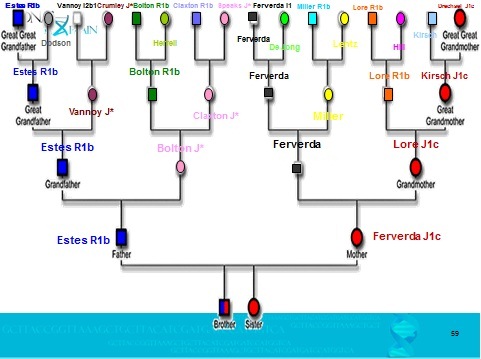
You can see the Y-line of my father and the mitochondrial line of my mother, on both ends of the pedigree chart. At the top of each line, I have recorded the haplogroup information for each family. Color coding each line helps in tracking descendants who would carry the DNA of the ancestor of that line. For example, my mother’s father’s mother’s line is the yellow Miller line. I need to find a daughter of my grandfather’s sisters, or their children, or their daughter’s children, to test for that mitochondrial DNA line. Which reminds me, I need to call my cousin. Family reunions, picnics and holidays are great for this type of thing. Sadly, so are funerals.
I blogged about how to put together your own DNA pedigree chart. If you’re Native and adopted, then refer to the adoptee blog instead, or in addition.
But sometimes, we can’t find the right people in order to test, so we move to autosomal testing to help us fill in the blanks.
Autosomal Testing – For Both Sexes – The Rest of the Story
Autosomal DNA testing tests all of your 23 pairs of chromosomes that you inherit from both of your parents. You get half of each chromosome from each parent. You can see this pattern on the pedigree chart, represented by all of the 16 genealogical lines. Therefore, as you move up that tree, you should have inherited about 25% of your DNA from each grandparent, about 12.5% of your DNA from each great-grandparent, as have all of their other great-grandchildren.
Therefore beginning with your parents, you carry the following approximate amount of DNA from each of these ancestors. I say approximate, because while you do receive exactly 50% of your DNA from each parent, there is no guarantee that their parents DNA was admixed in your parents such that you receive exactly 25% from each grandparent, but it’s close. You can see the percentages in the chart below.
| Generation | Relationship | % of Their DNA You Carry |
|
1 |
Parents |
50 |
|
2 |
Grandparents |
25 |
|
3 |
Great-grandparents |
12.5 |
|
4 |
GG-grandparents |
6.25 |
|
5 |
GGG-grandparents |
3.125 |
|
6 |
GGGG-grandparents |
1.56 |
|
7 |
GGGGG-Grandparents |
0.78 |
Given this chart, if the Native percentage is back beyond 6 generations and drops below the 1% threshold, it’s extremely difficult to discern today.
Autosomal testing will pick up relationships reliably back to about the 6th or 7th generations, and sporadically beyond that.
Autosomal testing provides you minimally with two things. First, with a list of “cousin matches” by percentage and estimated relationship. Second, percentages of ethnicity. It’s this second part that’s most important for the person seeking to prove Native American heritage.
Percentages of Ethnicity
As the field of genetic genealogy has moved forward, research has begun to indicate that certain autosomal markers are found in higher or lower frequencies in different ethnic populations.
For example, if someone has the Duffy Null allele, or genetic marker, we know they positively have African admixture. We don’t know how much African admixture, or from which line, or when that individual with African admixture entered their family tree, but we know for sure they existed.
Attempting to determine the population frequency of varying markers and what that means relative to other populations is the key to this analysis. Few markers are simply present or absent in populations, but are found in varying frequencies. Some populations are widely studied in the research literature, and others are virtually untouched. Thousands have only been recently discovered as part of the National Geographic, Genographic project.
The process of compiling this information in a meaningful manner so that it can be analyzed is a formidable task, as the information is often found in nearly inaccessible academic and forensic research publications. It’s difficult to determine sometimes if the DNA analysis of 29 individuals in a small village in northern Italy is, for example, representative of that village as a whole, of northern Italy, or more broadly for all of Italy. Is it representative of Italy today or Italy historically? These and other similar questions have to be answered fully before the data from autosomal testing can be useful and reliable.
Let’s take a look at all 3 of the contemporary autosomal tests and what they have to offer.
Note: as of 2019, MyHeritage is also a major player in the autosomal DNA testing space.
Family Tree DNA
Family Tree DNA sells the Family Finder test. Right now it is priced at $79 or bundled with attractive pricing with either the Y-line or mitochondrial DNA tests. I often like to use this tool in conjunction with the Y-line and mitochondrial DNA tests to see, if you match someone closely, whether you are actually related to them in a recent timeframe or if it is further back. Family Tree DNA is the only one of the autosomal testing companies that has the ability to do this type of advanced comparison. Compared to 23andMe and Geno 2.0, they are the only ones to offer traditional Y-line and mitochondrial DNA testing which provides individual marker results and matches.
In addition to a list of autosomal matches, you will receive your breakdown of ethnicity, by percent. The results below are for the same man with Native ancestry whose Geno 2.0 results are shown in the Geno 2.0 – First Peek blog.

You can read more about the Family Tree DNA autosomal product on their FAQ.
23andMe
Another company that sells autosomal testing is http://www.23andme.com. In addition to a list of cousins, you also receive admixture percentages, and their specialty, health traits. You also receive a paternal and maternal haplogroup, but with no markers for personal comparison. These Y-line and mitochondrial results are not as accurate at the Geno 2.0 nor the Family Tree DNA Y-line and mitochondrial DNA full sequence tests.
Be aware that while people who test at Family Tree DNA are interested in genealogy, the typical person at 23andMe tested for the health portion, not the genealogy portion, and may not answer contact requests or may know very little about their family history.
Right now, their test is $99, and you can download your results and upload them to Family Tree DNA for an additional $89, making the total price similar to the Family Tree DNA test. However, you need to be somewhat technically savvy to complete the download/upload process.
23andMe recently released a new version of their software which added quite a bit of resolution after years of being woefully behind. Native American wasn’t even a category previously.
Ancestry
Ancestry.com recently introduced an autosomal test. You receive matches and ethnicity percentages. However, their ethnicity percentages have significant issues and I would not recommend them at this time. Their cousin matches come with no analysis tools. So for now, just skip Ancestry and concentrate on the other resources.
One Last Autosomal Test
One marker value in particular, known as D9S919 is present in about 30% of the Native people. The value of 9 at this marker is not known to be present in any other ethnic group, so this mutation occurred after the Native people migrated across Beringia into the Americas, but long enough ago to be present in many descendants. You can test this marker individually at Family Tree DNA, which is the only lab that offers this test. If you have the value of 9 at this marker, it confirms Native heritage, but if you don’t carry 9, it does NOT disprove Native heritage. After all, many Native people don’t carry it.
To order this test, for existing Family Tree DNA clients, click on the “Order Upgrade” orange button on the right hand side of your personal page, then on “Advanced Test”, then enter “autosomal” in the drop down box, then you will see the list below. D9S919 is the last one and it costs $15. There may be a $10 one time transfer fee as well if your DNA sample is not in the Houston lab.

Swimming in Many Pools
As you can see there are lots of tools available to you that can be used individually or in conjunction with each other. Like anything else, the more work and effort you are willing to devote to the search, the more likely you are to be successful.
Most people test their Y-line and mitochondrial DNA, not just for Native ancestry, but to learn more about the lines they can test for themselves without reaching out to other family members.
Use your DNA pedigree chart to plan who to ask in your extended family to test for which lines.
Plan to test with multiple autosomal testing companies. Autosomal testing in particular is still in its infancy. I like to use the results of multiple companies, especially when you are dealing with small amounts of admixture. They use different markers, combinations, analysis tools and reference populations, so you can expect slightly different results. One company may pick up slight minority admixture while another may not. This has happened repeatedly with both my Native and African minority admixture.
GedMatch
After you obtain your results from either Family Tree DNA or 23andMe, you’ll want to download your raw data results and then upload the file to www.gedmatch.com. This is a privately run “donation” site, not associated with any of the testing companies, meaning there is no subscription or fee to use the tools, but they do appreciate and are funded by donations.
After uploading your results you can utilize several admixture tools to compare and contrast your results.
Getting Help
If you’re struggling with working through your family possibilities for who to test, I do offer a DNA Test Plan service.
If you would like a Personalized DNA Report for Y-line or mitochondrial results, those are available as well.
If you have what amounts to a quick question that I can answer in less than an hour, including prep, I offer the Quick Consult service.
For more extensive consulting, contact me. You can see my services here.
In Summary
Finding our Native ancestors is a way to pay homage to their lives and to the culture that was stripped from their descendants, ironically, by using their own DNA that has been gifted from them to us. Native people, after contact with Europeans were marginalized, and that’s the best that can be said. Many were killed, either intentionally or by European diseases, or enslaved. The results are that Native people left few if any individual records and those that might be available often can’t be identified or linked to them personally. For those who cannot unearth their Native ancestry using conventional genealogical means, genetic testing is the last hope left. Fortunately, the tools and our knowledge improve every day. We’re making great strides with what we can do, enlarging what was a pinhole into a keyhole, allowing us to peer into the past. So, click your heels, order your tests and let’s see where your DNA takes you.
______________________________________________________________
Disclosure
I receive a small contribution when you click on some of the links to vendors in my articles. This does NOT increase the price you pay but helps me to keep the lights on and this informational blog free for everyone. Please click on the links in the articles or to the vendors below if you are purchasing products or DNA testing.
Thank you so much.
DNA Purchases and Free Transfers
- Family Tree DNA
- MyHeritage DNA only
- MyHeritage DNA plus Health
- MyHeritage FREE DNA file upload
- AncestryDNA
- 23andMe Ancestry
- 23andMe Ancestry Plus Health
- LivingDNA
Genealogy Services
Genealogy Research
- Legacy Tree Genealogists for genealogy research
Share this:

Discover more from DNAeXplained - Genetic Genealogy
Subscribe to get the latest posts sent to your email.
Well, Roberta J. Estes, you might not repeat what you’ve already said, but I’m about to repeat what I always say!
First, thank you.
Second, thank you for being so consistently exhaustive in the information with which you fill every post. I swear each one takes me a week to work my way through because it’s so packed with links to follow and other things to consider. I’m guessing this one will take me well into the new year.
Third (which should really be first), I continue to be in awe of how you share this information in a way so novices like me can understand it at the same time you don’t talk down to more experienced researchers. Despite having plenty of formal education, I often find myself holding my head (literally) because I’m overwhelmed by it all. Yours is always a bright light in my den of ignorance. 🙂
Perhaps most of all, I appreciate the integrity you bring to your work and your sharing. As a Black person who has Native ancestry, I’m still intrigued (and, yeah, often infuriated) by some folks who have set themselves up as gatekeepers and behave as though “all things Native”–including information–are their personal possessions. While self-protection certainly makes sense given the United States’ long history of decimating indigenous cultures, I refuse to be blocked or otherwise bamboozled in my quest to know all I can. Which brings me back to your post.
Your straightforwardness and refusal to question folks’ motives, your ability to keep rising above the politics of this industry, all keep clearing the path for all of us. You and your work are a gem and a blessing. Muchisimas gracias!
Now I’m off to lay this post alongside my latest results from FamilyFinder.
Season’s greetings, good health, peace, and prosperity to all.
Bernestine – It is people like you who inspire me at 3AM to keep going. Thank you so very much for your encouragement. You have no idea how important it is! And this extends to all who have sent kind notes or contributed data or in one way or another. We are all in this together. But a very big thank you to you for making my day:) Roberta
interestingly, Ms. Singley is a relatively high DNA match with me…
I so totally agree with this post. We have no say so in the DNA markers that make us who we are. But we doggone certainly have a right to investigate and be given answers as to why those markers ARE there, without going through the 3rd degree. I was frustrated with my mtDNA results. It looked like a chemistry chart to me. I searched for guidance on the FTDNA site and, although I’m sure they MEANT to explain, it was waaaayyyy over my head. So, although, I still don’t understand but about 25% of my results, THIS site is what helped me get that far. I’ve got nothin’ but love for you also. THANKS!
Excellent summary as always!
Excellent information. I learn a lot reading your blogs.
Fort Lewis College in Durango, Colorado, is tuition free to Native Americans. Note this statement: “Qualified Native American students will be admitted to Fort Lewis College tuition free. They are still responsible for purchasing books, paying college fees, room and board expenses, etc.” on their Web page at http://www.fortlewis.edu/financialaid/NativeAmericans.aspx
Thanks Roberta for another incredibly informative article! I’d like to add that GedMatch, which you mention, can be very helpful in also determining Native ancestry percentage and where on which chromosome Native ancestry can be found, at least based on the datasets used. Under the site’s Admixture Proportion Analysis there are choices of using Chromosome Proportions and Chromosome Painting, the former giving the percentages and the latter a very detailed ancestry painting of each chromosome. There are four projects listed, developed by different individuals who have done autosomal admixture analysis; each has several versions with K indicating the number of population groups compared. The last, Harappa, is really for analyzing South Asian populations, but the others, including the Dodecad World9 analysis by Dienekes includes at least one Amerindian reference. My own results, downloaded from FTDNA (or is it uploaded?) indicated .87% Native American, and included a sizable segment on chromosome 15. I’m still not sure how the populations have been defined, but I would think at least the Amerindian designation is accurate.
Pingback: What is a Haplogroup? | DNAeXplained – Genetic Genealogy
Pingback: The Autosomal Me – Testing Company Results | Native Heritage Project
What percentage of DNA in the U.S. population is of Native Indian decent?
Dear Roberta, First, I hope you, your family and all your relatives are in the best of health. I also want to thank for such an informative site! I would like to share a recent experience. My family is heavily mixed we know this via oral tradition, what can be readily observed in phenotypes of family members, etc. I realize that these two vehicles are not very reliable, so many years ago family members took a series of DNA tests with DNAprint. The company is no longer in existance. Personnally I took the test 3 times because I could not believe (at the time) that such a science existed. The tests that my brother, sister and myself took revealed that indeed our family genetic make-up consisted of African- Native American and to a smaller degree European.
A few years later, I took another test with a company called DNAtribes. This company had me at 100% African as all my matches were in Africa! I kind of laughed it off and forgot about it.
At Christams this year my wife asked for a DNA test. Her families ethnic composition appears to be similar to mine. So I went ahead and took the test as well. This time with 23andme. The results show very little Indian, African is there but lower than European which was high for both of us!
I guess my question is if the autosomal testing was less accurate in the begining why does the older test reflect what we know to be true about our families and yet this modern test contradicts everything that we know?
Personally I feel ( and I know nothing about genetics) perhaps 23andme has more European than Native or African and these appear as lesser on results than the European.
Hi Dennis, I’ve written about this in a couple places. My family oral history placed my Native ancestor much closer to current time than they were. Also, my family oral history said they were “Cherokee” and they weren’t. But I think Cherokee became like the word Kleenex and stood for all Indians if you didn’t know the tribe for sure, especially if the tribe is not extinct. Furthermore, most Native people were heavily admixed by 1800, but many were still considered Native. Maybe what you are seeing is a reflection of early admixture that was considered normal in the Native community. If it makes you feel any better, my earliest tests said I was about 25%, which I thought was high, but figured it might be as a result of multiple lines. But then when I put my pedigree chart together and compared it with those results, I knew they were wrong. This is still a new field of science. I’ve compared by results from the most recent tests too, and as you see from the series, the results have been quite interesting. We are learning every day and things are still evolving. You are on the leading edge of science, a pioneer.
Roberta
Thank you Roberta!
My wife’s percentage went from 21% Native to 14.5% mine from 39% to 20%. I have been up for some nights now trying to understand these things!
I found some interesting information here as well : http://dienekes.blogspot.com/2011/03/note-of-caution-on-admixture-estimates.html
Again thank you for your time and the wonderful work you have done!
Dennis
The “free college” myth could derive from the American Indian Tuition Waiver at the University of Minnesota, Morris, which is not a myth but a fact. See
http://www.morris.umn.edu/financialaid/scholarshipswaivers/americanindiantuition/
There are several in ND thar offer this as well.
What about, Haskell Indian Nations University, Lawrence, Kansas????
There are Cherokee tribes people from the Cherokee Nation in Oklahoma some are testing 100 percent European. Route 23andme. Paper documents are good but seeing the DNA results are much better. Then you know you are genetically connected to that group of people And it is part of your ancestry.
Sorry I would like to add to my comment some of the Cherokee Nation that has tested that I sure where there blood quantum is 1/8 and test just about 1 percent but the register blood quantum does not come close. Some people may actually think their genetic from paper is 1/8 but in reality the DNA show the different story than the paper
Roberta, thanks for taking the time to help me understand what is possible and what is not. I followed family line after family line and found records of native ancestors and also of people who had been taken to court to prove they were not African. I see there are no easy answers.
I think you summed it up perfectly. There are no easy answers. But all of that research together makes a wonderful body of work for you and your family.
Hi there,
Would you know how to go about if my mtdna haplogroup is D but i cannot find any matches on family tree dna and neither mitosearch. Are there websites who have a better focus on amerindians?
Not a lot of Native people test, and many of the early tribes east of the Mississippi died off, for the most part, leaving only few. So, the answer is no, there aren’t any other data bases other than http://www.smgf.org and Ancestry whose mtdna search routine returns erroneous results. Hopefully, in time, you’ll have more matches. Do you know your tribal affiliation?
Thanks for your reply Roberta.
And no. No tribal affiliations, in the Caribbean where I am from the native people practically do not exist anymore. Just the heritage I carry in my DNA.
Emmanuel, in Caribbean such ad Puerto Rico has tribes if u have halpogroup C or such with native MtDna go to the link Guatu’ma’cu a Borike’n of Taino pueblo (sometime they says concilio Taino) they still carry traditions,music, songs,dances and Arawak dialect still using today (and yes Taino ppl r related to Arawak ppl from South America) unless ur from USA there’s a tribe in NYC that still teaching or in Texas as well even Connecticut they all coming together for powwow,ceremony n such sometime. Good luck 🙂 or reach Facebook u can find them most members.
Depend which Caribbean ur from for example Puerto Rico,Cuba, Bahamas,etc etc all are related Taino Amerindians such as Taino,ciboney,guanahatabey n more tribe names in Caribbean they all spoke Arawak dialects 😉
Thanks Kuya for the reply.
Since my last reply i have found a very interesting article that gives me the certainty that my maternal line has descended from the Caiquetio people. Which indeed belonged to the much larger group of Arrawaken peoples.
I am glad to know this, since i have always felt a great attraction to native peoples. Too bad that the culture is extinct including it’s language.
For those interesting in reading:
http://academic.uprm.edu/~jumartin/toro-labrador.pdf
Myth #1 is also NOT true. There are some states that offer 100% free tution to Natives American who are members of a Federally Recognized tribe.
To qualify you must often submit enrollment information and a certificate of blood quantum from your tribe.
one such college is the University Of Minnesota’s college in Morris, MN
http://www.morris.umn.edu/financialaid/scholarshipswaivers/americanindiantuition/
Pingback: Happy First Blogiversary | DNAeXplained – Genetic Genealogy
I’m not sure why you think that Native Americans don’t receive free tuition. As far as I can tell, the vast majority of colleges in the United States offer free tuition to Native Americans, provided that they are able to prove their Native American heritage and/or are a member of a federally recognized tribe. It says so in all (or at least most) of the College Financial Aid sections of websites and college catalogs. So, again, I’m really not sure why you listed that as a myth.
I need your help PLEASE! I was raised in foster care, and I never knew my real father, my mother and her family is/was definitely Caucasian looking, they are are now all deceased. There is no family around, for me to ask questions.
I was always told, I was one half American Navajo, I look American Indian, but many people often mistake me for Hispanic. I want a DNA test, to finally tell me, what race I am, or closest too. Could you recommend a test, that I could purchase, PLEASE!
This article tells you just that. At http://www.familytreedna.com, you can purchase the mitochondrial DNA test which tells you about your direct maternal line, the autosomal test which gives you percentages of ethnicity, but you can’t purchase the Yline test because you’re not male.
The free college/tuition thing is not a myth, at least, in Canada. If you are a band member in a federally recognized community, you are eligible to be ‘band funded’. The government distributes money to each community, and an application and proof of enrollment is required…and they cover tuition, books, and even living expenses up to $1500. You need to keep your grades up and have community involvement usually, as well. (I’m a member of a band in Ontario)
Pingback: Why DNA Test? | DNAeXplained – Genetic Genealogy
My father’s,father’s mother was the native american which came through her mother’s mothe. I am female, would we get better results if one of my brothers did the dna testing. Which test would we use. We know we are native american, just want proff. Kindest regards, jenny mcminn rice
Your best bet would be to find someone who descends from the Native woman though all females (the current generation can be male) and do the mtdna test on that person.
Pingback: DNA Testing for Genealogy 101 | DNAeXplained – Genetic Genealogy
i know this is a long shot (i’ve just done my kit at 23andme without understanding it’s just the mother’s side and the native american is on my dad’s!) but my aunt told me that her grandmother said that her grandmother was a tahoe from the red river area. i don’t believe there is a tahoe tribe (it’s actualy washoe in tahoe), but has anyone heard of anything remotely like this (from Louisiana). Thanks in advance for any consideration or assistance!
Very informative my friend, thank you for posting this!
I just received my DNA analysis from Ancestry.Com. According to the results, I’m 24% “Native American.” My mother was born in South America and I’m trying to determine if there is a test I can take that would pinpoint her race in the region of South America. I’m trying to find out where she was born, but have had no success. She was orphaned at a young age and never knew her parents. Her background is Spanish and Indian. Thanks for any help you can give me.
I recommend the mitochondrial DNA test at Family Tree DNA. It will tell you her haplogroup, provide matches to people with the same mtdna, and will show you regions where the haplogroup and your matches are found. I would suggest the full sequence test.
Hello Roberta,
You appear very educated and I have been researching for my wife. I am stuck in all of these options out there! Everyone has a better test! So here is the scenario… Please help?
My wife is adopted and both of her adopted parents are deceased(her mom in 1995 and her Dad just this June). She knows that she was born in Massachusetts and that her Bio-Father was Native American(unknown tribe or blood quantum) and her mother was not known to be NA but she is not sure what she “was”!
My wife is currently pregnant and we want to know how to discover her family lineage for historical health concerns, as well as she would love to find some family as she was the only child in the adopted family and now has no family relations left and feels all alone. It breaks my heart to see her sorrow at my family functions (even though my family loves her) and she often cries because she just wishes she had someone that was “really blood related” so she could learn about her ancestors.
Is there a specific test you would recommend and how would we then use that test to try and track down some of her bio family so she could feel whole again?
For the record money and benefits are not the motive here and we are financially secure and insured! She is not seeking nor does she desire enrollment in a tribe. I just want her to have the opportunity to meet her bio-family and the option to build a relationship with them if she chooses.
She is certainly not alone. Here is what I’d do. So that she will get health info, test at http://www.23andMe.com. Then transfer her autosomal results to http://www.familytreedna.com. Both of those companies are very good and have tools for genealogists. Then, at Family Tree DNA, have her take the mitochondrial DNA full sequence test. She can connect to various people through all of those tests. I was speaking a couple of years ago and a woman came up to me and took my hand. She told me that it was the first time in her life she had ever touched someone she was biologically related to. We both cried. I guarantee you, she’ll find cousins. People at 23andMe don’t reply as often, because many are not interested in genealogy. But people at Family Tree DNA are genealogists and there are lots of people to help you. There is also an adoptee group. http://dna-explained.com/2012/12/17/im-adopted-and-i-dont-know-where-to-start/
The answer is in her DNA. No more sad tears. Only happy tears in the future about family.
Thanks for the informative article. I’ve heard stories about my birth mom being part Native American so I was hoping to see proof in my DNA test results. No such luck. No trace of Native heritage turned up on my results. I took Family Tree DNA’s Family Finder test. Perhaps I will explore this further by taking the maternal line test.
By the way, I write about this topic at my adoption blog, Revelations (http://lynneamiller.com).
That’s the logical thing to do.
Great information, easy to read and understand, I can’t thank you enough! I’ve recently come across a family history published in 1837 that indicates my 6th great grandmother was a ‘quatroon Shawnee’. I found your article by searching for ‘finding my native american ancestry’. I may never know if this particular ancestor was indeed of the Shawnee but now I know how I can further the research using my own, and my siblings and cousins, DNA. Thank you!
1837 is very early and in the 1830s, being Native American certainly wasn’t a popular thing to be. So if an 1837 reference says they were Native, I’d give that a lot of weight.
That’s encouraging, thank you! I also am placing some confidence in the author, a great grandson of my 6th great grandmother, he was a Methodist minister that wrote many biographies and religious works in his lifetime.
Pingback: When DNA Results Are Disappointing | Revelations
Hello,
I’m 39 years old I was adopted through Childrens Home Society in 1975 out of Ocala Florida. My BIOLOGICAL FATHER was a full blooded NATIVE AMERICAN INDIAN. My BIOLOGICAL MOTHER was of FRENCH DECENT. wHEN I WAS 20 YRS OLD I CONTACTED THE ADOPTION AGENCY & THEY PUT ME IN CONTACT WITH MY MOTHER WE WROTE BACK& FOURTH FOR A SMALL AMOUNT OF TIME.wHEN I ASKED HER ABOUT MY FATHER SHE WOULDN’T TELL ME ANYTHING, I WANT TO KNOW ABOUT MY NATIVE AMERICAN HERITAGE BUT SHE’S THE KEY TO MY QUESTIONS, BECAUSE MY FATHER DIED SHORTLY AFTER OR BEFORE I WAS BORN???? I’m PLANNING TO TAKE A dna test to try to find out my percentage of native American blood. I would like to talk to some other people in situations similar to mine to help guide the way over the years I’ve become very fusturated & have given up but, this time I’m bound & determined please email me @ samanthamaffei@yahoo.com asap………….
Any info u get can u email it to
Albertnava87@com
And if u want I will do the same
I really don’t know how to put this my great grandmother was supposedly 100 percent Native American but her family died in a fire Florida in about 1910 so I’m not a hundred percent sure about how I go around finding out if she was native or what percentage I actually hold
Need to know if i have some native american .
Pingback: Thanksgiving Conundrum | Native Heritage Project
Pingback: Thanksgiving Conundrum | DNAeXplained – Genetic Genealogy
Pingback: Thanksgiving Conundrum | Oppression Monitor
Pingback: Thanksgiving Conundrum | Mixed American Life
I am trying to track down my Indian heritage & keep running into road blocks. My father, now deceased, was a hawk, my mother is a a distant decendant of Pohantas. I need information in proving my blocking & be given membership In my tribe!! Any way you can help would be very much appreciated!! Thank you, Buck
Try contacting the Pamunkey and/or the Mattipponi Indians of Virginia whom represent two of the tribes under the Powhatan Confederacy. Chief Powhatan was the father of Pocahontas. These tribes are situated in King William County, Virginia. Good Luck!!
Pingback: 2013 – DNA-eXplained in Review | DNAeXplained – Genetic Genealogy
Thank You, this was very helpful and informative as I conduct my own research.
I want to take a dna test to detemine im taino arawak an get the benefits thats required my grandmother an her father is natives from that indian in Puerto Rico im in waterbury ct where do i go to take the test thank you
You can take the test at http://www.familytreedna.com, but as the article said, tribes don’t accept DNA tests for benefits.
Hello Roberta, My Grandmother was Danish. Living in Souix Falls, S.D. and in love for 6 yrs.with a man who told her he was native American Indian. She gave birth to my Mother in Jan.1941. Her seven brothers beat him up and ran him off. My Great Grandmother raised my Mother and always told her she was Italian. My Mother is an only child as am I. I do have a Daughter and a Son. So, my question is. What tests should I have done? And on who? Would I do a mtdna on my Son? I would like to know the truth. Is my mother Italian or Indian? Thank You for your blog. It’s very informative. Although, I admit, With so much information. I am confused. Thank You for your time and effort. Tamra
Your son’s DNA won’t help you at all. Test yourself. Take the Family Finder test at Family Tree DNA. If he was native, you will be 50% in the ethnicity portion.
I am a mother interested in DNA testing in order to find my beautiful biracial daughters paternal lineage. I was assaulted her father and I do not even know his name. Which company do you recommend to best meet our needs? ? Should I test with her in order
to isolate her paternal lineage?
The only test available to a female to give any information about her paternal side is the autosomal test. I recommend Family Finder at Family Tree DNA, but you may want to test at all 3 companies that offer this test. The other two are 23andMe and Ancestry.
Hello, simple question really, and alil history bout me,
My birth farther known to me as Terrence Holliday had always claimed he had Indian decent, ither his mother was or his dad was it’s never been clear, I was raised by my mother but did once meet him when I was 12, he told me that he gave me my name on honor of his grandmother which was Iss-ah and it ment goddess of mountains career of flowers, altho he did look Indian to me he could never prove his claims, so I’m in conflict as I don’t know who I am and dare not ask anyone, in fear what he was saying was untrue, he said he was related to chamanchi tribe but can’t really link what he says, all I want to know is the truth about my self as in secret I like the idea of being so close to nature , and really someone I can talk to about how to go about finding out, there’s a lot of bogus sites out there and I’m still unclear on what I can /should be doing? Due to the my name being Iss-ah I had to change my name by de-pol to Lucy Watson which is a tipical British name, I hope you can help me,
Xx
You can take the appropriate tests described in this article. If he was Native you should have some percentage of autosomal that is as well.
I need help, I am adopted and like my adoption goes deep into my mothers past. My other was abandoned as a child and adopted, unfortunately she never got the chance to even look for her birth parents before she passed away when I was very young. So I literally have nothing to go on as I was adopted into the family that adopted her and as a child, before I realized things were more complicated, I always assumed I was Native American because my other family members were but as I only had 1 biological family member and she had died I never got the chance to find out if I was part Native American or not. My dad is Hispanic but he also dies when I was young and I do not know anything of his family. People have told me before that i look more Native american than Hispanic I have always wondered if I am or not. Is there a way I can find out? Any Help or information would be great! Thanks 🙂
Your problem is going to be that most Mexican people are part Native, whether then know it or not. You can still take the tests and go from there. If you don’t test, you’ll never know.
Pingback: Obtaining Help with DNA | DNAeXplained – Genetic Genealogy
It may also have meant that Indian heritage was claimed to cover much less desirable African heritage.
How would you take it if the sentence read….It may also have meant that AFRICAN heritage was claimed to cover much less desirable INDIAN heritage.
Re: Duffy or DARC gene. It is the Duffy negative gene which is almost exclusively African, but the positive (A:A) appears to represent Southwestern American Indians, Europeans and apparently some Colombians. The very ancient Sans tribe from Africa are an exception, they are mostly positive. I’m Duffy positive, too, so this subject is most curious. Can you add any enlightenment?
Thanks so much for your studies in Native American DNA!
Hi Roberta,
I love all of the information you post on your blog. It has been very helpful to know that I’m not the only one searching answers to my past. I recently had the autosomal test done by ancestry.com. I found that I have 20% Native American ancestry, this correlates with the information I have found on my father’s side, I believe them to be some sort of Pueblo in New Mexico. The problem I have encountered is that both my grandparents (parents of my dad) deny being Native American. My grandparents have passed away so I would like to test my father to determine further Native American ancestry. I believe his mother, my grandmother, was Native American. I’m not sure about his father. Would it be worth doing the mtDNA and y-DNA testing through FamilytreeDNA on my father even though I tested my self using ancestry.com?
Oh, absolutely. That’s exactly what you need to do.
You can also transfer your DNA from Ancestry to FTDNA. You can test your father’s autosomal as well. Then, when you get a match, if they also match your father, you’ll know it’s from your father’s side and if they don’t match your father, you’ll know they are from your mother’s side.
That is what I will do then. What exactly will the charts look like from FamilytreeDNA? Do you have examples?
Yes, there are many examples on the blog. Start with this article. What you are looking for is Native American haplogroups. http://dna-explained.com/help/
I did a DNA test with ancestry and my results came back that I am 25% Native American. The test also states that my Native Amercian hertiage was part of the Northwest Coast. I wanted to know if there is a more specific test I can take to find out which tribe. All of my grandparents are deceased so I am not sure if my Native Amercian roots are from my mom or my dad’s side. My parents are clueless as to who’s side of the family it is from.
If you test both of your parents, you’ll know whose side the Native is from. That’s a start. You can then test your father’s Yline at Family Tree DNA and your mother’s mitochondrial and that will tell you if those two direct lines are Native or not.
QUESTION FOR YOU: NO INFORMATION ON MY MOTHER, NO BIRTH CERTIFCATE, ALL HER FAMILY ARE GONE. HOW AND WHERE CAN I FIND SOMETHING ABOUT HER? I DID FIND OUT THAT WE ARE PART SENECA AND SOME SIOUX. THE SENECA ARE IN NEW YORK,BUT CHECK RECORDS NOTHING ON RECORD ABOUT HER. THANKS!
What about a death certificate or the 1940 census to begin?