
Marguerite Doucet was born about 1625 in France to unknown parents.
It’s Complicated
What we know about Marguerite’s parents is complicated. We know they had at least three children, son Pierre born about 1621, daughter Marguerite born about 1625, and her unknown sister who was born about 1635 and married Pierre LeJeune about 1654.
Marguerite’s unknown sister and her husband both died between about 1661 when her youngest child was born, and 1671 when the first census was taken. In 1686, their two LeJeune sons are both married and found living among only 6 families in the census location designated as “Port LeHavre and Merliguech,” on the far side of Acadia.
La Hève, now LaHave, was the location of Acadia’s first fort and seat of government, from 1632 to 1636, and Merligueche was associated with the Mi’kmaq and eventually a trading post. It has been suggested that the reason they were found so far from Port Royal is because they inherited land that was granted to their father, Pierre LeJeune, but we don’t know. The Mi’kmaq connection remains particularly interesting based on what we’ll learn about Germain Doucet born about 1641.
Marguerite’s Brother
Then there’s the matter of Marguerite’s brother, Pierre Doucet, born about 1621. You’ll need to sit down for this one!
Pierre Doucet, a mason, married Henriette Pelletret about 1660 in Port Royal and died in 1713 at the age of about 92. His burial is recorded in the parish register.

Margin: Pierre Doucet. 100 years old!! (“100 years old” was added later in a different handwriting.)
This second of June of the year one thousand seven hundred thirteen, I, the undersigned, performing the curial [parish priest] functions at Port-Royal of Acadia, have solemnly buried the body of Pierre Doucet, resident of Port-Royal, aged nearly one hundred years. In witness whereof I have signed the day and year as above.
Fr. Justinien Durand, Recollect Missionary
There’s no reason to suspect that Pierre’s age, “nearly 100 years old”, as given in his burial record is substantially incorrect. Priests (and census takers) often overstated the ages of the very elderly. It’s possible no one actually knew his birth year – just that he was “almost 100.” It clearly establishes him as the same man.
An Acadian man born in 1621 (or 1613 if he were 100) was unquestionably born in France because there was no French settlement in Acadia at that time, nor for the next 11 years.
Furthermore, Pierre’s identity and heritage are complicated by a surprise revelation. For a long time, this finding was unexplained, but I believe it is today.
For years it was believed that Germain Doucet de la Verdure, a French military officer who rose through the ranks to become captain-at-arms, then the commander of the garrison at Port Royal was the father of:
- Pierre Doucet, born about 1621
- Marguerite Doucet, born about 1625
- Unknown sister Doucet, born about 1635
- Germain Doucet born about 1641 (or maybe the son of Pierre Doucet)
This made sense based on the known Doucet settlers in Acadia, and the ages of the people involved.
Germain Doucet, born about 1641, appears to be both a namesake and possibly the next generation. Some thought he was the son of Pierre Doucet. Enter DNA testing.
Several Doucet men who have taken Y-DNA tests report their descent from Germain Doucet, born about 1641, who was married to Marie Landry about 1671. The newlywed couple lived only three doors from Pierre Doucet in 1671, so it was long believed that Germain was Pierre’s oldest son.
Seems reasonable. So far, so good.
The men who descend from Germain Doucet’s line who have taken Y-DNA tests descend on the direct paternal (surname) line through one of three sons, Claude, Laurent and Charles. Their Y-DNA haplogroups are subclades of Native American haplogroup C-P39.
What?
How is that possible?

The Acadian AmerIndian Project Group Time Tree, above, only displays Big-Y testers. They are grouped by the project administrators according to their genealogy provided, showing the three lineages.
Many additional Doucet men have tested at the 12-111 STR marker levels, which don’t provide the same Big-Y level of resolution. Still, they match these men on those markers, so we know they are related. They all report descent through one of the same three sons, and there’s no reason to doubt their genealogy.

Then, there’s Pierre Doucet’s son, Toussaint, who is shown on the 1671 census as age 8, so born about 1663. Only one man in the Acadian AmerIndian Project who descends from Toussaint has taken the Big Y test, but several others match him on STR markers. Toussaint’s haplogroup? R-FTF37401 – clearly European.
So, based on this, Germain Doucet (c 1641), with a Native American haplogroup, cannot be the biological son of Pierre Doucet born in France in 1621, nor is he the son of Germain Doucet (b 1595).
What do we make of this? The only logical possibilities I can think of are:
- Germain Doucet, born about 1641, was adopted as a child by Pierre Doucet, born in 1621
- Germain Doucet, born about 1641, was adopted as a child by Germain Doucet de la Verdure, born in 1595.
- Germain Doucet, born about 1641, was adopted as a child by the unknown parents of Pierre, Marguerite and their unknown sister
- Germain Doucet, born about 1641, was born to Marguerite Doucet, (c 1625) and an unknown Native American man
Just to confirm, I’d very much like to see Y-DNA tests from descendants of at least one of Pierre Doucet’s other sons:
- Jean Doucet, born about 1665, married Francoise Blanchard about 1692. They lived in Les Mines/Grand Pre and had one son who was known to survive to adulthood.
- Pierre Doucet, born about 1667 and died after the 1686 census. He may never have married as there is no more information known about him.
- Louis Doucet, born about 1674, married Marguerite Girouard around 1702 in Beaubassin and died after August of 1722. They had three sons, two of whom married and had children.
- René Doucet, born about 1678, married Marie Broussard in Port Royal and died after September 1731. They had four sons.
- Mathieu Doucet, born about 1685, married Anne Lord in 1712 in Port Royal, and died between 1744 and 1760. They had three sons.
If Pierre, who was born in 1621, was Native, he could not have been adopted, even as a servant child, until at least 1632 when the first French soldiers arrived. No families were at La Hève until 1636, and then only a handful.
Marguerite (c 1625), Pierre (c1621) and Germain (c1641) are the only three Acadians in the 1671 census with the Doucet surname. If Pierre is Marguerite’s brother, he was either born to the same parents as Marguerite (and her unknown sister) or he had to have been adopted by Marguerite’s unknown parents.
In 1687 Pierre Doucet, a citizen in Port Royal in good standing, signed a deposition attesting to the accomplishments of Charles d’Aulnay prior to his 1650 death.
Marguerite Doucet’s husband, Abraham Dugas, also made his mark on the same document, attesting to the same.
I’m not saying that this confirms that Pierre Doucet was not Native, but I’m unaware of any other French legal document signed by a Native person in this type of capacity.
If Pierre was born about 1621 and was Native, he had to have been fully Native, and he could not have been a biological sibling to Marguerite.
How do we know that with so much certainty?
- There were no French women in Acadia in 1621 and wouldn’t be for more than a decade.
- Marguerite’s mitochondrial DNA was passed to her directly from her matrilineal ancestors, through all women, with no admixture from any male.
- Her descendants have tested, and they match the mitochondrial DNA of her unknown sister.
- Their haplogroup, T2b7a2a, is unquestionably European.
So now we’re left with a quandary.
Was Germain Doucet born in 1641 adopted by either Pierre Doucet born in 1621, his unknown parents, or possibly by the childless Germain Doucet de la Verdure, born about 1595?

To confuse things further, Germain Doucet de la Verdure (born c1595), who, for a long time was believed to have been the father of the three Doucet children, meaning Marguerite, Pierre and their unknown sister, turned out to be their uncle.
Say what?
Pierre Doucet’s unknown father is the brother of Germain Doucet de la Verdure.
Adoption by either Germain Doucet (c 1595) or his unknown brother are the two most likely scenarios, especially since Germain born in 1641 was named after an Acadian man, married into and lived among the Acadian families in Port Royal. Furthermore, Pierre born in 1621 was only 20 years old in 1641, not yet married and functionally too young to adopt a child in Acadian culture.
Pierre Doucet (born in 1621) married Henriette Pelletret about 1660 whose family, one of the early settlers, lived dead center on the main street in Port Royal, which suggests that’s probably where Pierre lived too. That makes sense, since that’s where the early settlers lived, and where his uncle, the fort commander, would have lived too.
I told you this was complicated.
Germain Doucet de la Verdure
Germain Doucet de la Verdure (c1595-after 1654) was unquestionably in Acadia by 1640, serving as the captain at arms at the Fort at Pentagöuet, now Castine, Maine. He’s widely believed to have been among the “300 elite men” who arrived in 1632 with Isaac de Razilly.
Germain reportedly married an unknown woman, but in 1654, when the English took Acadia, he was identified as the brother-in-law of Jacques Bourgeois. Jacques was married to Jeanne Trahan. Therefore, Germain Doucet’s wife was either the sister of Jeanne Trahan, or the sister of Jacques Bourgeois – at least in 1654.
Germain Doucet de la Verdure was also d’Aulnay’s right-hand-man beginning in 1635 when d’Aulnay stepped in as Governor following Razilly’s death. Germain was remembered in d’Aulnay’s 1650 will and entrusted to be the guardian of his minor children. Given that Jacques Bourgeois arrived as a surgeon with Charles d’Aulnay in 1641 or 1642, and married Jeanne Trahan whose parents settled in Acadia, meaning she had sisters available to marry – that’s the most likely scenario. Jacques Bourgeois’s parents never came to Acadia, nor did any known family. Germain’s unknown Trahan wife was born about 1628, given that her parents were married in 1627 in Chinon, France and Jacques’s wife was born about 1629.

Germain Doucet de la Verdure (c1595) and his unknown Trahan wife might have married as early as 1643, when she was 15, but they never had any children, or at least none that lived, which was extremely unusual for that timeframe.
The fact that they never had children:
- Is part of why it was thought that Marguerite Doucet, Pierre Doucet, and their unknown sister were Germain Doucet’s children. He could also have been married prior to marrying his Trahan wife. But, as it turns out, Pierre, Marguerite and their unknown sister were not Germain Doucet’s children.
- Could also explain the Acadian upbringing of the Native child, Germain Doucet, who was born in 1641. We don’t know when he was adopted.
D’Aulnay’s Will
The key to the identity of the three Doucet siblings is held on page 23 of d’Aulnay’s will, of all places, where he addresses Germain Doucet (b 1595) as “Germain Doucet, called La Verdure, of Couperans in Brie.” Unfortunately, no village called “Couperans” exists, resulting in much speculation.

Stephen A. White, Acadian historian, believed that Couperans was actually “Couperoue en Brye,” today’s Coupru. A hamlet called La Verdure exists about 9 miles away.

There’s no church in the ancient crossroads hamlet of La Verdure. In the 1590s, La Verdure was in the commune and parish of Bassevelle.

If the family actually lived in La Verdure, they would have attended Église Sainte-Croix in Bassevelle, about three-quarters of a mile away, or about a 20 minute walk through the countryside.
It’s difficult to tell exactly where Germain Doucet came from based on how d’Aulnay referred to him, or even if we’re in the right ballpark. It’s possible that the family lived in Coupru, or someplace else. Unfortunately, no records exist for this timeframe.

If, and I stress “if”, Coupru is the location where Germain Doucet de la Verdure is from, then it stands to reason his unknown brother, the father of the three Doucet children, was from here as well.

If Marguerite and her siblings were born in the same village where her uncle was from, and presumably where her father was born, then she could well have been born here and baptized in Coupru’s church.
D’Aulnay specifically left Germain Doucet (b 1595) 200 livres in recognition of his many years of “loyalty and affection.” Doucet and his wife also received a promise of free food and 50 écus of rent per year for the rest of their lives.
Additionally, d’Aulnay said that he had left Germain the equivalent of another 100 livres, for the help that he, d’Aulnay, had provided to Germain Doucet’s “nephews and nieces”, which can only mean Pierre, Marguerite, and their unknown sister.
“On luy donnera, je ne luy donne que deux cent livres, mais le secours que je rend à ses nepveux et niepces et tous ceux qui luy touchent va bien à cent livres.”
The exact translation is:
One will give him, I give him only two hundred livres, but the assistance that I render to his nephews and nieces and all those who are related to him amounts easily to one hundred livres.
Translated less literally, d’Aulnay is explaining that he left Germain (b 1595) only 200 livres because he had rendered another 100 livres worth of assistance to Germain’s nephews and nieces.
It’s also interesting that nephews is plural, and the bequest includes “et tous ceux qui luy touchent” which translates literally to all those who touch or concern him, which could be connected by blood or marriage, or perhaps adoption.
In 1650, Pierre Doucet would have been about 29, Marguerite, about 25 and the unknown sister, about 15. Native American Germain Doucet would have been age 9.
After the fall of Acadia to the English in 1654, Germain Doucet de la Verdure was sent back to France along with the French soldiers, but all three Doucet children stayed. Marguerite was married and had two or three children. Pierre Doucet had not yet married Henriette Pelletret, and the unknown sister’s first known child was born about 1656, so she probably wasn’t married yet either.
If Germain Doucet de la Verdure (b 1595) had adopted Germain Doucet (b 1641), or even if his deceased brother had adopted him, there was a real problem in 1654 when Germain (b 1595) had to return to France after the fall of Acadia. Germain (c1641), born Native, would only have been about 13 years old. Would Germain (c 1595) have taken an adopted Native child back to France? What happened to Germain born in 1641 after 1654? Who did he live with? How did he obtain the Doucet surname?
There are still so many unanswered questions.
Marguerite Doucet’s Life
What we do know about Marguerite is that she was born about 1625, and that she had married Abraham Dugas by about 1648 when their first child was born. If they didn’t marry until 1647, Marguerite would have been about 22, which was relatively old for an Acadian bride. It’s certainly possible that their first child or children died prior to the 1671 census which is the first actual record we have of families.
Unfortunately, parish records don’t exist prior to 1702.
We don’t know when Marguerite’s parents died, but given d’Aulnay’s commentary about having helped Germain Doucet’s (b 1595) nieces and nephews, it was assuredly some time before d’Aulnay’s 1650 death. My speculation, and that is what it is, would be that Germain Doucet (b 1595) and his unknown brother both served d’Aulnay in one way or another.
After their parents died, presumably in Acadia, the three Doucet siblings lived with their uncle, Germain Doucet de la Verdure (b 1595) with d’Aulnay helping them. He clearly granted Pierre Doucet land.
Marguerite’s Mother
Marguerite’s mother was an unknown Bourg, sister to Antoine Bourg who was born about 1609 in France. Marguerite’s mother could have been born maybe about 1601 since her oldest known child, Pierre Doucet, was born about 1621. Her last known child was Marguerite’s sister born about 1635, so if Marguerite’s mother was 42 that year, she could have been born as early as 1592 or 1593. Marguerite’s mother could also have died that year, or shortly thereafter. It’s safe to say she was born sometime between 1592 and 1605. Marguerite’s father was probably about 10 years older. Females married much younger than males.
Historian André-Carl Vachon, in his book La colonisation de l’Acadie, cited six dispensations that narrowed the identity of Marguerite’s mother to either the sister of Antoine Bourg, or the sister of Antoinette Landry.
Carl’s work showed that six couples were granted dispensations of the 4th degree of consanguinity, which meant that they were third cousins. Their shared great-great-grandparents were Antoine Bourg and Antoinette Landry.
Mitochondrial DNA is passed directly from mothers to all of their children, but only females pass it on. Everyone inherits their mitochondrial DNA from their direct matrilineal line, mother to mother to daughter. Therefore, Antoinette passed her mitochondrial DNA to all of her children, but only her daughters passed it on to the next generation.

Antoinette Landry’s mitochondrial DNA haplogroup is H3a1g, as shown in the Acadian AmerIndian Project, which effectively eliminates her as a possibility. Marguerite’s maternal grandmother and Antoinne Landry’s mother are not the same person. Marguerite Doucet’s haplogroup is T2b7a2a which matches the haplogroup of the descendants of her unknown sister, but not Antoinette Landry.
Therefore, Marguerite’s mother is Antoine Bourg’s sister. If they were full siblings, that means their mother was born between about 1567 and 1572, and their father probably a decade earlier.

Click to enlarge
Piecing these tidbits together has been challenging, but now we have at least an outline of the family relationships of the earliest Acadian settlers and their families that reach back into France.
One additional piece of information becomes evident as well. The blue Doucet parents and the purple Bourg parents had to be living in the same location in France for their children, unknown “Father Doucet” and unknown “Mother Bourg,” to marry and have at least two of their three known children in France before Acadia was beginning to be settled. Unfortunately, we don’t know where either family hails from.
Marguerite Saw Some Things

We don’t know exactly when Marguerite’s parents arrived in Acadia, but the ships bound for Acadia set sail from La Rochelle in France.

If Marguerite’s parents didn’t live there, which is unlikely because d’Aulnay recruited from within his seigneury in the Poitou, over a couple weeks, they would have made their way from their village to the docks and camped in the grass along the quay until the ship was ready for their meager belongings to be loaded, and for them to board.
Marguerite must have thought this was a great adventure. She was getting to see things little French girls never got to experience.

Marguerite spent the next 8-10 weeks, depending on the wind and weather, mostly below deck on board the cramped ship with meager rations and almost no room to move.
If we make the assumption that her parents made the journey at the same time as Germain Doucet de la Verdure (b 1595), then Marguerite would have been a child of 10 or 11 if they arrived in La Heve in 1636, and about 16 if they arrived in Port Royal in 1641.

The first fort at La Heve was built on a stony outcrop extending into the Atlantic. It was beautiful, but very exposed to the elements, and the soil was rocky and difficult to farm.

The few homes were built on the peninsula rising from the sea, at right.

As a child of about 10, if the family first settled at La Heve, Marguerite probably strolled along this sandy beach and picked up pretty rocks as she walked from the fort to the habitation.
After Razilly’s death in 1635, d’Aulnay moved the fledgling colony to Port Royal which was protected, and the marshes along the river could be drained to become rich, productive farmland.
In 1641, d’Aulnay brought 20 families to Port Royal, so Marguerite’s family could also have been in that group. They may still have stopped at La Heve en route for fresh water and supplies after their arduous journey crossing the Atlantic.
In 1645, when d’Aulnay overran La Tour’s fort at Saint John across the bay, if Marguerite’s father was living, he would have been standing at d’Aulnay’s side. Marguerite, at about age 20, would have been nervously waiting for her father’s return.
Two years later, Marguerite married one of Port Royal’s upstanding citizens – Abraham Dugas, the King’s armorer. There weren’t a lot of families in Port Royal by 1647 – maybe 35 or so. I wonder if Germain Doucet de la Verdure (b 1595) was involved in a little matchmaking, assuring that his niece married well.
Around 1648, Marie Dugas was born to Marguerite and Abraham. We don’t know if Marie was their first child born, but she was the eldest living in 1671.
Their son, Claude Dugas, came along about 1649.
D’Aulnay died in 1650, and according to his will, he had obviously been assisting Marguerite and her siblings for some time. This means that before the age of 25, Marguerite had buried both of her parents.
Marguerite probably lost at least one child, and possibly two between the births of Claude in 1649 and Anne born about 1654.

Those children would have been buried in the cemetery beside the Catholic Church in Port Royal. Those graves are unmarked today, but they rest in this peaceful green space, within sight of their ever-watchful mother.
1654 – The Year of Fire
I certainly hope Marguerite wasn’t pregnant or just delivered of a baby in July of 1654 when English Colonel Robert Sedgwick captured Governor Charles La Tour’s fort on the St. Jean River, along with La Tour himself, before sailing on across the Bay to Port Royal.
Did Port Royal have any advance warning that the English warships were approaching? We know sentries were posted at the entrance to the river basin.
There were only 133 soldiers stationed at the fort. There might have been 35 Acadian families. Even with all of the local Acadian men coming to their aid, they were still no match for Sedgwick’s 750 soldiers.
The Acadians and soldiers tried to fend off the English, ambushing Sedgwick’s landing vanguard, killing one and injuring six. Six defenders lost their lives, but we don’t know who.
With the Governor held hostage, it fell to Emmanuel Le Borgne de Belle-Isle and Marguerite’s uncle, Germain Doucet de la Verdure to negotiate surrender terms that spared the lives and property of the Acadians.
Despite an agreement stipulating that the Acadians could keep their property and it was to remain undamaged, after surrender, the English plundered the homes in Port Royal and burned the town, including the Catholic church and monastery. Although the surrender terms allowed the Capuchin friars to stay, only Père Léonard de Chartres remained behind, and he was executed by the English.
Marguerite, then about 29, must have been terrified when the English overran Port Royal. We know from later documents that her home with Abraham Dugas was located adjacent to the fort, which made perfect sense for the King’s armorer. Given their proximity to the fort, not to mention the brutality of the soldiers, there’s no question that her home was burned.
I hope that Marguerite grabbed her children and literally headed for the hills behind Port Royal for safety. I pray that the conspicuous absence of a child or children born between 1649 and 1654 had nothing to do with this raid.
The good news, if there was any, is that as the armorer, or gunsmith, we can rest assured that Abraham Dugas had firearms in the house. I’m betting that Marguerite knew how to use them too. But one woman cannot fend off an army and defend her children alone. She sought shelter someplace as the town burned around her, leaving nothing but smouldering rubble
After the fires burned out and the English left, the Acadians rebuilt. This might have been when Marguerite and Abraham built their replacement house across Allain Creek, not on their lot beside the fort.
Nicolas Denys, who was held prisoner at the fort, reported that many Acadians moved upriver to Belle Isle and left their land in Port Royal behind after the 1654 raid. Abraham Dugas did not move upriver, but did, at some point, move outside of Port Royal proper.
Thanks to later maps, we know they still lived nearby.
The Cadence of Life
Around 1656, Marguerite welcomed another child into the world. Martin Dugas was born, followed by her namesake daughter, Marguerite, about a year later.

Since the Catholic church would not be rebuilt during the English reign, during this time babies were baptized at St. Laurent, the chapel called the Mass House on maps at Belle Isle. Burials occurred there too.
An unnamed child was probably born in 1659, but had died before the 1671 census.
In 1661, Abraham Dugas was born and named for his father.
Another silent gap about 1663 suggests that perhaps a child was born and died shortly after childbirth, because the next child, Madeleine, arrived the following year.
Marie Dugas Marries Charles Melanson
As was common in Acadian households, the oldest child married while the parents were still bringing their own babies to the baptismal font. Marguerite’s oldest child, Marie, married and began blessing the family with grandbabies while Marguerite was still bearing children herself.

Marie (the eldest) married French Huguenot Charles Melanson about 1662 and had her first child in 1663. I’d wager that neither Abraham nor Marguerite were happy about their daughter marrying a Protestant.
Marie may have lost a child in 1665 and her mother would certainly have shared her grief. Unfortunately, grief was a staple of Acadian life.

Charles Melanson and Marie Dugas lived in the Melanson settlement across the river from her parents and over the next 30 years, had a large family – 14 documented children.

Marguerite would have known them all and watched most of them grow to adulthood. Marie gave birth to rare twin boys in 1685, and both survived.

Today, the settlement is a peaceful field, having returned to nature.
Marguerite probably stood as godmother to her namesake granddaughter who was born about 1666, but she died as a child, sometime between the 1671 and 1678 censuses.

Burying the grandchild who bore her name must have been especially painful for Marguerite.
It’s sad to think about the deaths that might have been prevented with modern medicine.
In 1693, Charles Melanson and Marie Dugas named their final child, a daughter, Marguerite. That child was born in the year when Acadia fell under attack again. Marguerite would have stood for that baptism too, probably in the St. Laurent church upriver.

Marguerite had no way of knowing this at the time, of course, but five of Marie’s children would survive to walk Queen’s Wharf and witness the horrors of the Expulsion in 1755. They died scattered to the winds, in Quebec, France, and someplace in Canada.
Descendants of Marguerite’s other children found themselves in Massachusetts, Connecticut, New Brunswick, South Carolina and Louisiana. Some perished at sea on a ship that sank, and many were simply never heard from again. In total, more than 30 of her grandchildren lived beyond the Expulsion.
Marguerite’s granddaughter, Madeleine Melanson, stands out.
Marguerite’s Granddaughter, Madeleine Melanson

As remarkable as it sounds, the 80-year-old widow, Madeleine Melanson, took part in the mutiny of the Pembroke, one of the English ships that set sail from Port Royal in 1755 with exiled Acadians aboard. The ship was bound for North Carolina, but the Acadian passengers had other ideas. Charles Belliveau, Madeleine’s son, led the revolt, ultimately saving 232 fellow passengers from exile in the colonies.
The passengers banded together for an uprising after a storm separated the ship from its British escort. They overpowered the 8-man crew and took control of the Pembroke, eventually reaching the mouth of the Saint John River, where they fought the British and burned the ship to prevent the British from recapturing it – and them.

The group walked about 70 miles up the river to Ste-Anne-du-Pays-Bas where they spent the winter. By the summer of 1756, they were preparing to make their way cross-country some 300 miles to Quebec City. At least some had arrived by September when the first death of a 17-month old born in Port Royal was recorded in the parish register on September 7th. Just a few weeks later, as winter set in, smallpox swept Quebec City, taking many Acadians who had made it through so much only to reach a refuge with little food and a deadly disease.
On the Pembroke’s reconstructed passenger list, Madeleine is listed in family #1 with her widowed son and his three daughters.
Acadian historian Stephen A. White, citing the publication Nova Francia vol VI, mentioned that back in 1707, following the English attack and burning of Port Royal, a poor woman, the mother of 4 children whose husband, Jean Belliveau, had been killed and their house burned, received a captured ship as a gift from pirates. The privateers, under the command of Pierre Morpain had captured the ship off the coast of New England.
That widow was Madeleine Melanson, Marguerite’s granddaughter. History doesn’t tell us what happened to Madeleine after the Pembroke mutiny, but at 80 years old, she probably didn’t have a nearly 400-mile wilderness trek that included extremely remote and difficult terrain left in her.
Her son, Charles, probably buried her himself someplace along the way, prayed the rosary, and said his goodbyes.
Charles made it to Quebec where he died in January of 1758 during the smallpox epidemic. Life is simply not fair.
These defiant, heroic acts of courage are what legends are made of.
Madeleine, your grandmother would have been very, very proud of you! I am today! Wherever you rest, I hope it’s in peace, knowing how much you contributed to the survival of your fellow Acadians.
Let’s return to Acadia in the 1600s.
Marguerite’s Youngest Children Join the Family
Another silent space in the census marks 1666.
Marguerite’s final child, daughter Marie (the younger), was born about 1667.
Marguerite was 42 now, and her older children were starting families of their own.
Around 1668, Marguerite’s daughter, Anne, married Charles Bourgeois. Their first child was born in Port Royal about 1670. After 1671, they settled in Beaubassin which was founded by Charles’s father, Jacques Bourgeois. That means that Marguerite would have known that child when he was a baby, for the first year or two, but probably never met Anne’s other three children born before Charles died in 1678, the same year Anne had her 4th child.
Anne probably wished her mother was closer. Everyone wants their mother when tragedy strikes.
During the years between 1654 and 1670, with the English in charge, all French settlement had stopped, and the only growth in Port Royal was from within Acadia.
Port Royal Returns to French Control
In 1670, Acadia was returned to French control, and a shaky peace held for the next 20 years.
Fortunately, the first thing the French did was order a census.

The 1671 census shows Marguerite living with Abraham Dugas and their children. Their two married daughters, Marie and Anne, live nearby. Marguerite must have been as happy as a grandmother can be. She was raising her youngest children with her oldest grandchildren as playmates. How does it get better than that?

Charles Melanson, 28, lived across the river with wife Marie Dugas, 23. They had four children ranging in age from 7 years to six months. Acadian daughters married quite young.
Charles Bourgeois, 25, was a farmer. He and his wife, 17-year-old Anne Dugas, had a year-and-a-half-old child. Anne was likely pregnant for the next child.

Charles Bourgeois and Anne Dugas probably lived at Hogg Island on the east side of Port Royal, while Marguerite and Abraham lived near the fort, across Allain Creek, on the left side of this 1686 map.
All things considered, it was still a quick walk – a mile or two at most.
Marguerite’s name is recorded in the 1671 census as Marie Judith Doucet and her age as 46. Later records all list her name as Marguerite. She and Abraham had six children living at home. Claude was 19, and the youngest, Marie, was six.
If you said to yourself that they have two children named Marie, the oldest and youngest, you’re right. Marie was probably their first name, and the second name was something else. I don’t know how they could keep from getting the girls confused – with both (or neither) answering when addressed.
The Acadians would have been ecstatic to be back under French control, in part, because they could rebuild the Catholic church. Abraham Dugas was the church trustee, and in 1673 he coordinated raising funds to rebuild the church that had lain in ruins since 1654, nearly two decades.
That was a very long time to make do with church in a room someplace, or in the St. Laurent Chapel 9 or 10 miles upriver at Belle Isle.
1673 was the same year that Marguerite’s son, 24-year-old Claude Dugas, married Francoise Bourgeois, the daughter of wealthy Jacques Bourgeois who owned Hogg Island. Claude followed in his father’s footsteps and became an armorer. He had been unofficially apprenticing since he was old enough to walk.

Claude and Francoise lived just west of Abraham and Marguerite across the Allain River from the fort, and they always seemed quite close. By 1693, they were living in the same household.
Claude had at least 12 children and Marguerite would have known them all well. They were probably at her house as much as they were at home.
About 1675, daughter Marguerite Dugas married Pierre Arseneau and they had two children before Marguerite died between 1678 when her last known child was born, and 1685 when Pierre remarried.
Marguerite and Pierre were not enumerated in the 1678 Port Royal census, so they might have been living in Beaubassin which was not included in the census.
If they lived at Port Royal, that means that Marguerite Doucet buried another of her children. If not, she received the terrible news when the next boat arrived. It’s possible that Marguerite died in childbirth since there is no known child listed as having been born in 1680 or after, yet Pierre did not remarry until around 1685. He gave a deposition in Port Royal in 1683.
Marguerite’s next child to marry was Martin Dugas who married Marguerite Petitpas about 1677. They had two children before his death about 1680.
Another painful funeral for Marguerite. Mothers aren’t supposed to bury their children. Marguerite buried too many.

Martin’s oldest child, Abraham Dugas dit Grivois, born about 1678, would one day inherit the land that Abraham Dugas and Marguerite Doucet lived on. I would interpret this to mean that they lived quite close, if not on the same land, and Marguerite was probably quite close to Martin’s two sons.
Bishop François de Laval officially reestablished the Saint-Jean-Baptiste parish in Port Royal in 1678, but we don’t know exactly when. Perhaps baby Abraham Dugas was baptized in the new church that his grandfather was responsible for building. I can imagine it being the first baptism, with Abraham, the grandfather, proudly standing at the baptismal font with his new grandson who was named after him.
I’m sure a few tears of joy were shed, or maybe Grandpa Abraham simply had something in his eye.
The 1678 census shows us that Abraham and Marguerite are doing well. They are farming 12 arpents of land, the same as in 1671, and they have 20 cattle and one gun. The amount of land they have under cultivation suggests strongly that they are not living in Port Royal, but had moved across the river sometime before 1671. My guess would still be 1654 when Port Royal was burned.

Depending on when Martin died in 1680, where he lived, the weather, and the family’s preference, Marguerite could have gone to either the cemetery beside the church behind the fort in Port Royal, as shown on this 1686 map, or to the St. Laurent Church at Belle Isle for his funeral.
We don’t know if the Acadians continued to bury their dead at St. Laurent after the parish was reestablished, or if they had always buried people in the graveyard in Port Royal, even when there wasn’t a church there.
Daughter Anne’s husband, Charles Bourgeois, died about 1678, and she remarried in Beaubassin in April of 1679 to Jean Aubin Mignot. Her brother, Claude Dugas, was living there at the time, and her father, Abraham Dugas, signed for her as well. Was Marguerite able to be at Anne’s wedding to Jean Aubin Mignot?
This is quite interesting, because Abraham Dugas’s presence at Anne’s wedding raises the possibility that Abraham and Marguerite might have been considering a permanent move to Beaubassin. We know that their son, Claude, settled there for a short time. Regardless, both Abraham and Claude are back in Port Royal before 1686.
Anne Dugas had six children with Mignot, but since they remained in Beaubassin, Marguerite would not have known those children.
Madeleine Dugas was the next to marry. She wed Germain Bourgeois about 1682 in Port Royal. This is the third of Marguerite’s children to marry a child of Jacques Bourgeois.
The couple settled in Beaubassin for a while with Germain’s father, but they moved back to Port Royal after the 1701 census and before their second oldest child married in Port Royal in February of 1707. 1707 would turn out to be quite a year.
Marguerite must have been ecstatic that her daughter, Madeleine, was back, and to be able to spend at least a little time with some of her 9 grandchildren born before her own death. Madeleine’s eldest child had already married in Beaubassin and remained there, and her youngest was born the year after Marguerite died.
In 1683, Marguerite’s youngest daughter, Marie, married Andre LeBlanc. The LeBlanc family lived upriver, very near the St. Laurent church. Their first child, Jean LeBlanc, was listed as 2 years old in the 1686 Port Royal census. Marguerite would have known Jean as a baby, but not beyond. Marie’s second child might have been born in Port Royal and may have perished. Later in 1686, Marie and Andre moved to Grand Pre where they raised their 10 children.
Last to marry, Marguerite’s youngest son, Abraham Dugas, wed Jeanne Guilbeau about 1685 in Port Royal but was at far distant Cap de Sable with his wife by 1686. Eventually, they settled in Les Mines, so Marguerite never knew their six children. According to the censuses, they appear to have lost several children.

Marguerite Doucet and Abraham Dugas were both aging. The 1686 census shows Abraham as 70 and Marguerite as 50, but she was actually 60 or 61. I wonder if the census was misread when the separate sheets were recopied into one.
For the first time, they have no livestock and are farming no land. Their son, Claude, lives nearby and is farming 8 arpents of land. This might be as close to retirement as an Acadian couple ever gets. It also causes me to wonder if Abraham had become disabled or was ill.
By the time 1690 rolled around, Marguerite might have been very grateful that several of her children did not live in Port Royal.
Devastation!

By 1690, Marguerite was 65 years old. She probably wanted to sit back on her front porch in a rocking chair and watch the sails of the boats across the marsh in the distant river. Of course, back then, these trees would not have been growing in the field, and the view to the river, barely visible between the trees, was unobstructed.
Well, that plan might have worked right up until that fateful day in May of 1690. On that day, Marguerite would have seen seven British warships sailing up the Riviere du Dauphin. Those ships held more than 700 men – soldiers, sailors, and New England militia. The flagship, The Six Friends, was mounted with 42 cannons.
Plot Twist
Marguerite might have been forewarned that the English were going to attack through the most unlikely plot twist. This one’s a doozy, so buckle up!

Marguerite’s eldest daughter, Marie, was the wife of Charles Melanson who lived across the river. Their property was the first to be reached after leaving the bay and river basin.
They were also “friendly” with the English. In fact, Marie’s daughter, Marguerite’s granddaughter, had married David Bassett in Boston and lived there with him and their two children.
Not only that, but the intrigue deepens, because David Bassett was the captain of one of the seven warships in the river that day in 1690.
Yes, you heard me right. Marguerite’s grandson-in-law was among those attacking Port Royal.
William Phips was commanding the British expedition, and they stopped at Charles Melanson’s to inquire about the condition of Port Royal. David Bassett went ashore and brought his father-in-law, Charles Melanson, aboard the Six Friends and, according to Phip’s journal, Melanson “gave a full account of the strength of Port Royal.” Of course he did.
Phips anchored his fleet at Melanson’s for the night and the following day, according to Phips’ journal, sent a note to the fort at Port Royal demanding surrender while still anchored at Melanson’s.
What are the odds that Charles Melanson or maybe even Marie herself rowed silently across the river to her parents’ home or her brother Claude’s and warned them?
We’ll never know about the relationship between the families, but it seems like it would have been strained, all things considered. Still, would you allow your elderly parents to be caught up in a battle?
Melanson would have informed Phips that the decrepit fort was in the process of being rebuilt and currently indefensible. No cannons were mounted, and there were only about 70 soldiers stationed at the garrison who shared only 19 guns between them.
Port Royal fell without a single shot being fired – just a note from the English demanding surrender, followed by the negotiation of surrender terms, which also occurred while anchored at Melanson’s. Notes were sent back and forth from Melanson’s to the fort by boat.
On the following day, Sunday, May 11th, Phips sailed on upriver to Port Royal where the fort was surrendered. He anchored by the warehouse of English Boston trader, John Nelson.
Just like what happened in 1654, the Acadians were supposed to be left unharmed, with their possessions undamaged. In other words, the English were to take the fort, which belonged to the King of France, and assume administrative control, but not harm the residents in any way. That’s not what happened.
The day after surrender, the English went on a plundering, robbing rampage, even desecrating and destroying the church. The church where Abraham Dugas was trustee, rebuilt beginning in 1673 to replace the earlier church where Marguerite’s babies born before 1654 had been baptized, including Marie herself.
I can’t even begin to imagine the conversations that took place or how ostracized the Melanson family must have been.
But the raid itself actually wasn’t the worst thing that happened. A month later, English ships arrived again – not realizing that Port Royal had already been plundered for days and robbed of anything of value. They ransacked the town again, took anything that was left, and burned most if not all of Port Royal – 12 homes on the main street and 15 or 16 on the road headed south out of town.

If you look at this detailed 1686 map, you can see that there were only about a dozen houses in Port Royal at the time. I’m sure they didn’t touch the English storehouses, nor Le Bourg’s home, since he was sympathetic with the English. There were about 17 houses in the cape, and 15 or 16 of those were burned too.
They locked an unnamed Acadian woman and her children in their home, set it on fire, and burned them to death.
I’m sure that poor woman’s screams and those of her children haunted every person who heard them every single day for the rest of their lives. I hope they haunted those cruel soldiers too. That wasn’t warfare – that was the horrific, barbaric slaughter of innocents.
If Marguerite and Abraham still lived in Port Royal itself, which is doubtful after the 1654 fire, their home was assuredly burned again.
If they lived right across Allain Creek from Port Royal, their home may still have been burned. It was within full view.
Almost nothing in Port Royal was left standing. Everything was reduced to ashes.
Somehow, both Marguerite and Abraham survived, because we find them three years later in the 1693 census.
1693 Was a Brutal Year
We don’t know which came first, the English attack or the census.
Typically, the census was gathered during the spring and summer months, prepared, recopied, and submitted to the authorities in the fall.
The English descended again on Port Royal in October of 1693, so it’s unlikely that the census reflects what happened during that attack, and the aftermath. Still, for Marguerite, the 1693 census holds a clue about what happened earlier in Port Royal.
In the 1693 census Abraham Dugas, 74, with Marguerite Doucet, 66, are shown as heads of household. Their son, Claude, his wife and their 11 children ranging in age from one to 17 are living with them. They have 20 cattle, 30 sheep, and 15 hogs, live on 26 arpents of land and have 4 guns in the household.
The first thing that comes to mind is that the gunsmiths, Abraham and Claude Dugas included, aided by their fellow Acadian pirate, Pierre Maisonnat dit Baptiste, are making sure that the men of Port Royal never, ever find themselves without guns to defend themselves again.
This census probably reflects life before the 1693 raid, based on what we know happened during those raids. If this combined household occurred before the 1693 raid, that probably tells us that the Dugas home was burned in 1690, prompting the family to combine their resources into one home for Abraham and his son, Claude, and their families.
While the first 1690 English raid was to obtain Acadia and take her capital of Port Royal, and the second raid a month later can be chalked up to English privateers, the motivation for the 1693 raid was quite different.
It was vengeance, pure and simple.
The Acadians in Port Royal had become dependent upon their friendly neighborhood pirate, Pierre Maisonnat dit Baptiste. He made sure they had food, received supplies – and guns. The French had failed them, and so had the English.
Baptiste, on the other hand, came through every single time. He was their champion, even though he had at least two wives – at the same time. The Acadians chose to look the other way and ignore the indiscretions of their benefactor.
The English, however, were infuriated and returned to Port Royal to punish the residents and unleashed their wrath upon the Acadians.
Reports varied, but they burned between a dozen and 30 homes in addition to three barns full of grain. They slaughtered not just livestock needed for food, but all of it that they could find simply because they could.
The English tried to break the Acadian spirit and starve them during the upcoming winter that would settle upon them within a month. They failed, although the devastation and heartache was overwhelming.
Marguerite survived that too.
Life Goes On
Sometime between 1692 and 1697, Marguerite’s son, Claude Dugas, was widowed. His wife, Francoise, was only about 38, and they had a dozen children. We know this because Claude remarried to Marguerite Bourg before their first child was born around 1697.
In 1698, for some reason, Abraham and Marguerite are entirely missing from the census. Claude is there, right where you’d expect him among the neighbors who appeared beside him on later maps.
We don’t know if Abraham Dugas was still living, but Marguerite definitely was. She appears in the 1700 census as the widow of Abraham and listed as the head of household, aged 75. Her son, Claude, now 51, and his second wife who is the same age as his eldest daughter, live with Marguerite, along with Claude’s 10 children from both marriages, ages 1-23 years. They have 40 cattle, 25 sheep and 3 guns, and are farming a substantial amount of land – 28 arpents – almost the same as in 1693.

For Acadia, Claude is farming a massive amount of land, shown here, between his home at far right and that of his Boudrot neighbor.
Marguerite is missing from the 1701 census, but she’s still living. Acadia was, once again, beginning to prepare for conflict with the English. It was only a matter of time.
In 1704, a skirmish occurred, at least the French said it did. The English claimed that after raiding Grand Pre and Chignecto, they only thought about attacking Port Royal, but after anchoring in the harbour, they decided not to.
The Acadians told a different story.
Marguerite must have been worried sick. Three of her children and nine of her married grandchildren lived at Grand Pre or in the Les Mines area. Another child and three married grandchildren lived in Beaubassin or Chignecto, and one grandchild lived at Pisiguit.
Everything had been burned there, just like Port Royal had been so many times. Barns, mills and dykes were destroyed, flooding their fields with saltwater. Captives were taken, but Marguerite’s family was not among them, at least not that we know of, but she wouldn’t have known that at the time.
I can’t even begin to imagine the level of paralyzing anxiety Marguerite must have been experiencing.
Communal Households
As Acadian couples age, sometimes they live in communal households where the younger generation can take over the labor-intensive chores.

Acadian homes were universally small, as illustrated by this reproduction home in the Annapolis Royal Historic Gardens which measures about 18X18 feet, or 324 square feet.

The Acadian home in the gardens actually overlooks the Dugas dykes and marshes, visible across the Allain River, with a small house on higher land in the distance. It probably doesn’t look much different now than it did when Marguerite lived there.

Mom walked with me, joining me in spirit. Wearing the ring passed down through the Acadian side of our family, together, we visited Marguerite and her family.

This early Acadian home was faithfully reproduced from foundation measurements at both the Belle Isle (Savoie family) and Melanson archaeological sites.
Thatched roofs helped insulate against the biting winter cold, but also presented a grave fire risk given that open hearths were used year round.
Let’s see what Marguerite’s home was like. Come on in!

Acadian homes were only one room, regardless of family size, with a fireplace and an upper loft room that served as the sleeping quarters for children. The parents and infants slept downstairs.

A small table with a hand-hewn chair and benches served as modest furnishings.
Acadians wore woolen socks inside traditional wooden shoes called sabots that helped prevent their feet from sinking into the mud and wet marshes. The sabots were generally left outside to dry and keep the inside clean. Imagine the noise with a dozen pairs of sabots all clattering around on the wooden floor.
A cradle for babies seemed to always be necessary, and wood was stacked beside the fireplace to season and dry for the long, cold winter months.

Standing in the same doorway as we enter to visit our Acadian ancestor, we see a small cupboard built into the wall. Bundles of marsh grass and a broom lean against a white clay wall which kept the room bright, and various tools line the wall.

Surprisingly, many homes had hand-blown glass window panes. This might have been a luxury, but with Abraham’s standing within the community, Marguerite was almost certain to have enjoyed glass windows instead of oiled parchment.

Composite historical reconstruction created from the author’s photographs taken at BelleIsle Hall Acadian Cultural Centre and La Maison acadienne at the Annapolis Royal Historic Gardens using AI
Marguerite would have had at least one large cooking pot, a butter churn, a spinning wheel – shown here mid-task with freshly spun yarn on the spindle – wool cards, sewing needles, thread, and a pair of hand-forged scissors.
In Acadian homes, there was no such thing as privacy, at least not the way we think of it. Bathroom facilities were outside or chamber pots, and bathing was achieved by washing in basins if necessary. Notice the word, “if.” Hygiene was achieved by changing one’s linen underwear from time to time, which was then boiled in lye soap in a cauldron – probably outside. In the 1600s and 1700s, linen shifts and shirts were believed to cleanse the body by absorbing oils and sweat.
Acadians avoided full body immersion in water the way we bathe or shower today. Opening one’s pores was believed to let in miasma, bad air, and with it, deadly diseases. We have the 1707 parish burial record of one man, a soldier at the fort, who drowned in the river while bathing. Indeed, bathing was dangerous!

As Marguerite aged in this communal household, she likely traded heavy marsh and laundry chores for sewing, spinning and tending the garden.

She would have baked daily bread in the outdoor stone oven.
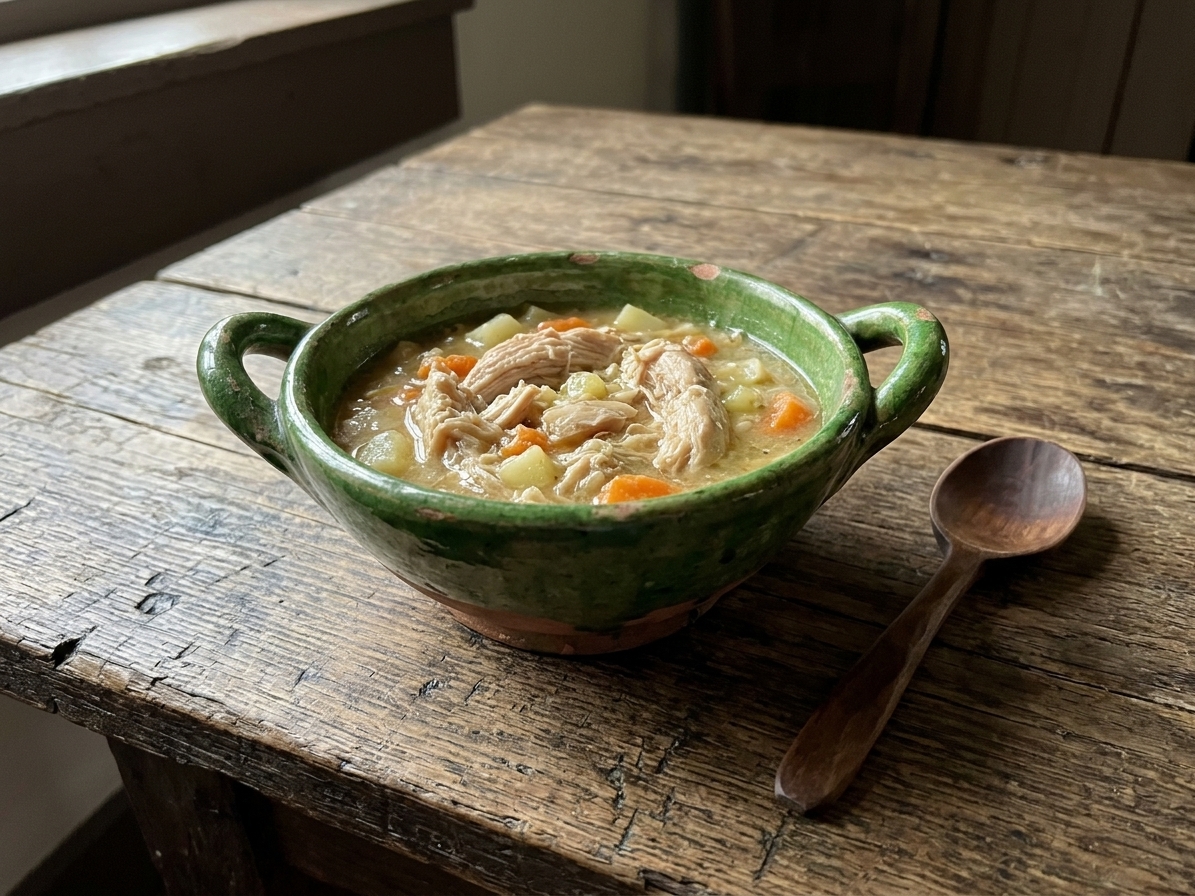
Authors photo placed in historically accurate setting using AI
She would have harvested root vegetables from the garden and simmered them in pots to make fricot, a traditional Acadian stew.
1705 Expropriation
Following the disaster in 1690 when Port Royal fell, at least in part due to the deplorable condition of the fort, and after Port Royal was returned to the Acadians by treaty in 1697, plans began to build a new fort.
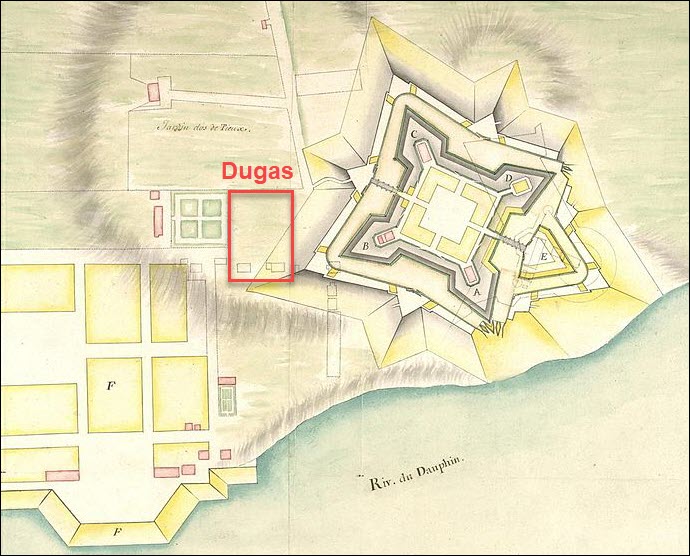
The remnants of the two older forts were to be incorporated into the new fort, but some of the lots owned by the original Acadian settlers needed to be expropriated to make room for the new construction.
This 1702 map, drawn by the King’s engineer, Pierre-Paul de Labat, in combination with the expropriation records that list the names of the people whose lots are being absorbed, their size and the amount they were to be paid allows us to identify where Abraham Dugas and Marguerite Doucet’s lots were located within Port Royal.
While Abraham was clearly deceased by this time, Marguerite was not, so she would have been the immediate beneficiary of the money paid for Abraham’s land and buildings.
We don’t know who was living in those structures in 1705, but based on the census and the land across Allain Creek, it wasn’t Marguerite and hadn’t been for many years. They had clearly moved across Allain Creek one of the times they had been burned out. Yet, there were two structures on the Dugas lots in Port Royal that abutted the fort.
This is where Abraham and Marguerite began their lives together.

Today, standing on George Street and St. Anthony, near the ditch by the rampart described in the expropriation document, we look across the rampart and parade ground of the new fort, past the garrisons where the older forts stood, at the river.
This is what Marguerite saw for the early years of her life.
This is the street where Marguerite grew up and where she and Abraham lived after they married.
This is where Abraham and Marguerite lived in 1654 when the English burned Port Royal the first time.
Marguerite’s son, Claude Dugas, signed a letter that he had someone write for him in 1705 that helps put this land in perspective. The translated letter stated that the proposed project “passes in the middle of his lands which he has enjoyed for sixty years.” Claude was only 56 years old in 1705. It was his father that had enjoyed that land for 60 years, beginning about 1645, not long after the first families arrived.
In 1705, Marguerite would have been grateful for the new fort to protect everyone, but I wonder what she thought about their original land being taken for the fort.
By this time, Marguerite was 80 years old, and she was probably relieved that the new fort would protect her still-living children, and their offspring. She probably cared little about physical things anymore.
A New Governor Arrives
Marguerite was living as peacefully as possible in her waning years, but tensions were rising again.
Everyone in Acadia surely experienced near-constant anxiety about what seemed certain to happen. They had seen this play out before, having been burned out by the English at least three times by now.
Daniel d’Auger de Subercase became governor of Acadia in 1706 and faced a depleted garrison, crumbling fortifications, and minimal supplies from Versailles during the War of the Spanish Succession (Queen Anne’s War). The colony faced acute shortages of food, clothing, and munitions, and he had to find a solution, or perish.
With little support from France and a colony left virtually defenseless against inevitable English invasion, Subercase chose to take the fight to the enemy before they could bring it to Port-Royal again. Determined to keep English forces occupied on their own soil and in a defensive position, rather than destroying Acadian farms, he adopted a strategy of aggressive defense.
Because France could not or did not send enough troops to defend Acadia directly, Subercase did what he could. He employed unconventional tactics, combining privateering at sea with Native alliances on the ground to disrupt New England’s ability to launch an attack on Port-Royal and to capture the goods desperately needed to keep the starving Acadian garrison and residents supplied.
Subercase’s tactics proved highly effective through Indian raids against the New England Colonies and privateering focused on English colonial shipping. Not only did he obtain the supplies Port Royal so desperately needed, the English fishing fleet along the Grand Banks was reduced by 80 percent between 1702 and 1707.
1707 – The Year from Hell
Four important events happened in Acadia in 1707, two of which are directly connected.
Like in earlier years, I’m not sure which came first, so let’s start with the census. This one is easy, because Marguerite isn’t listed. That’s not surprising, though, because she wasn’t listed in 1701 either, although she was definitely alive.
How do I know that?
Because the parish register tells us that she didn’t die until just before Christmas in 1707.
But first, she witnessed, for the fourth time in her lifetime, the near-total destruction of Port Royal.
It always started out the same way. Those dreaded English sails were spotted in the river, headed for Port Royal. Not one solitary merchant ship that had come to trade, but a fleet of warships bearing cannons. By now, everyone knew the rest of the story. The only remaining question was “how bad” it was going to be.
The first 1707 attempt by the English to recapture Acadia began in early June and lasted 11 days. Fortunately, the English commanders were both inexperienced and overconfident. Even though they came heavily prepared with more than 1,000 soldiers and 450 sailors, they could not land their cannons on solid ground close enough to fire upon the fort.
The local militia of about 60 Acadians joined the 100 or so French soldiers stationed at the fort, along with another 100 Abenaki Indians who had arrived for a visit just hours earlier. They had helped defend Acadia before.
The English tried to form a siege line around the fort, but they were too far distant. Looking at the terrain surrounding the fort, along with the commander’s records, we know that the English landed their ships too far west on the south side of the Riviere du Dauphin, which meant that their troops had to spend the day marching towards the fort. That meant they had to march straight through the Dugas and their neighbors’ lands, including their marshes along the river.
By this time in her life, Marguerite had lived through many of these “drills.” She probably knew exactly what to do and where to go. I’d wager that her son, Claude, made sure his mother, wife, and children were safe someplace before he and his older sons headed off to help defend the fort and Port Royal.

Based on a map drawn in 1708, and another a couple years later, Claude was living west of Abraham Dugas’s original land. Marguerite was probably either living with him, or with her grandson named Abraham Dugas, the son of her deceased son, Martin Dugas, who was living on the original homeplace across Allain Creek from the fort.

Based on what we know of that terrain, directly behind the Dugas land, South Mountain rises a mile or so across the marshes or through the woods. The earliest water mill was built there, and the woods would have sheltered and hidden women and children. The English wouldn’t have ventured that far away from the safety of their ships. Chasing women served no purpose.
After a chaotic council of war in which the various English commanders disagreed strongly, the English decided to retreat, but not before burning the town and slaughtering livestock. They had penetrated the settlement, but not the fort itself. It held because the English could not make use of their cannons.
Governor Subercase also ordered the clearing of brush and structures standing near the fort’s earthworks to prevent the English from using them as cover.
The English retreated and sailed out of the river, but they did not return to Boston. They knew victory celebrations were being planned, and they couldn’t face those expectant faces while returning in shame and defeat. Instead, they regrouped in Maine at Casco Bay, sending a letter to Massachusetts Governor Dudley.
Dudley was furious. He refused to allow them to return home and sent three council members to oversee the officers, along with 100 reinforcements. The men were confined to those ships in Casco Bay for weeks. Illness was rampant, morale plummeted, and conscripted men deserted.
For all the bad luck the English were experiencing, for a change, the Acadians were having a run of good luck.
Subercase fully expected the English to return – that was always an expectation at some level. He was using this reprieve to clear the rubble from the June destruction, continue to clear brush from areas near the fort, repair the fort’s earthworks where possible and build new defensive entrenchments.
Even better yet, our friendly French privateer Pierre Morpain sailed into Port Royal between the two English sieges with two captured prizes, bringing 340 barrels of flour, bacon, ham, and butter that restocked the garrison.
You might remember Morpain as the privateer who gifted one of those captured ships to Marguerite’s newly widowed granddaughter, Madeleine Melanson. That single act of kindness and compassion sustained Madeleine and her four young children, allowing her son Charles – then just 10 years old – to grow up as a skilled mariner who would one day lead the 1755 mutiny aboard the Pembroke, saving 232 Acadians from exile. It was the ultimate butterfly effect, reaching 48 years into the future.
Sure enough, in August 1707, Governor Dudley ordered the English ships to return and try to defeat Port Royal again.
Even with the reinforcements, the English only had about 850 soldiers this time.

Again, they landed about two miles west of the fort. What were they thinking? They knew exactly how difficult this march would be, especially hauling heavy cannons.
Commander Wainwright sent 300 men ahead to clear a road (through what, marsh?) and lay bundles of sticks or brush called fascines to stabilize soft ground.
Of course, the English soldiers had to cut the brush and saplings to make the bundles, which made them prime pickings for the French soldiers, the Acadian men and their Native allies.
In my mind’s eye, I can see Marguerite sniping at them from behind the outside stone oven which would have protected her from any return fire. Yes, I know she was 82 or so, but she was also Acadian.
In all fairness, the women and children might have been taken into the fort for safety.
As the English soldiers tried to make their way closer to the fort, Subercase and his men used guerilla tactics and ambush sniper techniques, pinning the English down.
For nine days the English lay under fire. When he finally could, Wainwright pulled back to his encampment and abandoned any plans to pull the heavy artillery through the swamp (duh).
Acadian militiamen and Wabanaki fighters kept the camp under constant sniper fire from the woods and dykes, prompting Wainwright to write that his men were “surrounded with enemies.” Yes, indeed you are. Enemies of your own making.
Snipers continued to push the English soldiers further west, until they fell back to a position where their ship cannons could cover them. That was probably near Ryerson Brook, the waterway shown as Dugas Creek on early maps. Still, the English could not resupply nor fortify that camp properly. The snipers, who knew the terrain like the back of their hand, moved with them, continuing to pick off men near the edges.
Those three English councilmen who had been sent to oversee the commanders pushed them to make one final stand. Let’s just say that did not go well.
Subercase had had enough, so he, along with 120 men, rode out of the fort and met the advancing English, engaging in fierce hand to hand combat. They fought with guns when they could, but they were too close and couldn’t reload, so they used their musket butts and axes as weapons. In many ways, their Native allies saved the day. In his report, Subercase recommended their leader for a royal commission as an enseigne for his conduct in the hand-to-hand fighting.
This brutal battle took its toll. More than 20 Acadian, French and indigenous men were injured, and five were killed. New England reported 16 killed and 16 injured, but the French reported around 200 losses for the English based on what they saw on the battlefield.
The English did not anticipate such spirited fighting or such difficult conditions. They turned tail and retreated, loading their injured and dead back onto their ships, and headed for the humiliation they faced in Boston.
As the final battle played out in the Dugas marshes and fields, Marguerite was assuredly listening from someplace, and probably praying the rosary. Her children and grandchildren were fighting, and their futures were what they were fighting for.
Sadly, one perished.
Burying the Dead and Coming Full Circle
The 1707 parish registers record two Catholic men who died during that battle, one of whom was Jean Belivue (Belliveau). He died and was buried on September 13 from a wound he received in battle.
Belliveau was the husband of Madeleine Melanson, 30, who was left a widow with four children to raise alone. The youngest was only 13 months old. She never remarried.
Madeleine was Marguerite Doucet’s granddaughter – the one who joined the mutiny on the Pembroke nearly 50 years later. Madeleine was a force to be reckoned with, earning the respect of hardened pirates and continuing as a femme forte. A strong Acadian woman, answering to no one except her own conscience.
It was probably the 1707 gift of the ship from the pirates that prevented her from “having to remarry” and allowed her to remain independent. Placide Gaudet, in 1922, wrote that her son, Charles, only 10 when his father died, became a ship carpenter and a good mariner.
Indeed, based on what he did in 1755, a very good mariner indeed.
Somehow, I suspect there’s more to this story than we’ll ever know.
The good thing that came from the raid, aside from the English rout, is that the following year, the King’s engineer, Pierre-Paul de Labat, drew maps detailing the destruction of the Acadian homes in Port Royal. That and a later 1710 map also included the homes up and down the river that we’ve been using as illustrations in Marguerite’s story.
Marguerite’s Death
Marguerite was elderly, and I’m sure she was tired. She had lived through and survived a lot. An awful lot!
Just three months later, the week before Christmas, Marguerite would depart this life.

Marguerite’s parish register entry says she died on December 19, 1707, and was buried the next day in the cemetery of the upper river at St. Laurent.

The left margin: The Widow Dugast
On the twentieth of December of the year one thousand seven hundred and seven, I, the undersigned, performing the parish functions at Port Royal in Acadia, buried with the customary ceremonies in the cemetery of the Upper River of the Chapel of St. Laurent the body of the Widow Dugast, mother of Claude Dugast, who died yesterday after having received all the sacraments with much edification. In witness whereof I have signed this present act on the same day and year as above.
(Signed) Brother Justinien Durand, Recollect Missionary

The exact location of the church and cemetery has been lost to time, but using the maps where it was marked and modern GPS technology, it’s either here or very near this location.
Marguerite’s winter burial far from her home on the west side of Port Royal probably goes a long way to answer questions about where burials occurred when there was no church in Port Royal. The church at the fort burned for the final time in 1690, so Abraham, her husband for half a century, is probably buried here too.
Marguerite’s poor granddaughter, Madeleine Melanson, a widow with four young children who had just buried her husband three months earlier now buried her grandmother less than a week before Christmas.
In Acadia, Advent was observed as a solemn season of fasting, penance, and quiet spiritual reflection, leading up to a midnight Mass on Christmas Eve. Given the dual English attacks, plus nearly all of Port Royal being burned, the mood would already have been quite somber.
Marguerite’s passing during this time would have been interpreted as spiritually profound.

Since Marguerite died the day before she was buried, her family would have gathered at the family home for an overnight wake. Because Advent forbade merriment, music, and rich feasting, the vigil would have been strictly quiet, reflective and devotional – centered around lighting candles, sprinkling holy water, and reciting the Rosary and the Litany of the Saints together through the long winter night.
Given her respected status as a matriarch and one of the original Acadian founders, and with her death occurring during Advent, her children and grandchildren would probably have observed a quieter Christmas, offering their Christmas Day communions and alms for the repose of her soul and that of her granddaughter’s husband as well.
While I’ve seen the phrase that Father Durand used, avec beaucoup d’édification – “with much edification” – before, it has particular relevance for Marguerite. It means that the deceased accepted her final sacraments with deep religious devotion, peace, and grace, serving as a spiritually inspiring example to those around her. In this case, after those horrific battles and fires, her life and death would serve as a reminder of mortality and readiness for judgment.
As I reflect back across Marguerite’s life, that description, “serving as a spiritually inspiring example,” written by a man of the cloth who knew her, right before one of the holiest of days, is certainly better than anything I could pen.
When we consider the few records we actually have about Marguerite, scattered censuses and her death, it’s easy to neglect the balance of her life because there are no records available.
There’s actually a lot of information we can glean about Marguerite. Births, deaths, funerals, battles, fires times four, children, betrayal, scandal, a child and grandchild marrying outside the faith that was clearly incredibly important to Marguerite, and another who seemed stronger than everyone else. We can even determine where Marguerite lived, prayed, walked, and was buried.
Marguerite’s life began in an unknown place in France. She sailed the wild Atlantic. Her parents died too soon, when, as a young person, she still needed them. Her uncle was sent back to France. After watching him board that ship, with her home in ashes, Marguerite turned around, alone, to face whatever she must.
Marguerite lived for more than eight decades and across that span of time, served as an inspiration many times over to those around her. Perhaps even to that independent granddaughter whose son, Charles, led the mutiny of the Pembroke, and maybe to Charles himself.
Now that we know Marguerite better, she can serve as an inspiration to us too.
_____________________________________________________________
Share the Love!
You’re always welcome to forward articles or links to friends and share on social media.
Subscribe!
If you haven’t already subscribed, it’s free. You’ll receive an e-mail whenever I publish by clicking the “follow” button at the top of the main blog page, here.
Help Keep This Blog Free
I receive a small commission when you click a vendor link in my articles and purchase that item. This does NOT increase your price but helps me keep the lights on and this informational blog free for everyone. Please click on the affiliate links in the articles or to the vendors below if you are purchasing products or DNA testing.
Thank you so much.
DNA Purchases and Free Uploads
- FamilyTreeDNA – Y-DNA, mitochondrial and autosomal DNA testing
- MyHeritage DNA – Autosomal DNA test
- AncestryDNA – Autosomal DNA test
- AncestryDNA Plus Traits
- 23andMe Ancestry – Autosomal DNA only, no Health
- 23andMe Ancestry Plus Health
Genealogy Products and Services
- MyHeritage Subscription with Free Trial
- Legacy Family Tree Webinars – Genealogy and DNA classes, subscription-based, some free
- Legacy Family Tree Software – Genealogy software for your computer
- OldNews – Old Newspapers with links to save to MyHeritage trees
- MyHeritage Omni comprehensive “everything included” subscription plan
- Newspapers.com – Search newspapers for your ancestors
- NewspaperArchive – Search different newspapers for your ancestors
My Books
- DNA for Native American Genealogy – by Roberta Estes, for those ordering the e-book from anyplace, or paperback within the United States
- DNA for Native American Genealogy – for those ordering the paperback outside the US
- The Complete Guide to FamilyTreeDNA – Y-DNA, Mitochondrial, Autosomal and X-DNA – for those ordering the e-book from anyplace, or paperback within the United States
- The Complete Guide to FamilyTreeDNA – Y-DNA, Mitochondrial, Autosomal and X-DNA for those ordering the paperback from outside the US
Genealogy Books
- Genealogical.com – Lots of wonderful genealogy research books
- American Ancestors – Wonderful selection of genealogy books
Genealogy Research
- Legacy Tree Genealogists – Professional genealogy research
Share this:

Discover more from DNAeXplained - Genetic Genealogy
Subscribe to get the latest posts sent to your email.