
Guillaume Blanchard was born about 1650 in Port Royal to Jean Blanchard and Radegonde Lambert.

In 1650, the first settlers hadn’t yet been granted land upriver at Belle Isle, so Guillaume would have been born here, in Port Royal, where his parents had been settled for at least a decade. But not settled peaceably.
Acadia was in the midst of its own Civil War where two Frenchmen, Charles La Tour, a Protestant, and Charles de Menou d’Aulnay, a Catholic, fought over who was going to be the administrator of Acadia.

After a 1645 battle, it seemed that question was settled. La Tour was defeated, his wife, who led the defense of La Tour’s fort in his absence, was murdered, and d’Aulnay was in charge of Acadia, with Port Royal as its capital.
Signed. Sealed. Delivered. Right?
D’Aulnay began dyking and draining the 1500 acres of salt marsh at Belle Isle, upriver of Port Royal. Note that Belle Isle is spelled Belleisle today.
However, in 1650 d’Aulnay drowned in an accident, and La Tour returned.
The Acadian men at Port Royal had all been involved in the destruction of La Tour’s fort across the Bay at St. John in 1645, the execution of all of his soldiers, and the death of his wife, so La Tour’s return from exile must have made everyone’s blood run cold.
What would he do? Would La Tour seek retribution?
And of course, Guillaume Blanchard was born in the midst of this upheaval.
Following the death of Governor d’Aulnay in 1650, Emmanuel Le Borgne (Senior), d’Aulnay’s principal creditor, claimed seigneurial rights due to the large debt owed. Le Borgne initially sent representatives to collect, including his son by the same name, but arrived himself in 1653 with a force of armed men to seize d’Aulnay’s estate to satisfy the debt.
Between 1651 and 1654, Le Borgne (Junior) began distributing land allocations upriver at Belle Isle to Acadians. This prime real estate was highly sought after because the salt marshes had already been dyked by d’Aulnay, offering substantially larger fields and a much safer agricultural alternative to the exposed waterfront at Port-Royal.
We don’t know exactly when Le Borgne granted what to whom, in part, because he was known to tipple a bit too much and when inebriated, he granted the same land to multiple people. He was later accused of withdrawing documents that would have incriminated him.
Guillaume was too young to remember any of this, or what came next, but he would have heard the stories as he grew up.
Including this unbelievable tale!
The Most Unlikely Marriage EVER
Are you ready for this?
Sit down.
On February 24, 1653, La Tour returned to Port Royal and married d’Aulnay’s widow, Jeanne Motin. So, yes, La Tour married the widow of the man who executed all of his soldiers, contravening the surrender terms negotiated with his wife before she then “died” after being forced to stand on the scaffold and watch the men hang.
La Tour and Motin sought to unify Acadia, both militarily, politically, and financially.
How well the financial part worked is certainly disputable. La Tour inherited d’Aulnay’s debts, and in August 1653, Le Borgne (Senior) arrived from France with his own brigade of 100 armed men, fully intending to seize d’Aulnay’s lands by force. His own personal brute-force militia terrorized and seized other Acadian forts not associated with d’Aulnay, imprisoning their commanders. Then in August 1653, he forced Jeanne Motin, under duress, to sign a document stating that 206,286 livres were still owed to him.
One benefit to Motin of the marriage was that La Tour became a partner in the fight for d’Aulnay’s lands, complicating the situation for Le Borgne. Jeanne was a “defenseless widow” with eight children, while La Tour was the newly-restored Governor of Acadia. To protect them, Jeanne moved her children to La Tour’s fort across the river, the same fort d’Aulnay had destroyed in 1645. No irony there, but it gets better.
In the greatest of all ironies, Jeanne’s first child with La Tour, Marie, born the following year went on to marry Alexandre Le Borgne about 1675, the chaotic wine-loving son of Le Borgne (Senior).
All of that aside, it’s a good thing that La Tour and Motin healed old wounds and rifts that still haunted the community, because in July of 1654, the English attacked, and Acadia needed to be unified.
We know that the Blanchard family was somehow a beneficiary of the land grants at Belle Isle. However, in 1654, when the English arrived, it’s unclear whether Jean Blanchard and family were still living along the waterfront in Port Royal, beside the fort, or if they had received land at Belle Isle, built a home and already moved upriver.
Things were about to get messy. Very, very messy.
1654
La Tour, Jeanne Motin and her children were living at his fort across the Bay at St. John.
On July 4, 1654, English Colonel, Robert Sedgwick, out of Boston, sailed into the Bay. Before approaching Port Royal, he first stopped at Saint John and captured the unsuspecting La Tour.

Sedgwick then sailed across the Bay, into the river basin, and on to Port Royal where Emmanuel Le Borgne Senior, then governor, was quite friendly with the English. Too friendly. Friendly to the point of being accused of treason.
Sedgwick, with a total of about 733 soldiers laid siege to Port Royal, whose 133 soldiers attempted unsuccessfully to defend both the fort and the town.
On August 8th, the siege ended. Le Borgne surrendered with terms that were “very” generous to the English, and to himself. By this time, 113 Acadians were being held captive by the English, along with 23 cannons, 500 weapons, 50 barrels of gunpowder, and Le Borgne’s own ship, the Chateaufort, which was loaded to capacity with alcohol.
In the surrender conditions that Le Borgne himself had negotiated, he was allowed to keep his ship, plus the alcohol, which was quite valuable, and return to France. His sons were allowed to remain at Port Royal “as hostages” to watch over his property in Port Royal and elsewhere in Acadia, which he was also allowed to retain.
Acadians accused Le Borgne of treason and blamed him for the capture of Port Royal and the ensuing savagery that befell them at the hands of the English. Was this attack truly unexpected, as portrayed, or was it coordinated by Le Borgne?
After the surrender, and contrary to the terms, Sedgwick’s men were unleashed and tore through Port Royal, plundering for spoils, defacing the church, smashing its windows, floors, and paneling before burning it, and then killing the settlers’ livestock just because they could.
Guillaume would have been about four years old at that time. If his family was still living in Port Royal, he would have assuredly remembered the rampaging soldiers and fires. In fact, it could well have been his first memory – one that he carried for life.
If their home burned in Port Royal, they would have moved to Belle Isle immediately, having little other choice.

Based on a reconstruction of the original Port Royal landowners due to a 1705 expropriation of their original lands when the fort was expanded, we know where Jean Blanchard’s land was located in Port Royal.
The original fort is labeled as 1 in Nicole Barrieau’s 1994 thesis, and subsequent forts expand on the original boundaries.

Here, Jean Blanchard’s land is drawn on a current aerial of the present-day fort, with the location of the church and cemetery marked as well. Guillaume’s family lived just 500 feet or so away from the church that went up in flames, just a two-minute walk.
How terrifying for a child. Let’s hope they had already transitioned upriver.
Sedgwick and Le Borgne’s handiwork would not be undone for another 16 years, in 1670, after Acadia was returned to French control through the Treaty of Breda. One of the first things the French did was to order a census. Thank goodness for Acadian descendants that they did!
Life at Belle Isle
In the 1671 Port Royal census, Guillaume is living with his parents and, at 21, is the eldest child living at home. They are enumerated in the Belle Isle community, 15 miles or so east of Port Royal, between Belle Isle and Bridgetown.
Guillaume married Huguette Gougeon around 1672, when he was about 22, which was somewhat young for an Acadian groom.

In the 1678 census, Guillaume and Huguette are living with his parents in a blended household, along with their 3 children – two boys and one girl. The family lives on 6 arpents of land, with 17 cattle and one gun.
By 1686, Guillaume is recorded as 35, Huguette is 27, and they have five children, two boys and three girls.
- Marie – 12 (so born 1673)
- René – 8 (so born 1678)
- Antoine – 6.5 (so born 1679 or 1680)
- Jeanne – 5 (so born 1681)
- Anne – 2 (so born 1684)
It looks like they have lost at least two children
The family is living on 5 arpents of land with 16 cattle and 20 sheep in the LeBlanc community at Belle Isle. They live next door to Guillaume’s parents who are elderly. His father, Jean, is 75, and his mother, Radegonde, is 65. Clearly, while they are residing in different houses, they are living on the same farm, and Guillaume is working the land.
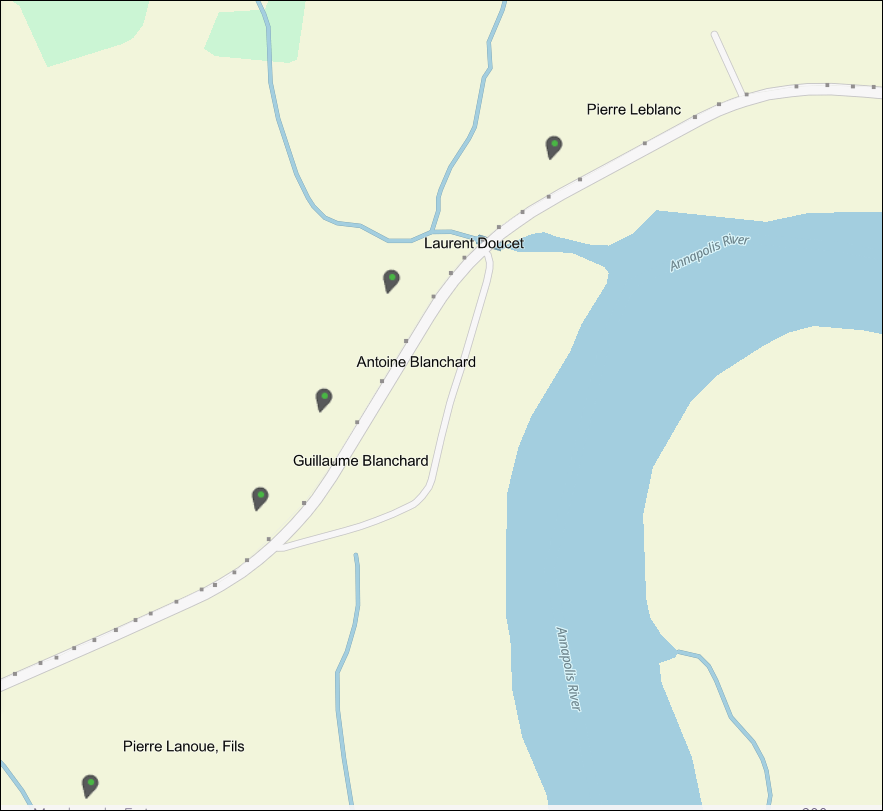
MapAnnapolis has mapped the Acadian homestead locations along the river based on censuses, early maps, and other information.
Taking a drive along Highway 1, also known as Evangeline Trail today, where it intersects with Marshland Road, the old homesteads are long gone, burned by the English in 1755, but the land remains substantially the same.

It was right about here that Guillaume Blanchard grew up, sharing a home first with his parents, then with his wife and children.

This landscape is timeless. The Blanchard’s stream still flows, running from the mountains north of the river, beneath Evangeline Trail, visible in the distance, and towards Marshland Road.

This freshwater stream sustained the families of Guillaume Blanchard and his brother Antoine, along with their parents before them. I can feel their souls here.

Standing on Marshland Road, and turning around to face south, we can catch glimpses of the Annapolis River today. It was the Rivière du Dauphin then.

The tranquil beauty belies the upheaval that occurred here three centuries ago.

When Guillaume lived here, the dykes d’Aulnay built and his father maintained held back the river’s salty water. Looking across the wheat fields between his home and the river, Guillaume could see the mountains behind the Girouard land on the south side of the Annapolis River. One of his daughters would marry into that family one day.
Guillaume lived most of his life here at Belle Isle, in the Annapolis River Valley, and probably died here as well.
1690 – Terror at Port Royal
Tensions in Acadia and the colonies in general began to ramp up again when the Nine Years’ War began in 1688 in Europe. The following year and early in 1690, the French capitalized on this turmoil to launch raids with their Native American allies along borders with New England and New York.
After the fall of Fort William Henry at Pemaquid in August of 1689, the English not only sought to retaliate, they also wanted to capture Acadia. Additional 1690 raids spurred a public outcry in New England, and the Massachusetts government authorized a raid against Acadia.
Boston merchant John Nelson had extensive trade dealings with the Acadians, but now he was one of the major proponents of an attack. He offered to lead the expedition but was rejected because of his previous trade relationships.
Ironically, he apparently had been scheming against the Acadians all along. It was John Nelson whom Acadian Jacques Bourgeois had entrusted with all of the Acadian land titles granted by d’Aulnay. Nelson took them to Boston, ostensibly to have them bound, but he never returned them and tried to claim Acadia for himself in 1692. Apparently, the English didn’t trust Nelson, and the Acadians shouldn’t have.
The expedition’s command was finally awarded to Sir William Phips, who, ironically, also had extensive trade dealings with Acadians – Jacques Bourgeois, in particular.
Phips was a Maine native who had no military experience, but who did have motivation. He had survived the French and Wabanaki raids that destroyed his hometown near Portland, Maine during the First Abenaki War in 1676.
In March 1690, Phips was commissioned, and on April 28th, he sailed out of Boston Harbor, bound for Acadia. His flagship, the Six Friends, was mounted with 42 cannons. A total of five ships carried 446 troops plus another 288 sailors and local men.

Eleven days later, Phips entered the basin of the Rivière du Dauphin, stopping at the home of the French Huguenot, Pierre Melanson, who was bilingual and known to be friendly with the English. Phips inquired of Melanson as to the condition of Port Royal, and the fort.

At some point, a sentry, possibly at present-day Digby, alerted Governor Meneval at Port Royal that the English fleet had entered the river.
The fleet spent the night anchored in the river at Melanson’s before pulling up anchor the next morning and proceeding to Port Royal, a few miles upriver, and anchoring there.
After his visit with Melanson, Phips clearly knew of the deplorable conditions at and of the fort, and he must have been thrilled.

Phips could clearly see from his position anchored in the river, in front of the fort, that there were no cannons mounted. This may, drawn in 1686, shows the fort in such poor condition that you can’t even tell it’s a fort.
Phips may or may not have known that there were only 90 soldiers stationed at the fort, which meant the English outnumbered them ten to one. Worse yet, if it could be any worse, only 70 soldiers were there, and the garrison’s soldiers only had 19 guns among them. They were doomed.
If you added every able-bodied Acadian man and their 71 guns to that total, the English soldiers still badly outnumbered and outgunned the Acadians.
Not to mention that the fort had been allowed to deteriorate to the point where it was essentially indefensible.

Phips didn’t even bother firing. He simply demanded that the fort, and Port Royal, meaning Acadia writ large, surrender.
Governor Meneval sent the Catholic priest to negotiate for the best terms possible – essentially to spare the lives and property of the soldiers and residents.
Phips agreed verbally, but the following day when Meneval boarded the Six Friends to sign the agreement, Phips refused.
One way or another, the fate of Acadia, and the Acadians now rested with Phips, and Meneval had no choice but to trust him at his word.
As it turned out, Phips’ word was worthless, and the resulting attack was brutal.
Contrary to his promises, he unleashed his soldiers on the town the following day, where they rampaged through town, plundering as they went. They stole what they could and burned the rest.
What the English did not do was travel upriver beyond Port Royal. That would have required them to leave the safety of their nearby ships in the harbor and fan out into unknown terrain. That was much more risky.
Safety at Belle Isle
In 1690, Guillaume was 39 or 40 years old and had nine or 10 children. Thank goodness his father had moved upriver and settled at Belle Isle in the 1650s when Guillaume was a child. Their location was the only thing that prevented their farms from being burned.
The upriver Acadians were warned about the imminent danger when Governor Meneval discharged the cannon to call the Acadian men to his aid at the fort. Meneval clearly knew he was in trouble.
Unfortunately, 42 Acadians were absent, and Meneval reported that only three Acadian men came to the fort to assist, which sounds absolutely bizarre. Perhaps they were preparing to defend their own farms and families.
Perhaps they wondered if they were walking into a trap by the English.
Maybe they knew the fort, which was in the process of being torn down to be rebuilt, could not be defended, and they weren’t interested in being slaughtered there.
We will never know, but Meneval’s hands were tied. He must have been furious with France, who had allowed her fort and defenses to decay, in spite of his repeated requests, and furious with the Acadian men for essentially abandoning him. Maybe the Acadians felt that France had abandoned them and they weren’t willing to intentionally risk their lives. I wish we knew more, specifically which Acadian men went to the fort, prepared to fight regardless.

Fortunately, Belle Isle was somewhat sheltered by being several miles upriver, beyond Port Royal and the bend in the river beyond which large ships could no longer navigate.
At Belle Isle, the Acadians lived behind the marshes, and in front of the mountains that separated the Annapolis River from the Bay of Fundy.

The mountains north of Guillaume’s lowlands provided safety and a refuge in time of need. A place where the English would not have known how to navigate, or where to find them.
The Oath
At some point, Phips and his soldiers either summoned or rounded up the Acadian men. They were probably held in the church or the fort where they were forced to sign a loyalty oath to the English crown. This document made its way to Boston, of course, where I found it in the Massachusetts Archives in 2008. The 1695 date threw me for a minute, but later correlation with the 1686 census, the oath signatures, the 1693 census, and known deaths confirm that, indeed, this is the 1690 document.
The only men missing were the very elderly, who the English wouldn’t have been terribly worried about causing a ruckus.
On the 1690 oath document, Guillaume Blanchard made his mark that looked something like a “P,” which tells us that he could not write. It says, “Marque de “P” Guillaume Blanchard”, where P is his mark made by his own hand.

Guillaume’s parents, Jean Blanchard and Radegonde Lambert, were living on the same land at Belle Isle with him in the 1686 census, and both were absent in the 1693 census. Jean Blanchard’s signature is missing from the 1690 document. If living, he would have been about 80 years old.
At least Guillaume didn’t have to load his very elderly father into a cart or a canoe and transport him to Port Royal to sign that cussed oath.
It was bad enough that Guillaume and his brother, Martin, had to sign.
The English left, but only a few weeks later, as the Acadians were trying to recover, English pirates attacked, killing the rest of the livestock and taking what little Phips’ men had missed the first time around.
1693
In the 1693 census, Guillaume, 42, is living with his wife whose name is spelled Agate Goujon, 37, and their nine children. Their oldest daughter, Marie, 19, is married to Charles Bourgeois, and they live with Guillaume and Agate. Both couples have a 1-year-old baby. They live on 30 arpents of land and own 30 cattle, 40 sheep, 15 hogs, and 3 guns.
We don’t know when Guillaume’s parents passed away, but they are gone by 1693 and were probably buried in the nearby churchyard of the St. Laurent Church.
Interestingly enough, Guillaume’s daughter, Marie, and her husband Charles Bourgeois were also listed in the Beaubassin census with their daughter, Marie, 4 months. Beaubassin, the next frontier, only had 20 families living there, with a total of 119 people. This tells us exactly when they relocated.
1698
Five years later, in the 1698 census, Guillaume is shown as 48, and Huguette is shown as 47. She was actually closer to 42.
Their 10 children still living at home range in age from son René at 22 to Charles who is listed as ½. They are living on 34 arpents of land with 26 cattle, 24 sheep, and 12 hogs. Guillaume owns 3 guns, and they have 12 fruit trees.

Their neighbor is Laurent Doucet.
By now, two of their daughters have married and removed to Beaubassin, and the rest of the family was considering pulling up stakes too.
1698 and 1699 were watershed years, filled with hope.
The Next Frontier

In July of 1698, Guillaume Blanchard and fellow Acadian Pierre Thibodeau, the miller who lived across the river at Pre Ronde, set out on Blanchard’s boat for what would one day become Chipoudy. Pierre had visited once before and may have already begun dyking marshes there.
The fact that Guillaume had his own boat tells us that he was among the more well-to-do. Not everyone had a boat.
Two of Guillaume’s sons accompanied them as they explored along the Petitcodiac River before returning to Port Royal a few months later. The two sons must have been Guillaume’s eldest, René, who would have been 20 or 21, and Antoine, the next-born child. Neither were married and both lived at home.

Given that both the Petitcodiac River, which empties into Shepody Bay, and the Minas Basin, marked with red stars above, are tidal estuaries, they likely explored both areas looking for the best, as-yet-undeveloped candidate location for a new settlement. Both estuaries suffer from extreme twice-daily bore tide surges. The tide at Les Mines rises suddenly from 46-53 feet, the highest in the world, and at Petitcodiac from 36-46 feet.
Several locations in the Minas Basin (Les Mines) had already been settled, beginning in the early 1680s.
Upon their return, the men would have been full of good news and encouraged their fellow Acadians to consider establishing themselves on the next frontier where land was plentiful and there were no English overlords to harass them.
Village des Blanchard
Guillaume Blanchard returned in late 1699 and founded “Village des Blanchard,” along the Petitcodiac River at or near Hillsborough, NB.

The Petitcodiac River, known colloquially as the Chocolate River, is heavily tidal, with marshes very similar to what the Acadian families had been dyking and farming at Belle Isle. Belle Isle had a tidal rise and fall as much as 25 feet, but minus the dangerous bore tides.

It takes three years after dyking the marshes with aboiteau for the salt to leach out of the soil and the land to become farmable.
Therefore, the Acadians would have needed to select land and invest the labor and time to dyke the land, then wait for three years to build homes and move their households.
In the meantime, they could have maintained some livestock there and traded with the Native people, but not farmed. It wasn’t yet hospitable to families, but sons in their early 20s would be the perfect people to begin transforming marshes into farmland, and molding homesteads from wilderness.

Hopewell is at Shepody Bay, just south of Hillsborough, and this entire area along the river is conducive to salt marsh farming. The fields are evident by the color change.

In 1755, the Battle of Petitcodiac was fought at Village des Blanchard, today’s Hillsborough, NB, where salt marshes line both sides of the river.

This 1755 map shows the location of Village des Blanchard and the Thibodeau village at Chipoudy.
1699
In 1699, after the fall harvest was in, a group of men from Port Royal set forth to establish the next Acadian village.
On November 1, 1699, an extract from a letter from Mathieu de Goutin concerning the founding of Chipoudy says, “Guillaume Blanchard and other settlers from Port-Royal came here two days ago to take up grants …”
Obviously, the men were on a scouting mission, evaluating locations to establish a community similar to Belle Isle.
Not quite two months later, on December 27th, another extract discussed the chartering of a ship by Guillaume Blanchard to his associates Jean Labat and Christophe Cahouet, at a rate of thirty livres per month.
Labat and Cahouet were business mariners focused on trade, such as transporting furs, timber, and provisions. Blanchard was laying the foundation for a profitable future for his new settlement.
Guillaume established a small village at Petitcodiac, reportedly eventually settling two sons and a daughter with her husband there. Guillaume and Pierre returned to Port Royal, but Guillaume returned to Village des Blanchard in both 1700 and 1701 when his sons, daughter, and son-in-law spent the winter.
It’s easy to surmise that the two sons left by Guillaume to overwinter were René and Antoine, his eldest.
Identifying the daughter and son-in-law is more challenging and less evident.
- Guillaume’s oldest daughter, Marie, born about 1674 had been married to Charles Bourgeois since about 1692, and they were already established in Beaubassin. Did they uproot and move to Petitcodiac? It’s unlikely, but we don’t know for sure.
- Guillaume’s second-oldest daughter, Jeanne, married Olivier Daigre on August 8, 1700, and their first child was born about 1701. Did they strike out and settle on the frontier with no midwife when they were either expecting a baby or with a newborn? I’d judge that to be unlikely.
They are shown in the 1701 census in Port Royal, but we don’t know when that census was actually taken. Their next child was baptized in August 1703 at Port Royal.
That said, it’s certainly possible that Olivier went with Jeanne’s brothers, and Jeanne stayed with her mother at Belle Isle to deliver her child.
- Guillaume’s third daughter, Anne Blanchard, married Claude Bourgeois around 1701, when they are shown at Beaubassin in the census alongside her sister, Marie, and her husband, who was Claude’s brother. In other words, Blanchard sisters married Bourgeois brothers. Did they go to Petitcodiac? Their first known child was born about 1704, so we can infer that their first child died.
Both Marie and Anne are shown in the 1703 census in Beaubassin, and Jeanne is living in Port Royal, so which daughter was established at Petitcodiac, even for one winter, cannot be determined.
By 1702, some of the land was arable, and the colony became permanent as settlers began to stay over the winter there instead of returning to Port Royal.

The dykes still restrain the brackish water and the bore tides today. A small dirt road runs between the dyke and the fields, while the houses are located far from the river. This dyke on the left could well have had its genesis in one of the original dykes built by Guillaume, his sons, and son-in-law.
They invested back-breaking labor and believed they were building a rosy future here.
The Early 1700s Censuses
In 1700, Guillaume Blanchard, 49, and Huguette, called Agathe, 45, are living at Port Royal with their eight children.
- René – 23
- Antoine – 21
- Jeanne – 18
- Anne – 16
- Elizabeth – 11
- Jean – 13
- Guillaume – 10
- Madelaine – 8
Their two youngest children are not listed, but based on later records, had not died.
Their daughter, Marie, with husband Charles Bourgeois, is living in Beaubassin.
The 1701 census is somewhat confusing. Guillaume, 52, and Huguette, 46, are living at Port Royal with their children on 20 arpents of land. They have 25 cattle, 25 sheep, 17 hogs, and five guns. One man by the name of René Blanchard, has married and is living at Riviere St. Antoine (Les Mines). However, René Richard, age 23, is living with Guillaume and Huguette in Port Royal, as is their son, Antoine, so those boys aren’t settled at Petitcodiac yet. The René Blanchard married and living in Les Mines is not their son.
The 1703 census is much less detailed than the earlier censuses and only gives the name of the head of household, with family members counted by sex. Guillaume is listed in Port Royal with his wife, six boys, two girls, and five arms bearers. If this is accurate, there’s an unknown boy living with them.
The same René Blanchard that was listed at St. Antoine in 1701 is listed in 1703 at Les Mines. Petitcodiac does not appear to be included, or if it is, it’s listed in a broad category. Or, maybe something else is happening.
The new colony at Petitcodiac may not have been included in the census, but the settlers had been noticed, and trouble was looming on the horizon.
Land Challenges
Maybe, just maybe, Guillaume Blanchard spoke too highly of Petitcodiac when he returned to Port Royal. Their settlement came to the attention of the Seigneur of Beaubassin, who claimed all the land was his and threatened legal action for trespass.
Claude-Sébastien de Villieu threatened to file suit on behalf of his wife’s father, Michel Leneuf de La Vallière, who lived at Beaubassin. La Vallière claimed Chipoudy, settled by Thibodeau, and the Petitcodiac settlement founded by Blanchard, as part of his seigneury.
Apparently, Blanchard and Thibodeau initially tried to negotiate, but Villieu refused, so Thibodeau and Blanchard applied to Paris for their own seigneury. Despite the dispute, building and land preparation continued. One report said that a mill had been built with materials out of Boston, probably by Thibodeau since he was a miller at Port Royal.
On October 2, 1702, a report by Mathieu de Goutin, Thibodeau’s son-in-law, concerning the founding of Les Mines, requested that Guillaume Blanchard be granted a half league on either side of the Petitcodic River:
“The said Blanchard has a sailing vessel, and grown sons, sons-in-law, and nephews, who will put the Petitcoudiac land along the Petitcoudiac River to use and will settle there many people, and in three years the colony will draw support from them.”
This request was for a massive amount of land. A French league equates to about 2.42 miles, and a half league is about 1.21 miles. This means that Goutin was requesting half a league on both sides of the river, with no specification for a restriction on distance. The agricultural buffer zone would straddle the river, ensuring that the Village des Blanchard controlled the rich, dykable tidal marshes on both shores.

Guillaume Blanchard had chosen well. On this map of the Petitcodiac River, the white areas along the riverbanks are salt marsh fields. The area near Hillsborough has deep marshes on both sides of the river. The marshes extend even further north to Moncton, while Chipoudy, where Thibodeau’s village and mill would have been located, was on the Cape to the south. Both are outside the picture.
By 1702, there were 7 families with 33 people at Shepody, and 5 families with 13 people at Petitcodiac. Villieu realized the settlers were dug in and had every intention of staying. Now, Villieu was ready to negotiate, but Blanchard and Thibodeau were not, because they were requesting their own seigneury.
Finally, on March 20, 1703, a royal decree was issued from the Conseil d’État in Paris that tried to balance both sides. It stated that the Acadian settlers could retain possession of the land and improvements, a “censitaire du seigneur,” essentially tenant farmers with the right to pass the tenancy of the land to their descendants. But it also established that La Vallière was to have seigneurial rights over the land.
This meant that neither Thibodeau nor Blanchard could grant rights to land to new settlers, could not collect rents, and had to obey the legal jurisdiction of La Vallière’s estate.
A 1705 decree restated the same. Pierre Thibodeau died in 1704, before the final decree. Guillaume Blanchard was about 55 by this time.
This was not at all what Guillaume and Pierre had in mind, and La Vallière’s successful claim destroyed their hope of obtaining seigneurial rights for themselves and their descendants.
Guillaume’s dream was crushed. Those rich farmlands would never be his.

The Blanchard family refused and returned to Belle Isle. Eventually, future generations, including some Blanchard descendants, would settle the Village des Blanchard where Guillaume first sank roots.
Even without the Blanchard family, Petitcodiac had been born and eventually thrived. By 1734, there were 65 families distributed on the Shepody, Petitcodiac, and Memramcook Rivers, and by 1750 the population had more than doubled.
In 1752, two Blanchard families are listed at Petitcodiac, three at Chipoudy, and six at nearby Memeramkook.
However, in the early 1700s, conflicts with the English that escalated into attacks slowed settlement even further.
We don’t know exactly when the Blanchards returned from Petitcodiac, but based on what we do know, I suspect it was either before or shortly after July of 1704 when Benjamin Church attacked.
I doubt that Guillaume ever returned.
Queen Anne’s War
With the outbreak of Queen Anne’s War between England and France, the small French colonial settlements like Port Royal, and the even smaller settlements like Beaubassin and Petitcodiac became English targets.
In 1704, the English set out to punish the Acadians for their attack, along with their Native American allies, on Deerfield, Massachusetts, killing dozens and taking more than 100 captives.
Furious, the Governor of Massachusetts recruited the notorious pirate, Colonel Benjamin Church, who had at his disposal a massive fleet of ships ranging from warships to fishing boats.
If they could not destroy the Acadians, they would starve them out.
It began on July 2nd, before dawn, when two English warships and seven smaller transport vessels slipped into the Port Royal Basin from the Bay. They captured the sentries on guard at or across from Goat Island and proceeded on to Port Royal, undetected.
Church captured the family of bilingual Charles Melanson (the younger) on the north shore of the river and sent his wife, Marie-Jeanne Bourg, as an emissary into the rebuilt stone-and-earth fort to relay his surrender demand to Governor Jacques-François de Monbeton de Brouillan.
The Acadians had no way of knowing that Church had instructions not to attack the fort, since London had not authorized the retaliatory expedition.
Brouillan flat refused to surrender, so the next 17 days were spent in a standoff. The French soldiers waited inside the fort for an attack that never came. Instead, Church simply waited, his warships on full display, anchored threateningly in the river.
For Church’s actual purposes, a blockade was perhaps even more effective, because it pinned down the French soldiers and many Acadians, while the rest of his flotilla moved on to even more-vulnerable targets.
Church rained destruction and fire on the secondary Acadian settlements: Grand-Pré, Pisiguit, Beaubassin, Chignecto, Petitcodiac and Chipoudy.
The Destruction of Petitcodiac and Chipoudy
In his 1716 memoirs, Benjamin Church described what he saw at Chipoudy and what happened there and at Petitcodiac.
Realizing he faced extreme tides, Church split his forces into smaller whaleboats to better navigate the rivers.
Church wrote that as they approached Chipoudy, they spotted a few Frenchmen and an Indian guide on the shoreline and immediately pursued them into the woods.
He recalled that the settlers had built their homes and outbuildings with distinct frontier craftsmanship. Following his orders to “leave no habitation standing,” his New England privateers systematically went house-to-house, torching them all.
Church specifically boasted about burning the newly constructed homes and barns at Chipoudy and that the inhabitants fled into the woods or marshes rather than barricading themselves in their homes.
He then detailed moving on upriver where the Blanchard Petitcodiac settlement would have been. He recounts killing their cattle and sheep, destroying their homes, and tearing down the dykes, allowing the salt tides to wash back over the land. He bragged that it gave him great satisfaction to break the “substance” of “the French” inhabitants, systematically destroying everything, hoping to also neutralize the assets of their allied “Indian Rebels.”
Quite a lovely man he was.
All I can say is that I’m glad the Acadians ran for the woods, because if Jeanne Blanchard was Guillaume’s daughter who was living there and she had chosen to barricade in her home, I wouldn’t be here today.
If three of Guillaume’s children had died on the new frontier, he would never have forgiven himself.
Back at Port Royal
After Church’s dastardly deeds leveling the Acadian outlier communities, he returned to Port Royal, where he withdrew after a minor skirmish. The Port Royal Acadians would have heaved a huge sigh of relief, but their families in the remote settlements were devastated. Their fields and dykes were ruined, and their homes burned. Many flooded back to Port Royal for safety and survival, and to somehow start over – again.
As soon as Church departed, I’m sure Guillaume Blanchard immediately headed for Petitcodiac to rescue his family and the other settlers. What he found probably made him sick. The years of investment, now all gone – but at least his children were alive. He hugged them and headed home, back to the safety of Belle Isle. I can’t help but wonder if everyone lived. Could this be a clue about what happened to Anne Blanchard’s first child?
Church’s scorched-earth tactics created a humanitarian and agricultural crisis in Acadia, followed by the death of iron-willed Governor Brouillan the following year.
By the time Governor Subercase arrived in 1706, he found a desperate colony. The French had ignored both the colony and its defenses, or lack thereof, for years. The former governors had pleaded for funds, the soldiers hadn’t been paid in years, and morale was in the toilet.
Subercase realized that the English would return to finish what they had started. It was nothing short of a miracle that they hadn’t already, and it was only a matter of when.
Subercase knew that the existing fort wasn’t enough to protect either the fort itself, the soldiers, or the town.

He ordered the construction of a new subterranean powder magazine to keep their powder dry and engaged with privateers to secure provisions. What else was he to do?
Those privateers brought captured English soldiers from the ships who revealed that Boston was raising a massive army specifically designed to capture Acadia.
But the intelligence gathering wasn’t one-sided. Disgruntled, unpaid, and hungry French soldiers defected, running away to the English colonies where they helped the English lay out their attack strategy.
Amidst this building anxiety, life in Acadia, along the river and in the marshes at Belle Isle continued somewhat normally.
1707
On January 31, 1707, Guillaume’s son, Antoine Blanchard, married Elizabeth Teriau.

Guillaume is listed as Antoine’s father, and the “P” shaped mark appears to be his signature, as it was in 1690. “Falaise,” beside Guillaume’s mark, is the signature of Louis de Gannes, Sieur de Falais, a French military officer who was appointed Major of Port-Royal in 1704, meaning he was second in command of the entire colony under Governor Subercase.
In 1707, Port-Royal was under immense stress, facing frequent English naval blockades and attacks. Because the colonial government and military elite were close to the local Acadians, high-ranking officers frequently stepped into the nearby Saint-Jean-Baptiste church to act as formal witnesses for notable weddings.
The English Are Coming
The conflict with the English that the Acadians had been warned about, and were dreading, was on the horizon.
The English in Boston had been preparing, but recruitment was difficult and they had to draft men. Eventually, 1,150 soldiers and 450 sailors on 24 ships sailed out of Boston Harbor and headed for Port Royal. One ship carried 50 cannons, and another carried 24.
This time, led by Colonel John March, the English sailed into the river at Port Royal on June 6, 1707.
As soon as Governor Subercase realized what was happening, he sounded the alarm by firing a cannon, summoning the Acadian men to the fort. His 100 French soldiers had recently been reinforced by another 60, and, as luck would have it, 100 Abenaki warriors were visiting too.
Subercase’s call to the local militia mustered about 60 men out of 102 families, bringing the total available men to about 320.
Was Guillaume among them? We don’t know. He might have been considered too old. His sons assuredly were.
Regardless, the French were vastly outnumbered. The English had more men than the Acadians had sheep! The total population at Port Royal was about 550, including children, and the entirety of all the Acadian settlements was about 1400 – still less than the number of English soldiers.
Imagine the terror of everyone in Port Royal who could see the size of the offensive. There was absolutely NO WAY they could overcome this – and they wouldn’t have if the English commanders had been even remotely competent. They lacked experience in siege warfare.
On the following day, March landed 700 men north of the fort and another 300 to the south – except they were too far away and spent most of the day marching back towards the fort.

The 1710 English siege map shows the 1707 landing locations as well.

This miscalculation allowed Subercase time to mount a defense – not to mention that Subercase’s soldiers were shooting down at the arriving English, making the unfortunate English, looking up into their guns, sitting ducks.
The English camped about a mile and a half from the fort, and of course, Subercase was commanding a group of soldiers who were familiar with the terrain.
A few men in the dark forest can sound like an army, and rumors began to spread among the English that men from the more distant villages were arriving to reinforce the Port Royal Acadians.
The English commanders began to argue among themselves about how they should, or should not, approach taking the fort. Their chief engineer didn’t think they could mount their cannons, and they couldn’t take the fort without them. They tried, on June 16th, and failed spectacularly, although at some point Subercase’s horse was shot out from under him, forcing a temporary retreat.
Governor Subercase’s report sent to Paris that fall tells us that the civilian habitations within the “banlieue,” about a mile surrounding the fort, had been “ravaged by fire” in June.
On June 17th, the English returned to their ships and sailed away – thoroughly humiliated that they had been unable to take the fort, even when they massively outnumbered the enemy. Unfortunately, they self-soothed by burning the surrounding town and nearby farms before leaving.
They stopped at Casco Bay on the way home where the commanders sent letters ahead to Boston blaming each other.
Not only was this a massively embarrassing disaster for the English, the Bostonians agreed, and crowds of women and children met the returning men with jeers. How humiliating.
In Port Royal, the Acadians were devastated about the loses, but also deeply relieved that the primary English goal had been thwarted.
But they had also been reminded once again of the powerful might of the English, and they knew they had to be better prepared. And quickly.
If at First You Don’t Succeed, Attacking Port Royal Might Not Be for You
The English men were ordered to stay put on the ships in Boston while the English commanders tried to figure out what to do next. They decided to try capturing Acadia again. However, roughly half of their men had deserted, so this time they sailed for Port Royal in late August with Commander Wainwright at the helm, but only about 850 men.

The Acadians had been forewarned, and Subercase had taken the opportunity after the June attack to quickly add defensive earthworks. Lady Luck was with him, and a French frigate arrived whose crew was added to their defenses. Not only that, but the captured English prize ships provided much-needed provisions.
The English fleet arrived on August 21st. Brilliantly, they landed their forces in nearly the same locations, which just happened to be where Subercase had reinforced.
Two days later, Wainwright ordered 300 troops to clear a path for their heavy cannons. Men clearing brush and dragging a cannon are easy marks. The French shot from the top of the fort’s ramparts and employed guerrilla tactics, forcing an English retreat.
Another brush-cutting party was attacked, and nine men were killed. They were fortunate the entire group wasn’t wiped out. Perhaps a tactical error.
Confused by the combined military and guerrilla attacks, the English not only retreated to their camp; they eventually moved the camp because they couldn’t defend it.
On the 31st, the English attempted another landing.

Subercase himself led 120 men out of the fort, engaging about 70 English soldiers in hand-to-hand combat. Reportedly, 20 of the Native American and Acadian defensive forces were wounded, and five were killed. Subercase reported that more than 200 English were killed, but British sources reported 16 wounded and 16 dead.
Again frustrated by their inability to take the fort, and with it, Acadia, they set about on an arson spree again.
French colonial records tell us that vast majority of Port Royal’s early land deeds and court registry files were completely lost to “an enemy fire on a single night in August 1707” at the home of Port Royal’s main notary, Jean-Chrysostome Loppinot. His home is later listed on the Labat map as location “O”, which was marked as broullée, burned. The only documents that survived from his office were a small handful of papers that happened to be in the physical possession of Judge Mathieu de Goutin on the night of the inferno.
On the other side, Thomas Hutchinson’s History of Massachusetts records that the English officers proudly detailed the destruction they had wrought, stating that during their retreat on June 7, 1707, their soldiers systematically set fire to the outlying Acadian houses, barns, and storehouses along the riverbank, and slaughtered hundreds of cattle to spoil the French food supply.
Yet, their repeated incompetence combined with Subercase’s experience and smart military tactics prevented the fall of Acadia.
Houses burned, and the Acadians were certainly damaged, but Acadia stood firm.

Click to enlarge
In 1708, Pierre-Paul de Labat documented the devastation on a map, and he appeared to update the map through 1709. In 1710, when the French administrators were expelled from Port Royal, he took his map with him to France.
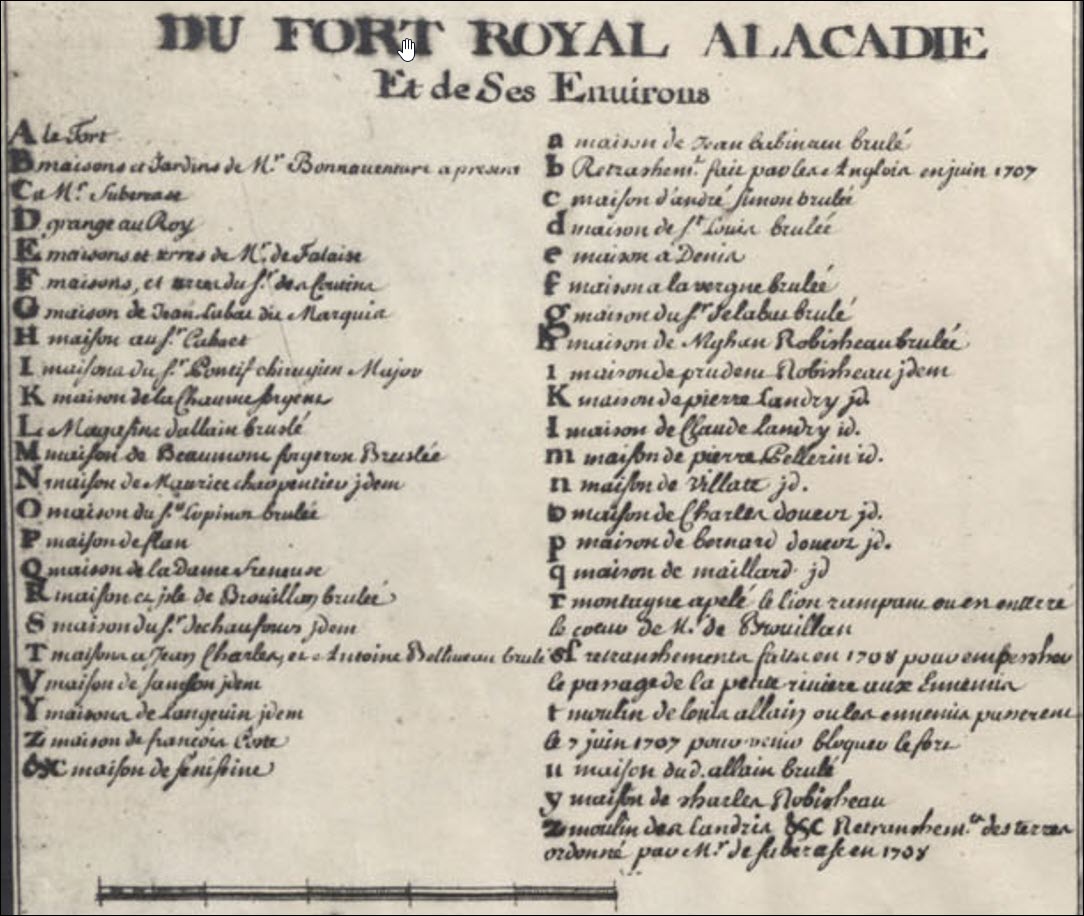
His invaluable legend details the list of burned properties by resident.
There’s another interesting gem buried here too. The circle drawn on the map that says “Limite de la banlieue” was an important demarcation. By royal decree, the banlieue of Fort Royal extended outward in a perfect geographic arc from the fort’s bastions, measuring exactly one league (roughly 3 miles or 4.8 kilometers) in radius. That circle marks the edge of the banlieue.
Everyone living within the banlieue circle was legally bound to the fort’s defense. That means that if warships appeared in the river, they were required to leave their homes and enter the fort for protection. The men were expected to bring their guns and fight.
Furthermore, if necessary, the garrison had the right to do whatever necessary to those properties to prevent their enemies from taking cover there. What that meant, or could have meant, goes without saying.
The English camped right near the edge of that circle, and when they couldn’t capture the fort, they burned everything they could. Almost all of Port Royal went up in flames, destroying the administrative and economic hub of Acadia.
And for everyone else living beyond that circle – while their property wasn’t burned, this time, they would certainly have seen the smoke rising in the distance. The message was clear – sooner or later, this WILL be you.
I can only imagine Guillaume gathering his family close and planning their strategy for when the English brought destruction to them once again.
While Subercase, the French soldiers, the Acadians, and their Native allies were all extremely relieved that the fort held, the Acadians continued to live in an emotionally exhausting high-stakes drama where no one could ever really relax.
They knew this was not the end of the English incursions, even if they were gone for a little while.
The next assault might be just around the corner, around the bend in the river, the next sail spotted in the distance – and France was doing nothing to protect her colony. Port Royal and the rest of Acadia were caught between two massive powers in a brutal game of ping-pong.
And they had to rebuild, alone.
The 1707 Census
The census was typically gathered over time, in the late spring and early summer months, compiled and bound together, then sent back to France in the fall. The 1707 census was dispatched to the Ministry of Marine in Paris in November, after the August siege.
While one would think this represents Acadia, particularly Port Royal, AFTER the English twice burned Port Royal, it isn’t. Comparing the census entries with the homes listed as burned on Labat’s map makes this contradiction evident. For example Claude Landry (location “I” on the map) could not have amassed 21 cattle, 15 sheep and 20 hogs before November after his home and barns had burned, and his livestock slaughtered in June and August. Nor could his brother, Pierre Landry (location “K” on the map) have amassed 19 cattle, 20 sheep and 13 hogs.
This makes the 1707 census a snapshot of Port Royal right BEFORE the dual English sieges, and shows us just how much those families who were burned out lost.
Guillaume haD probably never been so thankful that he lived upriver.
In the 1707 census, Guillaume’s age is not listed, but he and Huguette are aging. He would be about 57 years old. They have 2 boys who are 14 or older, 2 boys who are younger, and two girls who are 12 or older. They are doing well and own 32 cattle, 38 sheep and 14 hogs. They live on 25 arpents of land and have 6 guns.
They have now become the older generation. Their son Antoine is living next door with his wife, but no children have arrived yet. He has a gun, 2 cattle, 3 sheep and 4 hogs, but no land, so they are living on Guillaume’s land and working it as a family.
Weddings
More of Guillaume’s children are marrying.
On January 18, 1708, son René Blanchard married Marie Savoye, one of the local neighbor girls at Belle Isle.
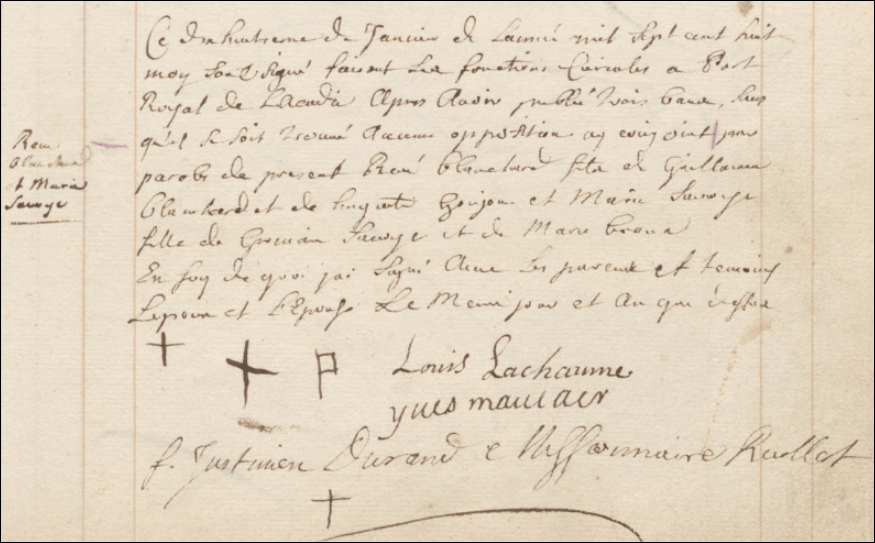
Guillaume Blanchard and Huguette Goujon are listed as his parents, and Guillaume signs with the now familiar “P” that looks something like a flag.
On February 5, 1709, daughter Isabelle Blanchard (also called Elizabeth in the margin and elsewhere) married Claude Girouard, whose family lived across the river.
1710
One would think that by 1710, the Acadians could be breathing a little easier, but that certainly wasn’t the case.
By now, Guillaume was about 60 years old.
First, the harvest failed. Late spring frosts combined with unusually heavy rainfall and a shortened growing season caused crops to rot in the fields.
Furthermore, an epidemic of some sort, probably either smallpox, typhus, or yellow fever, drove the privateers away. Not only were people dying, but their source of provisions dried up when they needed them most. Life was looking quite bleak.
To make matters even worse, the English returned. They might have taken a bit of a respite, but they had not given up on capturing Acadia and were probably aware of the weakened state of the Acadians. The 1707 sieges had failed, but this one would not.
While France was still neglecting Acadia, England was supporting her colony. Thirty-five English ships with more than 3,400 troops reached Port Royal on September 24, 1710.
They faced 300 hungry, neglected, and ill-equipped Acadian men and French soldiers, 20 unfortunate Quebecois who happened to be visiting, and a few Mi’kmaq warriors. The French soldiers hadn’t been paid in years, nor had the soldiers or Acadians been supplied.
Even if you add every Acadian man and boy above 15 to the mix, you’ve only added 100 to the defensive force. There were many times more English soldiers than the entire Acadian population, including women and children, which only totaled about 570 people.
The Acadians didn’t stand a chance, but miraculously, they held out until October 2nd.
After doing their best to defend the fort and town for eight days, facing impossible odds, the best the Acadians could hope for was to obtain reasonable surrender terms and save themselves from being slaughtered.
Guillaume was never one to shy away from conflict, so he was probably among the men in the fort. This was a do or die trying moment.

All things considered, the surrender terms were quite reasonable, at least compared to the alternative.

In addition to being allowed to march out of the fort through the gate, flags flying and drums beating, before handing the keys to the English, the soldiers and Acadians were not to be harmed.
The French soldiers and administration were sent back to France, but things were so bad that General Francis Nicholson, the English commander, had to provide rations for them on their journey.
The Acadians retained the right to worship as Catholics, their personal property, and those who lived within cannon-shot of the fort – about 3 miles – could stay for 2 years IF they signed an unconditional oath of allegiance. They had two years to remove their moveable items to another French-held location.
The 3-mile delineation covered about 481 Acadians, including women and children. Three months later, by mid-January, 57 heads of household had begrudgingly signed.
This little-known 1710 Acadian military census was ordered by Nicholson after Port Royal fell. He needed to know how many households and people fell within his jurisdiction, and within that 3-mile radius.
That partial census consists of 90 households, five of which were headed by widows. That tells us that 85 men were eligible to sign and only 57 had, so that means that 28, or 33% were holding out. That’s pretty remarkable when you think about David staring up into the face of Goliath and refusing.
Those terms left the Acadians beyond 3 miles, which included Guillaume Blanchard, who lived about 10 miles distant from Port Royal, on the far side of Belle Isle, in limbo.
Did that mean those Acadians didn’t have to take the oath, and didn’t have to remove? What did it mean, exactly?
Was Guillaume considering trying Petitcodiac once again, even though everything had been ruined there? If he was going to go that far to start over, he might as well go just a bit further and be outside “Acadia” altogether, but still in French territory.
We know for sure that some people were still living at Chipoudy, because the following year Francois Broussard of Chipoudy was arrested at Port Royal.
Of course, knowing the Acadians, they did everything possible to skirt the requirement to move from the land they had developed and nurtured for decades. Where would they go? How would they get there, and how would they support their families once they arrived?
Did Guillaume still have his boat, or had that been lost in the earlier depredations at Petitcodiac?
Yet, many Acadians weren’t about to take that despised oath, potentially having to fight against their own countrymen, their allies, and family members in the Native community.
And to add insult to injury, their priest, Father Justinian Durand was captured and held hostage in Boston.
By this time, Acadians had to be both physically and emotionally exhausted.
But it wasn’t over.
January of 1711 – Resistance
The Acadians were fighting back.
We can be nearly 100 percent certain that Guillaume Blanchard was involved in this next incident based on Samuel Vetch’s own records. He kept meticulous notes in his book of letters.
In January 1711, Vetch sent the garrison’s commissary, Peter Capon, to negotiate a purchase of grain from Guillaume Blanchard’s neighbor, Pierre LeBlanc. While the two men sat talking in LeBlanc’s house, a group of armed Acadians burst in “with their firelocks cocked”, seized Capon, and dragged him out into the night. LeBlanc quickly went after them and arranged for Capon’s release, paying a ransom of 20 pistoles.
Furious, Vetch sent an officer and fifty armed men to St. Laurent chapel (one half mile upriver from the LeBlanc homestead) the following Sunday morning to arrest Father Justinien Durand, whom he considered seditious. Vetch also arrested leading inhabitants at the church and elsewhere, including Louis Allain and Germain Bourgeois, along with their eldest sons, as well as Jean Comeau, Francois Broussard, and Captain Pierre LeBlanc himself. The men were taken to the fort where they remained in a dungeon for several weeks.
Some of these men were tortured, and at least one never left that completely dark dungeon alive.

- Germain Bourgeois of Beaubassin was “passing through” Port Royal and was arrested for capturing an English soldier, which would have been Capon. He perished after being held torturously for months in the subterranean “black hole” at Fort Anne after refusing to take the oath of allegiance.

Rest that brave man’s soul.
- Guillaume Bourgeois of Port Royal, son of Germain Bourgeois, was arrested and eventually released. Imagine having to watch your father be tortured and die slowly.
- Jean Comeau of Port Royal was arrested and eventually released.
- Pierre LeBlanc of Port Royal, Guillaume Blanchard’s neighbor, was arrested and eventually released.
- Francois Broussard, who went back and forth between Chipoudy and Port Royal, was arrested. The Broussard families were neighbors of the Blanchards and lived just upriver. Francois survived his torture in the Black Hole, but barely, dying two years later.
Keep in mind, these are only the men we know about, and there were probably more.
It’s no surprise, given the abuse and torture of the Acadian men held in the Black Hole that two of Francois Broussard’s sons, Alexandre Broussard dit Beausoleil, born about 1699, and more particularly, Joseph Broussard, dit Beausoleil, born about 1702 became legendary freedom fighters and Acadian folk heroes during the 1755 Expulsion.
Both men tried, unsuccessfully, to prevent the Expulsion of the Acadians from their beloved Acadia in 1755. Fighting to the bitter end, Colonel William Foster wrote of Joseph, one of the last Acadians still resisting, “These people are Spirited up in their obstinacy by one BeauSoleil . . .”
Belle Isle was producing a generation of, if not generations of, resistors.
The first uprising was only a few months away.
Uprising – The Battle at Bloody Creek
1711 wasn’t kind to the Acadians, but it wasn’t kind to the English either.
Winter descended on Port Royal shortly after the English took possession. Food shortages developed quickly for the English soldiers at the fort, and assuredly, the Acadians were in no mood to feed them. Several were being held in the Black Hole.
Unsurprisingly, the Acadians were openly hostile
Geez, I wonder why.
Between death, disease, and desertion, there were only about 450 English soldiers left at the garrison, and none of them wanted to be there.
By January 1711, Samuel Vetch, the British commander, had been reduced to sailing to Boston to beg for food for his soldiers. When he returned, he only had 200 soldiers left.
Vetch considered the Acadians intractable, because they were, and wore it like a badge of honor. Vetch was an evil man, and I’m sure they hated him with every ounce of their being.
It’s against this backdrop that the Battle of Bloody Creek occurred on June 21, 1711. Between 50 and 150 “Wabanaki warriors” ambushed about 70 English soldiers who had been foolhardy enough to travel upriver to attempt to force the Acadians to provide them with lumber and food.
What a bad idea.
You already know this isn’t going to end well.

The Blanchards lived near the Mass House shown on this 1733 map, and the LeBlanc Village. The Battle of Bloody Creek took place slightly upriver.

The site of the Bloody Creek Battle was about four miles as the crow flies from the Blanchard home. The distance as the boat rowed was about 6 miles. The English would have rowed past numerous Acadian homes, including those at Belle Isle, who probably quietly sent messengers upstream, warning of their impending arrival.
The Battle at Bloody Creek was initially described as an ambush between 50 and 150 Wabanaki warriors against about 70 English soldiers, killing 16, injuring 9, and capturing the rest.
Did I also mention that some of the captured English reportedly had to pay their own ransoms to be released? Pardon my chuckle.
I’ve always been very suspicious of the claim that the Wabanaki conducted the raid – or at least that it was only the Wabanaki.
Following this successful ambush, the Acadians and their Native allies were emboldened. Buoyed by their victory, a large joint force of approximately 600 Mi’kmaq, Abenaki, and Acadian men assembled under the leadership of Father Antoine Gaulin, who was anything but your quiet parish priest, and Bernard-Anselme d’Abbadie de Saint-Castin.
A total of about 600 men attempted to retake the fort at Port Royal. Unfortunately, they had no heavy weapons or artillery and could not launch an effective attack, but they hemmed the sickly English soldiers in for weeks. Gaulin went to Newfoundland and asked the Governor for supplies and reinforcements, which he received. The Acadians needed the heavy ammunition, siege equipment and other supplies being carried on the French ship dispatched by the Governor, but unfortunately, it encountered the British fleet and was captured, effectively ending their hope of dislodging the English at Port Royal.
Still, the English at Port Royal were worried, and Governor Vetch sent for reinforcements. The Acadian effort was abandoned when he returned with 200 English soldiers.
The English were not about to let this uprising go unpunished, and they cracked down HARD.
- Vetch arrested inner-circle hostages who lived within the 3-mile radius, like Pierre Melanson and Louis Allain. Thrown into the black hole on a rotating basis, they were held under threat of execution if they didn’t force the surrounding communities into submission.
- The English plundered the upriver Acadians who had openly participated in the ambush at Bloody Creek and subsequent blockade. They burned crops, barns, and killed livestock with the goal of ensuring that the resistance movement couldn’t feed itself, or any “visitors” who might arrive to help. Ummm, wouldn’t that have been every Acadian?
- Not only that, but Vetch also required an immediate payment of 100 pistoles, gold coins, per month, along with a mandatory levy of timber and logs to repair the fort.
- Vetch threatened that if any village failed to deliver on any of his demands, it would be burned to the ground.
Vetch and his soldiers wouldn’t have been selective about whose farms he burned, so this time, Guillaume very likely lost his home and farm to fire. Like always, the Acadians rebuilt, because they had no other choice.
Another Wedding
On May 18, 1712, Guillaume witnesses the marriage of his daughter, Magdelaine Blanchard to Charles Gautrot.
Both Guillaume the elder and his son by the same name signed as witnesses.
This wedding would have been held in the local St. Laurent Chapel, because the Belle Isle Acadians were no longer going into the church at Port Royal that had been repurposed as an English barracks.
1714
On January 16, 1714, Guillaume’s namesake son, Guillaume Blanchard, married Jeanne DuPuis, another neighbor.

It’s interesting that while Guillaume the father cannot read and write, as indicated by his signature “P” mark, his son can.
The 1714 census was taken four years after the English takeover. On it, we find two Guillaume Blanchards. One, the father, is shown with a wife and two sons. The second, newlywed Guillaume, is listed with his wife. They are living beside his parents, with his brother, René Blanchard, on the other side with his wife and three sons.
The Blanchard Village, just not at Petitcodiac.
Unfortunately, the 1714 census doesn’t show the amount of livestock or arpents of land being worked, so we can’t compare it to the 1707 census to gain some idea of how much was lost in the upriver community when Vetch went on his retaliatory burning campaign in 1711.
Guillaume’s Death
We don’t know exactly when Guillaume Blanchard died, but we can bracket the date within a couple of years. We know it was sometime after January 30, 1715, and before Huguette died on 18 October 1717, when she is noted as a widow.

On January 30, 1715, Guillaume’s widowed daughter, Jeanne, married for the second time to Jean LePrince. Her parents are shown as Guillaume Blanchard and Huguette Goujon, and neither are noted as deceased.
Guillaume Blanchard signed with his easily recognizable mark, and Jeanne’s brother Guillaume signed with his signature below the elder Guillaume.
On November 3, 1715, Guillaume Blanchard witnessed a baptism where he is noted as Guillaume the son, implying that Guillaume, the father, is still alive at this time.
Assuming the baptism information is accurate and Guillaume is still alive, he died between November 3, 1715 and October 18, 1717. Guillaume would have been between 65 and 67 years of age. Only history knows why his death and burial weren’t recorded in the parish registers, or didn’t survive.
But history also gives us a hint.
By September 1715, the temporary peace following the 1713 Treaty of Utrecht had collapsed into severe local tension. Queen Anne had died, King George I took the British throne, and the British authorities at the fort grew justifiably paranoid about an Acadian uprising or mass emigration to French-controlled Cape Breton (Île Royale). After all, just a few years earlier, they told the Acadians that they HAD to move. Be careful what you ask for.
On January 22, 1715, just a week before Guillaume’s daughter, Jeanne, remarried, the English required an unconditional oath of allegiance to King George. The Acadians refused, saying they would swear a conditional oath that guaranteed their religious freedom and exempted them from ever having to bear arms against their French or Mi’kmaq neighbors.
While initially requiring the Acadians to move, now the English forbade it, because they had come to realize that they needed the Acadians to feed them. Conversely, the Acadians now wanted to leave.
Terrified that the Acadians would move to French-controlled Cape Breton (Île Royale), and also furious at their refusal to take the oath, the English locked the fort gates and prohibited all trade – with them or with the Native people. The Acadians couldn’t even build boats, not even for fishing, nor sell their cattle or livestock outside the river valley.
Father Durand functioned as one of the leaders of the Acadian resistance, so he was targeted and heavily watched as he slipped from farm to farm, ministering to his flock as best he could. He preached that taking the oath would jeopardize their ability to worship as Catholics, and encouraged the upriver Acadians to hold out against the British demands.
The Acadians continued their resistance, and the English became increasingly desperate. While the fort’s soldiers starved, the Acadians developed a smuggling network with New England merchants, bypassing the English at Port Royal and their fort entirely, which made the fort commanders even angrier. Desperate for the Acadian cattle and grain, the Boston merchants were more than willing to bypass the garrison – and they paid with actual silver coins, sugar, molasses and textiles. This made the upriver Acadians like Guillaume Blanchard even more fiercely independent and contravened the effects of the fort’s embargo.
Unable to control the smuggling, the starving English at the fort began upriver expeditions to steal livestock and grain from the Acadians living there, because the Acadians would not willingly relinquish them.
One can rest assured that Guillaume and his neighbors were all hiding their assets from the local English while running a successful smuggling business and navigating the black market.
By 1716 and 1717, the lockdown had eased a bit through administrative paralysis. The British garrison realized their enforcement was an utter failure. The fort was completely out of money, the soldiers were mutinous and malnourished, and Lieutenant-Governor Thomas Caulfeild grew severely ill and died. The garrison simply lacked the manpower, energy, and resources to patrol the entire valley or stop the massive Boston black market. The two sides were effectively stalemated.
The parish records during 1715, 1716 and 1717 are disorganized and sparse. Father Durand was attempting to serve a fragmented population, with services and rites being held in individual homes up and down the river. He was sometimes assisted by other, traveling priests. Everyone avoided the three mile radius around the fort.
It was during this time that a second Catholic church was built at Granville Ferry since the Acadians had lost access to the one at Port Royal. This meant that Father Durand was now serving two churches, plus his other clandestine activities.
Clearly, many events, like Guillaume’s burial, never made it into the registers. Perhaps the officiating priest, if there was one, recorded them on slips of paper that never made it into the official parish register. People had to be buried when they died, and couldn’t wait on a priest, so often the local population leadership simply did what needed to be done.
This also causes me to wonder if Guillaume’s death had something to do with the smuggling operation that operated at night, under cover of darkness. Did he encounter English soldiers and have an “accident” at their hands, or perhaps drown in the river or bay? Did he die defending his property? Is that why his burial is never recorded? Was he part of the active, daily resistance network?

Assuming Guillaume died at or near Belle Isle where he lived, he was probably buried in the graveyard beside the neighborhood Catholic church, St. Laurent, shown on various maps as the “Mass House.”
The Mass House did not survive the fires and destruction following the 1755 expulsion of the Acadians from Nova Scotia, and neither did the cemetery.

However, using maps and other information, we’ve been able to approximate its location.
Guillaume Blanchard doesn’t rest someplace at Village des Blanchard on the Petitcodiac River where he established his short-lived community.

He probably rests in a lost grave beside the lost St. Laurent church, here, at Belle Isle, near his home in the original Blanchard Village.
_____________________________________________________________
Share the Love!
You’re always welcome to forward articles or links to friends and share on social media.
Subscribe!
If you haven’t already subscribed, it’s free. You’ll receive an e-mail whenever I publish by clicking the “follow” button at the top of the main blog page, here.
Help Keep This Blog Free
I receive a small commission when you click a vendor link in my articles and purchase that item. This does NOT increase your price but helps me keep the lights on and this informational blog free for everyone. Please click on the affiliate links in the articles or to the vendors below if you are purchasing products or DNA testing.
Thank you so much.
DNA Purchases and Free Uploads
- FamilyTreeDNA – Y-DNA, mitochondrial and autosomal DNA testing
- MyHeritage DNA – Autosomal DNA test
- AncestryDNA – Autosomal DNA test
- AncestryDNA Plus Traits
- 23andMe Ancestry – Autosomal DNA only, no Health
- 23andMe Ancestry Plus Health
Genealogy Products and Services
- MyHeritage Subscription with Free Trial
- Legacy Family Tree Webinars – Genealogy and DNA classes, subscription-based, some free
- Legacy Family Tree Software – Genealogy software for your computer
- OldNews – Old Newspapers with links to save to MyHeritage trees
- MyHeritage Omni comprehensive “everything included” subscription plan
- Newspapers.com – Search newspapers for your ancestors
- NewspaperArchive – Search different newspapers for your ancestors
My Books
- DNA for Native American Genealogy – by Roberta Estes, for those ordering the e-book from anyplace, or paperback within the United States
- DNA for Native American Genealogy – for those ordering the paperback outside the US
- The Complete Guide to FamilyTreeDNA – Y-DNA, Mitochondrial, Autosomal and X-DNA – for those ordering the e-book from anyplace, or paperback within the United States
- The Complete Guide to FamilyTreeDNA – Y-DNA, Mitochondrial, Autosomal and X-DNA for those ordering the paperback from outside the US
Genealogy Books
- Genealogical.com – Lots of wonderful genealogy research books
- American Ancestors – Wonderful selection of genealogy books
Genealogy Research
- Legacy Tree Genealogists – Professional genealogy research
Share this:

Discover more from DNAeXplained - Genetic Genealogy
Subscribe to get the latest posts sent to your email.
Thanks for another great story, this time about my 9th ggf.