
Anne Doucet’s life was one adventure after another. – a dark fairy tale where beauty and danger were inextricably intertwined. Twists and turns that, if you had told her when she was young, she would have found fantastical. The beauty of the tidal river overshadowed by betrayal and loss – woven in a sinister underbelly of political maneuvering that she knew nothing of – but ruined and shaped her life just the same.
Anne had never heard of most of the places she would be cast upon, or perhaps shipwrecked is a more appropriate description. She could never have anticipated where she would later live, in yet another unknown location, one after another, far from where she was born. An unwilling refugee.
Her life would unfold like chapters in a book, one where shadows stretch long over the ancient landscape, and you cannot put down nor anticipate the disaster about to befall our heroine in the next chapter.
And when the sleepless dawn finally arrives, your soul is crushed with hers, tears falling anew. Hearts aching.
Yet therein, in that darkness, we find an eerie beauty, the candlelight of her love – ever shining. A beacon.
Come turn the pages with me.

Anne Doucet was born March 23, 1713, in Port Royal to René Doucet dit Laverdure and Marie Broussard. Their neighbor Abraham Bourg, who lived just a few yards down the road, probably within sight, provisionally baptized her the day she was born. Perhaps his wife served as a midwife.
Given that the Catholic priest, Father Durand, didn’t baptize her until April 22nd, a month later, either he was gone or something else prevented the baby from being baptized immediately.

Anne’s godparents were Mathieu Doucet and Isabelle Broussard.
Mathieu Doucet is Anne’s uncle, the son of Pierre Doucet and Henriette Pelletret.
Pierre Doucet, Anne’s grandfather, was quite elderly but still living when Anne was born, although he would only get to dote on his new granddaughter for less than six weeks. He died on June 1st. Anne’s grandmother, his wife, had been gone for years.
According to the various Acadian censuses, Anne’s Godmother, Isabella Broussard, and Elizabeth Broussard, born between 1693 and 1696, are one and the same person, the daughter of Francois Broussard and Catherine Richard. Anne Doucet’s mother, Marie Broussard, is Isabella Broussard’s older sister.
So, Anne’s paternal uncle, Mathieu Doucet, and Isabella Broussard, her maternal aunt, were her godparents, standing up in late March 1713 with her parents, promising to raise Anne in the Catholic faith and care for her, should something happen to her parents. Anne’s baptism probably occurred in the priest’s house since the Port Royal church had been burned,

Or, maybe they stood in the little “Mass House” in BelleIsle, near where her maternal grandparents lived.
Committing as a Godparent was no trivial commitment to be taken lightly, given that the Acadians had been embroiled in war with the English through the end of 1710 – and one really couldn’t say things were exactly peaceful in 1713. The Treaty of Utrecht, signed in April 1713, worsened tensions considerably, given that Acadia was formally ceded to England.
In one of Anne’s children’s baptism records, her name is recorded as Jeanne, so her name could have included Jeanne as a middle name, but it’s quite unlikely. The priest didn’t record a middle name at her birth, and Jeanne is never recorded anyplace else. Maybe Jeanne was a nickname. I also noticed that during this time, the priests performing the baptisms were all different, so perhaps he didn’t know Anne very well, or simply made a mistake.
I should also note here that Anne’s name was recorded as “Marie” later in her life more than once, so perhaps her official name was “Marie Anne.” Marie was a very common “Saint’s name” for girls. We will never know.
Life on the River

Anne Doucet was raised near Fort Anne in Port Royal, although by the time Anne was born, Port Royal, the capital of Acadia, had been lost in battle to the British and was burned two and a half years earlier.
They lived not far from her grandfather, Pierre Doucet, along the river, and her grandmother, Henriette Pelletret, was raised right across the river in Port Royal. It’s possible, given her grandfather’s advanced age and the fact that all of her father’s brothers and all of his older siblings lived in Beaubassin, that Anne’s family was living on her grandfather’s farm and would inherit it soon. Somebody had to do that hard physical labor, and there wasn’t anyone else. Pierre was quite aged, over 90, so in all likelihood, they were all living together and Anne’s family was taking care of Pierre.
The 1714 Acadian census in Port Royal shows Rene Doucet, wife, one son and three daughters living beside Claude Granger and Laurent Granger, who are listed beside Abraham Bourg and Pierre Bourg. This cluster of neighbors lived directly across the river from Fort Anne.
Anne’s uncle, Pierre Broussard, who had married Marguerite Bourg, was living between Rene Doucet and the Lore family, whose land was further east.
Anne’s maternal grandparents, Francois Broussard and Catherine Richard, lived maybe 8 or 9 miles up the same side of the river, the other side of BelleIsle, near Hebb’s Landing today.
These families along the river mingled and intermarried freely.
Anne would have been unaware of the turbulence in Acadia during her childhood as the English and Acadians argued about whether the Acadians could stay or had to go someplace else, like Beaubassin or Ile-Royal.
Changing of the Guard

In Anne’s young life, another sibling arrived like clockwork every couple of years, and beginning in 1725, her older siblings began to marry.
Several things happened about 1730. Something was going on, and I certainly wish we had complete parish records or history from that time to reveal whatever that something was.
Sometime, probably in the summer of 1730, Anne’s mother, Marie Broussard, at age 44, gave birth to her youngest child.
Anne Doucet married Daniel Garceau about that same time, maybe in the fall or early winter, based on the birth of her first child.
There are no parish records for the birth of Anne’s sibling, nor her marriage.
Anne’s first child, Marguerite Garceau, was born on September 10, 1731. The conception date would be about December 14th, so her marriage probably took place just weeks to a few months before that.
Anne would have been ecstatic about the birth of her first baby. The entire family gathered that Friday, including Anne if she could, so that the priest could baptize Marguerite. Anne’s father, Rene Doucet, and their near neighbor, Anne Granger, stood proudly as Godparents. Perhaps at the foot of Anne’s bed.
Then tragedy struck. Anne’s father, Rene Doucet, died shortly thereafter, as he doesn’t appear in any later records. Unfortunately, there’s also no burial record for him, so we really don’t know if he died at home at Port Royal, out in the Bay on the water, or maybe visiting Chipoudy or someplace in the Minas Basin. Regardless, he was gone. And the family had a problem.
Anne’s oldest brother, Pierre Doucet, had married Francoise Dugas in 1725 and was in Chipoudy by 1732, so he might already have left the Annapolis Royal region by the time Anne’s father died.
Her oldest sister, Marie-Anne Doucet, married Pierre Landry from Pisiguit. In 1730, they were living in Chipoudy when their first child was born.
Anne’s next older sister, Agathe Doucet, married Pierre Pitre in 1726 and had their first child later that same year, but they, too, were in Chipoudy (now Shepody, New Brunswick) by 1732.
Anne was the only sibling to marry and remain locally, which meant Daniel Garceau might well have begun to work his mother-in-law’s farm. She certainly couldn’t do it with stair-step children from newborn to marriage age. As her children married, they were leaving for Beaubassin and the Bay of Fundy settlements, probably due to the more receptive political climate there – and the availability of farmland.
Anne’s next oldest sibling was her brother Francois Doucet, who would have been 16 in 1731. He would have been a big help in the fields. He lived at home and didn’t marry until 1742. He and his wife stayed in Annapolis Royal until the deportation, at which time, tragicly, they became separated from Anne’s family.
Anne’s other siblings were under 10 in 1731, so I’m wagering that Anne Doucet and Daniel Garceau stepped up and stepped in and farmed Rene Doucet’s land. It was an opportunity for Daniel and a problem solved for his wife and her family.
Based on the godparents noted in these baptisms, specifically Granger and Melancon, I believe that Anne Doucet and Daniel Garceau were living on the same land, perhaps in the same home where her parents lived. Probably the same home where Pierre Doucet had originally settled. That’s the way Acadian families worked.

Rene Doucet’s home, shown here by MapAnnapolis is where Pierre Doucet’s home was located on earlier maps. The Melancon settlement was slightly west of this grouping along the Riviere Dauphin.

Standing near the Doucet land, you can see Fort Anne right across the river, along with the Queen’s Wharf.

This 1708 map shows the location of Pierre Doucet, along with Abraham Bourg, who baptized Anne in 1713, and the Granger neighbors.

This 1733 map, enhanced in 1753, shows the Rene Doucet land, directly across from the fort, probably being farmed by Daniel Garceau. Note that there are two homes.
After her marriage, Anne’s own children began arriving regularly. All of Anne’s known children were born before the 1755 Exile began, but just by a few years.
The Unthinkable Happens

This 1753 drawing of Annapolis Royal from across the river, very near the Garceau/Doucet land, shows Fort Anne to the far right. The wharf, extending into the Annapolis River, foreshadowing the future, is visible.
From Anne’s childhood home, and where she likely lived her adult life across from Annapolis Royal, she could see the wharf that one day, she would be forced to walk, sheltering her children, clutching them to her so no one would be lost or ripped from her.
Could she see her siblings being loaded onto other ships? Had she any idea that she would never see them again? That she would never know what happened to them?
They all slipped away from each other, that terrible day, into the blackness of anonymity.

The cemetery was located just behind the fort, near where the church used to be. Several of Anne’s babies had perished and probably rested there with her father, Rene Doucet, who had died around 1731, and her mother, Marie Broussard, who died in 1751.

It looks for all the world like Anne had two or three babies that died early and whose births weren’t recorded. Note that PRDH records from Quebec only people who are found in Quebec records – so any child that was born and died elsewhere would not be listed here.
When Anne was forced to leave Port Royal, the graves would have had neatly placed wooden crosses, but now, they all lie in unmarked graves.
Anne’s oldest daughter, Marguerite Garceau, married Charles Lore/Lord in January 1755, just before their deportation from Port Royal in December.
Of course, we don’t catch up with any of Anne’s children until sometime in 1767, when they finally make it to Quebec from New York where they were exiled for more than a decade.
Anne survived the unthinkable. No one can imagine being rounded up like livestock being herded to slaughter, told to bring only what you could carry, then shoved into ships with nary a square inch to spare. In the deadly cold of winter.
Yet, that’s exactly what happened.

There were more Acadians to be deported than the ships could reasonably hold, so they were forced to abandon their few belongings on the wharf before being forced onto those ships, with no heat and not even toilet facilities. The next settlers, brought to Annapolis Royal by the English a few years later and given the Acadian farms, found their paltry possessions on the shoreline where they had been unwillingly left by the suffering Acadians.
I can only imagine the gripping terror and unrelenting tears. Especially if you realized that your family members were on a different ship – or your family was split in half – or your elderly parents…
One Acadian refugee who wound up in Pennsylvania said, “We were so crowded on the transport vessel that we had no room even for all our bodies to lay down at once.”
It’s no surprise that one in four Acadians died, and many were simply never heard from again – not by family members and not in any known records. Sometimes, we know they survived because of their descendants, but in the case of many of Anne’s siblings, there’s nothing but stony silence. It’s actually more surprising, given what we know, that more people didn’t die. Only very sparse records were kept, at best, so we really don’t know how many Acadians were deported or how many tried to run and hide, so we also don’t know how many perished.
The Acadians removed from Annapolis Royal were kept below deck except when small groups were allowed above deck for a few minutes at a time. There were no toilet facilities, so the floor, which was also the only place to sleep, was the toilet. It’s no wonder that dysentery, smallpox, and other sicknesses claimed so many.
Can you imagine the stench? The horror? Giving birth? That’s probably what befell Anne’s oldest daughter.
These conditions were inhumane by any measure, possibly intentionally. Regardless, no one who could have done anything about it seemed to care.
It makes me nauseous to know that my ancestors were treated like this. Not one, but all of them who were living at the time. My mother’s great-grandfather was Acadian, the grandson of Appoline Garceau, who married Honore Lore. Appoline was on this ship with her parents, and Honore may well have been shipboard with his parents as well.
It makes me nauseous to think about how horrifically seasick they must have been during the hurricane, in the bowels of the ship, literally living in the toilet. That journey didn’t end in a month in the colonies. That ship was blown clear to the Caribbean.
They had something of a break there, but we know nothing of their time in either Antigua or St. Kitts. We don’t even know for sure that they were allowed to get off the ship. Then had to get back on that same ship to sail to New York.
How terrified they must have been boarding that ship a second time, walking up the planks, probably prodded like cattle. Assuredly, no one went willingly. The families, sadly, were smaller now. Many had been buried at sea.
The ship Experiment, directly from Hell, twice. Miraculously, somehow, they survived that horrific journey and a decade someplace in New York.
We know almost nothing about that time, except that they were in close proximity to the Lore family, and that two of Daniel and Anne’s children were married to other Acadians.
Deliverance
Then, eleven years later, in 1767, Anne Doucet and her family climbed aboard a ship yet a third time – one that was to sail into the Atlantic, around Nova Scotia, and deliver them to Quebec. They must have been terrified then, too, but the ship Diana was the vessel of angels of deliverance. The answer to their dozen years of prayers.
As horrible as the deportation, hurricane, shipwreck, then exile were, as told in both Daniel’s and also Appoline’s articles, Anne was actually one of the lucky ones – as difficult as that is to believe.
Anne appears to have lost “only” one child, Anne, during the deportation or in New York, assuming that the other two “vacant spaces” between children were those who died before they left Acadia. And yes, I realize saying she lost only one child sounds horribly callous – but considering the conditions, it was a miracle that only one of eleven perished. Some families disappeared altogether.
Anne and Daniel both survived, and Anne was blessed in her later years with grandchildren.
Children and Grandchildren
Based on birth, death, and marriage records when we have them, I’ve compiled a list of Anne’s children, when they were born and died, and where. Godparents tell a story, too, often telling us when people died and where they lived. It’s thanks to a Godparent record that we know when Rene Doucet was last known to be alive.
Additionally, I’ve included the names of Anne’s children’s spouses and when they married, plus how many known children they had and how many lived to marry.
All of Anne’s children were born in Annapolis Royal, or Port Royal, as the Acadians would have referred to it, even after the English changed its name. Except for her namesake daughter, Anne, all her children died someplace in Quebec.
| Child | Birth | Godparents | Death (Quebec) | Marriage | Children Born, Married |
| Marguerite Garceau* | September 10, 1731 | Rene Doucet, Anne Granger | September 13, 1813 – Trois Rivieres | Charles Lore 1755 | At least 2, both of whom married *1 |
| Marie Josephe Garceau *3 | October 3, 1733 baptized Oct. 4 | Joseph Granger, Marie Lore | September 19, 1815 – St-Ours | Jean-Baptiste Lore c 1765 | 6, 2 married *2 |
| “Jean” Joseph Garceau *4 | April 12, 1735, baptized April 14 | Joseph Lore, Marguerite Doucet | May 8, 1770 – Yamachiche | Marie Josephe Aubois c 1754 | 8, 4 married |
| Anne Garceau | July 21, 1737, baptized July 22 | Pierre Garceau, Francoise Dugas | |||
| Jean “Baptiste” Garceau *5 | November 24, 1739 baptized Nov. 25 | Laurent Granger, Marguerite Doucet | July 31, 1790 – Yamachiche | Marie Denevers Boisvert 1769 | 8, 5 married |
| Apollonie Garceau *6 | February 8, 1742, baptized Feb. 9 | Jean Doucet, Marguerite St. Cene (St. Seine) | May 3, 1788 – L’Acadie | Honore Lore c 1765 | 7, 5 married |
| Charles Garceau | April 11, 1744 | Charles Babineau, Marie Joseph Doucet | March 3, 1825 – Yamachiche | Marie Josephe Grenier 1770 | 9, 6 married |
| Pierre Garceau | August 11, 1746 | Simon Thibeau, Francoise Melancon | December 11, 1815 – La Prairie | Marie Angelique Lemay 1773 | 12, 1 married *7 |
| Magdelaine Garceau | August 13, 1748, bap Aug. 15 | Gregoire Godet, Marguerite Garceaux | August 2, 1777 – Yamachiche | Jean Baptiste Boisvert 1768 | 5, 3 married |
| Ludivine (Devine) Garceau *8 | Abt 1751 | April 28, 1801 – Pointe-du-Lac | Pierre Bertrand 1775 | 9, 1 married | |
| Francois Garceau | January 21, 1752, baptized Jan. 22 | Charles Doucet, Marguerite Lavergne | July 25, 1823 – Pointe-du-Lac | Josephe Martin 1781 | 15, 9 married *9 |
*Anne’s name is listed here as Jeanne. All baptisms occurred the same day unless listed otherwise, and all children were born in or near Annapolis Royal.
*1 – Two children born in New England, both baptized in Yamachiche on August 14, 1768. There were probably at least four or five additional children born to this couple.
*2 – The oldest child was born about 1765 in the colonies and was baptized on September 14, 1767, in Becancour.
*3 – This couple was in St. Denis sur Richelieu by 1769 and St. Ours by 1773
*4 – Their first five children were born in 1767 or earlier and were baptized on August 23, 1767, in Yamachiche. By 1792, this couple was in St. Ours.
*5 – Married in February 1769 in Yamachiche. Spent his entire life there.
*6 – Marriage validated in Becancour on September 29, 1767. The first child was baptized in Yamachiche on February 28, 1768. The couple was in St. Denis by 1769, St. Ours by 1771, and L’Acadie by 1777. They left at some point after 1771, probably returning to the States, but returned to L’Acadie, where they spent the remainder of their lives.
*7 – This poor couple. They married in October of 1773 in Yamachiche and had 11 children in the next 16 years, all of whom died either shortly after birth or as young children. The notable exception was a son born in 1777 and who lived to be almost 7. The worst year was 1784, when they lost a child in June, July, and October. They buried two children in 1790 in Yamachiche. By October of 1792, they were in La Prairie, where their last child, Francois, was born, and somehow, miraculously, lived to marry. He had 10 children and lost most of them as children, but three did live to marry.
*8 – I am not entirely convinced that this is their child. Ludevine was married about 1774. Their first child was born in 1775 in Trois-Rivieres. Another child was born around 1777, with no baptismal record, but was married in Pointe-du-Lac in 1802 and died the same year in Yamachiche. No known children until 1782, when a child was born in Yamachiche, then beginning in 1784, six children, including a set of twins, were born in Point-du-Lac. The death record may give the parents’ names. This poor woman buried all but one of her babies, and the child she did not bury young died just 11 months after she married, 26 days after giving birth to her only child, born on November 12th. What a tragic life.
*9 – This couple married in early 1781, location unknown, but their children through 1807 were born in Pointe-du-Lac. In 1810, they were in Trois-Rivieres baptizing a child, but probably back in Pointe-du-Lac by 1813.
As best I can figure, Anne had at least 81 grandchildren, most of whom were born during her lifetime. She likely had more if you include the children assuredly born to her oldest daughter on that ship and in the colonies, none of whom survived. Thirty-eight grandchildren lived to marry, which, in most cases, means that the rest died before they reached marriage age.
Forty-three+ – that’s a lot of grandchildren to bury. More than half. More than one a year.
Losing her first several grandchildren in the colonies, where they couldn’t even be given a proper burial, would have been indescribably heartbreaking for Anne and the rest of the family members as well. There had been so much heartache in this family already – a veritable river of grief.
Given that two of Anne’s children, one male and one female, had several children, with only one of those grandchildren living to marriage age, I can’t help but ponder genetic factors. Add to that the fact that her oldest daughter only had two children known to have married, and several others lost roughly half of their children before adulthood, I really do wonder.
Yamachiche
Author Monique Michaud, when writing about Daniel Garceau, clearly had access to resources that I do not – or perhaps it’s her ability to speak French that opened doors to Canadian records. Additionally, she visited several locations to conduct research. I encourage you to read what she wrote about this family that formed chapters of a novel, and take special note of her maps.
Monique reports that the Garceau family finally received land concessions in 1771 in this area, north of Yamachiche along the Yamachiche River.

In tentatively placing this land, in addition to old cadastral maps, she noted the marriages of two Garceau children to the Boisvert family who lived in this area. Certainly food for thought here.
This is a high, hillside region, and Acadians typically settled in lower areas near water. That’s the type of farming they were most familiar with. However, given the circumstances, I’m sure they would have been satisfied with any land and were adaptable.

I took a virtual drive and didn’t see any buildings from the era that might be connected to the earliest Acadian settlers.
One thing is for sure: whether Daniel and Anne settled on and farmed this specific land or not, they were most assuredly here, especially given the Boisvert connection and the marker reported by Monique.
Widowhood and Remarriage
On August 28, 1772, at age 65, Daniel Garceau died and was buried in the cemetery at what was then the village of Yamachiche. By this time, the family had been in Quebec for about 5 years.

Two years earlier, on May 8, 1770, Anne’s son, Jean Joseph Garceau, died and was buried here as well. In 1795, the graves were moved to the present-day church cemetery in Yamachiche, as this area was too prone to flooding.
Several of Anne’s children remained in Yamachiche. On the concession map in this article by novelist Monique Michael, you can see the location of the original church and village at the large red dot correlating to the photo above and the land concession map along the Yamachiche River.
This aligns with Monique’s research, and also with the land along Rang des Garceau, a road named after the family where Anne’s children and grandchildren lived.

Monique mentions that Bleuetière Grande-Rivière sud, a blueberry farm, is located on the original Garceau land.

Movin’ on Up
Surprisingly, Anne moved on after Daniel’s death, although not terribly far, about 28 miles upriver.

Based on a marriage contract recorded by Notary Marin Jehanne, two years later, on February 2, 1774, in Saint-Hyacinthe, Quebec, Anne remarried to Claude Arseneau. Prior to locating this physical record, I questioned if this is really was our Anne, but this entry leaves no doubt about the identifies of the two parties involved.
Contract of marriage of Claude Arsenault widower of Marie Commeau and Anne Doucet widow of Daniel Garceau.
Next, I found the church record.

They married at Immaculate Conception in St. Ours.

Anne would become familiar with this beautiful church on the Richelieu River, as she would visit often over the next 17 years. Several of her grandchildren were baptized here, and it may well have been her new home church.

The priest at Immaculate Conception at St. Ours seemed to be confused when they married. He initially wrote in the margin that Claude Arsenault was marrying Marguerite Cormier, the name of Claude’s mother, then struck the name and wrote Marie Doulet – which isn’t accurate either. Given that none of the principals were literate, no one caught the error.
In the year seventeen hundred and seventy-four, on the fourteenth of February, after the publication of three bans of marriage, carried out on three consecutive Sundays, between Claude Arsenault, widower of Marie Comeau, and Marie Doucet, widow of Daniel Garceau and without any impediment being discovered, I, the undersigned priest, received their mutual consent to marriage and gave them the nuptial blessing according to the ceremonies of our Holy Mother Church, in the presence of the witnesses Louis Duhamel and Pierre Duhamel, who have declared they do not know how to sign.
Claude was a significantly younger man, about 17 years Anne’s junior. He had four living children and had lost his wife, Marie Comeau, in February 1772, probably to complications of childbirth, a few months before Daniel Garceau had died. Nothing more is known of the baby born in January 1772 after her baptism, but it’s presumed she died, probably around the same time as Marie Comeau. There is no burial record.
When Anne Doucet married Claude, she became an immediate mother to:
- 16-year-old Marie Suzanne Arseneau
- 13-year-old Pierre Arseneau
- 10-year-old Pelagie Arseneau
- 8-year-old Louis Arseneau
It’s possible that Marie Josephe Arseneau, born in January 1772, did not die near her mother’s death and was still living in 1774. There is no record of her death.
Taking on four more children was a big responsibility, especially given that Anne’s youngest child was already 22. Anne was old enough to be a grandmother to her stepchildren. Claude was born about the same time as Anne’s oldest daughter. I questioned if we are positive these are the right people, and indeed, multiple records confirm this, even if Anne’s name is recorded as Marie.
I asked myself, how and why did Anne get to St. Ours? She clearly knew someone, or some people. It’s not like she wandered upstream to an unknown location in a boat by herself.
The answer is found with her children.
- Appoline Garceau, who was married to Honore Lore, was baptizing children in St. Ours in 1771, 1773, and 1775.
- Marie Garceau, who had married Jean Lore, was in St. Ours by 1771.
If Anne went to visit her daughters, or perhaps stay with them to help with the babies, she would have had ample opportunity to meet Claude Arseneau at church. The aspect that surprises me most is the age difference between the bride and groom.
A lot of older men marry younger women, but I don’t ever recall seeing a 17-year difference with the male being that much younger. I’m sure it happened, but not often. I wonder if that’s why the priest included the words, “I, the undersigned priest, received their mutual consent to marriage…”
There’s yet another twist.
In 1783, Anne’s grandson, Charles Garceau, son of Jean Joseph Garceau and Marie Josephe Aubois, married Anne’s stepdaughter, Pelagie Arseneau, in St. Ours. So their children, assuming they had some, would have been both Anne’s great-grandchildren and her step-grandchildren.
Anne’s Final Departure
Anne may seem invincible, but she wasn’t. We all push up Daisies eventually.
Anne Doucet died on April 14, 1791, and was buried two days later, on April 16, 1791, in Sorel, Quebec, reportedly in the Cemetery of Saints-Anges. Note the word, “reportedly.” It matters.

Also, Anne’s name was goofed up again. I like to NEVER found this burial record.
Not only is it recorded as Marie Garceau. It has been indexed in Drouin at Ancestry as Marie Jarceau, and her age is given as 43, which is off by 35 years. Is this even the correct woman? Indeed, she was Anne Garceau when she married Claude Arseneau, but French women were recorded in records and buried using their birth surnames, not their married names. This strongly suggests that the priest who recorded her burial didn’t know her well or at all – or is this the wrong person? Also, the record is at Sorel, not at St. Ours.

This is a very poor copy, and I can’t even begin to read it, let alone translate it. I can’t even figure out which entry is Anne’s. Thankfully, I found a much better copy at FamilySearch, which I was able to both see and translate with a little help from ChatGPT.

On April 16, 1791, we, the undersigned, buried the body of Marie Jarceau (Monte?) who had received the sacraments the day before yesterday, aged eighty years, living wife of Claude Arcenault. Present were Emmanuel Peloquain, Claude Arcanault, and several others.
I’m so glad that I found this copy because an actual translation removes all doubt that this is the correct person. The Ancestry indexing and “translation” were both awful and extremely misleading.
We know Sorel, now Sorel-Tracy, is where or at least near where Anne’s husband, Claude, lived because his son, Antoine Arsenault, born in 1769 and died in 1771, is buried here. Claude’s first wife, Marie Comeau, who died in 1772, rests here as well as does Claude Arseneau himself when he died in 1801.
Having said that, Claude’s oldest child, Marie Suzanne, married in 1779 in St. Antoine sur Richelieu, and her only child was baptized at St. Ours. Two additional Arseneau children married in St. Ours too, in 1788 and 1800.
Was Sorel preferred for funerals, and St. Ours for marriages, perhaps? One or the other of these churches was probably Claude’s home church.
Anne moved to his home and took up residence with Claude and his children, plus her two children who were still at home. Or maybe Anne didn’t literally “move” when she married. Maybe she had already made the journey with her younger children, and they were living with one of her older daughters.
Visiting for a while, perhaps, then she met Claude. They must have been the gossip of the region based on that age gap. “Did you hear that Anne is going to marry Claude? Why, she’s old enough to be his mother…”
Perhaps she was stunning, or lovely, or both. I’m sure there’s a story we don’t know, but I surely wish we did.
One thing is for sure, given where she married, both daughters, Appoline Garceau and Marie Garceau, and their husbands, who were brothers, along with several grandchildren, were able to attend Anne’s wedding.
I tried to unravel who was living where, and when.
Anne’s youngest child, Francois, married in Pointe-du-Lac in 1781, very near Yamachiche, so he wasn’t living in Sorel at that time. These families were clearly traveling back and forth, up and down the river. Otherwise, that 1783 wedding between Anne’s grandson, whose parents did not live in Sorel or St. Ours, and Anne’s stepdaughter couldn’t have happened. I’m actually surprised that the priest didn’t take issue with that wedding, or at least grant a dispensation, even though the bride and groom were not biologically related.
The records for Anne’s other unmarried child, Ludevine, are pretty much a hot mess. We know she married Pierre Bertrand about 1775 and that he died in Trois-Rivieres in 1819, which is further downriver from Yamachiche, in the direction away from Sorel.
Records of some people from Sorel appear in St. Ours records, including Claude’s own children. St. Ours is about 10 miles distant – further upriver.

The family seemed to utilize both churches.
Claude and Anne probably lived someplace in between along the tranquil, serene Richelieu River.

The beautiful Richelieu River, along whose banks at least some of Anne’s descendants would settle, could well have reminded her of peaceful childhood days before the horrific ordeal of 1755.

Sweet days of life with her parents along the Riviere Dauphin, renamed the Annapolis River, and as a bride, across from Port Royal, before Hell descended. Perhaps the Richelieu River felt similar to her. Safe, like she had come full circle to more peaceful times.
Regardless of how she arrived along the river here, Anne lived and worshipped between St. Ours and Sorel for nearly seventeen years.
I surely hope this woman found peace.
Anne lived to see all of her children who survived marry, along with several grandchildren—a privilege denied to many by fate’s ugly hand.
She buried or at least lost four adult children in Quebec, along with many grandchildren. She lived up the river with Claude when some died, so she probably did not get to attend their funerals. The river grapevine would have brought her the sad news, though.
Anne lived long enough to welcome six great-grandchildren into the world, beginning in 1783. She would have actually had the chance to know them, as the oldest four were baptized at St.Ours. One was born near Yamachiche, and another at L’Acadie. She probably has more grandchildren and great-grandchildren who have never been documented.
Anne saw three of her step-children marry, and buried one of them.
Anne rests in the cemetery in Sorel, but discerning where was an adventure all of its own.
I sure hope Anne has a sense of humor!
Anne, where the heck are you???
Where is Anne Buried? A Scavenger Hunt
FindAGrave says Anne is buried in the Saints-Anges Cemetery in Sorel, so that’s where I started – but it’s not where I ended.
Like always, I went to take a look.

The Saints-Anges cemetery is huge, with over 15,000 burials. There are two (or three) much older cemeteries. The offices for this contemporary cemetery and two others accepting burials is across the road. You can view a drone video of the three contemporary cemeteries, here. Note that they, the caretakers, state that this cemetery was established in 1884. A slightly earlier, now-defunct cemetery was established in 1852 beside the present-day church and is now a parking lot. Anne clearly isn’t buried in any of these.
Someone added her to FindAGrave and plopped her in Saint-Anges without doing further research, a cemetery that wouldn’t exist for another 93 years after she died. Someone fix her, PLEASE!
The first cemetery in Sorel was apparently founded in the 1600s inside the fort on the waterfront. That’s not where Anne is buried, as it was closed in 1702.
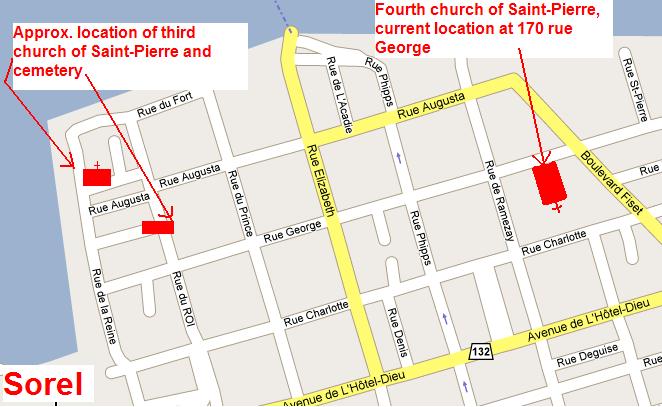
A second cemetery was established in 1702, and no discernable trace is left today. Quebec locates this cemetery someplace in the square block between Rue de Prince, Rue Augusta, Rue George, and Rue Elizabeth but states that they can’t be more specific due to a lack of specificity. (A surveyor or GIS technician could place this easily from the drawing, but I digress.) I originally thought that Anne wasn’t buried in this cemetery, but I’ve since revised my thinking based on new information. I love history and other obsessive genealogists.
There are reports of stones being moved from at least one earlier cemetery to Saints-Anges. I doubt that means the graves were moved, too, but it’s possible. Many of the early graves would have had only wooden crosses until time took them, so the earlier ones may not have been able to be located in 1852.
There’s an absolutely wonderful history of Sorel here, written by a genealogist, with contemporaneous maps that include the fort, early churches, and cemetery. Apparently, the St. Pierre “church” was built four times. The first two significantly predate Anne.
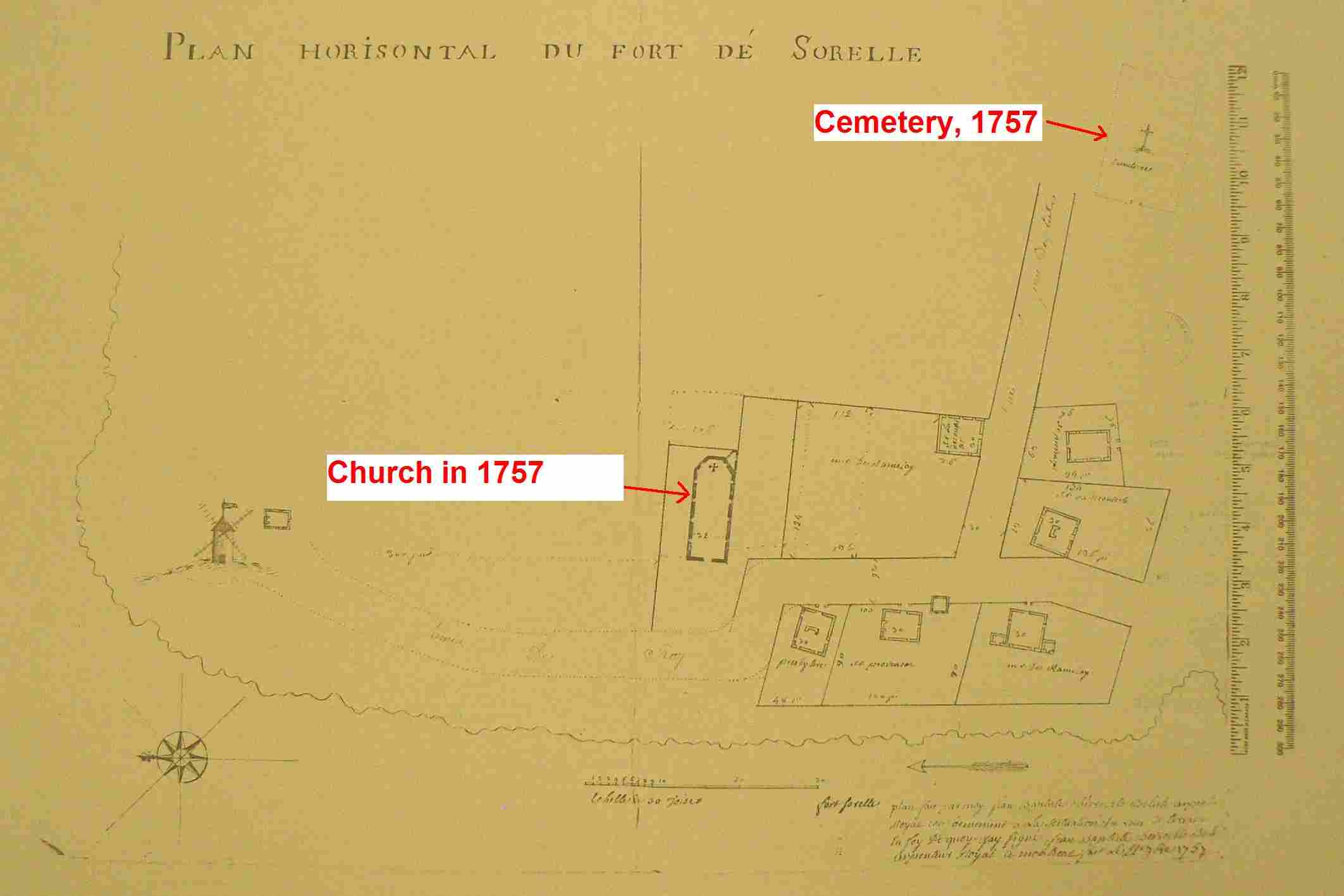
Due to ongoing warfare with England, the third St. Pierre church was built of stone and was located within the fort in 1750. On this map, you can see both the cemetery in 1757, and the church within the fort. Now we are getting someplace. In 1769 and 1770, the church was renovated, so we know it was still inside the fort. In the late 1700s, the church was enlarged.
The author notes that in 1791, the year Anne died, the population of the city itself was primarily English and Loyalist Americans who had escaped the US when it threw off English rule during the Revolutionary War and that the Franco-Canadians lived in the rural areas. This shift in population must have really grated on the Acadians, given their history with the English. However, I would have expected Acadians to live rurally anyway, along the river if possible.
Claude is not found on the list of Sorel residents, which might suggest to us that he did live rurally, further upriver towards St. Ours.
For all of Anne and Claude’s lives together, they attended either St. Ours or the St. Pierre church in the fort. During that time, all family burials were at Sorel—none at St. Ours, although there are burials in the St. Ours cemetery from that timeframe. In other words, they selected Sorel over St. Ours for some reason that we will never know.
In 1822, in Sorel, due to river flooding, a new St. Pierre church was built at 170 rue George, but was not completed until 1833. By 1822, Anne had been buried for 31 years, and Claude for 21.
Based on this history and maps, I believe strongly that Anne is buried in the St. Pierre Cemetery, located near the original fort church, located near the intersection of Rue du Prince and Rue Augusta.

Based on the size of the church documented in 1757, the location of the fort, the block length and the shape of the road, the old cemetery appears to have been below (south of) Rue Augusta and extending across Rue du Prince.
Note the original divot in this 1757 drawing, and the current divit in the road indicated by the red arrow at Rue Augusta and Rue de la Reine. You can see that the original road was located slightly above that divot connecting to the larger Rue Augusta, which is located between Rue du Roi and Rue du Prince.
You can also judge distance based on the distance between the windmill on the breakwater and the fort, the fort and the street, and the divot street (original Rue Augusta) to the cemetery. Note that the 1757 cemetery is larger than the church and maybe half the size of the fort area. That cemetery may also have grown between 1757 and 1852 when the new cemetery was established at the new St. Pierre church when it was built.
Ok, so let’s take a look today.

The red star is the fort area where the 1757 church was located.

Unfortunately, where the original church and fort were located is entirely shipping, industrial, and commerce today, and you can’t even see the Richelieu River. This parking lot, probably exactly where the church was located, and the red star is above, is the best we can do today.

This is the intersection of Rue Augusta, looking south down Rue du Prince. At that time, the cemetery would have extended on both sides of Rue du Prince, to the left and the right. Rue du Prince didn’t yet exist, then.
It’s actually a short block, and this location makes a lot of sense because you’re looking up a hill, meaning the cemetery is not likely to flood here.

If I’m correct, the cemetery, side to side (north to south), would begin about here and end about at that crosswalk behind the oncoming vehicle.

Almost everything here is either buildings, streets, sidewalks, or parking lots in the rear, but here and there, there’s a tiny strip of grass and an occasional small tree. I wonder if the residents in this area have any idea that they are living above a cemetery.

This view is from the upper side (east end) of Rue Augusta, looking south at what would have been the upper right corner area of the cemetery.
Just a block from the water, this region is heavily developed and has been for a long time. There’s almost no grass to be seen. The graves have been abandoned for probably nearly 200 years now, since at least 1852 when the new church was built, and possibly earlier. They have been covered over since these old homes were constructed here.
But Anne’s spirit can’t be paved over and remains a blessing to her descendants. Her journey lasted for 78 years, began and ended on a river, crossed oceans three times, and spanned four countries – depending on how you count. Boundaries and “ownership” shifted, which, of course, was the underlying source of all the heartache that befell the Acadians.
Anne bore witness to unspeakable atrocities and suffered an immense amount of heartache, but she survived, and thanks to her perseverance and stamina, nearly 1100 known descendants claim Anne as their ancestor today.
_____________________________________________________________
Follow DNAexplain on Facebook, here.
Share the Love!
You’re always welcome to forward articles or links to friends and share on social media.
If you haven’t already subscribed (it’s free,) you can receive an e-mail whenever I publish by clicking the “follow” button on the main blog page, here.
You Can Help Keep This Blog Free
I receive a small contribution when you click on some of the links to vendors in my articles. This does NOT increase your price but helps me keep the lights on and this informational blog free for everyone. Please click on the links in the articles or to the vendors below if you are purchasing products or DNA testing.
Thank you so much.
DNA Purchases and Free Uploads
- FamilyTreeDNA – Y, mitochondrial and autosomal DNA testing
- MyHeritage DNA – Autosomal DNA test
- MyHeritage FREE DNA file upload – Upload your DNA file from other vendors free
- AncestryDNA – Autosomal DNA test
- AncestryDNA Plus Traits
- 23andMe Ancestry – Autosomal DNA only, no Health
- 23andMe Ancestry Plus Health
Genealogy Products and Services
- MyHeritage Subscription with Free Trial
- Legacy Family Tree Webinars – Genealogy and DNA classes, subscription-based, some free
- Legacy Family Tree Software – Genealogy software for your computer
- OldNews – Old Newspapers with links to save to MyHeritage trees
- MyHeritage Omni comprehansive “everything included” subscription plan
- Newspapers.com – Search newspapers for your ancestors
- NewspaperArchive – Search different newspapers for your ancestors
My Books
- DNA for Native American Genealogy – by Roberta Estes, for those ordering the e-book from anyplace, or paperback within the United States
- DNA for Native American Genealogy – for those ordering the paperback outside the US
- The Complete Guide to FamilyTreeDNA – Y-DNA, Mitochondrial, Autosomal and X-DNA
Genealogy Books
- Genealogical.com – Lots of wonderful genealogy research books
- American Ancestors – Wonderful selection of genealogy books
Genealogy Research
- Legacy Tree Genealogists – Professional genealogy research
Share this:

Discover more from DNAeXplained - Genetic Genealogy
Subscribe to get the latest posts sent to your email.
Roberta:
Here we go again… Your stories always send me searching on the computer…
First, an easy fix – “Monte?” is actually “morte” – died.
Now for the Sorel cemetery, I decided to search for details on BAnQ using Sorel and cimetières as keywords:
And I find a book called “Histoire de Sorel des ses origines à nos jours”
“Nos jours” being 1926, the date of publication.
https://numerique.banq.qc.ca/patrimoine/details/52327/2022189?docref=fiS_PP75rCqGM35Rd-VnrQ&docsearchtext=Cimeti%C3%A8res%20Sorel
With the picture of the parish priests of the four parishes of Sorel in 1926 on the first page, I was sure to find the answer to the locations of the cemeteries.
Well, not really, but the problems the bishops had between 1720 and 1790 in getting the inhabitants to build and care for a church, a presbytery and a cemetery explain a lot. Several pages are dedicated to the fence that was still lacking some 30 years after the establishment of a parish cemetery in 1702 that had replaced the “seigneurial” one close to the mill. And then, the English won the war in 1759 and before the protestant religious infrastructure was ready, insisted in having burials in the catholic cemetery…
So the choosing of a parish – well – the church in Sorel was in such bad shape that the bishop forbade its use sometimes… So, no choice, really.
I think Anne was most likely buried in the old parish cemetery, but the bodies must have been moved, because in that area most buildings would have dug basement. There is probably a mass grave somewhere in the cimetière des Saints-Anges.
Other resources? Well yes, Library and Archives Canada do have a lot of documentation regarding Acadia, half of it on-line and not always an easy search. To make matters worse, they have a new website that was supposed to help, but most researchers who had finally got to know their way a around the old site, agree that it doesn’t help…
In theory, the land grant to the Garceau in 1771 should be here, but I could not find it…
https://www.bac-lac.gc.ca/eng/discover/land/land-petitions-lower-canada-1764-1841/Pages/land-petitions-lower-canada.aspx
First, thank you. Second, I don’t feel nearly as bad if this gives you problems too. 😁
It’s so hard to think about what our ancestors had to survive. Those that went through the Grand Derangement suffered tremendously. The difficult part is that it was done to them intentionally.
I work with many people who descend from Acadians. Most of them don’t realize the tragedies of their ancestors. They think they just moved to Louisiana at some point. No matter what you call it, you don’t understand what they went through until you look into their histories.
Thanks for bringing some of those histories to light.