
Françoise was born about 1679 in Port Royal, the daughter of Claude Dugas and Françoise Bourgeois.
The first record we find of Françoise Dugas is the 1686 census, where she is living with her parents and seven siblings on eight arpents of land in Port Royal, on the peninsula of what is now Nova Scotia. They have 25 head of cattle, 9 sheep, and 11 hogs. She is 8 years old. The family is doing well.

It looks like they may be living near or even in the Melancon/Melanson Settlement, today a historic site, given that in the census, they are living beside Charles Melancon who has married Marie Dugas, a sibling to Claude.
The 1690 Upheaval
In 1690, Françoise was about 10 years old, give or take a year.
Warfare between England and France on the soil of Acadia was just the way life was. An odd form of normal. Always on edge. Always watchful but at the same time carrying out the routines of everyday life. Everyday life is what fed your family. Protecting your farm enabled you to feed your family. The English were always trying to take Acadia, and then the French were always trying to take it back. Rinse and repeat.
Having reverted to French control in 1670, English warships attacked Acadia once again in May of 1690, surprising the unprepared Acadians.

Before approaching the town, William Phips, the fleet’s commander, made contact with Pierre Melanson dit Laverdure, a bilingual French Huguenot. Phips determined the town’s condition, then weighed anchor and sailed further into the bay and up to the town, today’s Annapolis Royal, where the fort was located.
Given where they lived, Françoise would have seen the huge ships passing by. Was she fascinated or terrified?
Fort Anne, which normally stood sentry over the town and harbor, was being torn down and rebuilt. Less than 70 French soldiers were in the garrison, 42 of whom were absent at that time. The French couldn’t defend themselves and surrendered.
After the surrender, the English breached the surrender terms, plundered and burned the town and fort, and desecrated the church after promising they wouldn’t.
In Phips own words, “We cut down the cross, rifled the Church, pulled down the High-Altar, breaking their images,” and on May 23rd, “kept gathering Plunder both by land and water, and also under ground in their Gardens.”
Clearly, the English meant business and behaved in an incredibly cruel manner – unlike the style of warfare the Acadians had been used to in the past. 28 homes and the church succumbed to flames, but the mills and upriver farms were spared, whatever “upriver” meant. Was the Dugas home burned? I would guess that it was, given that we know they lived near the fort and town.
Many Acadians hid in the forest. Françoise may well have been among them. Phips threatened them, and fearing slaughter, they came out of the woods and returned to their homes.
Following the devastation, the English required a loyalty oath to the English King. Phips ordered that his soldiers “burn, kill and destroy” anyone who refused to take and sign the oath.
Men signed out of self-preservation. Françoise’s father, Claude Dugas, and her future husband, René Forest, both signed. They had little choice if they wanted to keep their farms, livestock, and their lives – or whatever of that was left.
Françoise witnessed all of this as a young child.
Later Censuses
Changes from the 1686 to the 1693 census may well have resulted from the English burning so many homes in 1690 and the subsequent pirate attacks that resulted in more devastation.
In 1693, Françoise was 14 and is listed in the census with her parents and her elderly grandparents, Abraham Dugast and Marguerite Doucet, on 26 arpents of land – quite a bit more than in 1686. She now has 10 siblings. The family owns 4 guns but only owned one 7 years earlier and has 20 cattle, 30 sheep, and 15 pigs. This is clearly a combined household. In the 1686 census, her grandparents had been living alone.
In 1697, the French once again took control of Acadia.
The next census in which Françoise appears is 1698, after she married René Forest. His age is listed as 28, and hers as 20, which, based on their children’s ages, means she married at about 17 in about 1695. Daughter Marie is 2, and Marguerite is 1. They are doing well, especially for a young couple, with 18 cattle, 22 sheep, and 2 hogs. Unlike before, the census lists 40 fruit trees, and her husband owns 2 guns.
Five years later, in 1701, Françoise, now 22, has two more children: Marie is 5, Marguerite is 4, Joseph is 3, and Francois is 1. They farm 6 arpents of land, have 1 gun, 23 cattle, 18 sheep, and 3 hogs.
Two years later, in 1703, they reportedly have 4 sons and 4 daughters with one arms-bearer, who is clearly René.
In 1707, they had 4 males under 14, 2 girls less than 12, 8 arpents of land, 14 cattle, 24 sheep, and 15 hogs. They also had one gun.
In 1714, the last census, which, unlike the others, was ordered by the English, they had 10 children, 5 boys and 5 girls. Very little information is contained in the census, probably due to what happened in 1711,
Acadia Falls
In our mind’s eye, we see a peaceful census taker visiting each farm, climbing out of his canoe, waving as he approaches the house, and chatting with his neighbors. That belies what was actually going on in Acadia during this entire time. Acadia was never peaceful.
For example, let’s look at what happened in 1711 that clearly affected all of the Acadians.
Françoise Dugas’s aunt, Madeleine Dugas (1664-1738) married Germain Bourgeois (1650-1711) about 1682 in Port Royal. By 1686, they were living in Beaubassin with the other Bourgeois family members, who had created a village there.
The men from this village, eventually called Bourgeois Village, visited Port Royal from time to time. Among other reasons, their family members lived there.
On September 24, 1710, the English once again attacked Port Royal with 5 warships and 3400 troops. The Acadians, with 300 soldiers, which consisted of all able-bodied men, stood absolutely no chance. A siege began. The English blockaded Port Royal. Battles ensued for the next month, but on October 12th, the beleaguered Acadians surrendered. The British allowed the soldiers, which would have assuredly included René Forest and the rest of the Acadian men, to surrender the fort and leave, with their flag flying,

One of the terms of surrender stated that inhabitants within cannon-shot, 3 English miles, could stay for 2 years. This meant they had two years to move their “moveable items” to a French territory, which at that time was any of the rest of Acadia, including the Minas Basin. 481 Acadians pledged allegiance to the Queen of England, and the French troops left Port Royal, now renamed by the English to Annapolis Royal.
It would always be Port Royal to the Acadians.
450 English soldiers remained, but they clearly didn’t want to be there. By June of 1711, only 100 were left – the rest having either deserted or died.

By Verne Equinox – Own work, CC BY 3.0, https://commons.wikimedia.org/w/index.php?curid=10531352
On June 21st, a contingent of British soldiers was ambushed and killed at “Bloody Creek,” upriver about 15 miles, and ironically, where René Forest’s Village would later be drawn on a map.

Sixteen British were killed, 9 injured, and the rest captured, supposedly by the Mi’kmaq – although the Indians and Acadians were very closely allied.

About this same time, Acadians Guillaume Bourgeois, Jean Comeau, and Pierre LeBlanc of Annapolis, Germain Bourgeois of Beaubassin, and Francois Brassard of Chipody (who were passing through Annapolis) were arrested, reportedly for capturing a British soldier.
A descendant reports that Germain was held in the subterranean Black Hole at Fort Anne, originally a powder magazine, for several weeks. While his son, Guillaume, and the others were released, Germain died as a result. I can’t even begin to fathom that torture.
Writ large, we don’t know the outcome of this incident, but I decided to see if I could locate any corroborating evidence. As it turns out, the parish death records provide a clue.

Germain Bourgeois 1711 death
The priest, Father Durand, had been kidnapped and taken to Boston in January 1711, so deaths during his absence were not recorded on the day that they occurred. Nonetheless, we find that the priest later entered a burial record for Germain Bourgeois and the others who had perished during this time. “Died 1711, died during Durand’s captivity at Boston.”
A Bourgeois book by Paul-Pierre Bourgeois, page 72, states that Germain “d 1711, Port Royal, en prison comme hôtage du serment d’àllégence (61a)”. This translates into something like “he died in prison as a hostage for the oath of allegiance.”
To add insult to injury, without a priest, there was no one to perform the traditional Catholic Mass for Germain. The family would have made do, somehow, and buried him in the cemetery near his parents, who had died just a few years earlier – if they were able to have a funeral at all.
Françoise would have attended whatever service they had, standing by her mother and aunt who had children ranging in age from 28 to the baby, who was just three.
He died for being in the wrong place at the wrong time – and Acadian. There was no evidence he had been involved in the capture of the soldier.
Organizing the Census Data
The only avenue we have to discern birth dates of individuals born before parish records began is to correlate their ages across multiple census years. That’s also how we determine how many children were born to a family.
Françoise is with her parents in 1686 and 1693, but married before the 1698 census.
| Family Member | Birth Year | 1686 | 1693 | 1698 | 1701 | 1703 | 1707 | 1714 |
| Françoise Dugas | 1679 | 6 – born 1680 | 14 – born 1679 | 20 – born 1678 | 22 – born 1679 | 4F & 4M | 4M<14, 2F<12 | 5F & 5M
|
| Rene Forest | 1670 | 28 | 31 | |||||
| Marie Forest | 1696 | 2 born 1696 | 5 | F1 | F1 | F1 | ||
| Marguerite Forest | 1697 | 1 born 1697 | 4 | F2 | F2 | F2 | ||
| Joseph Forest | 1698 | 3 born 1698 | M1 | M1 | M1 | |||
| Francois Forest | 1700 | 1 born 1700 | M2 | M2 | M2 | |||
| Unknown male Forest | 1701 | M3 | gone | |||||
| Unknown male Forest | 1701/2 | M4 | gone | |||||
| Unknown female Forest | 1702/3 | F3 | gone | |||||
| Unknown female Forest | 1702/3 | F4 | gone | gone | ||||
| Mathieu Rene Forest | Jan 1704 | M3 | M3 | |||||
| Jacques Forest | June 1707 | M4 | M4 | |||||
| Marie Madeleine Forest | June 1709 | F3 | ||||||
| Elisabeth Forest | 1710 | F4 | ||||||
| Unknown male Forest | 1711/2 | M5 | ||||||
| Catherine Josephe Forest | May 1713 | F5 | ||||||
| Anne Forest | May 1715 | |||||||
| Pierre Forest | July 1717 | |||||||
| Jean Pierre Forest | July 1719 | |||||||
| Space for child Forest | 1721 | |||||||
| Charles Forest | Oct 1723 |
The number of children listed in the census, especially in 1703 is confusing. If they had four named children with ages listed in 1701, two males and two females – how did they have 8 children, four of each, two years later?
Four years later, in 1707, they had six children, but we know that children died often.
I suspect 1703 is simply wrong, or someone else’s children were counted as theirs that day. Unfortunately, 1703 doesn’t include the children’s names and ages.
As best we can tell, Françoise had at least 15 children, probably 18 and possibly 20. We only know the names of 13. We know for sure that four died as children, and another four may have died as adults before Françoise.
After their marriage, René and Françoise have the following resources listed in the census.
| Item | 1698 | 1701 | 1707 |
| Arpents of land | 16 | 6 | 8 |
| Fruit Trees | 40 | ||
| Cattle | 18 | 12 | 14 |
| Sheep | 22 | 18 | 24 |
| Hogs | 2 | 3 | 15 |
| Guns | 2 | 1 | 1 |
It’s interesting that in 1698, they have 16 arpents of land under cultivation and 40 fruit trees. Almost every family has fruit trees listed. Champlain’s men brought apple seeds with them in 1605, and by 1633, trees were planted in the Annapolis Valley.
In 1701, less land is listed, and no fruit trees – but neither are fruit trees listed for any other family. Maybe that accounts for the difference in the amount of land under cultivation, too. No fruit trees are listed in 1707 either, so 1698 provides us with a special glimpse of life in Acadia.
Françoise’s Children?
Like most women of that era, Françoise spent most of her adult life caring for her husband and children. Life, especially life with children, required a partnership between two people. One worked the fields and took care of things, literally, outside the house, and the other bore and nursed the children, made clothes, cooked, and kept the household in order. Families were large, in part due to the lack of modern birth control and the tenets of the Catholic church, combined with the need for children to become “hands” to help their parents.
Children raised in a farm culture looked forward to being old enough to help in some capacity. Being permitted to do different chores were rites of passage.
Marie de Forest was born about 1696, died Feb 1, 1770, in Montreal, Quebec, married Joseph Robichaud (Robichaux) (c 1794-1768) on Feb 7, 1718, in Port Royal, and had 9 children.

Marie Forest Robichaux marriage
Marguerite Forest was born about 1697 (per the 1698 census) and died May 27, 1747 in Port Royal, about 47 years old (per her death record). Witnesses were Claude Bourgeois and Francois Forest, her brother, and she was buried the following day.

She married on January 19, 1724 to Pierre Bastarache (1702-1751) and had 6 children. The last child was born in 1738 when she would have been 41 years old.
One of her sons, Michel Bastarche, was deported to SC with his brother, but they returned to Acadia quickly by 1756. He died there at age 89. Apparently, his two sisters remained in Acadia.
Joseph Forest was born about 1698, died January 10, 1732 in Port Royal, aged about 32, married Marie Jeanne Guillebaud (1701-1763) on November 25, 1720 and had 4 children. His wife remarried in 1737 to Francois Girouard and had two additional children. She was buried on November 27, 1763 in Cherbourg, Manche, Normandy.

Joseph Forest Guilbaud 1720 marriage
On July 6, 1723, Marie Joseph Forest was born to Joseph Forest and Marie Guilbaud with godparents Charles Guilbaud, father of Marie Guilbaud, and her grandmother, Françoise Dugas, mother of Joseph Forest.
Francois de Forest was born about 1701, died October 22, 1777 and was buried two days later at L’Assomption, Quebec, Canada, aged about 77. He married Jeanne Girouard (1709-1767) on October 20, 1727, age 26, with witnesses Alexandre Girouard, Antoine Blanchard, René Forest and Pierre Le Blanc, son of the late Pierre Le Blanc. They had 9 children.
1701/1702 child or children unknown
Parish records in Port Royal begin in 1702. Four years between children tells us that a child was born about 1702 and died.
The first child whose birth is recorded in the church records is Mathieu.
Mathieu René Forest was born January 11, 1704, and was baptized on April 20th with godparents Mathieu de Goutin, lieutenant general of this province, and Renee Bertrant dit de Forest (who is this person?). Is the name Bertrant a clue to a different surname and is Forest entirely a dit name?
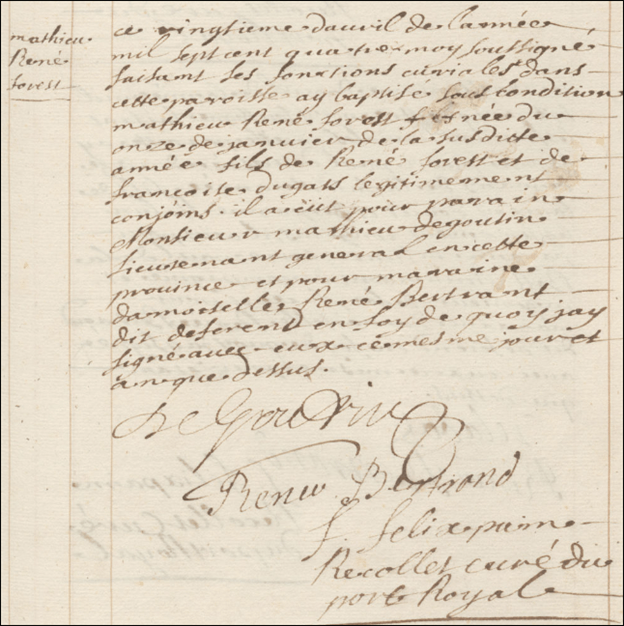
Forest Mathieu 1704 birth
Mathieu married on January 19, 1728, to Marie Madeleine Guilbeau (born 1712) with witnesses René Forest, Joseph Forest, brother of the groom, Jacques Forst, son of the said René Forest and brother of the groom, Charles Guilbaut, and Charles Guilbaut, the son, brother of the bride. They had two known children, born in 1728 and 1740. He appeared on the 1763 census of Connecticut.
Jacques Forest was born June 21, 1707 and baptized on July 19th in Port Royal with godparents Sieur de Teinville, lieutenant of a company and Jeanne Dugast, wife of La Forest.

He married on January 25, 1734, to Marie Josephe LePrince (born in 1715) with wintesses Claude Granger, Pierre Lanoue, Ambroise Beliveau, René Forest, Pierre Granger.
Jacques Forest and his family were deported to Connecticut in 1755 where he appears on the 1763 census.
Marie Madeleine (Magdelaine) Forest was born June 30, 1709, and was baptized on July 3rd with godparents Francois Dugast and Magdelaine Dugast, wife of Jean Hebert. She married Pierre Guilbeau (1704-1758) on January 21, 1731, with witnesses Charles Guilbaut, son of Charles Guilbaut, brother of the groom, Alexandre Guilbaut, son of Charles Guilbaut, brother of the groom, René Forest and Jacques Forest, his son.

Forest Marie Madeleine Guilbaut 1731 marriage
She died on March 27, 1758, the day after Easter, in Quebec, age 48, and was buried the next day in Bellechassse. Her husband and three children died in the same week. Her son, Jean-Baptiste, age 16, died the same day as his mother. Her husband died 9 days later, on April 5, 1758. Joseph died three days before his father, on April 2nd, about age 7, and Ursule, 14 years old, died the day after her father, on April 6th. What an incredibly grief-filled week. I wonder what took the family and if neighbors were dying, too. I can’t imagine being the two barely adult children left and having to deal with the magnitude of this loss.
Elisabeth (sometimes Isabel) Forest was born about 1710 and died on September 12, 1767 in Becancour, Nicolet, Quebec. She married under the name of Isabelle to Honore LePrince (1717 – c 1756), son of Jean Le Prince and Jeanne Blanchard on November 24, 1738, in Port Royal with witnesses René Forest, father of the bridge, Jean Le Prince, father of the groom, Pierre Forest, Paul Blanchard, Joseph Le Prince.

Forest Isabelle LePrince 1738 marriage
They had two known children. Their daughter, Marie Jeanne Victoire, married Francois Cornier in Becancour, Nicolet, Quebec, on January 7, 1760, so they were there by then. Another daughter married another Cormier male in the same place in 1771.
Catherine Josephe Forest was born on May 17, 1713 in Port Royal and was baptized the same day with godparents Claude Girouard and Isabelle Broussard.
She married Claude Gaudet (1713-1786) on August 18, 1737 with witnesses René Forest, father of the bride, Bernard Godet, father of the groom, Pierre Forest, Paul Blanchard, Isabelle Forest and Madelene Tibaudot.

Forest Catherine Josephe Godet 1737 marriage
They had 8 known children. Some may have been born after the deportation. This family is on the list of Refugees at Camp L’Esperance in 1756 and 1757. They are at Fort Edward in 1761/1762 with three in their household and settled at St-Jacques-de-Cabahannocer, Louisiana.
Karen Theriot Reader reports that Catharine Josephe died in Louisiana, and her name is recorded on the Acadian memorial Wall of Names where she is listed along with Claude and one child as early Acadian immigrants to Louisiana. Two of their children are known to have died in Louisiana, but the balance are unknown. She does not appear on the January 1, 1777 census at St. James, LA, but Claude died there before May 2, 1786.
Anne Forest was born May 3, 1715, and was baptized the following day with godparents Claude Brossard and Marie Forest.
She married on January 25, 1740, to Joseph LePrince (1719-1781) in Port Royal, son of Jean LePrince and Jeanne Blanchard, with witnesses René Forest, Jean Le Prince, and Simon Le Blanc. He died on May 24, 1781, in Becancour, Nicolet, Quebec, aged 62.

Forest Anne LePrince 1740 marriage
This family escaped the deportation by fleeing to Miramichi in New Brunswick. Her husband and children are noted on the passenger list in Quebec in July 1757, but Anne is not. Anne had died by the time her daughter, Marie-Joseph, born in October 1753 in Port Royal, died in Quebec on January 5, 1758, and probably died during their time in Miramichi.
Pierre Forest was born July 10, 1717 and was baptized provisionally by Claude Teriot. On August 1st he was baptized by the priest in Port Royal with godparents Guillaume Blanchard and Jeanne Richard.

Forest Pierre 1717 baptism
He married on June 30, 1744 to Marie Madeleine Richard (1718-1761) in Port Royal with witnesses René Forest, Prudent Robichaux, Etienne Robicheaux, Simon Richard, and Joseph Richard.
According to the Belle-Ile-en-Mer depositions, he died in 1750 inthe Memramcouk village of Beaubassin.
Jean Pierre de Forest was born July 22, 1719, and was baptized the next day in Port Royal with godparents Francois de Forest and Agnes Godet.

Forest Jean Pierre 1719 baptism
On November 11, 1743, he married Anne Richard (born in 1720) with witnesses René Forest, Bruno Robicheaux, Simon Richard and Joseph Richard.. He was listed in 1763 in the Connecticut census.
Space for 1721 child – unknown
Charles Forest was born On October 23, 1723 and baptized the next day in Port Royal.

Forest Charles 1723 birth
He married on May 10, 1745 to Marie Chaisson in Beaubassin, Acadia, but was then married about 1746 to Marie Josephe Poirier, with whom he had 5 known children. In 1763, he was listed on the Fort Beauséjour census. In 1792, he married again to Marie Josephe Girouard. Karen Reader shows his death in 1805 in Menoudie, Cape Breton, at age 82.
There is significant confusion surrounding two men by the same name – see here.
What Happened to Françoise’s Children?
We have some information about what happened to Françoise’s children by the time the deportation occurred.
The more we are able to learn about the destination of her children and where they eventually wound up, the more hints about where Françoise may have eventually been laid to rest.
Keep in mind that known children does not necessarily equate to all children, especially not for grandchildren born in remote locations in Acadia, or after deportation. Many were simply “lost.”
| Child | Spouse | Death | Known Children | Deportation |
| Marie b 1696 | Joseph Robichaud m 1718 | 1770 Pointe-aux-Trembles, Montreal, Quebec | 9 | Some of her children went to MA, some were prisoners at Halifax, NS, until 1763, and some settled in LA. |
| Marguerite b 1697 | Pierre Bastarache m 1724 | May 1747 Port Royal | 9 | Some children to New Brunswick, others to Clare and Pubnico, NS |
| Joseph b 1698 | Marie Guilbeau m 1720 | Jan 1732 Port Royal | 4 | Some children to Quebec |
| Francois b 1700 | Jeanne Girouard m 1727 | Oct 1777 L’Assomption, Province de Québec | 9 | Some children to MA, CT, Quebec, lower Canada near Montreal |
| Mathieu Rene b Jan 1704 | Madeleine Guilbeau m 1728 | Before 1777 Louisiana | Unknown | CT but left during the Rev War following loyalists back to Canada – this person uncertain |
| Jacques b June 1707 | Marie Josephe Le Prince m 1734 | Unknown | 9 | Deported to CT, one child to l’Acadie, Quebec, the rest still lost |
| Marie Madeleine b June 1709 | Pierre Guilbeau m 1731 | Mar 1758 in St-Charles, Bellechasse, Canada | 8 | Husband + 3 children died the same week she did. One child in New Brunswick and others in Quebec. |
| Elisabeth b 1710 | Honoré Le Prince m 1738 | Sept 1767 Bécancour, Québec | 5 | Some to Quebec and others to Lower Canada near Montreal |
| Catherine Josephe b 1713 | Claude Gaudet m 1737 | Louisiana after 1763 | 8 | Escaped to Camp d’Esperance on the Miramichi, only one child survived, after 1763 went to Louisiana. |
| Anne b May 1715 | Joseph (Le) Prince m 1740 | Between Oct 1753 and Jan 1758, probably in Miramichi with 3 of her children | 7 | Escaped to Miramichi in New Brunswick, then to Quebec. |
| Pierre b Jul 1717 | Marie Madeleine Richard m 1744 | July 1750 Memramcouk, Beaubassin | Unknown | |
| Jean Pierre b Jul 1719 | Anne Richard m 1743 | After 1763, probably CT | Unknown | Deported to CT and listed on 1763 census. |
| Charles b Oct 1723 | Marie Chaisson 1745, Marie Josephe Poirier 1746, Marie Josephe Girouard 1790 | About 1805 Menoudie, Nova Scotia | 6 or 7 | Memramcock, then Restigouche, then Chedaik, Point Beausejour. In 1761 Gaspe Refugees. 1763 Fort Beausejouir. Menoudie later. |
Françoise had at least 75 grandchildren and probably several more. Unless they were exiled in the same location that she was, she would never have known about any born after the summer of 1755. Furthermore, she would have grieved the absence of every one of these sweet souls. They were ripped away from her. Grandchildren are the light in the life of grandmothers, and hers were gone. She probably prayed every single day for them and that their separation would not be forever.
Many of the deported Acadians never accepted that they weren’t one day going back home
Two of Françoise Dugas’s grandchildren were documented in depositions on Belle-Ile-sur-Mer in France in 1766 and 1767 after deportation. Marie, the daughter of Pierre Richard and Marie Girouard, married Pierre Forest. Her sister, Anne. married Jean Forest.
Françoise’s family was literally tossed to the winds, with leaves falling across the globe.
Godmother
After the 1714 census, information about Françoise is sparse but some information is found in the Catholic parish registers.
On what must have been an incredibly joyful day, Françoise Dugas stood as the godmother for her first grandchild, a boy, Prudent Robichaux (also spelled Robicheau and Robichaud), born to her eldest daughter, Marie, on Monday, December 19, 1718.
She was probably present for the child’s birth too.

The original parish records were recopied once, above, and they are much more legible than the original below. I always check both. Sometimes whoever made the copy can make out words in the original that I can’t.

Robichaux Prudent 1718 original
Françoise Dugas was mistakenly noted as the wife of René Robichaux instead of René Forest, but it’s clear who was meant. There is no René Robichaux or similar spelling in the St. Jean-Baptiste parish records between 1702 and 1755.

Forest, Marie Josephe 1723 baptism
On Tuesday, July 6, 1723, Françoise stood as the godmother for Marie Josephe Forest, her son Joseph’s first daughter, where she is noted as Joseph’s mother.

Fortunately, the Nova Scotia Archives records are indexed by the name of the primary individuals, meaning those who are being buried, baptized or married. Unfortunately, there’s no every-name index published, even though the individual record transcriptions do show that information.
If we were to check the baptismal records for Françoise’s grandchildren born in Port Royal, beginning with the ones born closest to the 1755 deportation date and working backward, we might discover more instances of her serving as Godmother.
1755 – The Final Battle
You might think that Françoise’s final battle was death, but in this case, it wasn’t.
The final battle was the horrific genocidal eviction of the Acadian people from their homelands in 1755. At least all of the Acadians that the English could find.
By 1755, Acadia reached throughout most of Nova Scotia, stretching entirely across the peninsula from Pubnico through Port Royal, past Halifax, northeast past Louisbourg, and back to the Les Mines basin, including Truro, Grand Pre, and Beaubassin.

The English were determined to take Acadia once again. Not just to oversee or rule the land but literally to “take” all of the land and property, evicting, removing, and essentially robbing the Acadian people of all of their belongings. Their intent was to settle English families who would, of course, be much easier to control.
If Acadian lives were lost in the process – so what.
Ships were sent to round up and forcibly deport the Acadians. No effort was made to keep families together, either on ships or relative to their final destinations.
Many were sent to the colonies, but the colonies weren’t prepared, and some rejected shiploads of destitute people.

For many families, the only connecting glue is if someone was baptized in Acadia and some two decades later, is once again found in the parish records elsewhere, say, Louisiana or Quebec, for example.
My ancestors either died or made it to Quebec, south of Montreal. Many families were simply never heard from again.
Several overloaded ships headed back to ports in Europe, and some sank en route.
Where was Françoise? Was she alive? Where did she go? Was she entirely separated from her family? Did she ever see any of them again?
Françoise’s Death
Françoise died sometime after October 12, 1723, when she stood as godmother. That much we know for sure. She was about 43 then and could certainly have lived many more years.
Françoise may still have been alive when René died and was buried in Port Royal on April 20, 1751. She would have been about 70.
His burial record in Port Royal indicates that two sons and a son-in-law were witnesses on his burial entry: Claude Godet, Mathieu Forest, and François Forest. That tells us that at least these three children were still living in Port Royal, although they would be separated during the deportation 4 years later.

Rene Forest 1751 burial
It doesn’t say he’s the widower of Françoise Dugas, although it does mention her, so she may have outlived him. If so, that means she also outlived at least four of her adult children, plus the ones who died young.
There’s no death record for Françoise before the deportation, Le Grand Dérangement, which probably means she was rounded up and deported at 75 or 76 years of age.
Let’s hope that she managed to get on a ship with at least one of her children.

How her heart must have ached for the children and grandchildren who would disappear into the mists of time, ghosts on other ships, screaming across the water until their voices could no longer be heard. Frantic outstretched arms.
Mémère!
Mémère!
Grandchildren she would only reunite with in the hereafter. She probably heard them in her nightmares, still screaming for her – unable to reach them.
The church where her entire spiritual life had been spent – joys and sorrows – elation as a bride, and tears as she buried those dear to her heart, including that groom more than half a century later. Now, simply disappearing as she could see it behind the fort and garrison, an ever-smaller dot and spire on the horizon, slipping away.
René’s grave – those of her parents, brothers, sisters, their children, her children, and, yes, grandchildren too. The grave where she was supposed to rest beside her beloved family members for eternity. She would never rest in peace now.
There would be no comfort. No peace ever again.
If Françoise lived to see this horrific day, she slowly sailed out of sight of everything she had ever known – into the yawning jaws of the inky abyss. I hope she didn’t realize…but in my heart, I know that that she did.
Goodbye, Port Royal.
_____________________________________________________________
Follow DNAexplain on Facebook, here.
Share the Love!
You’re always welcome to forward articles or links to friends and share on social media.
If you haven’t already subscribed (it’s free,) you can receive an e-mail whenever I publish by clicking the “follow” button on the main blog page, here.
You Can Help Keep This Blog Free
I receive a small contribution when you click on some of the links to vendors in my articles. This does NOT increase your price but helps me keep the lights on and this informational blog free for everyone. Please click on the links in the articles or to the vendors below if you are purchasing products or DNA testing.
Thank you so much.
DNA Purchases and Free Uploads
- FamilyTreeDNA – Y, mitochondrial and autosomal DNA testing
- MyHeritage DNA – Autosomal DNA test
- MyHeritage FREE DNA file upload – Upload your DNA file from other vendors free
- AncestryDNA – Autosomal DNA test
- AncestryDNA Plus Traits
- 23andMe Ancestry – Autosomal DNA only, no Health
- 23andMe Ancestry Plus Health
Genealogy Products and Services
- MyHeritage Subscription with Free Trial
- Legacy Family Tree Webinars – Genealogy and DNA classes, subscription-based, some free
- Legacy Family Tree Software – Genealogy software for your computer
- OldNews – Old Newspapers with links to save to MyHeritage trees
- Newspapers.com – Search newspapers for your ancestors
- NewspaperArchive – Search different newspapers for your ancestors
My Books
- DNA for Native American Genealogy – by Roberta Estes, for those ordering the e-book from anyplace, or paperback within the United States
- DNA for Native American Genealogy – for those ordering the paperback outside the US
- The Complete Guide to FamilyTreeDNA – Y-DNA, Mitochondrial, Autosomal and X-DNA
Genealogy Books
- Genealogical.com – Lots of wonderful genealogy research books
- American Ancestors – Wonderful selection of genealogy books
Genealogy Research
- Legacy Tree Genealogists – Professional genealogy research
Share this:

Discover more from DNAeXplained - Genetic Genealogy
Subscribe to get the latest posts sent to your email.
Roberta, I really sharpened my nearly nonexistent French language skills working on my husband’s genealogy. Had even more difficulty with the rather ornate handwriting in the documents of Quebec.
Wonderful and sad story of your ancestors.
Are you familiar with the song “Acadian Driftwood”? It was written by Robbie Robertson when he was with The Band. It is about the sad story of the Acadians. Robertson was Canadian.
I actually like folk singer Richard Shindell’s version even better than The Band’s. https://youtu.be/Cb29GYV4mqo?si=odtdPkVbLX2QwZfD
No but I’m going to listen now. Thank you.
Pingback: Claude Dugas (1649-1732), Acadian Octogenarian Armorer – 52 Ancestors #437 | DNAeXplained – Genetic Genealogy
I would not assume triangulation. It would be interesting to see how many people who have a shared match anyplace do traingulate on any segment.