
Despite my attempts at clarity, the early life of Jacques Le Prince remains a mystery, as does his death.
We can’t prove anything about Jacques’ early years at this point, but there are possibilities that need to be considered and evaluated.
It’s likely that Jacques was born in France, around 1646, according to a later census.
The Carignan Regiment?
A man named Jacques Prince, or LePrince, was a member of the 1300-man Carignan Regiment, which was dispatched to New France from 1665 to 1667 to fight the Haudenosaunee, an Iroquoian confederacy. Their numbers were impressive, but the French soldiers were ill-prepared for the type of fighting they would encounter on the frontier.
After peace was declared in 1667, most of the soldiers returned to France, but not all. France offered attractive incentives for those who wished to stay and settle, including land, a year’s worth of provisions, and a sum of money dependent upon the soldier’s rank.
About 400 stayed, and 283 are known to have married near Quebec where many Acadians would one day take refuge after the 1755 Expulsion, including Jacques’ grandchildren.
However, that leaves about 120 Carignan soldiers unaccounted for.
One Jacques LePrince is on the regimental list of soldiers in the Laubia company.
A WikiTree contributor provides the following summary. I have fixed the broken links in this version.
According to an article by Chantal Gaillardetz Bourque, “Les Prince,” [7] and to various compiled genealogies, a soldier named Jacques Leprince (or Prince) appears in lists associated with the Carignan-Salières Regiment. There was a Jacques Leprince or Prince in the regiment’s list of soldiers.
It is claimed that he embarked from La Rochelle aboard “Le Saint-Sébastien” on 24 May 1665 and arrived at Québec on 12 September 1665. Two days later, members of the Laubias Company reportedly traveled to Trois-Rivières aboard La Justice, where they remained until about 1668.
A Jacques Leprince, aged 25, is said to appear in the 1666 census of Trois-Rivières as a servant in the household of the notary Sévérin Ameau. Stephen White questions whether this individual can be identified with the Jacques Leprince who later married Marguerite Hébert in Acadie. [1] It is also believed that after being discharged from the Regiment, Jacques went to Acadia, around 1667.
The website migrations.fr, citing Roy and Malchelosse, notes that the surname Leprince does not appear in the official roster of the Laubias Company, but is mentioned elsewhere in the same source.
(My note.) Page 111 in the same volume for soldiers not included on the roll who returned to France or remained in Canada. The soldiers are listed by their nicknames. This means that if this is our Jacques, his actual surname may not have been Prince or LePrince. We need a LePrince man proven to descend from Jacques through all males who is willing to take a Big Y-700 test. I’m offering a DNA testing scholarship, so please reach out.
From this, some authors infer that the soldier and the Acadian settler were the same person; however, no direct documentary link has been demonstrated. [9]
Other writers further hypothesize that Jacques Leprince was born about 1641 in Normandy, the son of Nicolas Leprince, seigneur de la Bretonnière, and Judith Hurault. This lineage is based on interpretive readings of heraldic material rather than on contemporary civil or parish records.
Another person also states, with no evidence, that Jacques was actually named Jacques Nicolas LePrince and was born in St. Malo.
Cousin Mark did a deep dive into the French records at Filae and reports:
There is absolutely no evidence that Jacques Le Prince was born in Normandy or the son of anyone from there.
The soldier Jacques Le Prince recorded in the 1666 census for Trois-Rivières as domestique for the notary Sévérin Ameau shows an age of 25, so born about 1641, not 1646.
On 3 Nov 1667 he appears as witness to the marriage of Noël Laurence dit l’Orange, a soldier in the Lafouille Company, at Trois-Rivières; he is identified as “soldat nommé LePrince de la compagnie de Loubias”. Likely the same Jacques Le Prince appears as a witness on 15 Apr 1671, to the marriage of Paul Daze, an immigrant from Loudun and an older widow Françoise Goubillo, which raises an interesting thought. This Jacques Le Prince no longer appears in the records of Québec.
While PRDH and others have linked the soldier Jacques Le Prince with Acadian Jacques Le Prince, there is no additional evidence to do so. Stephen White had reason to wonder if the two are the same.
It is even possible that Le Prince was a “dit” name given to the soldier, just as Julien Lore/Lord dit La Montagne was usually referred to by his “dit” name in Acadia. There are several family trees on Filae.com with a Jacques Prince/Le Prince scattered throughout Southwest France, the recruitment area for the Carignan-Salières Regiment and the Loubias/Laubia company. It was not Normandy.
This information makes me wonder if there were actually two men named Jacques LePrince in the Quebec area at the same time. One, a soldier, while the other, is, at the same time, a valet for the notary. It seems impossible that one person is serving in both positions at the same time, but I don’t know.
Is this the same Jacques Le Prince or Prince that married Marguerite Hebert in Acadia sometime between 1671 and 1678? We don’t know.
Keep two things in mind:
- The English had captured Port Royal in Acadia in 1654, but it was returned to France by treaty in 1667. However, it wasn’t until September of 1670 that the new French governor was established, marking the effective return of Acadia to French control. It’s unlikely that Jacques LePrince, the soldier, would have made his way to Port Royal until after it was firmly under French rule.
- Jacques LePrince, who may or may not be our Jacques LePrince, witnessed a marriage in April of 1671, in Trois-Rivieres.
What We Do Know
The first actual record that we have that positively includes “our” Jacques LePrince in Port Royal, or anyplace, is the 1678 Acadian census.
Jacques “La Prence” and Marguerite Hebert are listed with one child, a female, 2 arpents of land, and 8 cattle. Their household is located far upriver, between Olliver Daigre and his wife, Marie Godet, and neighbor, Jean Hebert, northeast of Bridgetown today.

Essentially, Jacques LePrince and his family inhabit one of the furthest homesteads from Port Royal, some 18 miles upstream as the crow flies, but Jacques would have been paddling a canoe through all of the twists and turns in the river – so probably more like 25 miles to get to town, or church.
This census suggests that Jacques and Marguerite Hebert were married by at least 1677 if they had an infant daughter. The child’s age is not recorded.
However, there’s evidence to suggest that they might have been married by 1671. In the 1671 census, Marguerite Hebert, age 19, is listed with her widowed mother, and the census indicates that she is one of two married daughters. In the 1671 census, typically the married children are listed with their parents, PLUS in their own household – but there is no hint of Marguerite in any other household, nor is Jacques LePrince listed. The other married daughter, Marie Hebert, age 20 with three children, is living next door with her husband Michel de Forest.
Relative to Jacques LePrince, there are two flies in this ointment.
The first Acadian census was taken in the spring of 1671 following the new governor’s arrival in September of 1670. We know the census was taken sometime in the spring of 1671, because the passengers on the ship, L’Oranger, which left La Rochelle in the spring, so probably arrived May-ish, were not recorded in the census. This includes Pierre Arsenault, Martin Benoit and wife Marie Chaussegros, and possibly Francois Broussard which means they arrived after the census had already been taken.

Therefore, if Jacques LePrince was witnessing a marriage in Trois Rivieres in mid-April 1671, he probably didn’t have a wife in Port Royal. Not to mention that those locations are hundreds of miles apart, and transportation was challenging. While an overland walking route is shown above, it would have been very dangerous and quite long. The typical journey was on a ship, traveling down the Saint Lawrence River, crossing the open sea, then circumnavigating Nova Scotia to Port Royal. The trip took between one and three months, depending on the weather.
I’m not saying that the Jacques in Quebec isn’t the Jacques in Port Royal, I’m saying we need to consider this possibility carefully, all things considered.
The second potential fly is that the 1671 census says that Marguerite Hebert, age 19, was married – but it doesn’t say to whom. It’s possible that she had married but was widowed by 1671, but had remarried by the 1678 census when she is found with Jacques LePrince.
It’s also possible that Jacques LePrince was on the ship, L’Oranger that arrived in Port Royal from France later in 1671 with 50 new colonists.
If Jacques and Marguerite had children before their daughter, Marguerite, was born around the time the 1678 census was taken, those earlier children had all died prior to the 1678 census.
In 1678, Jacques La Prence and Marguerite Hebert are living between Oliver Daigre and his wife, Marie Godet, and Jean Hebert. In 1715, Jacques’ son, Jean LePrince would marry the widow of Oliver Daigre’s son, Oliver. Jean Hebert is Marguerite’s brother.

In 2024, I located the Daigle homestead near Button Brook, east of Bridgetown.

The Daigle homestead is shown here on the MapAnnapolis map.
In the 1686 Port Royal census, Jacques LePrince is age 40, so born about 1646, and shown with his wife, Marguerite Hebert, 35, with 4 children, 5 sheep, and 3 hogs. Children’s ages and names are listed for other Acadian couples, but frustratingly, not for Jacques and Marguerite’s children. No land is listed either, nor does Jacques own a gun, which is very difficult to believe. We really can’t tell where he’s living based on his neighbors, although it’s likely that they are living in the same location as 1678. I suspect they are living very remotely – and the census taker simply didn’t visit. Hence, the omission of data.
Jacques’ name is also absent from the 1690 mandatory loyalty oath to the English crown, forcibly signed under duress in Port Royal by all the Acadian men. The English clearly weren’t coming to find him in the hinterlands.
The Move to Minas
It’s difficult to know whether to interpret the lack of his 1690 signature as evidence of the fact that he lived so far away, meaning upriver beyond Bridgetown, or evidence that he had already taken his family and settled at Minas, which is also possible. If he hadn’t already left, the unprovoked 1690 attack on Port Royal by the English, followed a few months later by a second pirate attack, may have been what prompted that move.
In the 1686 census, 10 families had already settled at “Baye des Mines,” including Marguerite’s brother, Etienne (Estienne in the census) Hebert, who married Jeanne Comeau, and Marguerite’s sister, Catherine Hebert, who married Philippe Pinet.
By the 1693 census, Jacques Le Prince and his family had moved to Minas, and Jacques had died, probably either in Minas or Pisiquid, but we will never know for sure. Both are possibilities. It’s also possible, but extremely unlikely, that Jacques died in Port Royal and Marguerite joined her family in in the Minas Basin.
Marguerite Hebert, Jacques’ widow, is listed in the census as age 40, with:
- Daughter Marguerite, 15 (so born about 1678)
- Twins Francois and Jacques, 13 (born about 1680)
- Estienne, 5 (born about 1685)
- Francoise, 1 (born about 1692)
Francoise may be incorrect. Francoise may have been their youngest son, Jean LrPrince, unless Francoise died young and Jean was actually born in 1693 after the census had already been recorded.
Another child;s name was misrecorded too. Based on later marriage records, the twin named Jacques here was actually named Antoine.
Were their children mis-recorded because they were newcomers to the area, or perhaps because they were living very remotely again?
This tells us that Jacques LePrince died between 1691 when Marguerite would have become pregnant for the child who was listed as “1” in 1693, and when the census was taken that year. Unfortunately, there are no parish registers prior to 1707, so Jacques’ death is not recorded.
If daughter Marguerite was 15 in 1693, then she would have been born about 1678, which correlates with the 1678 census when one female child was listed.
This means that Marguerite and Jacques were probably married by 1676 or 1677, or if they married earlier, prior to the 1671 census, their children born between their wedding and Marguerite’s birth about 1678 had all died.
Life at Grand Pre and Minas
Pierre Melanson and his family led the way to Minas between 1682 and 1684, followed by others. The first families to settle in Grand Pre in the Minas Basin would have selected land close to each other. One of the first group activities was probably to dig a well and build a small church, home of the St. Charles aux Mines Parish, founded in 1686. Of course, that church was probably improved and expanded in later years before being destroyed by the English in 1755.

The church at Grand Pre has been rebuilt and preserved, welcoming visitors today.

Inside the church, mirrors are beautifully engraved with the names of the early families as recorded in the parish register. Our Le Prince family is honored here, shown to the right of my black bag.
I don’t know if this was the intention or not, but as I looked at their name, and me, in the mirror, I’m looking at a little bit of them.
Jacques LePrince would have worshipped here. At least his youngest child, and perhaps more of his children, would have been baptized here if they actually lived at Minas when the family first moved to the Basin from the Riviere Dauphin, as the Annapolis River was called then.
Ten households consisting of 57 people were recorded in the 1686 census.
Probably encouraged by Marguerite’s siblings who had already made the move, Jacques and his family arrived sometime during the next seven years, likely with a group of Port Royal families who made the journey together. When the next census was taken in 1693, there were 307 people living in 55 homes. The population had increased more than fivefold.
The labor, as well as the fruits of that labor, were shared.

Jacques probably helped plant this orchard, but he never lived long enough to reap those benefits. His wife and children may have.
If he didn’t plant this orchard, he surely planted one similar.

A community well was dug which tells us that the inhabitants lived in close proximity.

This particular well is believed to have been used to water livestock.


How many times did Jacques dip the wooden bucket in the well for fresh water?

Standing beside the church, as Jacques surely did, we see the Bay of Fundy in the distance, across the salt marsh fields.

The millstone lying beside the church today speaks of grinding crops – wheat, oats, barley, rye and sometimes buckwheat. Grains essential to their survival and particularly suitable for production in the rich reclaimed marshlands.

Flowers line the walkway between the church, the well, and the cemetery.
If Jacques died in close proximity to the church, and a priest was available, his funeral mass would have been celebrated in this sacred place.

A stone cross marks the location of the cemetery and honors the Acadians who are buried here. This cemetery location was confirmed when coffins were found in the late 1800s.
Incomplete parish records show about 170 burials, but historians believe there are probably around 400 located between the church and the road.

Graves would have been marked with white crosses when they were fresh, but anything left was destroyed by the English during and after the Expulsion.

This French Willow tree was probably standing when Jacques and the Acadian men were fetching water from the well and planting the orchard.

This tree probably was too. They may have been planted by the Acadians.
Initially, Jacques may have lived within walking distance of the church.
We don’t know when settlers migrated away from the Minas area to Pisiquid and the Riviere Hebere.
We don’t know where or how Jacques died. He was still a relatively young man, between 45 years old in 1691, and 47 in 1693, his bracketed death dates.
Jacques could have perished in the sea, the river, or in the back country. If so, there would have been no funeral or graveyard burial.
He could have died at home, perhaps from a farming accident, an infection or illness that we have medicines to effectively treat today.
If the family actually did live at Minas, at least initially, and not distantly, he would have been buried in the cemetery beside the church in Grand Pre, in consecrated ground.

Today, we can sit quietly and reflect, knowing that their graves surround us.

Perhaps Jacques’ spirit came to visit in the form of this raptor. Was he carrying a message?

Do they know we’ve come to visit them?
Given the early date of Jacques LePrince’s death, it’s possible that the original settlement group was still clustered together and the next wave of settlers had not yet begun reaching out further to establish homesteads.
That said, we really don’t know exactly when the new frontier summoned several families to move on. We do know that Jacques certainly wasn’t concerned about living some distance away from the main village.
We also know, from priests’ records, that Father Jean Buisson de Saint-Cosme served Minas from 1692-1698. There were significant periods when the area, especially the villages established further east, at or near Pisiquid, were without priests or churches.
Riviere Hebere

Based on this 1755 map of Minas, it’s possible that the Jacques LePrince and Marguerite Hebert family lived a significant distance away from Minas and Grand-Pré itself, near the arrow indicating the Riviere Hebere.
When did the early families settle at Pisiquid, relatively distant from Minas? Did family groups settle into small villages there directly, and not establish themselves at Minas first?

Today, the Riviere Hebere, now the Herbert River, is beyond the St. Croix River that branches into the Meander River, then branches again into the Herbert River to the east of Mantua.

Tidal bore rivers provided fertile salt marshes that were dyked and drained using sluices.

The Grand-Pré National Historic Site provides a wonderful museum that, among other things, illustrates the Acadian farming practices.

Sluices let the rainwater escape as the wooden flap opens, then closes to prevent seawater from flooding the fields.

Remnants of the old aboiteau drainage systems are regularly unearthed, more than 300 years later.


This area would have felt quite familiar to Jacques LePrince and the Acadians, as it is located on a tidal bore river that required dyking and draining through a complex series of aboiteau and sluices – just like Port Royal.
You can read more about the Herbert River, here. Be sure to download the pdf file for wonderful maps.
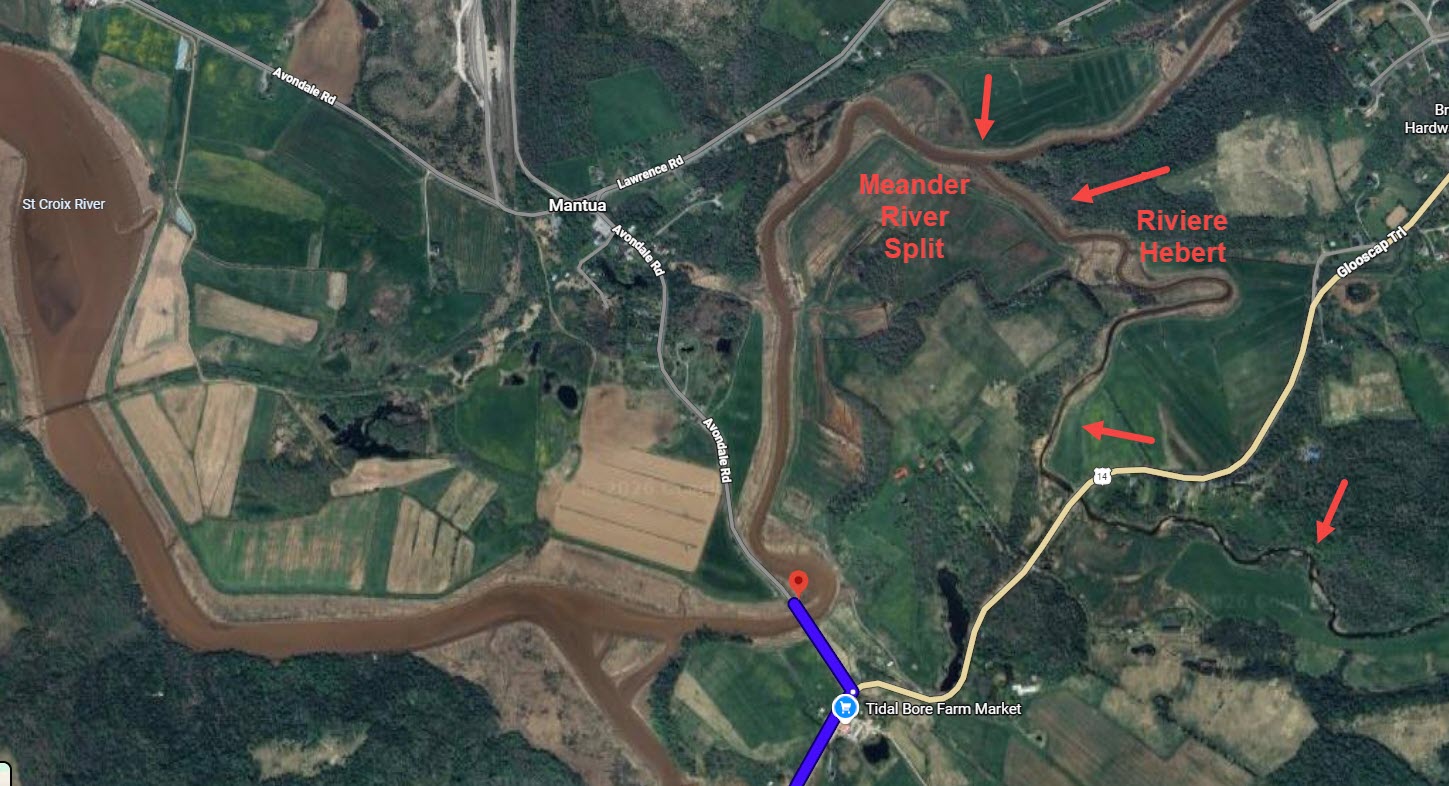
Tidal rivers always look brown thanks to the constant churn of the mud from the bottom of the river as the tide rushes in and out twice each day.
The Herbert River stretches many miles inland but loses the tidal bore effect at the point where the brown coloration changes on the map. Acadians were experts at reclaiming and farming tidal marshland. In fact, the more marsh, the better, so they would have settled and farmed the area near the Meander River split.

If, in fact, Jacques LePrince did live among the Hebert family in the remote area near Mantua, it’s no wonder the census taker listed his children incorrectly. The census taker may have been the priest, and you can bet the only time those in the remotest regions saw the priest was when he passed through from time to time, baptizing babies and hoping for a friendly place to stay. Maybe he asked someone who came to town, “Who else lives out there?”, and recorded what they said.
The overarching theme, to this point in Jacques’ life, is that he lived in the most remote part of Port Royal at Paradis Terrestre, possibly followed by the most remote part of the Minas Basin at Pisiquid.

The curves of the Meander River as seen from Avondale Road near the Mantua Bridge, although we don’t know if this was considered part of the Riviere Hebere at the time. It’s still quite remote, and there are few roads.
As I look at this tidal river, I can’t help but wonder if Jacques got too close when the tide was rushing in or out. It’s quite dangerous, and nothing like the tidal river at Bridgetown which is barely visible and quite tame by comparison. This YouTube video is taken at nearby Moncton, but you can see the huge wave and the person riding the surf in front of it. This video shows the smaller tidal bore on the St. Croix River further inland.

Crossing the Mantua Bridge. You can see progressive photos of the tidal bore, here. This is probably very close to, or where the Hebert family village was located, and where Jacques would have lived if they had established homes here before he died.
By the time you’ve driven just a mile or so further east of the bridge, the terrain has changed and is no longer primarily salt marsh, although it’s still tidal to some extent. I see marshlands to the right, but not on the left-hand side.

This part of the Herbert River shoreline would probably not have been cultivated by the Acadians.

The Herbert River is heavily forested here and would have been the abode of the friendly Mi’kmaq people. Today, there are hiking trails.
Remote Parishes and Parishioners
The original parish at Pisiquid, Sainte Famille, was established in 1698. Priests traveled throughout the region and served several parishes. If Jacques lived here when he died, his Acadian neighbors would simply have taken care of business and buried him someplace dry.
When no priest was available in a remote location, a community elder or family member would have lead prayers, prayed the rosary, and said funeral liturgies, similar to a memorial service or less formal celebration of life, today.
The family may have held a veillée, similar to a wake, where the family surrounds the deceased all night, lighting candles, praying the rosary and singing hymns. This served as a form of protection and support for the family, especially in the absence of clergy.
The following day, the family or a neighbor would perform a “dry” funeral, sprinkling holy water if it was available on the casket and grave, before a reading and the burial. When a priest did visit, often months later, he would officially bless the deceased person, maybe perform a funeral mass, and record the burial in the parish register that he carried with him.
In 1996, a work crew accidentally unearthed bones on Gabriel Road in the Mountain View Subdivision near Falmouth. More than two dozen graves were identified along with artifacts dating to the 1700s. Additional analysis of the site showed roughly 300 burials and the lot next door was identified as the original location of the Sainte Famille church.
The church would have been located in the center of the Acadian community. While the original families may have initially used a house or barn as a church, they would have established a graveyard with the first community death, and the ground would have been consecrated as soon as possible. The subsequent church was probably built adjacent to the cemetery.

A memorial park was established at 419 Gabriel Road between the homes.

While closer than Minas, this location was still far from what would eventually be marked on the map as the Riviere Hebere. It was also difficult to get there from the east side of the river, which is why another parish. L’Assumption, was established in 1722 in the location where Fort Pisiquid, then eventually Fort Edward, would one day be located. This church was torn down in 1750 when the English erected Fort Edward, but there are assuredly burials there as well.
That’s still not convenient to the families living at Riviere Hebere – at least six miles distant.
Interestingly enough, there were also two known family chapels, one at Ville Foret and one in the Trahan Village. We don’t know when they came into use, but it’s very likely that no one transported their deceased family members across heavily tidal rivers to Sainte Famille once they had established their homesteads in the furthest eastern area of Pisiquid. It’s most likely that the LePrince family worshipped in the Trahan Chapel, or perhaps in their own home in a personal chapel that has evaded recorded history.
Did the early Acadian group settle at Saint Famille and then spread further east? Where was Jacques Le Prince living when he died, leaving his wife, Marguerite Hebert, with a 15-year-old daughter, 13-year-old twin boys, a 5-year-old, a daughter shown as one, plus Jean, his youngest son who was either mis-recorded as Francoise, or was born in 1693 after the census, to a mother who was already widowed?
Jean was the son Jacques would never know.
Fortunately for Marguerite, in 1693, after Jacques had died, of the 55 households in Minas, 7 held her closest relatives, including:
- Her brother, Estienne Hebert (already there in 1686)
- Her sister, Catherine Hebert, who married Philippe Pinet (already there by 1686)
- Her brother, Michel Hebert, 24, married to Isabelle Pelerin
- Her sister, Martine Hebert, 27, married to Nicolas Barillet or Barrieu
- Her brother, Jean Hebert, 33, married to Jeanne Doiron
- Her nephew, Jean Hebert, 40, who married Anne Doucet
- Her niece, Catherine Hebert, 32, married to Jacques LeBlanc
Marguerite would have needed all the support she could get without Jacques. To the best of our knowledge, she never remarried.
It appears that when they moved to Minas, Jacques did not sell his land upriver from Port Royal. Truthfully, few would have wanted to be that distant from other settlers, market and trade opportunities, the mill, or the church. Maybe the famly wasn’t sure they wanted to stay in Minas and decided to try it out, retaining the option to return.
Two Decades Later, Jean LePrince Returns to Paradis Terrestre
Jacques’ youngest son, Jean LePrince, born either just before or just after his death, returned to Port Royal in 1715 to marry and farmed what appears to be his father’s land near present-day Bridgetown. Then, Bridgetown was known as the Gaudet Village. An important tidbit is found in an article written by Vincent Prince in 1968 where he states of his extensive research:
First, tradition holds, according to Monsignor Louis Richard and Lucien Serre, that Jean Prince inherited the land that his father had kept at Port-Royal when he moved to Pisiguit after 1686. Moreover, thanks to a member of the Genealogical Society Canadian-French, Mr. Marcel Dubois, married to a Doucet, I was able, recently, to become acquainted with old papers preserved in the archives of this Doucet family concerning certain transactions carried out by Jean Prince.
These contracts identify the exact location of Jean’s land, northeast of Port Royal.

Given the landmark of “Paradis Terrestre”, which still exists today, and a description of the waterways, I was able to locate the land that probably belonged to Jacques LePrince.

Looking south.

Looking north, across the Riviere Dauphin (Annapolis River) in the distance, viewing North Mountain on the horizon. If this is not Jacques’ exact land, then his land was nearby.

It was this mountain range over which Jacques’ grandchildren would escape in the bitter winter of 1755, first to Morden beach, then on to Quebec.

Jacques’ son, Jean, along with about 200 other refugees who escaped the brutal English didn’t survive the winter on Morden Beach, where this cross stands today, but some of Jean’s children did.
Had Jacques disposed of this land when he took his family to Minas, then Jean’s family would not have been living in the best possible escape point in all of the Annapolis River Valley. So, two generations and half a century later, Jacques saved them! But I digress…
As we continue to sift through the clues, it’s also worth noting that Vincent Prince’s narrative mentioned Jacques LePrince moving to Pisiquid, not Minas. Of course, we don’t know if Vincent had informatoin that we do not.

The road from Minas, past where Fort Edward (originally called Pisiquid Post and Pisiquid Fort) would be constructed in 1750, and passing the Riviere Hebere, is labeled as “Road to Pizaquid.”

You can see the same family groupings that we find at Port Royal.

Foret is Forest, who owned land near Jacques LePrince and the Heberts, all neighbors living upriver from Port Royal on this 1733 map.
Piziquid, spelled multiple ways, reflected the Mi’kmaq place name of Pesikitk which means “to flow splitwise” or “junction of waters,” and refers to the Avon River basin and fork area, including the St. Croix River.

This 1744 map shows the broader region, including Les Mines, the basin, “le Grand Praye ou les Mines”, which is Grand Pre, the Pigiquit river, the “Pigiguit Village Sauvage” which is the Mi’kmaq village standing where Assumption Parish was established in 1722, and Fort Edward would be built in 1750, then the Riviere St. Crois to the right. The settlement at Cobeguit (Cobequid) is shown to the right of the Minas Basin.
You can read more about the early settlement of Pisiquid in an article by archaeologist Jonathan Fowler, here.
One Final Hint – Maybe
Although beginning a decade after Jacques’ death, we have records the marriages of four of Jacques’ children.
Records exist in the St. Charles aux Mines Parish in Grand Pre beginning in 1707.
In the “Mines” parish registers, we find three LePrince marriages:
- Antoine Prince, (Jacques Prince, decd, and Marguerite Hebert, of the parish of des Mines), married May 23, 1712 Anne Trahan (Guillaume Trahan and <omitted>, habitants of Piguguit) witnesses Jacques Terriot, signed, Pierre Forets, signed, Guillaume Trahan, mark, Francois Michel, mark, Antoine Prince, mark, Anne Trahan, mark. Triple wedding with Louis Sire/Marie Joseph Michel and Francois Prince/Catherine Benois (SGA-1,11)
- Francois Prince (<omitted> and Marguerite Hebert) married May 23, 1712 Catherine Benois (Martin Benois and Marie Chosegros of Pigiguit) witnesses Jacques Terriot, signed, Pierre Forets, signed, Guillaume Trahan, mark, Francois Rimbauld, mark, Pierre Benois, mark, Francois Michel, mark, Francois Prince, mark, Catherine Benois, mark. Triple wedding with Louis Sire/Marie Joseph Michel and Francois Prince/Catherine Benois (SGA-1,11)
Interestingly, Jacques and Marguerite are listed as members of the “des Mines” parish, not Saint Famille at Pisiquid. This strongly suggests they were originally members there, so may have initially lived in Minas.
This triple wedding was performed by the priest of St. Charles aux Mines, and must have sufficed as a joyful regional reunion. Both brides, Anne Trahan, and Marie Chosegros lived at Pisiguit. The Trahan family is one of the neighbors of the Hebert family at Pisiquid, as is the Foret family.
Jacques’ daughter, Marguerite, married in 1734.
- Marguerite LePrince (Jacques LePrince and Marguerite Hebert, both decd) married 27 April 1734 (dispensation for third degree consanguinity) Jean Hebert, habitant of Cobedic (Jean Hebert and Anne Doucet, both decd) witnesses A. Bourg, priest writes for Alexandre Bourg, Jacques LeBlanc, signed, Pierre LeBlanc, mark, Bellile, signed, Jean Hebert, mark, Marguerite LePrince, mark (SGA-2, 201-202)
Cobedic is also referred to as Cobequid
In the 1751 Acadian census for this area, there are four Jean Heberts, and all four are living among the 20 families at “Riviere des Mines ou Riviere des Hebert.”
It’s also worth noting that there are no LePrince burials in the St. Charles aux Mines parish register, which suggests that they were not living at Minas. Furthermore, you can’t court and marry people you don’t see – so that’s probably why there was a double wedding of the LePrince boys to brides from Pisiquid. It was a long way to travel for a wedding, so three couples took advantage of the opportunity when the stars aligned, the weather was good, and the priest was present.
The parish registers for both Pisiquid and Cobequid are lost, and only two burials at Pisiquid are recorded in the St. Charles aux Mines register.
In 1715, Jacques’ youngest child, Jean LePrince, married in Port Royal. Jacques was listed as deceased, but Jean’s mother, Marguerite was listed as a resident at Minas.
We know that Jacques’s wife, Marguerite, died sometime between 1715 and 1734, and there is no burial record in the existing Minas register, so it stands to reason that she was living at, and eventually buried someplace else – probably at Pisiquid.
At least one child died after the family moved to the Minas region. In the 1693 census, Estienne was 5 years old, but we find no further record. No marriage and no burial. If the family lived at Minas, and Estienne died, he would have been buried in the St. Charles aux Mines cemetery. If Estienne died at Pisiquid, no record remains.
If Francoise LePrince was recorded correctly in 1693, and wasn’t mistakenly entered in place of Jean, she died too. Again, there’s no record in the Minas parish register.
Last, there are no baptisms for Jean LePrince, nor any of the children of either Francois LePrince or Antoine LePrince who married in 1712, yet we know conclusively that they had children.
While we don’t know where the family was living in 1692 or 1693 when Jacques died, they were assuredly living in Pisiquid after 1707 when other records should have been showing up in Minas parish registers if they lived there.
In 1714, both Antoine LePrince and Francois LePrince are recorded in the census “de la Riviere Pisiguit.”
I wish we had a more definitive answer for Jacques’ early life, as well as the end of his life – an event that, tragically, occurred far too soon, leaving a young family.

We will just have to settle for a rosary that would have assuredly graced Jacques’ life and probably his home altar, left by an Acadian descendant on the base of the cross honoring all Acadians at Horton’s Landing, overlooking the Minas basin at Grand Pre.

_____________________________________________________________
Share the Love!
You’re always welcome to forward articles or links to friends and share on social media.
Subscribe!
If you haven’t already subscribed, it’s free. You’ll receive an e-mail whenever I publish by clicking the “follow” button at the top of the main blog page, here.
Help Keep This Blog Free
I receive a small commission when you click a vendor link in my articles and purchase that item. This does NOT increase your price but helps me keep the lights on and this informational blog free for everyone. Please click on the affiliate links in the articles or to the vendors below if you are purchasing products or DNA testing.
Thank you so much.
DNA Purchases and Free Uploads
- FamilyTreeDNA – Y-DNA, mitochondrial and autosomal DNA testing
- MyHeritage DNA – Autosomal DNA test
- AncestryDNA – Autosomal DNA test
- AncestryDNA Plus Traits
- 23andMe Ancestry – Autosomal DNA only, no Health
- 23andMe Ancestry Plus Health
Genealogy Products and Services
- MyHeritage Subscription with Free Trial
- Legacy Family Tree Webinars – Genealogy and DNA classes, subscription-based, some free
- Legacy Family Tree Software – Genealogy software for your computer
- OldNews – Old Newspapers with links to save to MyHeritage trees
- MyHeritage Omni comprehensive “everything included” subscription plan
- Newspapers.com – Search newspapers for your ancestors
- NewspaperArchive – Search different newspapers for your ancestors
My Books
- DNA for Native American Genealogy – by Roberta Estes, for those ordering the e-book from anyplace, or paperback within the United States
- DNA for Native American Genealogy – for those ordering the paperback outside the US
- The Complete Guide to FamilyTreeDNA – Y-DNA, Mitochondrial, Autosomal and X-DNA – for those ordering the e-book from anyplace, or paperback within the United States
- The Complete Guide to FamilyTreeDNA – Y-DNA, Mitochondrial, Autosomal and X-DNA for those ordering the paperback from outside the US
Genealogy Books
- Genealogical.com – Lots of wonderful genealogy research books
- American Ancestors – Wonderful selection of genealogy books
Genealogy Research
- Legacy Tree Genealogists – Professional genealogy research
Share this:

Discover more from DNAeXplained - Genetic Genealogy
Subscribe to get the latest posts sent to your email.
I applaud your effort in thoroughness. Your pictures help me visualize where my ancestors lived.
I’m a very visual person too. I love to see where they lived. It’s a whole other dimension.