

This is the third article of a multi-part series about my trip to Australia and New Zealand. You can read about Australia, here, and Tasmania, here.
My Phone Becomes My Camera
I’ve received numerous questions about what camera I’m using. It’s my iPhone 11 Pro. I have a love-hate relationship with this phone.
For years, I’ve carried my phone plus a “real” 35 mm digital camera. I love the quality of the digital camera, but it has drawbacks.
- No ability to upload directly to social media
- Must upload to laptop or similar device
- Heavy
- Bulky
- Not quick to take photo by the time you turn it on and get it ready
What I really want is a high-quality, small, lightweight camera with cellular and the convenience of my phone. If they can make one of those, I’m all in.
Wait, that’s almost my phone.
My iPhone needed to be replaced this past fall, so an iPhone 11 Pro was the way to go. The 11 Pro had 3 built in cameras – not one camera with a digital zoom which is not the same as a real SLR zoom.
Once I started using the 11 Pro, I never looked back.
However, it has downsides too:
- No capability for telephoto and those types of lenses
- Resolution not the quality of the 35 mm digital
However, a significant upside is that:
- It’s not heavy
- I’m carrying it anyway
- Small footprint
- Cellular and ability to upload directly onto social media
- On screen editing
After this trip, I may never carry the 35 mm again, BUT, I’m very, very angry with Apple right now.
They just up and decided to invent a new file type – HEIC.
Never heard of it, right? Well, not only had I never heard of it, I didn’t realize I had 3400+ photos in that format. Apple made it the default file type in the 11 Pro. You may not care about this, because you can upload to Facebook and Instagram.
You’ll care a lot if you upload your photos on to a Windows PC and do anything, or try to do anything. If you’re a blogger, guess what – unsupported file type.
This means that you have to convert each file to .jpg format. There is no good way. You can read more here.
Now I have more than 3400 files of my own, plus Jim’s that I cannot use for my blog without an extra two steps for every single picture, nor can I drop them into a word document or share them with someone with an Android phone. Nothing NADA.
I HATE THIS!
I feel like Apple is holding my pictures hostage, trying to make me stay within the Apple family of products. It won’t surprise you to discover that you can upload to a MAC without any apparent problem. I can’t vouch for that, because I haven’t tried. I do know that I’ve now invested 3 days in something I shouldn’t have had to do at all.
Had I any idea, I would either have used the 35mm, or I would have purchased the older iPhone 10, hoping that by the time I needed to upgrade the next time, Windows and WordPress (my blogging platform) will both have figured out how to deal with Apple’s frustrating HEIC file format.
I did discover after I returned home that you can change that option in your phone by accessing: Settings> Camera> Formats and changing it back to .jpg. Photos will take more space on your phone. Frankly, that’s the least of my concerns.
I did find free tools online such as https://freetoolonline.com/heic-to-jpg.html. Some tools convert your first couple photos for free, or individual conversions for free one by one, but I have 3400 to convert. I’m always at least somewhat suspicious of what “free tools” are doing, because there has to be some motivation for someone to do something – and there is a lot of motivation for people to find ways to creep into our computer systems. What better way than helping us salvage our photos from an intrusive file format that we don’t discover until it’s too late.
This is probably more than you ever wanted to know. Hopefully it can save someone from these same issues. Unfortunately, it was part of this experience.
New Zealand
The South Island is the larger of the two major islands that comprise New Zealand. The North Island is smaller but has a larger population today. The South Island was more heavily populated at one point due to a gold rush in the 1860s.
All of New Zealand was the land of the Māori people before European colonization. The Māori arrived from Polynesia sometime between 1250 and 1300, settling on the islands and developing a distinctive culture.
In 1840, the Māori agreed in the Treaty of Waitangi to British sovereignty.
Nearly all locations have an English name and an equivalent Māori name as well. In fact, New Zealand itself is called Aotearoa in Māori, translated as “land of the long white cloud.”.
European settlement of New Zealand began in 1823. Today, the Queen of England is still the monarch, with a Governor General appointed.
Wellington is the capital, although Auckland is the largest city. The Ross Dependency is New Zealand’s territorial claim in Antarctica where it operates the Scott Base research facility.


Our ship stopped first to visit Christchurch, then Wellington, Napier, Tauranga and finally, Auckland.
The Dogs Pole
The first thing I encountered after we docked in Lyttelton Harbour, the cruise ship gateway to Christchurch, is a mystery that has yet to be solved. Maybe one of my Kiwi followers can educate us all.


The Dogs Pole. Notice that the Dogs Pole is entirely fenced, so the dogs can’t possibly get to the dogs pole to do what dogs do on poles. It’s also plural, not possessive.
One of my New Zealand friends suggested it might be an acknowledgement of the Antarctic expeditions that begin here. You can read more about those here.
Here, in 1957 dogs are helping to unload the Endeavor after a mishap in Lyttleton Harbour
Or maybe it’s an inside joke meant to baffle tourists and make people scratch their heads.
Harbour Cruising
This day dawned cloudy and cold. The weather in Australia and New Zealand can vary by a season in a day. How is it possible to be 120 degrees in Australia at the same time it’s cold in neighboring New Zealand?
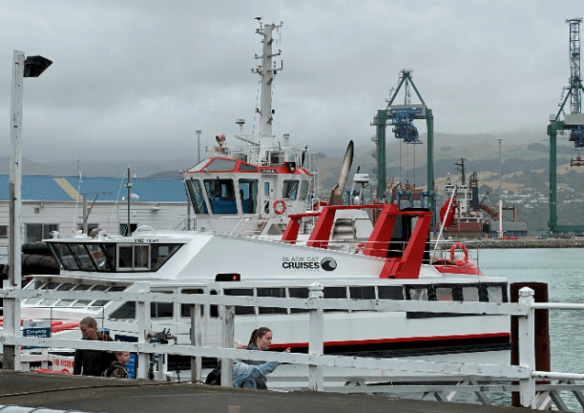

We set out on a catamaran for some serious whale, dolphin and penguin watching – or at least we hoped to.


Sometimes on these types of adventures, you get really lucky, and sometimes you don’t.


That’s the dolphin. As in, the only dolphin.


This is as close as we got to a dolphin – on the boat.


The scenery, however, was stunning.


My normal perch on these kinds of adventures is right up front. You can’t photograph what you can’t see.
It was so cold and extremely windy that I had to go in and out.


I had a sweatshirt with me, and a light windbreaker for rain – but nothing more. I don’t even want to admit this to you, but I bought a thinsulate jacket. Hard to believe it was 120 degrees just a couple days earlier and I had been sweating to death.
We’re calling that jacket a souvenir. I actually do really like it.


We were told that you can often see penguins and seals in these caves and rocky outcrops along the waterline, but we didn’t.


I look at caves partly submerged in water and wonder if there are human remains there from hundreds or even thousands of years ago, and if we could obtain their DNA.


The whitewash is bird poo. Jim saw a couple of birds happily perching above one of the caves.


There they are!


This area is known as Banks Peninsula, but today was not our lucky day. Not even many birds.
So much for that.
Christchurch, New Zealand
You may recall that Christchurch was devastated by a violent earthquake in February of 2011, causing massive damage to the central portion of Christchurch. Aftershocks continued for months, with smaller quakes continuing to this day.
Not only did buildings fall and sustain structural damage, but the soil liquified in Christchurch.
One might expect that the damage from this quake would be repaired 9 year later, but that’s not the case, at least not uniformly. Most of the structures that need to be removed have been, but not all. Rebuilding in some areas has simply not occurred.


The older timber buildings, like the ones painted blue, yellow and green fared better than either taller structures, or ones made of brick or stone.


The Cathedral midtown is still in a state of disrepair and indecision.


At first, I thought these were gravestones, until I looked closer and realized it is the remains of a building, with a window in the wall for pedestrians.


There are many, many simply vacant spaces – in a sort of timeless limbo.


Battles over what to preserve in its current state, tear down or restore continue.


The Catholic church of the Blessed Sacrament waits on its verdict.


The church is fenced off to protect the church, residents and visitors.


We can see how the basilica used to look.


Parishioners of this church are already worshipping in another location, but the debate about whether to repair, restore or tear down this historic building continues. A decision was made in August 2019 by the Bishop to demolish the building, but not everyone is convinced that the decision is final.


Murals grace the walls of many buildings. Parking lots sprung up where buildings used to be.


Like other cities, art is everyplace.


Sometimes I wasn’t sure exactly what the art depicted.


These chairs were painted white and roped off, so I’m presuming you’re not supposed to sit down.


This mural, which I think is actually a construction barricade, reminds me of a quilt pattern. Hmmm, maybe for my New Zealand quilt?


Look closely. These triangles actually hold images of New Zealand.


If you watch carefully, you can see graffiti art in several places.


Parks abound.

It felt just lovely to walk in the warmth and sunshine knowing how cold it was back home.
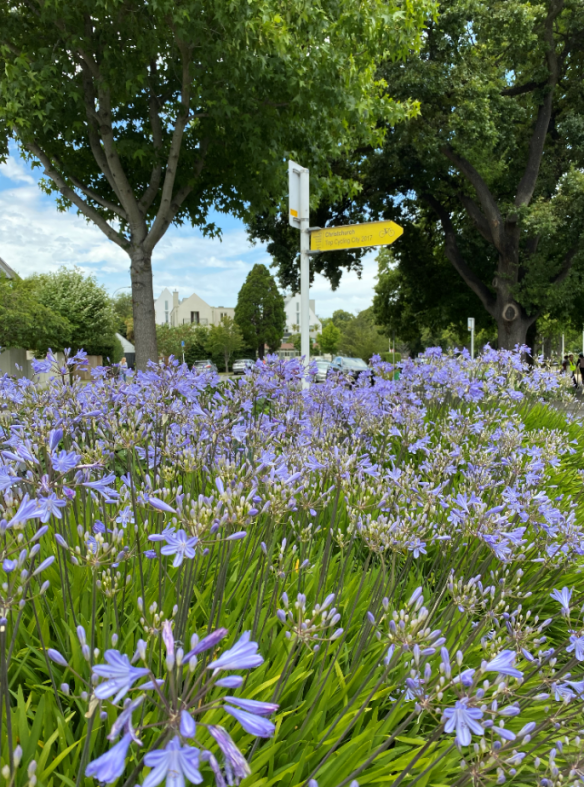

Let’s Go Punting!!!
Our plan for the afternoon is to go punting on the River Avon.
Don’t know what punting is? Neither did I.
Punting is an Edwardian activity wherein a person with a very large stick pushes you along in a boat on the River Avon. Think of gondolas in Vienna, but different.
It’s best if I just show you.


Adjacent the botanical gardens and museum, we walked to those green and white striped buildings in the distance where the boats are housed.


Christchurch residents and visitors have been punting for a long time.


The punters of yesteryear wore these jackets and hats, and so did ours today.


Each boat has a punter standing at the rear.


There is only one female punter.


Thankfully, the temperature had warmed up after we left the coast and the sun came out.


It morphed into a glorious day.


Jim and I sat at the rear of our boat, just in front of our punter. Taking selfies of places where we’re having fun has become a bit of a ritual, along with the obligatory trip leaving and returning picture.


Our punter seemed to be having a great time too. His smile was infectious.


The punter had to duck as we slipped beneath the bridge.


There are flowers everyplace along the water.


The botanical gardens line the river.
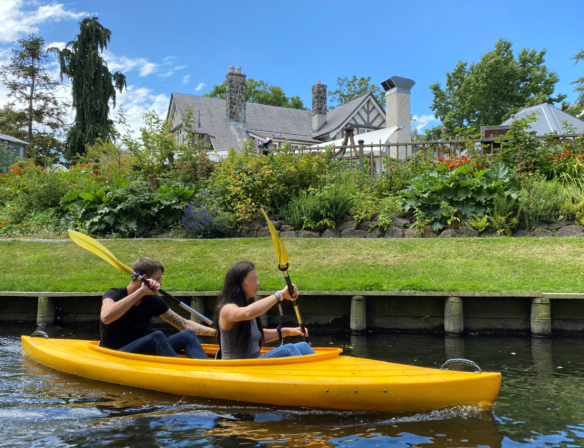

Kayakers paddle among the flat-bottom punting boats.


Wildlife enjoys the sunshine too.


Willow trees love water. Not sure if this is a willow, but it certainly looks similar.


Trees overreach the water forming green archways.

The ducks enjoy napping along the waterway.

Some things are universal.


Back at the boat sheds, we disembarked.
After our punting adventure, we still had an hour before catching the bus, so we decided to go for a walk.

The University of Canterbury campus was just across the street.
University of Canterbury


The architecture here is very reminiscent of England.


I would have loved to sit in the sidewalk cafe, but it wasn’t open.


This building reminds be a great deal of the University of Cambridge.


The entryway leads to central common areas.


Students gather inside in the piazza.


Construction repair from the earthquake 9 years ago.


Modern art intertwined with the classic buildings such as this wrought iron fence in front of the University of Canterbury at the market area.


The farmer’s market is parked in the lot reserved for the University during weekdays.


We found Paua shell hair barrettes and a polished and sealed shell in the open-air shops surrounding the farmer’s market. I would like to have found Paua pearls, but they are rather rare and our time was limited. If you’d like to view stunning jewelry, just google “Paua pearls.”
We found Paua shells later on the beach, but you aren’t allowed to take those off of the cruise ship, so we couldn’t bring them home.
Headed Back to the Coastline


New Zealand has been dry too, as you can see from the color of the foliage.


Leaving Christchurch, a tunnel under the mountain connects the city with the coast.


The harbor is stunningly beautiful as we drive along the coast on the way back to the ship.


Back in our cabin, we see the pilot boat approaching. Pilot boats carry captains who are specialists in navigating the local waters.


The local pilot assists the cruise ship’s Captain navigate the harbor. The pilot boat motors alongside until the ship passes the dangerous area.
Then, the pilot boat pulls up as close as possible to the water-level door, but not bumping the cruise liner, while the pilot waits for the perfect moment and jumps, yes jumps, from the open door to the deck of the pilot boat, even if it’s slippery and wet. One mis-judgement or misstep and the pilot is either possibly injured and miserably wet, or worse, crushed between the two boats. If that’s not the definition of nerve-wracking, I don’t know what is. First time I saw this, I couldn’t believe my eyes and my heart leaped into my throat.
Next port, Wellington.
