

Recently, I’ve been reading the Claiborne County, Tennessee court minutes 1829-1843 page by page at FamilySearch. Not because I really WANT to, but because I need to and there is no every-name index available for the years in question. As genealogists desperate to discover information about our ancestors, we do what we need to do and there are lots of buried goodies here!
The court minutes are full of all kinds of routine proceedings which include a great deal of both evident and hidden information.
- Men are assigned to road crews which tells you who their neighbors are and what road they live on.
- Men are assigned to collect taxes in their districts, which tells you which district they live in and who was the head of the volunteer militia in that district. Both tax collectors and militia leaders are men clearly in good standing and healthy.
- Residents who were insolvent and could not pay their taxes. These notes state that some had left the state or county.
- Men were summoned for jury duty and served as commissioners which tells you that they were white, owned land and were considered upstanding citizens.
- Wills were recorded, probated and estates managed. Supplies for the widows were portioned while the estate was in probate, which means the widow was named.
- People, mostly but not always men, were arrested and their families or neighbors posted bond, assuring they would show up in court. Not a lot different than today.
- Poor people were cared for in the homes of neighbors or other residents and the county paid for their care. A lot different than today.
- Guardians were appointed for orphans and the orphans ages were given.
- People were sued by their neighbors for trespass, which generally meant a disputed property line.
- Registration of livestock earmarks.
- Payment for wolf scalps, after which the sheriff burned the scalp so they couldn’t be claimed a second time by someone else
- “Juries” were assigned to survey and lay out roads, “the best way,” with as little damage to property as possible. Often property owners adjacent the road were named.
- A jailer was paid for each prisoner who was named, but there generally weren’t many.
Every now and then, something really scandalous happened – although most of the time the trials were financial in nature. In one case, three men were tried for fighting within sight of the court. I’d love to know what that was about.
One of the most common types of cases was debt. If the debtor had no personal property that could be sold, then their land was attached and sold for the amount of the debt in question. Generally, these transactions provided a description of the property in question, including location, landmarks and neighbors, which can be a godsend when the deed books in question have been destroyed or disappeared as is the case with some Claiborne County records.
Court ordered sales were often not recorded from the previous owner to the new owner, but from the sheriff or constable to the new owner, making tracking the land forward or backward using deeds impossible. The court records provide that missing link.
I’ve been looking for three things in particular dealing with two ancestors and one of their children. Mind you, none of which I’ve found so far which begets many questions and so far, no answers. But them, I’m only through page 360 of 736, which means I have a lot more opportunity to find something.
Plus, I’ve discovered that reading these court notes cures insomnia, but only as long as you are sitting in front of your computer😊
I did discover something about another ancestor, quite unexpected and heartbreaking.
Elijah Vannoy’s Trouble
Elijah Vannoy was born about 1784 in Wilkes County, North Carolina. I wrote about Elijah’s life, but when reading the court minutes, I discovered a chapter I didn’t know before.
Elijah was in Claiborne County by 1817 and obtained two land grants, one in 1826 and one in 1829. The land grant process took several years from the time a grant was applied for, the land surveyed, and the actual land was patented and registered with the county clerk – although the men were living on and farming the land that entire time. There were costs involved too; the filing fees, the surveyor and the recording fees. Many times grants weren’t actually recorded for many years, some descending to heirs without having been properly recorded.
On Elijah’s two land grants, his name is spelled Elijah Venoy and it’s spelled the same way in the court record as well. This makes me wonder if Venoy is how Elijah actually spelled his surname – although we know from his deeds that he didn’t write later in his life. However, in 1817, it appears that he did sign his signature and it was Vannoy.
Elijah makes a few other appearances in the records. In 1818, Elisha Venoy was assigned to a road crew. He was called for jury duty once in 1820, but never again. Many men were called repeatedly. Then, there’s a long gap.
On image 351, page 224 in the actual minute book, at the court session taking place on Wednesday, Dec. 17, 1834, I found the following suit which I’ve transcribed in summary:
Thomas R. McClary vs Elijah Venoy. Found for plaintiff against defendant for the sum of $12.58… no (personal) property found, debt levied against two tracts of land. 125 acres lying on the waters of Mulberry Creek, beginning on an oak and hickory, corner of my twenty five (should say 125) acre survey and survey of John Rays beginning with John Rays chestnut corner bounded by J. Coles and Bakers, this entry number 549 (difficult to read but verified with the actual entry) and 100 acres entry no 272 lying on the north side of Big Mulberry creek beginning at a white oak and maple near a branch and running due west and various other courses for ? so as to include the improvement he (Elijah) lives on. November 19, 1834. Court ordered the sale together with costs.


On November 19th, the sheriff had gone to Elijah’s and surveyed what property he had, culminating with the recommendation that he had nothing to sell, which meant no cattle, horses, pigs, corn, wagon, nothing. The sheriff’s recommendation was to sell not one, but both of Elijah’s tracts of land – which included the one Elijah lived on.
That’s Brutal
While I certainly understand that’s how the legal system worked, it’s brutal. Why take both of Elijah’s pieces of land? Why not sell one, the one without his home, and see if the debt was covered before selling the second one? 100 acres of land was selling for a lot more than $12.58 in Claiborne County at that time, especially with “improvements.”
In 1834, Elijah was 50 years old. His wife, Lois McNiel either had died since 1830, or would die before 1840. In the 1830 census, Elijah still had 9 children at home – 3 males and 6 females. At 50 years of age, Elijah had no prayer of starting over AND he had children to raise. By 1840, Elijah still had 4 children at home and Lois was assuredly gone.
It is the greatest of ironies that the property owner a few years ago still had Elijah’s original land grant for the property. Few of these State-issued grants remain nearly 200 years later, so this is a rare document indeed. These were the documents shown for the land to be registered, then retained by the property owner. And now, Elijah was losing this land.


What was Elijah to do? Where would he live? How would he support his family without a farm or any resources?
Joel Tries to Help
As it turns out, in 1833, Elijah’s son, Joel, also obtained a land grant. Joel was young, just 20 in 1833, but Joel tried to help his father by putting a mortgage on his own adjacent land to prevent his father’s land from being sold.
In 1836, both Joel and Elijah are listed on the tax list, but by 1839, only Joel and his younger brother, Elijah Jr. who owned no land but paid a poll tax appeared.
The elder Elijah is missing on the tax list entirely, probably indicating that he is living with another person and had no personal property or real estate. He was not listed as a head of household, but he was a year later in the 1840 census, suggesting perhaps that he was still living in his house on land that someone else, namely Joel, owned.
A Poll Tax had to be paid by and for every while male age 21-50 in order to be eligible to vote. Elijah Sr. would have been 55 in 1839, so he would have been exempt from Poll Tax, but if he owned land or other taxable goods, he would still have had to pay the other taxes due.
Joel, however, is listed with 225 acres total worth $500. It appears that Joel probably owns his own 100 acre tract as well as his father’s 125 acre tract, which is probably where Elijah is living. It appears that Elijah’s 100 acre tract with the house is gone, although later deeds raise confusion about which property was actually retained.
Chickens Come Home to Roost
By 1841 the chickens had come home to roost. Joel and Elijah were refinancing, in today’s vernacular. Both men signed a joint deed of trust because they owed merchants more than they could pay. Elijah signed a mortgage against his wagon and team of oxen, Three months later, two more debts were filed and now both Elijah and Joel are signing deeds of trust for their land. Elijah was indebted to William Houston, merchant in Tazewell, for $33.08, plus interest and to William Fugate for $62.50.
Then, Elijah sells land for $5 to Walter Evans in a deed of trust, stating that if he doesn’t make payments, Walter can sell the land on the courthouse steps in Tazewell.
Elijah also sells land to William Cole for $50.
In October 1845, 11 years after the original Claiborne County suit, both Elijah and Joel, probably very weary of the battle, jointly sold Elijah’s land, signing together, for $250, half of Joel’s land value on the 1839 tax list. The debt being paid was probably to William Fugate because he witnessed the deed, probably anxious to walk out of the room with his funds.
These debts had probably been accumulating and increasing with each refinancing since before 1834. Borrowing from Peter to pay Paul, until that pattern was no longer sustainable.
By 1845, Joel was 33 years old and had lived with this problem his entire adult life. In January, he had married Phoebe Crumley and I’m sure they wanted to start a life of their own, unencumbered by the behemoth that was clearly not going to resolve itself.
Was There More to the Story?
In 1845, at more than 60 years of age, Elijah went to live with his daughter, Sarah and her husband Joseph Adams, probably a broken man.
Elijah died sometime between the 1850 and 1860 census, his burial location lost to time.
Joel remained in Hancock County (upper right, below) until after 1860 according to the census, but sometime during or after the Civil War, in which Joel was reported to be a Rebel sympathizer, he moved down the valley a few miles to the Little Sycamore community in Claiborne County to start over on what would become Vannoy Road.


This part of Hancock County saw families torn between the Union and the Confederacy, and not only was there fighting between the north and south, there was infighting between family members. Joel’s wife’s niece and family were murdered for being northern sympathizers.
By 1870, Joel was living in Claiborne County in the Little Sycamore community where his children were marrying neighbors. He apparently owned land, according to the census, but things began not adding up. First, just hints of trouble and oddities, then clear indications.
While Joel Vannoy did “purchase” land again, his life was haunted by the demons of mental illness. By 1872, in Claiborne County, land was deeded to Joel’s wife, Phoebe, instead of to Joel. Deeding land to a wife when the husband was living simply did not happen in that day, time and place. It became impossible to ignore these “irregularities.”
Apparently, by age 50, Joel’s mental health had deteriorated to the point where he could no longer conduct business. No one seemed to question why his wife owned the land instead of Joel, so Joe’s condition was clearly known as a fact and not disputed within the community or by the court.
Fourteen years later, Joel was transported to the “hospital for the insane” in Knoxville, not long after it first opened. According to records of the now-closed facility, obtained in the 1980s, other Vannoy family members were treated in the same facility some years later.
Fifty years of age is the exact age of Elijah in 1834 when the Claiborne County court ordered both of his pieces of property sold for a debt of $12.58 which is equivalent to about $360 today.
Maybe there was more going on than Elijah simply needing $12.58. Had Elisha been suffering from the same creeping and intensifying mental illness that Joel eventually suffered from too? According to family members, Joel’s condition worsened throughout his life. In the end, he had to be “watched” 24X7 and could never be left alone given that he was disconnected from reality. Based on what the family said and his behaviors, I would guess that Joel had a form of schizophrenia, which can be hereditary, and Elijah may have suffered from the same disease.
Any of these problems, unmanageable debt, possible mental illness, or raising children alone is bad enough. However, combined, they may have snowballed on both Elijah and Joel as well. How kind of Joel to attempt to help his father and how sad that it didn’t work, especially after such a long battle, approaching a dozen years.
I can see the two saddened men, father and son, walking together along this creek perhaps, on Elijah’s land, by then owned by Joel, perhaps trying to make it through until they could at least harvest the crops. Maybe, just maybe those crops would bring enough to pay the debt? Maybe this year?


But the fall of 1845 was no different and they had to make that final, agonizing decision to sell the last piece of Elijah’s land, acquiescing to the fact that they had reached the end of the road. The inevitable had arrived and there was nothing left for them to do. They had fought a long, losing battle and Elijah would have to leave the idyllic little valley and the land he had cleared and farmed along Mulberry Creek, for more than two decades, yet he would live close enough to watch another man farm the land for the rest of his life.
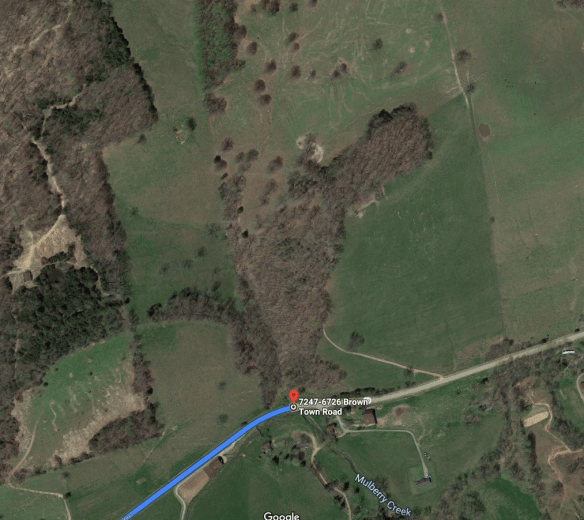

Still, Elijah handed his cherished grant paper for the land he had struggled so long to keep to the next owner. Elijah didn’t have to do that. The deed had already been registered. Thank goodness he did though, because it’s how we verified that indeed, we had found Elijah’s land. A gift to future generations that he didn’t know he was making.
Knowing that Elijah was raising children alone, having lost his wife, farm, home and resources is both tragic and heartbreaking, especially understanding that there may have been yet another health issue complicating factors. All for the lack of $12.58 in 1834.
But that I could send $12.58 back through time and perhaps change the final chapters of Elijah’s life.
______________________________________________________________
Disclosure
I receive a small contribution when you click on some (but not all) of the links to vendors in my articles. This does NOT increase the price you pay but helps me to keep the lights on and this informational blog free for everyone. Please click on the links in the articles or to the vendors below if you are purchasing products or DNA testing.
Thank you so much.
DNA Purchases and Free Transfers
- Family Tree DNA
- MyHeritage DNA only
- MyHeritage DNA plus Health
- MyHeritage FREE DNA file upload
- AncestryDNA
- 23andMe Ancestry
- 23andMe Ancestry Plus Health
- LivingDNA
Genealogy Services
Genealogy Research
- Legacy Tree Genealogists for genealogy research
