

Recently, I’ve noticed a lot of confusion surrounding X DNA matching and mitochondrial DNA. Some folks think they are the same thing, but they aren’t at all.
It’s easy to become confused by the different types of DNA that we can use for genealogy, so I’ll try to explain these differences two or three different ways – and hopefully one of them will be just the ticket for you.
Both Associated with Females
I suspect the confusion has to do with the fact that mitochondrial DNA and the X chromosome are both associated in some manner with female inheritance. However, that isn’t always true in the strictest sense, as women also inherit an X chromosome from their father.
Males Inherit:
- An X chromosome from their mother
- Mitochondrial DNA from their mother
Females Inherit:
- An X chromosome from their mother
- An X chromosome from their father
- Mitochondrial DNA from their mother
The difference, as you can quickly see, is that females inherit an X chromosome from both parents, while males only inherit the X from their mothers. That’s because males inherit the Y chromosome from their father instead – which is what makes males male.
As a quick overview about inheritance works, you might want to read the article, 4 Kinds of DNA for Genetic Genealogy.
The good news is that both mitochondrial DNA and the X chromosome have very specific inheritance paths that can be very useful to genealogy, once you understand how they work.
Who Gets What?

Mitochondrial DNA Inheritance
Mitochondrial DNA is inherited by both genders of children from their mothers. Mitochondrial DNA is NEVER recombined with the mitochondrial DNA of the father – so it’s passed intact. That’s why both males and females can test for their direct matrilineal line through their mitochondrial DNA.

In the pedigree chart above, you can see that mtDNA (red circles) is passed directly down the matrilineal line, while Y DNA is passed directly down the patrilineal (surname) line (blue squares.)
I’ve written an in-depth article titled, Mitochondrial DNA – Your Mom’s Story that might be useful to read, as well as Working with Y DNA – Your Dad’s Story.
The X Chromosome
The X Chromosome is autosomal, meaning that it recombines in every generation. If you are a female, the X recombines just like any other autosome, meaning chromosomes 1-22. You receive a copy from each parent.

The 23rd pair of chromosomes is the X and Y chromosomes which convey gender. Males receive an X from their mother and Y from their father. The Y chromosome makes males male. Females receive an X chromosome from both parents, just like the rest of chromosomes 1-22.
Inheritance Pathways
If you are a male, the inheritance path of the X chromosome is a bit different from that of a female, because you inherit your X only from your mother.
Females inherit their father’s ONLY X chromosome intact, which he inherited from his mother. Females inherit their X chromosome from their mother in the normal autosomal way. A mother has two X chromosomes, so the mother can give a child either chromosome entirely or parts of both of her X chromosomes.
Because of the different ways that males and females inherit the X chromosome, the inheritance path is different than chromosomes 1-22, portions of which you can inherit from any of your ancestors. Conversely, you can only inherit portions of your X chromosome from certain ancestors. You can read about more about this in the article, X Marks the Spot.

Female X inheritance chart. For male distribution, look at my father’s side of the tree.
My own colorized X chromosome chart is shown above, produced from my genealogy software and Charting Companion. An X match MUST COME from one of the ancestors in the pink and blue colored quadrants. It’s very unlikely that I would inherit parts of my X chromosome from all of these ancestors, but these ancestors are the only candidates from whom my X originated. In other words, genealogically, these are the only ancestors for me to investigate when I have an X DNA match with someone.
Because of this unbalanced distribution of the X chromosome, if you are a male and you match someone on the X chromosome, assuming it’s a legitimate match and not a match by chance, then you know the match MUST come from your mother’s side of the family, and only from her pink and blue colored ancestors – looking at my father’s half of the tree as an example.
If you are a female the match can come from either side, but only from a restricted number of individuals – those colored pink or blue, as shown above.

X chart with Y line included in purple, for males, and mitochondrial line in green.
My mitochondrial line, shown on the X chart would consist of only the women on the bottom row, extending to the right from me, colored in green above. My father’s Y DNA line would be the purple region, extending along the bottom at left. Of course, I don’t have a Y chromosome, because I’m female.
Of the individuals carrying the purple Y DNA, the only one with an X chromosome that a female could inherit would be the father. A female would inherit both the mtDNA of all of the green women, plus could also inherit an X chromosome (or part of an X) from them too.
For males, looking at my father’s half of the chart. He can inherit no X chromosome from any of the purple Y DNA portion, because those men gave him their Y chromosome. My father would inherit his mitochondrial DNA from his direct matrilineal line, shown in yellow, below.

X chart with mitochondrial inheritance line for mother (and child) shown in green, for father shown in yellow. Both yellow and green lines can contribute to the X chromosome for males and females.
In my father’s case, the females in his tree that he can inherit an X chromosome from are quite limited, but people who have the opportunity to pass their X chromosome to my father are never restricted to only the people that pass his mitochondrial DNA to him. However, the X chromosome contributors always include the mitochondrial DNA contributors for both males and females.
In my father’s case, above, he inherits his X chromosome from his mother, who can only inherit her X from the people on his side of the chart shown in yellow, blue or pink. In essence, the people in yellow or to the left of the yellow with any color.
As his daughter, I can inherit from any of those ancestors as well, since he gives me his only X, who he inherited from his mother. I also inherit an X from my mother from anyone who is green, pink or blue on her side of my chart.
As you can see, my X can come from many fewer ancestors on my father’s side than on my mother’s side.
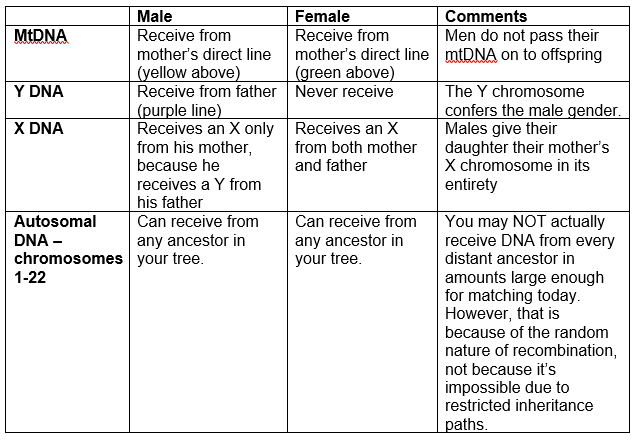
It just happens that ancestors in the mitochondrial line also are able to contribute an X chromosome and either gender can inherit parts of their X chromosome from any female upstream of their mother in the direct matrilineal line. However, only the direct matrilineal line (yellow for your father and green for your mother) contributes mitochondrial DNA. None of the other ancestors contribute mtDNA to this male or female, although females contribute their mtDNA to other individuals in the tree. For a more detailed discussion on inheritance, please read the article, “Concepts – ‘Who to Test Series”.
Special Treatment for X Matches
While the generally accepted threshold for autosomal DNA is about 7cM, for X DNA, there appears to be a much higher incidence of false matches at higher levels than the rest of the chromosomes, as documented by Philip Gammon as in his Match-Maker-Breaker tool. This appears to have to do with SNP density.
I would encourage genetic genealogists to consider someplace between 10 and 15 cM as an acceptable threshold for an X chromosome match. This of course does not mean that smaller segment matching can’t be relevant, it’s just that X matches are less likely to be relevant at levels below 10-15 cM than the rest of the chromosomes.
Summary
As you can see, the mitochondrial DNA is passed from one line only – the direct matrilineal line – green to my mother and then me, yellow to my father. The mitochondrial DNA has absolutely NOTHING to do with the X chromosome, as they are entirely different kinds of DNA. It just so happens that the individuals who contribute mitochondrial DNA are also some of the ancestors who can contribute an X chromosome to either males or females.
The yellow and green ancestors always contribute mitochondrial DNA, but the pink and blue NEVER contribute mitochondrial DNA to the father and mother in our chart.
The X chromosome has a very distinctive inheritance path, shown in the first fan chart, that will help identify potential ancestors who may have contributed your X chromosome – which is wonderful for genealogists. If your ancestor is not colored pink or blue, in the first chart, they did not contribute anything to your X chromosome – so an X match MUST come from a pink or blue ancestor (which includes yellow and green in the later charts.)
By color, the people in the fan chart provide the following:
- Purple – Y chromosome to father only. Y is passed on to a male child, but not to females.
- Yellow – Mitochondrial always to father. X always from mother to males but X can come from either yellow or pink and blue ancestors upstream.
- Green – Mitochondrial always to the mother. Females receive an X chromosome from their green mother and also from their father, who received his X chromosome from his yellow mother.
- PInk and blue on father’s side – contribute to the father’s X chromosome, in addition to yellow.
- Pink and blue on mother’s side – contribute to the mother’s X chromosome, in addition to green.
If you are a male and see an X match on your father’s side of the tree, you know that match is either actually coming from your mother’s side of the tree, or the match is false, meaning identical by chance.
The great news is that X matching is another tool with special attributes in the genealogist’s toolbox, along with both mitochondrial and Y DNA.
Your X chromosome test is included as part of the Family Finder test. You can order the Family Finder or the mitochondrial DNA tests here.
______________________________________________________________
Disclosure
I receive a small contribution when you click on some of the links to vendors in my articles. This does NOT increase the price you pay but helps me to keep the lights on and this informational blog free for everyone. Please click on the links in the articles or to the vendors below if you are purchasing products or DNA testing.
Thank you so much.
DNA Purchases and Free Transfers
- Family Tree DNA
- MyHeritage DNA only
- MyHeritage DNA plus Health
- MyHeritage FREE DNA file upload
- AncestryDNA
- 23andMe Ancestry
- 23andMe Ancestry Plus Health
- LivingDNA
Genealogy Services
Genealogy Research
- Legacy Tree Genealogists for genealogy research
