

In late 2012, the way haplogroups were being named and referenced began changing. Before the introduction of the Geno 2.0 test in July 2012, there were approximately 850 SNPs identified on the haplotree, meaning 850 haplogroup names that all began with the letter of the haplogroup, but then had alternating numbers and letters that were added as new haplogroup branches were discovered.
The most common one in Europe is R1b1a2. This means that after haplogroup R itself was discovered, then another haplogroup, R1 was discovered, then R1b, and so forth. But now, for the fly in the ointment. Let’s say that a new haplogroup has been discovered and it needs to be inserted between haplogroup R1 and haplogroup R1b. What happens? This naming methodology is not conducive to insertions. It’s only been a couple of years that the tree was entirely rewritten, redrawn. Haplogroups that were previously called E3a became E1b1a. To say it was a large and very disconcerting shift is an understatement. Add to this that all of the academic papers on which we depend are written in the lingo of the time. So something that references haplogroup J1a in 2002 may not be talking about the same J1a, as defined by a SNP, in 2013 or some time in the future.
Now for the jolt. The Genographic project utilized over 10,000 new SNPs not before known or utilized for a total of over 12,000 Y DNA SNPs in their Geno 2.0 test introduced in July of 2012 . Therefore, the tree was going to have to be entirely drawn with the haplogroup branches renamed, once again. This was going to be a much bigger shift than before, simply due to the sheer magnitude, and more SNPs are being discovered almost daily. Therefore, a new methodology was needed.
Every haplogroup, such as R1b1a2, is defined by a specific SNP, in this case, M269. This SNP and haplogroup name have a specific location on the haplotree. The SNP locations can change without a problem, but the names of the haplogroups that need to change are the problem. This has already led to different trees maintained by different organizatiosn being out of sync with each other.
Today, at Family Tree DNA, this is what the top part of the haplogroup R tree looks like.
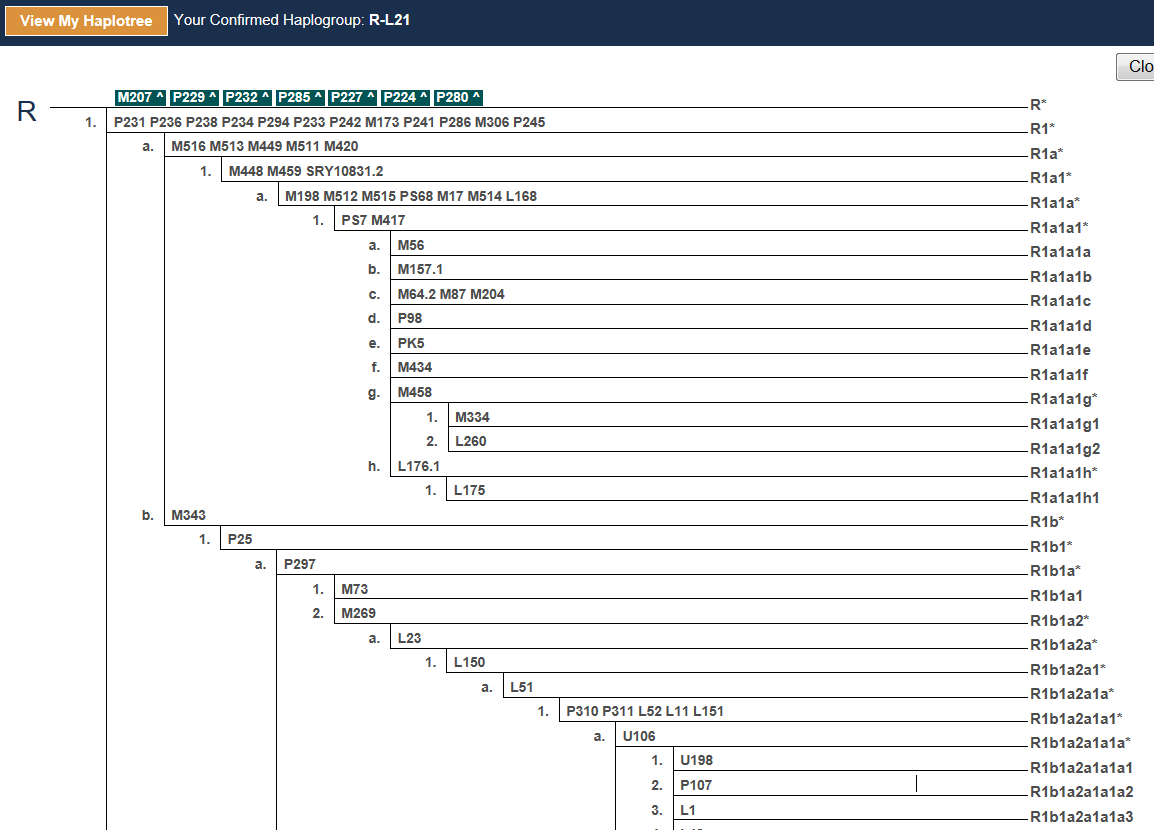
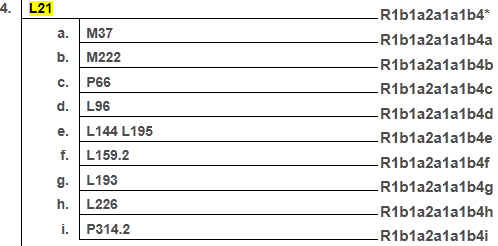
As new SNPs are discovered and inserted into the tree, there will no longer be a name assigned, shown in the right hand column. As the names are obsoleted because of shuffling of branches on the tree, they will not be renamed. Already, at Family Tree DNA, they are using just the SNP name as the haplogroup indicator, as you can see in the top bar where is says “Your confirmed haplogroup R-L21. This means haplogroup R, SNP L21, which occurs further down on the tree.
Today, R-L21 is still shown on the tree with its name, R1b1a2a1a1b4, but as the tree branches shuffle and this name no longer applies to R-L21, the name will be obsoleted and the haplogroup will only referenced as R-L21.
Max Blankfeld and Bennett Greenspan of Family Tree DNA recently wrote this explanation which is found on the haplogroup pages at Family Tree DNA.
Long time customers of Family Tree DNA have seen the YCC-tree of Homo Sapiens evolve over the past several years as new SNPs have been discovered. Sometimes these new SNPs cause a substantial change in the “longhand” explanation of your terminal Haplogroup. Because of this confusion, we introduced a shorthand version a few years ago that lists the branch of the tree and your terminal SNP, i.e. J-L147, in lieu of J1c3d. Therefore, in the very near term, Family Tree DNA will discontinue showing the current “longhand” on the tree and we will focus all of our discussions around your terminal defining SNP.
This changes no science – it just provides an easier and less confusing way for us all to communicate.
Obviously, more than a decade’s worth of information exists that references the haplogroups in both formats. Other companies in this space are not doing this level of testing and do not yet need to address this type of issue, so their data bases and references will likely stay the same, at least for the time being. For some time to come, we will be dealing in a dual world where both methodologies are utilized and yes, some amount of confusion will certainly result. In preparation, I wanted you to understand what has happened in the past, the recent changes, what the future holds, and why.
______________________________________________________________
Disclosure
I receive a small contribution when you click on some of the links to vendors in my articles. This does NOT increase the price you pay but helps me to keep the lights on and this informational blog free for everyone. Please click on the links in the articles or to the vendors below if you are purchasing products or DNA testing.
Thank you so much.
DNA Purchases and Free Transfers
- Family Tree DNA
- MyHeritage DNA only
- MyHeritage DNA plus Health
- MyHeritage FREE DNA file upload
- AncestryDNA
- 23andMe Ancestry
- 23andMe Ancestry Plus Health
- LivingDNA
Genealogy Services
Genealogy Research
- Legacy Tree Genealogists for genealogy research
