

Yesterday, Ancestry quietly introduced a new feature of their AncestryDNA autosomal product called “Amount of Shared DNA.”
This can be seen when you view your match, beside the confidence bar, as shown below. Fly over the little “i.”
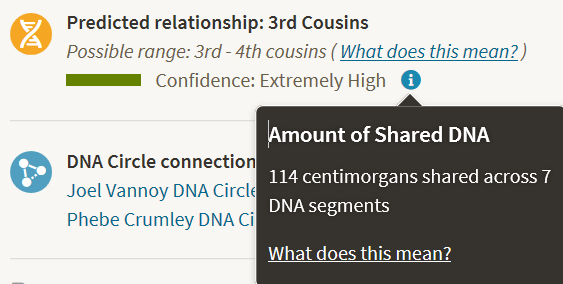
It’s nice to know how much DNA we share and across how many DNA segments – but what does this really mean, how is it calculated, and how do these calculations stack up against the same information from other vendors?
Why would it be any different, you ask?
Because Ancestry runs their academic phasing program, Timber, and removes segments identified as matching to many people, constituting pileup areas. Remember when Timber was introduced and people lost more than half of their matches? I went from 13,500 to 3,350. Today, 50 weeks later, I have about 6,700.
Real phasing is when you utilize your parents DNA to divide your own DNA into half. Half your matches match you and your mother, and half your matches match you and your father. If not, then they are not IBD matches.
Timber attempts to remove segments that are too matchy – areas where Ancestry feels you have too many matches so they might be “population” based match segments instead of real genealogical segments.
This new “Amount of Shared DNA” feature gives us the opportunity to test their matching against other vendors.
Thankfully, my cousin Harold has tested at all the vendors and uploaded to GedMatch, as have I.
Therefore, we can compare our results on all platforms.
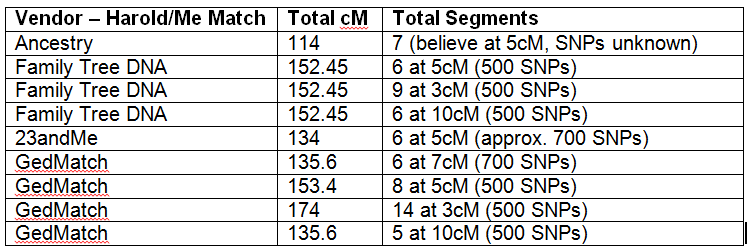
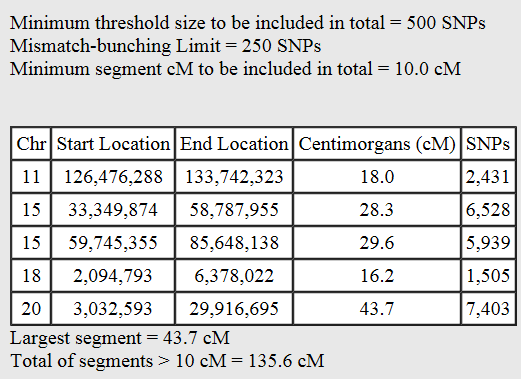
Why is the Ancestry total cM so much smaller than the other vendors, at any threshold? Timber. Ancestry is removing many segments that other vendors are counting and using, even at higher thresholds like 10 cM. In fact, at GedMatch, their maximum threshold is 10cM and even at that level, the total match cM was 135, 21 more than Ancestry, and the SNPs were all well over 1000.
The Acid Test
I’ve believed since the introduction of Timber that it removed too many segments – segments that are valid and useful – thereby removing valid matches.
However, the acid test is a parent/child match. Each child should match their parents on exactly 23 segments (or 22 if Ancestry is not counting the X chromosome), one complete match for each chromosome. Once in a while you’ll have a read error that may divide a chromosome into two match segments, so an occasional 24 or 25 wouldn’t be surprising.
What are we seeing? A quick read of forums and looking at the results I have access to shows me that parent match segments are ranging from about 85 to about 110, which, in case you are counting, is from 64 to 87 more than the 22 (or 23 counting the X) chromosomes that we have.
What this tells us is twofold:
- Timber is removing 64 to 87 VALID segments in parent/child matching, believing that pileups are invalid. Rule #1 of DNA – you must match your parents. If you double this number, because you have two parents, each person has in the ballpark of from 130 to about 200 areas where their DNA is “too matchy” and segments/matches are removed. This illustrates the magnitude of the Timber problem.
- You cannot draw or correlate any relationship inferences from either the total amount of shared DNA nor the number of segments by utilizing the typical tools utilized by genetic genealogists because Ancestry’s totals will be lower and their segments will be broken into more pieces due to the removal of segments identified by Timber as invalid matches. Blaine Bettinger is beginning to collect information at this link on Ancestry’s shared cM data for known relatives. This information will be made public for all to utilize, as has his earlier shared cM work. Please contribute if you can.
Hopefully Ancestry will take this opportunity to address the Timber issue, and hopefully they will eventually provide a chromosome browser type tool. Now all we need is the chromosome number and start/end addresses for those chopped up segments. These tidbits and pieces of solutions are not appeasing the genetic genealogy community and this new “amount of shared DNA” feature will not “do” in place of a chromosome browser. I know this sounds like a broken record…and it is. While Ancestry seems to be inching in the chromosome browser direction by providing additional information….I wouldn’t hold my breath. I don’t think it will ever happen – but I would really, REALLY like for Ancestry to prove me wrong!
Fortunately, Ancestry’s tree matches and Circles are useful and thankfully, we can download our autosomal DNA results to both Family Tree DNA and to GedMatch and utilize their chromosome browsers and other tools. Unfortunately, not everyone is willing to download, so we do really need that chromosome browser.
______________________________________________________________
Disclosure
I receive a small contribution when you click on some of the links to vendors in my articles. This does NOT increase the price you pay but helps me to keep the lights on and this informational blog free for everyone. Please click on the links in the articles or to the vendors below if you are purchasing products or DNA testing.
Thank you so much.
DNA Purchases and Free Transfers
- Family Tree DNA
- MyHeritage DNA only
- MyHeritage DNA plus Health
- MyHeritage FREE DNA file upload
- AncestryDNA
- 23andMe Ancestry
- 23andMe Ancestry Plus Health
- LivingDNA
Genealogy Services
Genealogy Research
- Legacy Tree Genealogists for genealogy research
