

Ancestry added a greatly anticipated feature this week that promises to help genealogists – shared matches. This is similar to the “In Common With” feature at Family Tree DNA – at least in concept.

Previous to this announcement, when you match someone at Ancestry, the only way you can see who else they happen to match in common with you is if you are placed in an ancestor DNA Circle with them – and then you can only see the other people in that Circle.
For example, here is my Henry Bolton DNA Circle.

The people I match are shown with an orange line. Each of those people match me, and they may also match other people in the Circle that I don’t match.

Regardless of whether I match the individuals directly, or they match someone else that I match, the common factor is that we all share Henry Bolton identified as an ancestor in our tree.
What Ancestry introduced today is the ability to click on any of these people who match me, OR, the people in the circle who do NOT match me but who do share Henry Bolton in their tree and match others in the circle – and see who they match in common with me. This should allow people to group their matches, at least tentatively and is especially promising for those frustrating people with whom you match closely but have private trees and won’t reply to messages.
While this is interesting for circles, it’s not terribly useful in terms of breaking down walls, because I already know Henry Bolton is my ancestor. In other words, I wouldn’t be in the circle if I didn’t already know the identity of that ancestor.
What I’m particularly interested in, is applying this tool to my NADs, or New Ancestor Discoveries, because if I can figure out how these people truly are related to me, then I may be able to make a discovery of a new ancestor in my tree. Now THIS holds a lot of promise and intrigues me greatly. So, let’s take a look at my NADs and see how this new tool works and if it’s useful. I can hardly wait!!!
State of the NADs
If you’ve been following my blog, you’ll know that Ancestry and I have been having a bit of a friendly Bad NAD duel. Ancestry keeps giving me new ancestor discoveries (NADs) but in several cases, I have unquestionably proven that those NADs are not my ancestors – hence the term – Bad NADs. In one case, the new ancestor assigned to me is the husband of my ancestors sister. However, I currently have three NADS that are related to each other than may benefit greatly by this new shared matches tool.
Since my last NAD update, where Diedamia Lyon and John David Curnutte were given to me a second time, another NAD has been added – John David Curnutte’s mother, Deresa Chaffin.

Here’s the tree version of this relationship

NAD Circles and Matches
In the NAD Circle for Diedamia Lyon, John David Curnutte and Deresa Chaffin, we find both Don and Michael, whom I match.
First, keep in mind that I may match both Don and Michael on other lines – so the fact that I match both of them and they both descend from a common ancestor does NOT mean that is how I connect genetically to both of them. But for purposes of this discussion, let’s assume that it is and proceed.
The fact that we find these two individuals whose DNA I match in all three circles suggests that the relationship is through the Curnutte line, and not through Diedamia Lyon at all, except for the fact that these men also descend from her. Given that John David’s Curnutte’s mother is also a NAD suggests that the connection to Diedamia Lyon and John David Curnutte is through the Curnutte line. Although Deresa Chaffin’s husband is not listed, he is John Tolliver Curnutte and clearly, the connection might be through him as opposed to Deresa – just like the connection to the couple Diedamia Lyon and John David Curnutte was through the Curnutte husband.
The NAD Circle for Diedamia Lyon and John David Curnutte are identical, with two matches and 5 non-matching individuals.

For each one of these individuals in the Circle, if you click on their name on the right, you’ll be able to see a variety of information, including their pedigree and matching surnames, maps and locations, and the new shared matches tab.
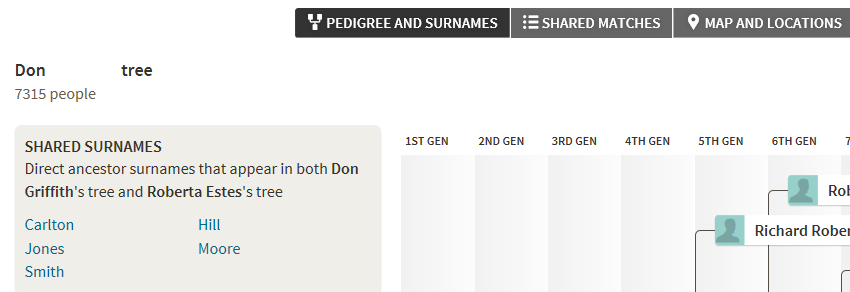
The new shared matches tab is a great tool, and it’s particularly important, when unraveling NADs to use it in conjunction with the shared surnames, shown at left. These are the surnames found in both your tree and the person whose tree you’re comparing against.
Let’s take a look at one of these – Moore, as an example.

As you can see, these are either not the same line or at least can’t be identified as such. However, in some cases, you may recognize your matches’ end of line person as connecting with your tree further upstream. It’s times like this that having a robust tree where you’ve tracked downstream lineages of your ancestor’s siblings can be very beneficial.
By clicking on the shared matches option, you’ll see the following people who you match in common with the individual – in this case, Don, my DNA match. I could also compare to one of the people in the Circle whom I don’t DNA match.
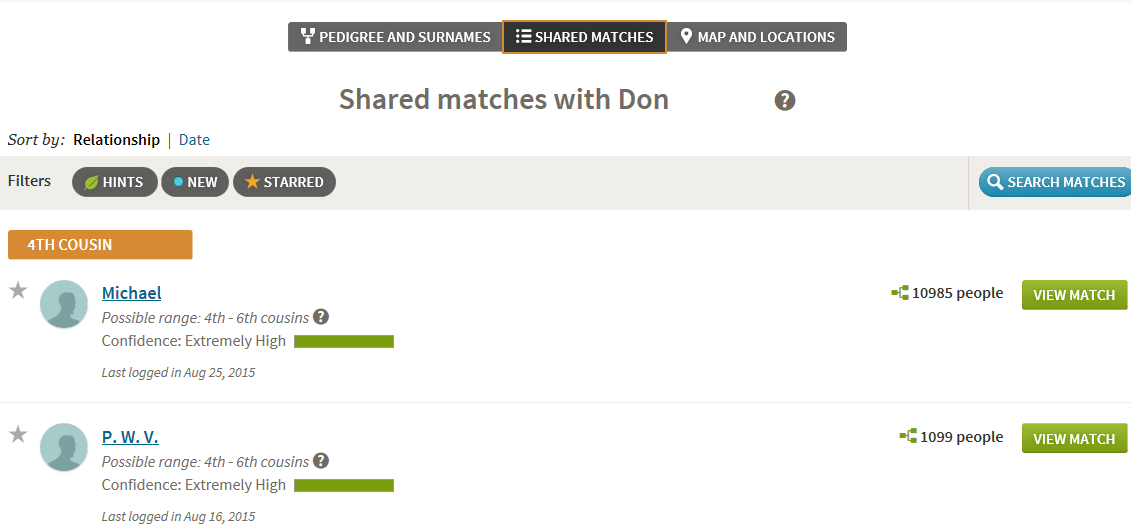
What I’m particularly looking for are matches with that lovely shakey leaf by the View Match button on the far right. Ahem…there aren’t any, which means none of these matches match me with a known common ancestor. Rats!!!
While Diedamia Lyon and John David Curnutte have the same members as each other in their NAD circles, John’s mother, Deresa Chaffin, has more members in her NAD circle – which means more opportunities for me to find common line hints..

The DNA matches are to the same 2 people, but now there are additional people in the circle who also match Michael and Don.
The great news is that in addition to clicking on your matches to see who else they match, you can also click on any other circle member. I’m very, very hopeful that a distinct trend emerges so I can tell at least what line these NADs might be associated with.
I needed a mechanism to keep track of who all my matches match, that I match, and what lines they descend from – so I created a spreadsheet.
NAD Matches Spreadsheet

Column 1 – NAD – The ancestor’s name of the NAD Circle where these individuals are found as members.
Column 2 – Person in Circle – The “person in circle” is the individual whose name shows either as a DNA match or as a circle member who does not match my DNA, but does match the DNA of at least some of the other circle members.
Column 3 – DNA Match – Tells me if this person is a DNA match to me or not.
Column 4 – Common Family Line to Person in Circle – The common ancestral line (or lines) if I can determine whether or not we share a specific ancestral line. By the way, just because we share that line does NOT mean that is how we are DNA related – and no – there is no way to tell without a chromosome browser.
Column 5 – Common Surnames to Person in Circle – Common surnames between my tree and the person in the Circle, as identified by Ancestry.
Column 6 – Shared Matches with Person in Circle – Names of Shared Matches between me and the person in the Circle.
Column 7 – Common Line with Shared Match – Common ancestral lines with shared matches (column 6).
I combined the information from Diedamia Lyon, John David Curnutte and John’s mother, Deresa Chaffin. I sorted column 6, Shared Matches with Person in Circle, alphabetically, hoping that some of these matches would be the same, and they are, and would be identifiable to specific family lines.
So….Drum Roll….Who is the Common Ancestor???
I compared each person identified as a person in the NAD Circle (column 2), or any person that matches me and a person in the NAD Circle (column 6) with my other spreadsheet that I maintain listing all of my Ancestry matches and our common ancestors.
The group that includes the initials EVH are a family of siblings and their children, so they really only count once. The person by the name Mars has a private tree, but told me that our common ancestor was Joel Vannoy and Phebe Crumley, the same individuals as my cousin group through EVH.
It’s certainly possible that the common DNA that connects me with Michael and Don and possibly with John David Curnutte’s parents are through the Vannoy/Crumley line.
If indeed, our common ancestor is upstream of Joel Vannoy and Phebe Crumley, which is a VERY BIG if, but it’s the only lead I have – then they must fill a known pedigree void.
Deresa Chaffin, according to the Ancestry overview (which is all I have to go on at this moment and is compiled from 705 trees which makes me exceedingly nervous) was born in 1775 in Virginia to Simon Chaffin and Agatha Curnutte. She married John Tolliver Curnutte, so we have an intermarriage already (or incorrect surname information), which can mean a larger dose of the Curnutte DNA. Trying to follow these individuals up their trees at Ancestry was an exercise in frustration and futility with many of the wives surnames being the same as the husband and no sources or documentation of any kind. Suffice it to say, I can’t connect the dots through surnames or location, other than the state of Virginia.
However, looking at my tree, my vacancies for ancestors in that timeframe, in the Vannoy/Crumley branch of the tree are limited.

Phebe, Jotham Brown’s wife’s surname is unknown, but they were married about 1760.
William Crumley’s wife’s name is unknown, but they were married by about 1788. Clearly, Deresa being born in 1775 cannot be William Crumley’s wife (or Jotham Brown’s), and Deresa married a Curnutte, so she cannot be the ancestor in question for either vacancy.
John Tolliver Carunutte, Deresa’s husband was born about 1774, so clearly, he isn’t my ancestor either. One generation upstream, I have vacancies for six unknown parents, one of which would have been surnamed Brown. These people would have been born between 1720 and 1740, at the latest, and possibly earlier, so probably not John Tolliver or Deresa Chaffin’s parents either.
Unfortunately, we’re now back into the ether – and it’s very tenuous ether at that. Without a chromosome browser, I can’t confirm that the DNA of any of these matches triangulate with the Vannoy/Crumley DNA line – or any line for that matter.
However, in the spirit of running every lead down, right into the ground, and in this case, into the rathole – I view these new shared matches as my only hope of ever unraveling the mystery of the 3 related NADs. So far, I’ve proven they can’t be my ancestors, at least not in that line, but I still have absolutely no idea of how or if they are related to me – despite due diligence on my part- at least all the due diligence I can think of.
Suffice it to say I’m disappointed. It’s not my lucky day. No happy dance for me. I guess I probably don’t have to mention that if Ancestry provided a chromosome browser, I wouldn’t even have to be slogging around in the mud trying to piece these puzzle pieces together that might not even be from the same puzzle.
However, your mileage may vary and it may be your lucky day, so please give this new shared matches tool a try. If nothing else, it will help you group your matches by ancestral group and will give you clues as to the family groups of those people with private (or no) trees. And who knows, maybe you’ll unravel your NAD and actually discover a new ancestor!!! It could happen, especially if your matches are willing to download to GedMatch for verification!
Here’s Ancestry’s blog posting about the new shared match tool which includes a nice “how to” video.
______________________________________________________________
Disclosure
I receive a small contribution when you click on some of the links to vendors in my articles. This does NOT increase the price you pay but helps me to keep the lights on and this informational blog free for everyone. Please click on the links in the articles or to the vendors below if you are purchasing products or DNA testing.
Thank you so much.
DNA Purchases and Free Transfers
- Family Tree DNA
- MyHeritage DNA only
- MyHeritage DNA plus Health
- MyHeritage FREE DNA file upload
- AncestryDNA
- 23andMe Ancestry
- 23andMe Ancestry Plus Health
- LivingDNA
Genealogy Services
Genealogy Research
- Legacy Tree Genealogists for genealogy research
