

Update: This article is no longer current, but I am leaving it for historical context.
On one of the lists I follow, there was some discussion recently about why some people have no matches. Someone expressed the rather unpleasant opinion that this was “just a way to rip people off.” I explained that when I do the Personalized DNA Reports for people, I see this regularly, even in haplogroup R1b, because of rare marker values.
Someone else then said that “it is because the pool at present is too narrow and unfortunately for many people it is still very early yet to find any matches. . .not that it is a rip off, but you do have a marketing strategy and it is rather robust and full of promises which may not be met for another five to ten years depending on how many more people test.”
Hmmmm…..really? I don’t think so, but let’s take a look.
First, let’s take a look at the size of the pool. Family Tree DNA alone, not counting records from other testing companies, or the Genographic participants who did not transfer to Family Tree DNA, which I estimate is about 400,000 in total (mtdna and yline), as of October 5th, 2012, has 243,921 Y records. Of those, 156,396 tested at 25 markers, 136,335 at 37 markers and 63,265 at 67 markers. Not a terribly shallow pool, it would seem.
Let’s look at this another way. The population of the US is about 311,000,000. If you divide the quarter million people who have Y line tests at Family Tree DNA, alone, into that total, you come up with 1,244, meaning one of every 1,244 people has had their Y-line DNA tested. If you take into consideration that approximately half of that population doesn’t have a Y chromosome that means that one of every 622 men has had their Y-line DNA tested. Of course, all of the participants aren’t from the US, but hopefully the math puts it into perspective. Not bad for a brand new industry 12 years ago!!!
I decided to do a little scientific survey for myself. When I do Y-line DNA reports for people, one of the things I do for them is to explain why they have the number of matches they do at each level. This invariably has to do with both the haplogroup, subgroup and the rarity of the individual markers. I have built a very large chart of marker frequencies for each haplogroup over the years I’ve been doing the Personalized DNA Reports.
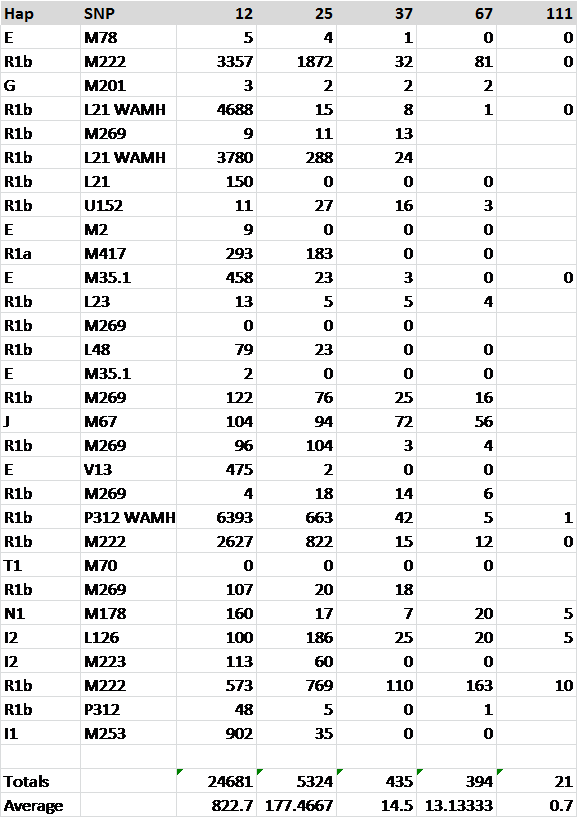
So, let’s look at 30 people, selected at random, in no particular order. The only selection criteria I used is that they must have tested at 37 markers or more.
In the table below, the numbers in the marker columns are the number of matches. Blank means that the individual did not test at that level. Zero means they did test and have no matches.
So let’s see what we have here.
Lots of 12 marker matches. The most for one person was 6393. This person was fortunate though, because they had rare markers to whittle that down to 663 at 25 markers, then 42, 5 and 1, respectively on the higher panels.
Being a WAMH (Western Atlantic Modal Haplotype), the most common 12 marker value grouping in Europe (allowing for one mutation to still be considered WAMH) means a lot of matches in the first panel, but has little influence past that.
Two people had no matches, one R1b and one T1. When I first started doing these reports, I was surprised to see R1bs with no matches, but I probably have as many of those as all other haplogroups combined. We think of R1b being extremely common, and it is as a whole, but there are obviously lots of pockets of rare lines out there just waiting to be discovered.
The average person has about eight hundred 12 marker matches, just under 200 25 marker matches, fourteen 37, thirteen 67 and not quite one 111 marker match. There still aren’t a lot of folks who have tested at the 111 marker level. The good news is that if you have a 111 marker match, it’s generally a very solid genealogical match. Most people use the 111 marker test to resolve 67 marker matches or to find line marker mutations within a family to identify specific ancestral lines.
But back to the original question. Is this pool too shallow to produce results? It think all of those 24,000+ people who have matches at 12 markers don’t think so. I think the 28 of the 30 people who have matches at any level don’t think so. The “average” guy who has matches at every level doesn’t think so. The 2 who don’t have any matches might wonder. I don’t think so, but I’ll let you wade in for yourself. Does this look like a shallow pool to you or a way to rip people off?
______________________________________________________________
Disclosure
I receive a small contribution when you click on some of the links to vendors in my articles. This does NOT increase the price you pay but helps me to keep the lights on and this informational blog free for everyone. Please click on the links in the articles or to the vendors below if you are purchasing products or DNA testing.
Thank you so much.
DNA Purchases and Free Transfers
- Family Tree DNA
- MyHeritage DNA only
- MyHeritage DNA plus Health
- MyHeritage FREE DNA file upload
- AncestryDNA
- 23andMe Ancestry
- 23andMe Ancestry Plus Health
- LivingDNA
Genealogy Services
Genealogy Research
- Legacy Tree Genealogists for genealogy research
