

The MCRA or time to the Most Recent Common Ancestor is a calculation provided by both Family Tree DNA and Ancestry.com for their clients who have taken the Y-line DNA tests. This is also written MRCA, Most Recent Common Ancestor, MCA and all of the above prefaced with a T meaning “time to”. Regardless of which way you see this acronym, it means the same thing – the closest ancestor you share with someone in the DNA line being tested.
I have a great example of how this actually translates into reality using the results from both companies.
Often, I receive communications from people who say something like this:
“It says that I’m related to John Doe within 6 generations. I have both of our genealogies to 6 generations, and I can’t find our common ancestor. What is wrong?”
The answer to “What is wrong?” is easy. The person doesn’t understand what the tool that estimates MCRA is telling them. And, I’m betting they didn’t read the instructions and explanations either, that is if they tested at Family Tree DNA who provides such.
Family Tree DNA provides a great deal more information and a far more robust tool than Ancestry. Family Tree DNA begins with this information:
“The probability that John Doe and William Doe shared a common ancestor within the last X generations…” The number of generations and the percentage probability are shown below.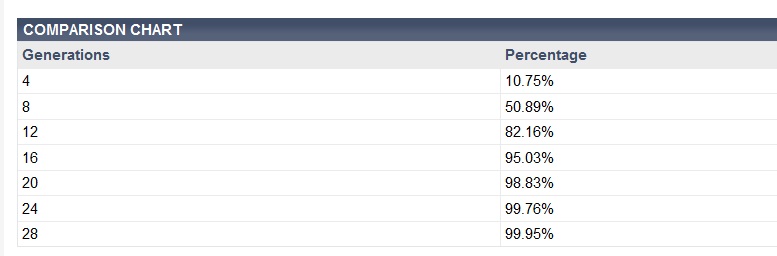
You can also change the generational display. I changed mine to “every generation.”
This is followed by an explanation and instructions for how to refine the calculations:
Refine your results with paper trail input
However, these results can be refined if their paper trail indicates that no common ancestor between John Doe and William Doe could have lived in a certain number of past generations.
If you don’t know this information for a fact, do not change the “1” in the box in the next paragraph. However, if you have the information, please enter in the box and click on the recalculate button.
John Doe and William Doe did not share a common ancestor more recently than 1 generation(s). (Because the important factor in calculating the time to the Most Recent Common Ancestor is the number of generations between which mutations could take place, the number of years per generation is irrelevant in FTDNATiP™ calculations).
After that, additional explanation and a reference to a FAQ sheet:
* The FTDNATiP™ results are based on the mutation rate study presented during the 1st International Conference on Genetic Genealogy, on Oct. 30, 2004. The above probabilities take into consideration the mutation rates for each individual marker being compared.
Since each marker has a different mutation rate, identical Genetic Distances will not necessarily yield the same probabilities. In other words, even though John Doe has a Genetic Distance‡ of 4 from William Doe, someone else with the same Genetic Distance may have different probabilities, because the distance of 4 was prompted by mutations in different markers, with different mutation rates.
‡Note: The Genetic Distance is the count of the total difference between two individuals. For example, if a marker differs by 2, then the Genetic Distance will count this as a distance of 2.
More questions? Please refer to the FTDNATiP™ FAQ page.
This is a huge difference compared to Ancestry who only gives you a number with absolutely no explanation at all:
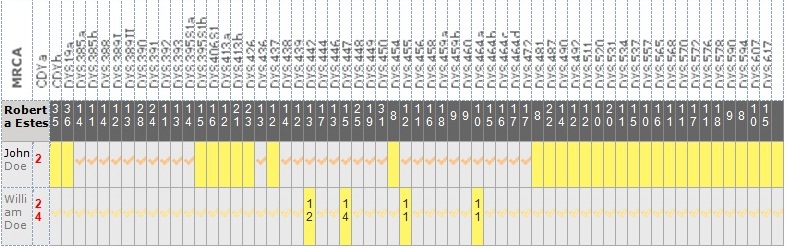
The MCRA is the small number beside the name – so John Doe is an MCRA of 2 and William is 24. I have highlighted these in red below so that you can see them.
Here is the explanation the Ancestry which is followed by the match table.
“You could be close to a meaningful family connection! The list below is sorted by how close your DNA matches (MRCA). The closest matches are at the top.”
Real Life Example
Ok, but what does all this really mean, in real life, to me?
Fortunately, I have a client who has tested at both locations, and has another man who he matches both at Ancestry and at Family Tree DNA. In addition, we know who their common ancestor is, and we can use this information to compare the accuracy and usefulness of the MCRA calculations.
At Ancestry, these men have tested 34 markers in common and have 4 mutations difference. Ancestry calls this relationship a distant match at 24 generations to the most common recent ancestor (MCRA).
At Family Tree DNA, they have tested 37 markers in common and have 4 mutations. Family Tree DNA, without refining the MCRA with the paper trail, calls this as the 50th percentile at 11 generations. This means that there is a 50% chance that you have a common ancestor within 11 generations. I use the 50th percentile number because that is the “most likely” spot – meaning that it’s equally likely that your ancestor was closer generationally or further away.
We know that these men are at 8 generations to a common ancestor for one man and 7 generations for the other.
Checking Family Tree DNA’s chart for 7 and 8 generations, that percentage or probability is 20% and 27% respectively.
Interestingly enough, Family Tree DNA says that at 24 generations, which was Ancestry’s estimated number of generations, there is a 97+% likihood that indeed they have a common ancestor.
So what we’ve learned is that Ancestry, aside from providing no tools or explanation, is very, very conservative. In this case, the number they give you is more likely their 100% sure number, not their “most likely” 50th percentile number. In fact, if we divide their number in half, it’s still high.
We’ve learned that Family Tree DNA’s 50th percentile is much closer to reality, even without any tweaking that you can do based on known pedigree charts.
______________________________________________________________
Disclosure
I receive a small contribution when you click on some of the links to vendors in my articles. This does NOT increase the price you pay but helps me to keep the lights on and this informational blog free for everyone. Please click on the links in the articles or to the vendors below if you are purchasing products or DNA testing.
Thank you so much.
DNA Purchases and Free Transfers
- Family Tree DNA
- MyHeritage DNA only
- MyHeritage DNA plus Health
- MyHeritage FREE DNA file upload
- AncestryDNA
- 23andMe Ancestry
- 23andMe Ancestry Plus Health
- LivingDNA
Genealogy Services
Genealogy Research
- Legacy Tree Genealogists for genealogy research
