Revisiting AncestryDNA Matches – Methods and Hints

I think all too often we make the presumption about businesses like Ancestry that “our” information that is on their site, in our account, will always be there. That’s not necessarily true – for Ancestry or any other business. Additionally, at Ancestry, being a subscription site, the information may be there, but inaccessible if your subscription lapses.

For a long time, I didn’t keep a spreadsheet of my matches at Ancestry, and when I began, not all of the information available today was available then – so my records are incomplete. Conversely, some of the matches that were there then are gone now. A spreadsheet or other type of record that you keep separately from Ancestry preserves all of your match information.

I was recently working on a particular line, and I couldn’t find some of the DNA Shared Ancestor Hints (aka green leaves) that were previously shown as matches. That’s because they aren’t there anymore. They’ve disappeared.

Granted, Ancestry has been through a few generations of their software and has made changes more than once, but these matches remained through those. However, they are unquestionably gone now. I would never have noticed if I hadn’t been keeping a spreadsheet.

Now, I have a confession to make. At Ancestry, the ONLY matches that I really work with are the DNA matches where I ALSO have a leaf hint – the Shared Ancestor Hint Matches.

ancestry-ancestor-hint

That’s not to say that this approach is right or wrong, but it’s what works best for me.  The only real exception is close matches, 3rd cousins or closer.  Those I “should” be able to unravel.

I’m not interested in trying to unravel the rest. About 50% of my matches have trees, and those trees do the work for me, telling me the common ancestor we match if one can be identified. For me, those 367 green Ancestor Hints DNA+tree-matches are the most productive.

So I’m not interested in utilizing the third party tools that download all of my Ancestry matches. I also don’t really want all of that information either – just certain fields.

Adding the match to my spreadsheet gives me the opportunity to review the match information and assures that I don’t get in a hurry and skim over or skip something.

So, when some of my matches came up missing, I knew it because I HAVE the spreadsheet, and I still have their information because I entered it on the spreadsheet.

Here’s an example. In a chart where I worked with the descendants of George Dodson, I realized that three of my sixteen matches (19%) to descendants of George Dodson are gone. That’s really not trivial.

ancestry-match-information

If you’re wondering how I could not notice that my matches dropped, I asked the same question. After all, Ancestry clearly shows how many Shared Ancestor hints I have.

Ancestry matches periodically have a habit of coming and going, so I’ve never been too concerned about a drop of 1 in the total matches – especially given adoptee shadow trees and such. Generally, my match numbers increase, slowly. What I think has actually been happening is that while I have 3 new matches, what really happened is that I lost two and gained 5 – so the net looks like 3 and I never realized what was happening.

ancestry-dna-main-page

Because I’m only interested in the Shared Ancestor Hint matches, that’s also the only number I monitor – and it’s easy because it’s dead center in the middle of my page.

When I realized I have missing matches, I also realized that I had better go back and enter the information that is missing in my spreadsheet for my early matches– such as the total segment match size, the number of matching segments and the confidence level. That’s the best we can do without a chromosome browser. It would be so nice if Ancestry provided a match download, like the other vendors do, so we don’t have to create this spreadsheet manually.

The silk purse in this sow’s ear is that in the process of reviewing my Ancestry matches, I learned some things I didn’t know.

Why Revisit Your Matches?

So, let’s take a look a why it’s a good idea to go back and revisit your Ancestry Shared Ancestor Hints from time to time.

  • People change their user name.
  • People change their ancestors.
  • You may now share more than one ancestral line, where you didn’t originally. I’ve had this happen several times.
  • People change their tree from public to private.
  • People change their tree from private to public.
  • Your matches may not be there later.
  • Circles come, and Circles go, and come, and go, and come and go…
  • If you contacted someone in the past about a private tree, requesting access, they may have never replied to you (or you didn’t receive their correspondence,) but they may have granted you access to their tree. Who knew!!!
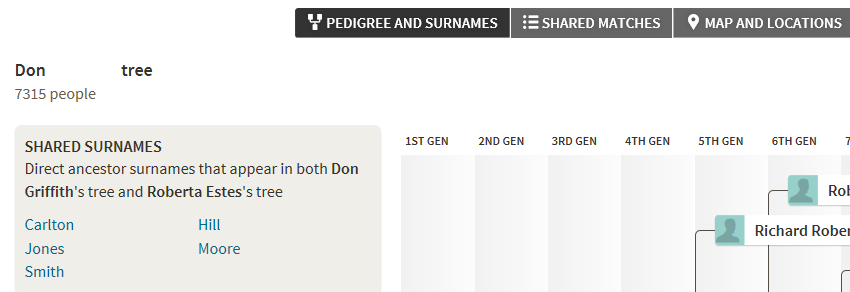
  • Check, and recheck Shared Surnames, because trees change. You can see the Shared Surnames in the box directly below the pedigree lineage to the common ancestor for you and your match.

ancestry-shared-surnames

  • Ancestry sometimes changes relationship ranges. For example, all of the range formerly titled “Distant Cousin” appears to be 5th – 8th cousins now.
  • When people have private trees, you’re not entirely out of luck. You can utilize the Shared Matches function to see which matches you and they both match that have leaf hints. Originally, there were seldom enough people in the data base to make this worthwhile, but now I can tell which family line they match for about half of my Shared Ancestor Hint matches (leaf matches) that are private.

This is also my first step if I do happen to be working with someone who doesn’t have a tree posted or linked to their DNA.

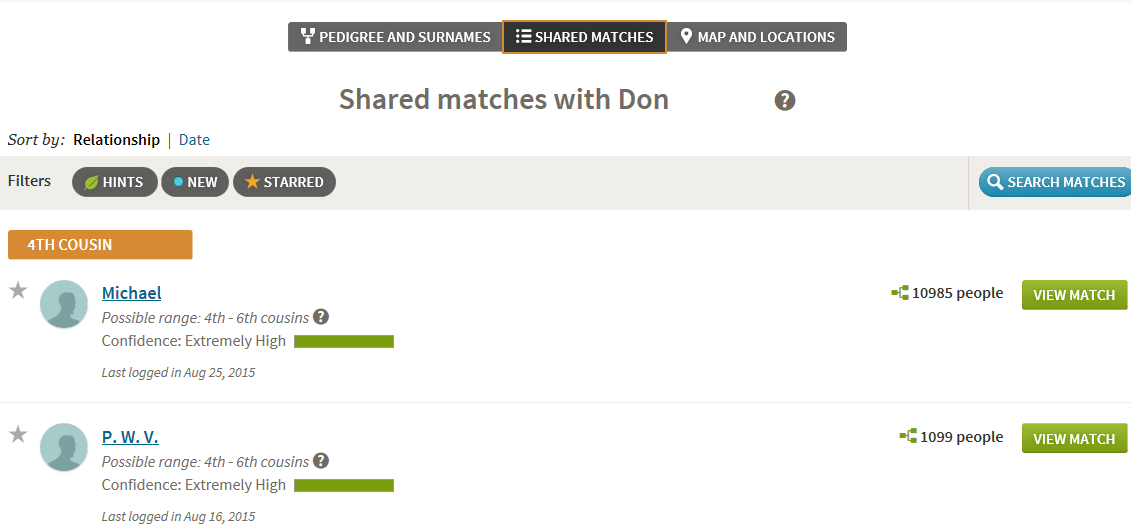
Click on the “View Match” link on your main match page for the match you want to see, then on the “Shared Matches” in the middle of the gray bar.

ancestry-shared-matches

The hint that you are looking for in the shared matches are those leaf hints, because you can look at that person’s tree and see your common ancestor with them, which should (might, may) provide a hint as to why the person you match is also matching them. It’s not foolproof, but it’s a hint.

ancestry-shared-matches-leaf

Of course, if you find 3 or 4 of those leaf hints, all pointing to the same ancestral couple, that’s a mega-hint.

Unfortunately, that’s the best sleuthing we can we can do for private matches with no tree to view and no chromosome browser.

  • You may have forgotten to record a match, or made an error.
  • Take the opportunity to make a note on your Ancestry match. The “Add Note” button is just above the “Pedigree and Surnames” button and just below the DNA Circle Connection.

ancestry-note

On your main match page, you can then click on the little note icon and see what you’ve recorded – which is an easy way to view your common ancestor with a match without having to click through to their match page. When the person has a private tree, I enter the day that I sent a message, along with any common tree leaf hint shared matches that might indicate a common ancestor.

ancestry-note-n-match-page

Tracked Information

Part of the information I track in my spreadsheet is provided directly by Ancestry, and some is not. However, the matching lines back to a common ancestor makes other information easy to retrieve.  The spreadsheet headings are shown below.  Click to enlarge.

ancestry-spreadsheet-headings

I utilize the following columns, thus:

  • Name – Ancestry’s user name for the match. If their account is handled by someone else, I enter the information as “C. T. by johndoe.”
  • Est Relationship – ancestry’s estimated relationship range of the match.
  • Generation – how many generations from me through the common ancestor with my match. Hint – it’s always two more than the relationship under the common ancestor. So if the identification of the common ancestor says 5th great-grandfather, then the person (or couple) is 7 generations back from me.
  • Ancestor – the common ancestor or couple with the match.
  • Child – the child of that couple that the match descends from.
  • Relationship – my relationship to the match. This information is available in the box showing the match in the shared ancestor hint. In this case, EHVannoy (below) and I are third cousins.
  • Common Lines – meaning whether we have additional lines that are NOT shown in Ancestor Hints. You’ll need to look through the Shared Surnames below the Shared Ancestor Hint box. I often say things in this field like, “probably Campbell” or “possibly Anderson” when it seems likely because either I’ve hit a dead end, or the family is found in the same geographic location.

ancestry-common-lines

  • Shared cMs – available in the little “i” to the right of the Confidence bar, shown below.

ancestry-shared-cms

Click on the “i” to show the amount of shared DNA, and the number of shared segments.

  • Confidence – the confidence level shown, above.
  • MtDNA – whether or not this person is a direct mitochondrial line descendant from the female of the ancestral couple. If so, or if their father is if they aren’t, I note it as such.
  • Y DNA – if this person, or if a female, their father or grandfather is a direct Y line descendant of this couple.

I’m sure you’ve figured out by now that if they are mtDNA or Y descendants, and I don’t already have that haplogroup information, I’m going to be contacting them and asking if they have taken that test at Family Tree DNA. If they have not, I’m going to ask if they would be willing. And yes, I’ll probably be offering to pay for it too. It’s worth it to me to obtain that information which can’t be otherwise obtained.

  • Comments – where I record anything else I might have to say – like their tree isn’t displaying correctly, or there is an error in their tree, or they contacted me via e-mail, etc. I may make these same types of notes in the notes field on the match at Ancestry.

Musings

It’s interesting that at least one of my matches that was removed when Ancestry introduced their Timber phasing is back now.

However, and this is the bad news, 82 previous leaf hint matches are now gone. Some disappeared in the adjustment done back in May 2016, but not all disappearances can be attributed to that house-cleaning. I noted the matches that disappeared at that time.

If you look at my current 367 matches and add 82, that means I’ve had a total of 449 Ancestor Hint matches since the Timber introduction – not counting the matches removed because of Timber. That means I’ve lost 18% of my matches since Timber, or said another way, if those 82 remained, I’d have 22% more Ancestor Hint matches than I have today.

Suffice it to say I wish I had more information about the matches that are gone now. I’d also like to know why I lost them. It’s not that they have private trees, they are simply gone.

As you may recall, I took the Ancestry V2 test when it became available to compare against the V1 version of the Ancestry test that I had taken originally.

ancestry-v2-match

It’s interesting that my own V2 second test doesn’t show as a shared match in several instances, example above and below.

ancestry-no-v2-match

It should show, since I’m my own “identical twin,” and the fact that it does not show on several individual’s shared matched with my V1 kit indicates that my match to that individual (E.B. in this case) was on the 300,000 or so SNPs that Ancestry replaced on their V2 chip with other locations that are more medically friendly. All or part of that V1 match was on the now obsolete portion of the V1 chip that my V2 test, on the newer chip, isn’t shown as a match. That’s 44% of the DNA that was available for matching on the V1 chip that isn’t now on the V2 chip.

My smallest match was 6cM. Based on the original white paper, Ancestry was utilizing 5cM for matches. Apparently that changed at some point. Frankly, without a chromosome browser, I’m fine with 6cM. There’s nothing I can do with that information, beyond tree matching without a chromosome browser anyway – and Ancestry already does tree matching for us.

Frustrations and Hints

Aside from the lack of a chromosome browser, which is a perpetual thorn in my side, I have two really big frustrations with Ancestry’s DNA implementation.

My first frustration is the search function, or lack thereof. If I turn up bald one day, this is why.

Here’s the search function for DNA matches.

ancestry-search

I can’t search for a user ID that I’ve recorded in my notes that I know matches me.

I can’t narrow searches beyond just a surname. For example, I’d like to search for that surname ONLY in trees with Shared Ancestor Hints, or maybe only in trees without hints, or only people in my matches with that surname, or only people who have this surname in their direct line, not just someplace in their tree. Just try searching for the surname Smith and you’ll get an idea of the magnitude of the problem. Not to mention that Ancestry searches do not reliably return the correct or even the same information. Ancestry lives and dies on searching, so I know darned good and well they can do better. I don’t know of any way around this search issue, so if you do, PLEASE DO TELL!!!

My second frustration is the messaging system, but I do have a couple hints for you to circumvent this issue.

I have discovered that there are two ways to contact your matches, and those two methodologies are by far NOT equal.

On your DNA match page, there is a green “Send Message” button in the upper right. Don’t use this button.

ancestry-messaging-green-button

The problem with using this button is that Ancestry does NOT send the recipient an e-mail telling them they received a message. Users have to both know and remember to look for the little grey envelope at the top of their task bar by their user name. Most don’t. It’s tiny and many people have no idea it’s there, especially if they are receiving e-mails when other people contact them through Ancestry. They assume that they’ll receive an e-mail anytime anyone wants to contact them. Reasonable, but not true.

I’m embarrassed to tell you that by the time I realized that envelope was there, I had over 100 messages waiting for me, all from people who thought I was willfully disregarding them, and I wasn’t.

So, if you use the green button, you’ve sent the message, but they have no idea they received a message. And you’re waiting, with your hopes dropping every day, or every hour if it’s an important match.

If you click on your little gray envelope, you’ll see any messages you’ve sent or received through the green contact button on the DNA page.

You can remedy this notification problem by utilizing the regular Ancestry contact button. Click on the user name beside their member profile on this same DNA page. In this case, EHVannoy.

You’ll then see their profile page, with a tan “Contact EHVannoy” button, EHVannoy being the user name.

ancestry-messaging-brown-button

Use this tan contact button to contact your matches, because it generates an e-mail. However, the tan button does NOT add the message to your gray envelope, and I don’t know of any way to track messages sent through the tan button. I note in my spreadsheet the date I send messages and a summary of the content. I also put this information in the Ancestry note field.

What’s Next?

Now, I know what you’re going to be doing next. You’re going to be going to look at your grey envelope and resend all of those messages using the tan button. There is an easy way to do this.

First, click on the grey envelope, then on the “Sent” box on the left hand side. You will then see all the messages you’ve sent.

ancestry-sent

Then, just click on the user name of any of your matches and that will take you to their profile page with the tan button!!! You can even copy/paste your original message to them. Do be sure to check your inbox to be sure they didn’t answer before you send them a new message.

ancestry-sent-to-profile

Hopefully some of the people who didn’t answer when you sent green button messages will answer with tan button messages. Fingers crossed!!!

______________________________________________________________

Disclosure

I receive a small contribution when you click on some of the links to vendors in my articles. This does NOT increase the price you pay but helps me to keep the lights on and this informational blog free for everyone. Please click on the links in the articles or to the vendors below if you are purchasing products or DNA testing.

Thank you so much.

DNA Purchases and Free Transfers

Genealogy Services

Genealogy Research

23andMe’s New Ancestry Composition (Ethnicity) Chromosome Segments

I was excited to see 23andMe’s latest feature that provides customers with Ancestry Composition (ethnicity) chromosome segment information by location.  This means I can compare my triangulation groups to these segments and potentially identify which ancestor’s DNA that I inherited carry which ethnicity – right?? Another potential way to help discern whether I should ask Santa for lederhosen or a kilt?

Not so fast…

Theoretically yes, but as it turns out, after working with the results, this tool doesn’t fulfill it’s potential and has some very significant issues, or maybe this new tool just unveiled underlying issues.

Rats, I guess Santa is off the hook.

Let’s take a look and step through the process.

Ancestry Composition Chromosome Painting

To see your Ancestry Composition ethnicity chromosome painting, sign into 23andMe, then go to the Reports tab at the top of your page and click on Ancestry. Please note that you can click on any of the graphics in this article to enlarge.

23andme-eth-seg-1

Then click on Ancestry Composition, which shows you the following:

23andme-eth-seg-2

Scrolling downs shows you your chromosomes, painted with your ethnicity. This isn’t new and it’s a great visual.

You may note that 23andMe paints both “sides” of each chromosome separately, the side you received from your mother and the side you received from your father. However, there is no way to determine which is which, and they are not necessarily the same side on each chromosome.

If one or both of your parents tested at 23andMe, you can connect your parents to your results and you can then see which ethnicity you received from which parent.

Let’s work through an example.

23andme-eth-seg-3

This person, we’ll call her Jasmine, received two segments of Native ancestry, one on chromsome 1 and one on chromosome 2, both on the first (top) strands or copies. She also received one segment of African on DNA strand (copy) 1 of chromsome 7.

Caveat

Words of warning.

JUST BECAUSE THESE ETNICITIES APPEAR ON THE SAME STRANDS OF DIFFERENT CHROMOSOMES, STRAND ONE IN THIS CASE, DOES NOT MEAN THEY ARE INHERITED FROM THE SAME PARENT.  

Each chromosome recombines separately and without a parent to compare to, there is no way to know which strand is mother’s or father’s on any chromsome. And figuring out which strand is which for one chromsome does NOT mean it’s the same for other chromsomes.

In fact, Jasmine’s mother has tested, and she has NO African on chromosome 7. However, Jasmine and her mother both have Native American on chromosomes 1 and 2 in the same location, so we know absolutely that Jasmine’s strand 1 on chromosome 7 is not from the same parent as strand 1 on chromosome 1 and 2, because Jasmine’s mother doesn’t have any African DNA in that location.

If you’re a seasoned 23andMe user, and you’re saying to yourself, “That’s not right, the chromosome sides should be aligned if a parent tests.”  You’re right, at least that’s what we’ve all thought.  Keep reading.

Let’s dig a bit further.

Connecting Up

23and Me encourages everyone to connect their parents, if your parents have tested.

Jasmine’s mother has tested and is connected to Jasmine at 23andMe.

23andme-eth-seg-4

Even though the button says “Connect Mother,” which makes it appear that Jasmine’s mother isn’t connected, she is. Clicking on Jasmine’s “Connect Mother” button shows the following:

23andme-eth-seg-5

Furthermore, if the parent isn’t connected, you don’t see any parental side ethnicity breakdown – and we clearly see those results for Jasmine.  Below is an example of the same page of someone whose parents aren’t connected – and you can see the verbiage at the bottom saying that a parent must be connected to see how much ancestry composition was inherited from each parent.

23andme-eth-seg-not-connect

If a child is connected to at least one parent, 23andMe, based on that parent’s test, tells the child which sides they inherited which pieces of their ethnicity from, shown for Jasmine, below.

23andme-eth-seg-6

In this case, the mother is connected to Jasmine and the father’s ethnicity results are imputed by subtracting the results where Jasmine matches her mother. The balance of Jasmine’s DNA ethnicity results that don’t match her mother in that location are clearly from her father.

23andMe may sort the results into the correct buckets, but they do not correctly rearrange the chromosome “copies” or “sides” on the chromosome browser display based on the parents’ DNA, as seen from the African example on chromosome 7. Either that, or the ethnicity phasing is inaccurate, or both.

You can see that 23andMe tells Jasmine that all of her Native is from her mother’s side, which is correct.

23andMe tells Jasmine that part of her North African and Sub-Saharan African are from her mother, but some North African is also from her father. You can see Jasmine’s African on her chromosome 7, below.

23andme-eth-seg-7

There is no African on Jasmine’s mother’s chromosome 7, below.

23andme-eth-seg-8

So if African exists on chromosome 7, it MUST come from Jasmine’s father’s side. Therefore, side one of chromosome 7 cannot be Jasmine’s mother’s side, because that’s where Jasmine’s African resides.

This indictes that either the results are incorrect, or the “sides” showing have not been corrected or realigned by 23andMe after parental ethnicity phasing, or both.

Here’s another example. Jasmine shows Middle East and North Africa on chromosomes 12 and 13 on sides one and two, respectively.

23andme-eth-seg-9

Jasmine’s mother shows Middle East and North Africa on chromosome 14, only, with none showing on chromosome 12 or 13.

23andme-eth-seg-10

Yet, 23andMe shows Jasmine receiving Middle East and North African DNA from her mother.

23andme-eth-seg-11

Jasmine is also shown as receiving Sub-Saharan African and West African from her mother, but Jasmine’s mother has no Sub-Saharan or West African, at all.

Interestingly, when you highlight both West African and Sub-Saharan African, shown below, it highlights the same segment of Jasmine’s DNA, so apparently these are not different categories, but subsets of each other, at least in this case, and reflect the same segment.

23andme-eth-seg-12

23andme-eth-seg-13

Jasmine’s mother shows this region of chromosome 7 to be “European” with no further breakdown.

Clearly Jasmine’s sides 1 and 2 have not been consistently assigned to her mother, because Jasmine’ African shows on both sides 1 and 2 of chromosomes 12 and 13 and Jasmine’s mother has no African on either on those chromosomes – so those segments should be assigned consistently to Jasmine’s father’s side, which, based on Jasmine’s match to her mother on chromosome 1, side 1 – Jasmine’s father’s “copy” should be Jasmine’s side 2.  This tool is not functioning correctly.

Jasmine’s father is deceased, so there is no way to test him.

The information provided by 23and Me contradicts itself.

Either the ethnicity assignment itself or the parental ethnicity phasing is inaccurate, or both. Additionally, we now know that the chromosome “sides,” meaning “copies” are inaccurately displayed, even when one parent’s DNA is available and connected, and the sides could and should be portrayed accurately.

This discrepancy has to be evident to 23andMe, if they are checking for consistency in assigning child to parent segments.  You can’t assign a child’s segment to a parent who doesn’t carry any of that ethnicity in a common location.  That situation should result in a big red neon sign flashing “STOP” in quality assurance.  Inaccurate results should never be delivered to testers, especially when there are easy ways to determine that something isn’t right.

The New Feature – Ethnicity Segments

Like I said, I was initially quite excited about this new feature, at least until I did the analysis. Now, I’m not excited at all, because if the results are flawed, so is the underlying segment data.

My original intention was to download the ethnicity segment information into my master spreadsheet so that I could potentially match the ethnicity segments against ancestors when I’ve identified an ancestral segment as belonging to a particular ancestral line.

This would have been an absolutely wonderful benefit.

Let’s walk though these steps so you can find your results and do your own analysis.

When you are on the Ancestry Composition page, you will be, by default, on the Summary page.

23andme-eth-seg-14

Click on the Scientific Details tab, at the top, and scroll down to the bottom of the page where you will see the following:

23andme-eth-seg-15

You will be able to select a confidence level, ranging from 50% to 90%, where 50% is speculative and 90% is the highest confidence. Hint – at the highest confidence level, many of the areas broken out in the speculative level are rolled up into general regions, like “European.”  Default is 50%.

23andme-eth-seg-16

Click on download raw data and you can then open or save a .csv file. I suggest then saving that file as an Excel file so you can do some comparisons without losing features like color.

In my case, I saved a 50% confidence file and a 90% confidence file to compare to each other.

I began my analysis with both strands of chromosome 1:

Strand 1 was easy.  (Click on graphic to enlarge.)

23andme-eth-seg-17

At the 50% confidence level, on the left, three segments are identified, but when you really look at the start and end positions, rows one and two overlap entirely. Looking back at the chromosome browser painting, this looks to be because that segment will show up in both of those categories, so this isn’t an either-or situation. Row 3 shows Scandinavian beginning at 79,380,466 and continuing through 230,560,900, which is a partial embedded segment of row 2.

At the 90% confidence level, on the right, above, this entire segment, meaning all of chromosome 1 on side 1, is simply called European.

You can see how this might get complex very quickly when trying to utilize this information in a Master DNA Spreadsheet with your matches, especially since individual segments can have 2 or 3 different labels.  However, I’d love to know where my mystery Scandinavian is coming from – assuming it’s real.

Now, let’s look at strand 2 of chromosome one. It’s a little more complex.

23andme-eth-seg-18

I’ve tried to color code identical, or partially-overlapping segments.

The red, green and apricot segments overlap or partially overlap at the 50% level, on the left, indicating that they show up in different categories.

The red segments are partially the same, with some overlapping, but are grouped differently within Europe.

The green Native/East Asian segments at the 90% level are interrupted by the blue unassigned segments in the middle of the green segments, while at the 50% confidence level, they remain contiguous.

All of the start and end segments change, even if the categories stay the same or generally the same. The grey example at the bottom is the easiest to see – the category changes to the more general “European” at the 90% level and the start segment is slightly different.

Jasmine and Her Mother

As one last example, let’s look at the segments at the 50% confidence level, which should be the least restrictive, that we were comparing when discussing Jasmine and her mother.

You can see, below, that Jasmine’s Native portion of chromosome 1 and 2 are either equal to or a subset of her mother’s Native portion, so these match accurately and are shown in green.

This tells us that Jasmine’s mother’s side of chromosomes 1 and 2 is Jasmine’s “copy 1” and given that we can identify Jasmine’s mother’s DNA, all of Jasmine’s “copy 1” should now be displayed as her mother’s DNA, but it isn’t.

23andme-eth-seg-19

On chromosomes 7 and 12, where Jasmine’s copy 1 shows African DNA, her mother has none. All African DNA segments are shown in red, above.

Furthermore, 23andMe attributes at least some portion of Jasmine’s African to Jasmine’s mother, but Jasmine’s mother’s only African DNA appears on chromosome 14, a location where Jasmine has none. There is no common African segment or segments between Jasmine and her mother, in spite of the fact that 23andMe indicates that Jasmine inherited part of her African DNA from her mother.  It’s true that Jasmine and her mother both carry African DNA, but not on any of the same segments, so Jasmine did not inherit her mother’s African DNA.  Jasmine’s African DNA had to have come from her father – and that’s evident if you compare Jasmine and her mother’s segment data.

Where Jasmine has African DNA segments, above, I’ve shown her mother’s corresponding DNA segments on both strands for comparison. I have not colored these segments. Conversely, where Jasmine’s mother has African, on chromosome 14, I have shown Jasmine’s corresponding DNA segments covering that segment.  There are no matches.

Clearly Jasmine did not inherit her African segments from her mother, or the segments have been incorrectly assigned as African or European, or multiple problems exist.

Summary

I initially thought the Ancestry Composition segments were a great addition to the genealogists toolset, but unfortunately, it has proven to be otherwise, highlighting deficiencies in more than one of the following area:

  • Potentially, the ancestry composition ethnicity breakdown itself.  Is the underlying ethnicity assignment incorrect?  In either case, that would not explain the balance of the issues we encountered.
  • The chromosome “sides” or “copy” shown after the parental phasing – in other words, the child’s chromosome copies can be assigned to a particular parent with either or both parents’ DNA. Therefore, after parental phasing, all of the same parent’s DNA should consistently be assigned to either copy 1 or copy 2 for the child on all of their chromosomes.  It isn’t.
  • The child’s ethnicity source (parent) assignment based on the parent’s or parents’ ethnicity assignment(s).  Hence, the African segment assignment issues above.
  • The ethnicity phasing itself.  The assigning of the source of Jasmine’s African DNA to her mother when they share no common African segments.  Clearly this is incorrect, calling into question the validity of the rest of the parental ethnicity phasing.

Unfortunately, we really don’t have adequate tools to determine exactly where the problem or problems lie, but problems clearly do exist. This is very disappointing.

As a result, I won’t be adding this information to my Master DNA spreadsheet, and I’m surely glad I took the time to do the analysis BEFORE I copied the segment data into my spreadsheet.  In my excitement, I almost skipped the analysis step, trusting that 23andMe had this right.

All ethnicity results need to be taken with a large grain of salt, especially at the intra-continent level, because the reference populations and technology just haven’t been perfected.  It’s very difficult to discern between countries and regions of Europe, for example.  I discussed this in the article, “Ethnicity Testing – A Conundrum.”

However, it appears that adding parental phasing on top means that instead of a grain of salt, we’re looking at the entire shaker, at least at 23andMe – even at the continent level – in this case, Africa, which should be easily discernable from European. Parental phasing by its very nature should be able to help refine our results, not make them less reliable.

Is this new segment information just showing us the problems with the original ethnicity information?  I hate to even think about this or ask these difficult questions, but we must, because testers often rely on minority (to them) ethnicity admixture information to help confirm the ethnicity of distant ancestors. Are the display tools or 23andMe’s programs not working correctly, or is there a deeper problem, or both?

I think I just received a big lump of coal, or maybe a chunk of salt, in my stocking for Christmas.

Bah, humbug.

______________________________________________________________

Disclosure

I receive a small contribution when you click on some of the links to vendors in my articles. This does NOT increase the price you pay but helps me to keep the lights on and this informational blog free for everyone. Please click on the links in the articles or to the vendors below if you are purchasing products or DNA testing.

Thank you so much.

DNA Purchases and Free Transfers

Genealogy Services

Genealogy Research

The Big Y and Genealogy

holiday-lights

For the holidays, I want to talk briefly about one particular type of DNA that is tested, and why one might want to order that particular test.

I’ve seen questions this past week about the Big Y test, so let’s talk about this test today.

The Big Y Test

The questions I’ve seen recently about the Big Y mostly revolve around why the test isn’t listed among the sale prices shown on the Family Tree DNA main page.

The Big Y test is not an entry level test. The tests shown on the Family Tree DNA main page are entry level and can be ordered by anyone, at least so long as the Y DNA tests are ordered for males. (Females don’t have a Y chromosome, so Y tests won’t work for them.)

The Big Y test is an upgrade for a male who has already taken the regular 37, 67 or 111 STR (short tandem repeat) marker test. For those who are unfamiliar, STR markers are used in a genealogically relevant timeframe to match other men to search for a common recent ancestor and are the type of markers used for 37, 67 and 111 marker tests.

SNPs (single nucleotide polymorphisms) are used to determine haplogroups, which reflect deep ancestry and reach significantly further back in time.

Haplogroups are predicted for each participant based on the STR test results, and Family Tree DNA’s prediction routines are very accurate, but the haplgroup can only be confirmed by SNP testing. These two tests are testing different types of DNA mutations. I wrote about the difference here.

Different SNPs are tested to confirm different haplogroups, so you must have your STR results back with the prediction before you can order SNP tests.

The Big Y is the granddaddy of SNP testing, because it doesn’t directly test each SNP location, and there are thousands, but scans virtually the entire Y chromosome to cover in essence all known SNPs. Better yet, the Big Y looks for previously unknown or unnamed SNPs. In other words, this test is a test of discovery, not just a test of confirmation.

Many SNPS are either unknown or as yet unnamed and unplaced on the haplotree, meaning the Y DNA tree of mankind for the Y chromosome. The only way we discover new SNPs is to run a test of discovery. Hence, the Big Y.

It’s fun to be on the frontier of this wonderfully personal science.

Applying the Big Y to Genealogy

In addition to defining and confirming the haplogroup, the Big Y test can be immensely informative in terms of ancestral roots. For example, we know that our Lentz line, found in Germany in the 1600s, matches the contemporary results of Burzyan Bashkir men, descendants of the Yamnaya. I wrote about this here, near the end of the article.

Even more amazing, we then discovered that our Lentz line actually shares mutations with ancient DNA recovered from Yamnaya culture burials from 3500 years ago from along the Volga River. You can read about that here, near the end of the article. This discovery, of course, could never have been made if the Big Y test had not been taken, and it was made by working with the haplogroup project administrators. I am eternally grateful to Dr. Sergey Malyshev for this discovery and the following tree documenting our genetic lineage.

JakobLenz Malyshev chart

Our family heritage now extends back into Russia, 3500 years ago, instead of stopping in Germany, 400 or 500 years ago. This huge historical leap could NEVER have been made without the Big Y test in conjunction with the projects and administrators at Family Tree DNA.

And I must say, I’m incredibly glad we didn’t wait to order this test, because Mr. Lentz, my cousin who tested, died unexpectedly, just a couple months later. His daughter, when informing me of his death, expressed her gratitude for the test, the articles and shared with me that he had taken both articles to Staples, had them printed and bound as gifts for family members this Christmas.

These gifts will be quite bittersweet for those family members, but his DNA legacy lives on, just as the DNA of our ancestors does inside each and every one of us.  He gave all Lentz descendants an incredible gift.

______________________________________________________________

Disclosure

I receive a small contribution when you click on some of the links to vendors in my articles. This does NOT increase the price you pay but helps me to keep the lights on and this informational blog free for everyone. Please click on the links in the articles or to the vendors below if you are purchasing products or DNA testing.

Thank you so much.

DNA Purchases and Free Transfers

Genealogy Services

Genealogy Research

Building Your Personal Mitochondrial Tree

People who test at Family Tree DNA and receive mitochondrial DNA full sequence results often have questions about how they can use their results to further their understanding of their ancestors.

One of the things you can do is to build a mitochondrial DNA haplotree of your own, showing how various people that you match are or are not descended from common ancestors. To do this, you’ll need to contact your matches and share your mutations.

Your results at Family Tree DNA tell you how many mutations you have, shown below, in the genetic distance column.  For more information on genetic distance, how it is calculated and what it means, click here.

GD my results

Your results at MitoSearch, if you upload, or within projects at Family Tree DNA, show you the HVR1+HVR2 region mutations, but the only way to compare the coding region, or full sequence matches is for the people involved to share them directly with each other.

How can mutations help identify your common ancestors with your matches, or if not the ancestor themselves, at least where they were from?

Let’s look at reconstructing a DNA tree based on both your common mutations and mutations you don’t share with your matches.

When building a DNA tree, remember that once a mutation enters the mitochondrial DNA, unless there is a back-mutation, which is exceedingly rare, that mutation will be found in all descendants.

This discussion excludes heteroplasmic mutations, which can be easily identified as any mutation that ends with any letter other than T, A, C or G – for example 16519Y would be heteroplasmic, indicated by the Y. The simple explanation for heteroplamic mutations is that they are a mutation in progress, and therefore relatively recent. They don’t pertain to deeper ancestry, so we are ignoring them for this discussion. Most people don’t have heteroplasmic mutations.

Building Your Tree

Let’s look at an example of how to build a mitochondrial mutation tree.

A common ancestor, at the top of the tree, has 2 mutations that they pass to all of their descendants.

Ancestor B and C have those 2 mutations, so they match ancestor A and each other.

Both ancestor B and C have both developed mutations that don’t match each other. In real life, it would be very rare for mitochondrial DNA to develop mutations in every generation, so just view this as a rather time-compressed example.

In ancestor B’s line, there are two contemporary individuals, D and E, who have all 3 of the mutations that Ancestor B carried.

So, you have a tree that looks like this.  You can click to enlarge.

mito-tree

Ancestor C also has two descendants, F and G, who both carry all of Ancestor C’s mutations, plus both F and G each have a mutation that doesn’t match each other.

So, now let’s say Person I comes along as a match. You can tell which line they belong to, and which lines they don’t, by which mutation(s) person I carries, as compared to your tree. For example, if person I carries mutations 1, 2 and 4, then you know that they are a descendant of Ancestor C, not B.  If they carry 1, 2, 4 and 5, then they descend from Person G’s line.

I suggest that you work with your full sequence matches to build this type of mitochondrial descendancy tree. You must work with your matches, because you cannot see your matches’ coding region results, not even in projects, so you’ll have to ask each one to share with you. Be prepared, some people won’t answer, but often, based on who the people match that do respond to you, and are willing to share, you can figure out the missing blanks.

For example, Let’s say John matches you with one mutation, and so does Joe, but Joe doesn’t answer your e-mail. However, John wants to work with you and John matches Joe exactly. Now you know which mutation Joe has as well – the same one as John.

You know that each of your full sequence matches is within a maximum of 3 mutations difference from you, because that’s the maximum that Family Tree DNA allows to be considered a match at the full sequence level.

Of course, not all of your matches will have the same 3 mutations, which is why you’ll need to work with them to see how your tree fleshes out. Who knows what surprises you may find.

The first question I ask each of my matches, after explaining what I’m trying to do, is whether they share any of my extra or missing mutations, with the exception of the insertions at 309, 315 or 522 and/or any mutation at 16519. These mutations are extremely common. Sometimes people are more comfortable sharing specific mutations than sending you their results. Other people will be glad to send results. In rare instances, the coding region may hold mutations that have medical significance, which is why Family Tree DNA doesn’t show specific mutations, only whether you match or not.

mito-extra-and-missing

In the example above, you can see that C16189T is normally present in this mitochondrial sequence, but it missing from this person’s results.

Your mitochondrial tree that you build may well shed light on your common ancestor and based on the location of the oldest ancestor of the person at the top of your tree, may also shed light on the location where your common ancestor may have lived and the migration path she took to where your most distant ancestor in this line was found.

My own mitochondrial DNA tree begins in Scandinavia and only my line winds up in Germany before 1700.  Another branch is found in Poland.

mitomatches

Ironically, my exact matches are in Norway (red), not to the line in Poland (orange). The rest of the lines whom I match and that also descend from my Scandinavian ancestor are still found in Scandinavia with one exception found in southern Russia which could be a result of migration to this region from the Germanic region of Europe in the 1700s and 1800s. This tells me that I’m closer, genetically, to the Scandinavian branches than the Polish branch, which is not at all what I would have expected. The Polish branch apparently migrated separately from mine.

My mitochondrial tree also tells me that the common ancestor of all of the matches likely originated in Scandinavia, possibly Norway, also not something I would have expected, given that my most distant ancestor is very clearly German, based on church records.

Give building your mitochondrial tree a try and see what kinds of surprises it may hold!  If you haven’t yet tested your full sequence mitochondrial DNA, order that test today.  You have ancestors waiting for you!

______________________________________________________________

Disclosure

I receive a small contribution when you click on some of the links to vendors in my articles. This does NOT increase the price you pay but helps me to keep the lights on and this informational blog free for everyone. Please click on the links in the articles or to the vendors below if you are purchasing products or DNA testing.

Thank you so much.

DNA Purchases and Free Transfers

Genealogy Services

Genealogy Research


Ancestry V1 vs V2 – Shared DNA and Relationship Predictions

I reviewed the results of Ancestry’s V1 chip in comparison with their V2 chip relative to matches recently in the article titled Ancestry V1 vs V2 Test Comparison.

I had previously tested on the V1 chip, and recently tested on the V2 chip to see how many of the same matches were present on both match lists. The results were better than expected. Out of my 333 V1 Shared Ancestor Hint matches, all but 7 were on the V2 match list. Given that Ancestry replaced almost half of the SNPs on their chip, that’s an amazingly high retained match number – about 97.5%.

Another genetic genealogist asked about how much of the DNA is the same, or in common for the individual matches. In other words, did the amount of shared DNA with individual matches change between the two chip versions?

While Ancestry does not provide us with a chromosome browser, they do provide us with the amount of DNA in common with a match after their Timber algorithm removes segments that Ancestry feels are “too matchy.”  You can read more about how this is done, here.

ancestry-self-to-self-shared-dna

In the screen shot above, you can see that the amount of shared DNA is displayed when you click on the “i” button beside the confidence level of the predicted relationship.  In this case, I’ve looked at my V1 kit match to my V2 kit match.  Clearly, I don’t have 26 chromosomes, so some of my chromosome segments have been severed, either by faulty reads or by Timber removing segments.

Because of Timber, the amount of shared DNA shown by Ancestry is not the actual amount of matching DNA when compared to matching DNA at any other vendor or Gedmatch.  However, the amounts of shared DNA are consistently calculated between the V1 and V2 chips, so comparing Ancestry V1 to Ancestry V2 is certainly reasonable.  What we don’t know is whether this is the same DNA that is matching between V1 and V2, or if the matching DNA is actually on different segments, partial segments or different combinations of segments.  Without a chromosome browser or specific segment information, we have no way of knowing or discovering that information.

In the chart below, I’ve compared my 100 top shared ancestor hint (green leaf) matches (other than my own V1 to V2 kit comparison), meaning those with tree leaf hints indicating:

  • That our DNA matches and
  • That we share at least one common ancestor in our trees

Please note, for purposes of clarity, a shared ancestor hint (green leaf) does NOT mean or confirm that the DNA we share is from that common ancestor. The shared DNA could be from a secondary or different common line or the genealogy could be incorrect in one or both trees.  The fact that we share DNA, and that we have an identified common ancestor in our trees are independent pieces of information that both serve as important hints.  Both need to be verified.  Without a chromosome browser and triangulation, we cannot confirm that the shared DNA is from that particular ancestor.

Amount of Shared DNA Between V1 and V2 Chips

For each of my 100 top V1/V2 shared ancestor hint matches, I recorded the amount of shared DNA as displayed by Ancestry and the number of shared segments.  In addition, I also recorded the Ancestry predicted relationships and actual relationships as shown in my tree and my matches tree, as shown in the example below for Match 1.

ancestry-common-ancestors

My top 100 matches are shown in the table below, with their V1 and V2 results along with predicted and actual relationships.

  • Bold=increases and decreases in the amount of shared DNA
  • Red=increase or decrease of 2cM or greater
  • Yellow=increase or decreases in the number of shared segments

ancestry-shared-cm-and-rel

Increases and Decreases

Of the various matches, 9 increased between V1 and V2, indicating that these individuals match on some of new newly included SNPs.

On the other hand, 52 decreased between V1 and V2 indicating that some of the SNPs where they previously matched have been removed on the new (current) chip.

Increases and decreases are bolded, including those in red which signify an increase or decrease of 2cM or greater. Nine matches had an increase or decrease of 2cM or more. Of those, 2 increased and 7 decreased.

The maximum increase was 5.3 cM.

The maximum decrease was 6 cM.

In most cases, the number of shared segments remained the same. Of the 4 that changed, 3 decreased and one increased, indicated by cells highlighted in yellow. In one case, the cMs dropped, but the segments increased, causing me to wonder if a segment was split in the V2 version. In another instance, the shared cMs remained the same, but the segments moved from 2 to 1. I’m not sure how to explain that one, except for the possibility that some of the removed SNPs caused the measured area to be counted as one instead of two, or perhaps the matching segments aren’t the same.

Actual vs Predicted Relationships

Eight people, or 8% had private trees meaning they can see the identity of our common ancestor, because my tree is public, but I cannot see the identity of that ancestor.  That also means that I can’t determine the actual relationship for this comparison.

The 5 noted with ? means the ancestor is not the same ancestor or the match’s tree information is incorrect.  In this case, that means 5% of the tree matches, or common ancestors as indicated in the trees are known to be inaccurate for one reason or another.  There are likely additional inaccurate “common ancestors” given the amount of “tree grafting” that occurs.

In two cases the relationship was further out in time than predicted, although the predicted ranges are fairly broad and do significantly overlap. For example, one range is 4-6th cousins, and the next range is 5-8th cousins.

In 16 cases the relationship was closer than predicted.

I do have an endogamous Acadian line as noted.

In all cases, the amount of shared DNA was within the range of other people whose predictions were accurate, so this prediction variance is clearly a factor of the variability of inheritance of DNA.

The Net-Net

The net-net of this exercise is that when comparing the shared DNA between the same match on the V1 and V2 chip, far more people lost matching DNA than gained – 52% vs 9%.  In this comparison, all 100 of the people remained as matches, which isn’t surprising since these are my 100 closest shared ancestor hint matches, meaning those with the highest amounts of shared DNA.  However, with matches that have “less to lose,” meaning more distant matches having fewer matching centiMorgans of DNA to begin with, matches are more likely to be lost.

In this comparison, the people who appeared as matches on the V1 chip remain as matches on the V2 chip, but just over half showed less matching DNA utilizing the V2 chip.

______________________________________________________________

Disclosure

I receive a small contribution when you click on some of the links to vendors in my articles. This does NOT increase the price you pay but helps me to keep the lights on and this informational blog free for everyone. Please click on the links in the articles or to the vendors below if you are purchasing products or DNA testing.

Thank you so much.

DNA Purchases and Free Transfers

Genealogy Services

Genealogy Research

Increasing “In Common With” (ICW) Functionality at Family Tree DNA

You know how Murphy’s Law works, right?

Right after I wrote the article Nine Autosomal Tools at Family Tree DNA, as in minutes later (Ok, that’s probably an exaggeration), Family Tree DNA made a change and the ICW (in common with) tool functioned differently.  Murphy lives at my house, I swear!

I initially thought perhaps this was unintended, but it may well be a design change since additional functionality was provided and three months have elapsed.

So regardless of whether or not this change is permanent or will change minutes after I publish this article, I’m providing instructions on how this feature works NOW. If it changes or works differently in the future, I’ll let you know!

In all fairness, it’s the addition of the combination searches, I think, that has caused the confusion. Combo searches are great features and powerful, if you know how to use the functionality correctly for what you want to accomplish.

Let’s take a look at how to utilize the various kinds of searches, individually and in combination, step-by-step.

Example One – Regular “In Common With” Matches

The ICW feature shows you who your matches match in common with you. I’ve signed on as my mother for these examples to illustrate this feature since she is a generation more closely related to these folks than I am.

First, let’s do a normal “in common with” search between my mother and her cousin, Donald.  The results of this search will show us everyone that matches mother and Donald, both.

icw-donald-arrow

In this example, I’ve done the following:

  1. Selected Donald (who appears on mother’s match list, above) by clicking on the box to the left of his name, which you can see in the “Selected Matches” box at the bottom left indicating he has been selected.
  2. Click on the “in common with” function button above the list of names.

icw-donald-results-arrow

After clicking on the “in common with” button, what I see (above) are all 91 people that match mother in common with Donald, meaning that mother and Donald both match all 91 of these people. This does NOT mean mother and Donald both match them on the same segment(s), only that they do match on at least one segment over the matching threshold.

As you can see, Donald’s name appears now in the “In Common With” box at the top left, along with a total of 91 people who match Donald and my mother both.

To clear any search, meaning all options, at any time, just click on the “reset filter” blue button, located to the right of the “not in common with” function button.

There are multiple features that work together for “in common with” matching and surname searching. Let’s take a look.

Example Two – Surname Searches Plus ICW, Combined

Now, I’ll enter the name Miller in the search box at the upper right. This shows me everyone who has name of Miller, or Miller appearing in their ancestral surnames, who match my mother.

Next, I want to select someone from that Miller match list to see which other people on the Miller match list they match in common with mother. Hey, let’s pick Donald!!!

To utilize a surname search (Miller) and ICW (Donald) together, do the following:

  1. Enter the surname Miller in the search box on the upper right and click enter or the search (blue magnifying glass) icon. Donald appears on the Miller match list, as well as 90 other people.  This means that Donald has Miller appearing in his list of ancestral surnames, since his surname is not Miller.
  2. When the match results are returned, select Donald by clicking on the box to the left of his name.
  3. Then click on the “in common with” function box above the list of matches.

icw-work-arrows

I selected Donald, as you can see, by clicking the box beside his name, and his name now appears in the “Selected Matches” box in the lower left hand corner of the page, indicating that he has been selected. However, note that the name Miller still appears in the search box in the upper right hand corner.

Next, I click on the ICW function button, above the list of matches, and I see the following 22 matches that all share the Miller surname or Miller on their list of ancestral names AND match Donald and mother, both. I’m NOT seeing all of mother’s 91 Miller matches, but ONLY her Miller matches that are ALSO “in common with” Donald.  This immediately gives me a list of people that are very likely descended from this same ancestral Miller line, and some of them will likely triangulate by utilizing the chromosome browser and other tools described in the Nine Autosomal Tools article.

icw-combo-results-arrow

This combination search is a wonderful feature, but this isn’t always what people want to do. Sometimes you want to first see the Miller matches, then select someone from that match list to run the full ICW tool and see ALL of their matches, not just the ICW Miller matches. This is the functionality that works differently than previously, but it’s actually very easy to accomplish.

Surname Search, Then ICW to Person on Match List, but not Combined

Often, you’ll find someone in the ICW Miller match list, for example, and you then want to see ALL of the ICW matches to that person, NOT just the ICW matches with Miller. Said another way, you want to utilize the name of someone found in the Miller search, but not limit the ICW results to just the Miller surname.

In this case, simply follow these steps:

  1. Run the Miller search as in Example One.
  2. Select Donald from the results by clicking on the box beside his name – step #2 in Example Two.  Do NOT click on the ICW button, yet.
  3. REMOVE Miller from the search box at upper right. After removing Miller, you will see the full match list load again (replacing the Miller match list), but Donald remains selected in the “Selected Matches” box in the lower left corner.
  4. Click on the “in common with” function button to see the full ICW match list for the person selected.

Once again, you will see the full match list of 91 people between mother and Donald, as if Miller was never selected.

What Doesn’t Work

One function doesn’t work that worked previously, and that’s the ability to search for a location, meaning those locations in parenthesis in the ancestral surnames.  This type of search is particularly important to people with Scandinavian ancestors whose surnames are patronymic, meaning they derive from a father’s first name, such as Johnsson for John’s son.  These surnames changed generationally and locations are often more reliable in terms of genealogy searches.

This is probably a function of a feature that was being utilized by users in a way never imagined by the designers.  Regardless, a bug report or enhancement request, depending in your perspective, has been submitted, but there is no known work-around today.

______________________________________________________________

Disclosure

I receive a small contribution when you click on some of the links to vendors in my articles. This does NOT increase the price you pay but helps me to keep the lights on and this informational blog free for everyone. Please click on the links in the articles or to the vendors below if you are purchasing products or DNA testing.

Thank you so much.

DNA Purchases and Free Transfers

Genealogy Services

Genealogy Research

Ancestry Shared Matches Combined With New Ancestor Discoveries

Ancestry added a greatly anticipated feature this week that promises to help genealogists – shared matches.  This is similar to the “In Common With” feature at Family Tree DNA – at least in concept.

Shared Matches

Previous to this announcement, when you match someone at Ancestry, the only way you can see who else they happen to match in common with you is if you are placed in an ancestor DNA Circle with them – and then you can only see the other people in that Circle.

For example, here is my Henry Bolton DNA Circle.

circle henry bolton matches2

The people I match are shown with an orange line.  Each of those people match me, and they may also match other people in the Circle that I don’t match.

circle henry match matches2

Regardless of whether I match the individuals directly, or they match someone else that I match, the common factor is that we all share Henry Bolton identified as an ancestor in our tree.

What Ancestry introduced today is the ability to click on any of these people who match me, OR, the people in the circle who do NOT match me but who do share Henry Bolton in their tree and match others in the circle – and see who they match in common with me.  This should allow people to group their matches, at least tentatively and is especially promising for those frustrating people with whom you match closely but have private trees and won’t reply to messages.

While this is interesting for circles, it’s not terribly useful in terms of breaking down walls, because I already know Henry Bolton is my ancestor.  In other words, I wouldn’t be in the circle if I didn’t already know the identity of that ancestor.

What I’m particularly interested in, is applying this tool to my NADs, or New Ancestor Discoveries, because if I can figure out how these people truly are related to me, then I may be able to make a discovery of a new ancestor in my tree.  Now THIS holds a lot of promise and intrigues me greatly.  So, let’s take a look at my NADs and see how this new tool works and if it’s useful.  I can hardly wait!!!

State of the NADs

If you’ve been following my blog, you’ll know that Ancestry and I have been having a bit of a friendly Bad NAD duel.  Ancestry keeps giving me new ancestor discoveries (NADs) but in several cases, I have unquestionably proven that those NADs are not my ancestors – hence the term – Bad NADs.  In one case, the new ancestor assigned to me is the husband of my ancestors sister.  However, I currently have three NADS that are related to each other than may benefit greatly by this new shared matches tool.

Since my last NAD update, where Diedamia Lyon and John David Curnutte were given to me a second time, another NAD has been added – John David Curnutte’s mother, Deresa Chaffin.

shared matches nads

Here’s the tree version of this relationship

shared matches nad tee

NAD Circles and Matches

In the NAD Circle for Diedamia Lyon, John David Curnutte and Deresa Chaffin, we find both Don and Michael, whom I match.

First, keep in mind that I may match both Don and Michael on other lines – so the fact that I match both of them and they both descend from a common ancestor does NOT mean that is how I connect genetically to both of them.  But for purposes of this discussion, let’s assume that it is and proceed.

The fact that we find these two individuals whose DNA I match in all three circles suggests that the relationship is through the Curnutte line, and not through Diedamia Lyon at all, except for the fact that these men also descend from her.  Given that John David’s Curnutte’s mother is also a NAD suggests that the connection to Diedamia Lyon and John David Curnutte is through the Curnutte line.  Although Deresa Chaffin’s husband is not listed, he is John Tolliver Curnutte and clearly, the connection might be through him as opposed to Deresa – just like the connection to the couple Diedamia Lyon and John David Curnutte was through the Curnutte husband.

The NAD Circle for Diedamia Lyon and John David Curnutte are identical, with two matches and 5 non-matching individuals.

shared nad diedemia lyon

For each one of these individuals in the Circle, if you click on their name on the right, you’ll be able to see a variety of information, including their pedigree and matching surnames, maps and locations, and the new shared matches tab.

shared matches shared surnames

The new shared matches tab is a great tool, and it’s particularly important, when unraveling NADs to use it in conjunction with the shared surnames, shown at left.  These are the surnames found in both your tree and the person whose tree you’re comparing against.

Let’s take a look at one of these – Moore, as an example.

shared matches surname compare

As you can see, these are either not the same line or at least can’t be identified as such.  However, in some cases, you may recognize your matches’ end of line person as connecting with your tree further upstream.  It’s times like this that having a robust tree where you’ve tracked downstream lineages of your ancestor’s siblings can be very beneficial.

By clicking on the shared matches option, you’ll see the following people who you match in common with the individual – in this case, Don, my DNA match.  I could also compare to one of the people in the Circle whom I don’t DNA match.

shared matches shared with

What I’m particularly looking for are matches with that lovely shakey leaf by the View Match button on the far right.  Ahem…there aren’t any, which means none of these matches match me with a known common ancestor.  Rats!!!

While Diedamia Lyon and John David Curnutte have the same members as each other in their NAD circles, John’s mother, Deresa Chaffin, has more members in her NAD circle – which means more opportunities for me to find common line hints..

shared matches nad circle

The DNA matches are to the same 2 people, but now there are additional people in the circle who also match Michael and Don.

The great news is that in addition to clicking on your matches to see who else they match, you can also click on any other circle member.  I’m very, very hopeful that a distinct trend emerges so I can tell at least what line these NADs might be associated with.

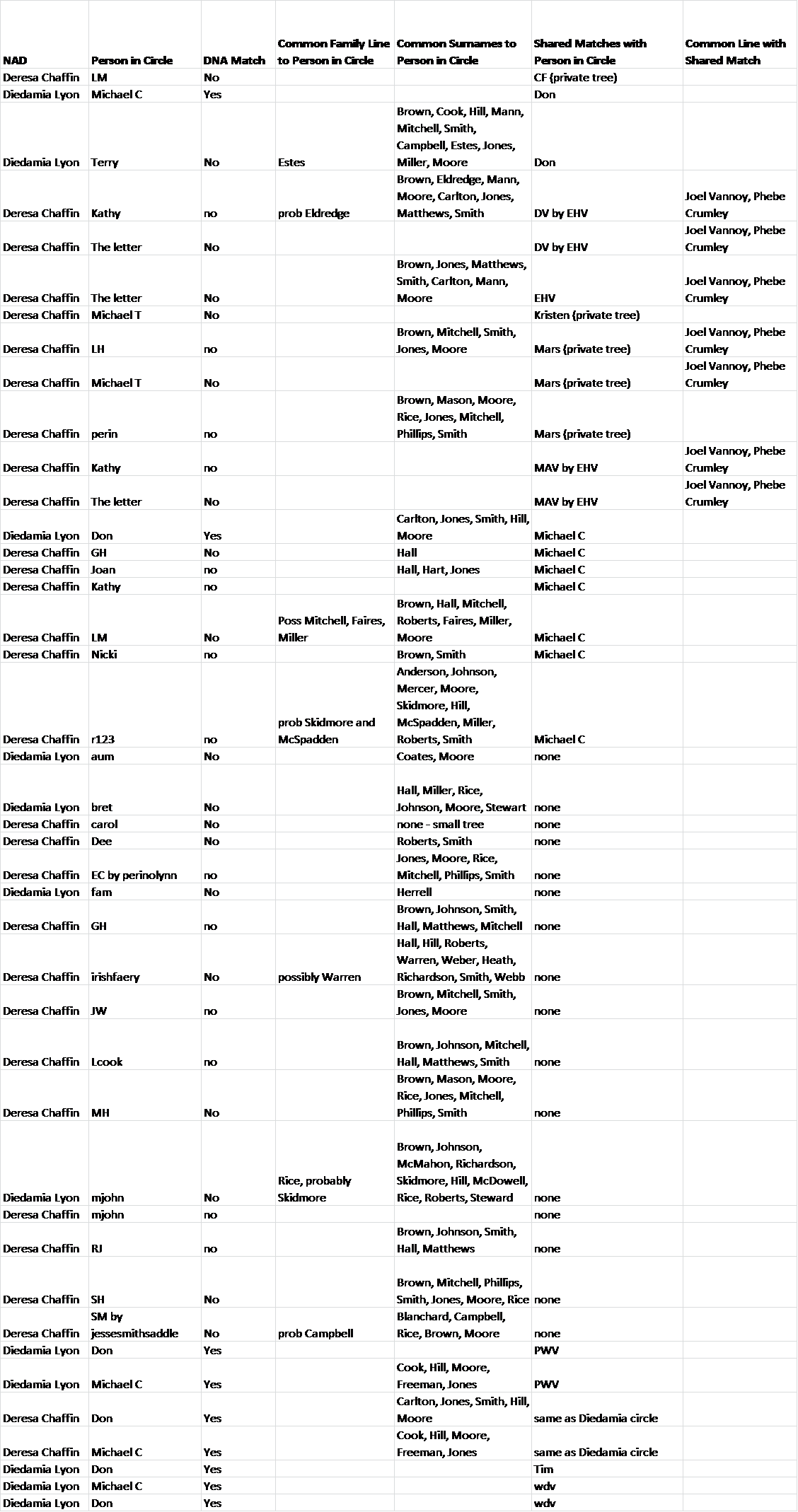
I needed a mechanism to keep track of who all my matches match, that I match, and what lines they descend from – so I created a spreadsheet.

NAD Matches Spreadsheet

shared matches spreadsheet

Column 1 – NAD – The ancestor’s name of the NAD Circle where these individuals are found as members.

Column 2 – Person in Circle – The “person in circle” is the individual whose name shows either as a DNA match or as a circle member who does not match my DNA, but does match the DNA of at least some of the other circle members.

Column 3 – DNA Match – Tells me if this person is a DNA match to me or not.

Column 4 – Common Family Line to Person in Circle – The common ancestral line (or lines) if I can determine whether or not we share a specific ancestral line.  By the way, just because we share that line does NOT mean that is how we are DNA related – and no – there is no way to tell without a chromosome browser.

Column 5 – Common Surnames to Person in Circle – Common surnames between my tree and the person in the Circle, as identified by Ancestry.

Column 6 – Shared Matches with Person in Circle – Names of Shared Matches between me and the person in the Circle.

Column 7 – Common Line with Shared Match – Common ancestral lines with shared matches (column 6).

I combined the information from Diedamia Lyon, John David Curnutte and John’s mother, Deresa Chaffin.  I sorted column 6, Shared Matches with Person in Circle, alphabetically, hoping that some of these matches would be the same, and they are, and would be identifiable to specific family lines.

So….Drum Roll….Who is the Common Ancestor???

I compared each person identified as a person in the NAD Circle (column 2), or any person that matches me and a person in the NAD Circle (column 6) with my other spreadsheet that I maintain listing all of my Ancestry matches and our common ancestors.

The group that includes the initials EVH are a family of siblings and their children, so they really only count once.  The person by the name Mars has a private tree, but told me that our common ancestor was Joel Vannoy and Phebe Crumley, the same individuals as my cousin group through EVH.

It’s certainly possible that the common DNA that connects me with Michael and Don and possibly with John David Curnutte’s parents are through the Vannoy/Crumley line.

If indeed, our common ancestor is upstream of Joel Vannoy and Phebe Crumley, which is a VERY BIG if, but it’s the only lead I have – then they must fill a known pedigree void.

Deresa Chaffin, according to the Ancestry overview (which is all I have to go on at this moment and is compiled from 705 trees which makes me exceedingly nervous) was born in 1775 in Virginia to Simon Chaffin and Agatha Curnutte.  She married John Tolliver Curnutte, so we have an intermarriage already (or incorrect surname information), which can mean a larger dose of the Curnutte DNA.  Trying to follow these individuals up their trees at Ancestry was an exercise in frustration and futility with many of the wives surnames being the same as the husband and no sources or documentation of any kind.  Suffice it to say, I can’t connect the dots through surnames or location, other than the state of Virginia.

However, looking at my tree, my vacancies for ancestors in that timeframe, in the Vannoy/Crumley branch of the tree are limited.

shared matches pedigree

Phebe, Jotham Brown’s wife’s surname is unknown, but they were married about 1760.

William Crumley’s wife’s name is unknown, but they were married by about 1788.  Clearly, Deresa being born in 1775 cannot be William Crumley’s wife (or Jotham Brown’s), and Deresa married a Curnutte, so she cannot be the ancestor in question for either vacancy.

John Tolliver Carunutte, Deresa’s husband was born about 1774, so clearly, he isn’t my ancestor either.  One generation upstream, I have vacancies for six unknown parents, one of which would have been surnamed Brown.  These people would have been born between 1720 and 1740, at the latest, and possibly earlier, so probably not John Tolliver or Deresa Chaffin’s parents either.

Unfortunately, we’re now back into the ether – and it’s very tenuous ether at that.  Without a chromosome browser, I can’t confirm that the DNA of any of these matches triangulate with the Vannoy/Crumley DNA line – or any line for that matter.

However, in the spirit of running every lead down, right into the ground, and in this case, into the rathole – I view these new shared matches as my only hope of ever unraveling the mystery of the 3 related NADs.  So far, I’ve proven they can’t be my ancestors, at least not in that line, but I still have absolutely no idea of how or if they are related to me – despite due diligence on my part- at least all the due diligence I can think of.

Suffice it to say I’m disappointed.  It’s not my lucky day.  No happy dance for me.  I guess I probably don’t have to mention that if Ancestry provided a chromosome browser, I wouldn’t even have to be slogging around in the mud trying to piece these puzzle pieces together that might not even be from the same puzzle.

However, your mileage may vary and it may be your lucky day, so please give this new shared matches tool a try.  If nothing else, it will help you group your matches by ancestral group and will give you clues as to the family groups of those people with private (or no) trees.  And who knows, maybe you’ll unravel your NAD and actually discover a new ancestor!!!  It could happen, especially if your matches are willing to download to GedMatch for verification!

Here’s Ancestry’s blog posting about the new shared match tool which includes a nice “how to” video.

______________________________________________________________

Disclosure

I receive a small contribution when you click on some of the links to vendors in my articles. This does NOT increase the price you pay but helps me to keep the lights on and this informational blog free for everyone. Please click on the links in the articles or to the vendors below if you are purchasing products or DNA testing.

Thank you so much.

DNA Purchases and Free Transfers

Genealogy Services

Genealogy Research

Phasing Yourself

Do you ever have one of those “lightbulb” moments?

I do.

I was wishing there was a way at GedMatch to compare everyone against me and my mother at the same time – to see who we both match.  And then I realized….there is….but not in the way I had been thinking.

Both of my parents are deceased now, but my mother swabbed before she passed over…a gift I thank her for daily.

GedMatch provides a Phasing program, under Analyze Your Data.

GedMatch phasing

I used the Phasing program to recreate my father whose DNA hasn’t been available from him since 1963.  I had my DNA and my mother’s autosomal DNA results, so the phasing program compared those two files and split my DNA in half and created a “half” file that is my mother and the remainder “half” file that is my father – or at least the half of him that I received.

I looked at the Mom half file and thought to myself that I should delete it to make space since I have the whole Mom file.

I’m glad I didn’t, although I could certainly have recreated the file, because it’s that phased half Mom file that is the equivalent of running my matches against me and Mom together to see which of my matches match us both.

And the clear benefit, of course, is that I know immediately which side of the family my matches are from.  Plus, if anyone doesn’t match me and a parent, then the results are not IBD, identical by descent.  Phasing against a parent is the gold standard in determining IBD vs IBC or identical by chance.

Let’s take a look at the match results.  Please note that 1500 is the GedMatch display limit, so when you see 1500, it means more than 1500, but you have no idea how many more than 1500.  By running your two (maternal and paternal) half phased kits, you can obtain up to 3000 instead of being constrained by the 1500 limit.  In order to see more than 1500, you can sort several columns in highest to lowest and lowest to highest order, and often you can obtain the entire list by sorting the columns and copy/pasting to Excel, so long as the entire list isn’t over 3000.

10 cM 7 cM 5 cM
Full Kit 825 1500 1500
Mother Half 145 495 1500
Father Half 583 1143 1500
Total 2 Halves 728 1638 3000
Not IBD 97 >138 unknown

Truthfully, I was surprised to lose 97 matches at 10cM by having them match neither parent.  That’s about 12%.

The other tidbit you may find interesting is that I have so many more matches on my father’s side than on my mothers.  My mother’s four grandparents were Dutch (the immigrant off the boat), Brethren (endogamous, German), German (immigrant off the boat) and Acadian/English (here since very early 1600s, endogamous).  My father’s ancestors have been in this country for hundreds of years – all of them.  The German, Dutch and French aren’t nearly as well represented in the DNA data bases as are the traditional colonial Americans who had lots of children and moved west, into Appalachia leaving lots of descendants today trying to sort through their ancestry.

So, if you have one or both of your parents’ DNA, phase yourself at GedMatch.

For those of you who don’t have parents available, but do have other relatives, try the Lazarus tool to reconstruct part of an ancestor’s genome.

______________________________________________________________

Disclosure

I receive a small contribution when you click on some of the links to vendors in my articles. This does NOT increase the price you pay but helps me to keep the lights on and this informational blog free for everyone. Please click on the links in the articles or to the vendors below if you are purchasing products or DNA testing.

Thank you so much.

DNA Purchases and Free Transfers

Genealogy Services

Genealogy Research

4 Generation Inheritance Study

I’ve recently had the opportunity to perform two, 4-generation, inheritance studies.

In both of these cases, we have the DNA of 4 generations: grandmother, parent, child and grandchild or grandchildren.  I’ll be using the second study because there are two great-grandchildren to compare.

Let me introduce you to the players.

4 gen pedigree

I wanted, with real data, to address some assertions and assumptions that I see being made periodically in the genetic genealogy community.  We need to know if these hold up to scrutiny, or not.  Besides that, it’s just fun to see what happens to DNA with 4 generations and 5 people to compare.

What kinds of information are we looking to confirm or refute in this study?

1 – That small segments don’t occur within a couple generations, meaning that that DNA can’t be or isn’t broken into small segments that quickly.

2 – That small segments can never be used genealogically and are not useful.

3 – That DNA is most of the time passed in 50% packages.  While this is true in the first generation, meaning a child does receive half of each parent’s DNA, they do not receive 25% of each grandparent’s DNA.

4 – That segments over a certain threshold, like 5 or 7 cM, are all reliable as IBD (identical by descent.)

5 – That segments under a certain threshold, like 5 or 7 cM are all unreliable and should never be used, in fact, cannot ever be used and should be discarded.

6 – That there is a rule that you cannot have more than two crossovers per chromosome.

All individuals tested at Family Tree DNA and we’ll be using the FTDNA chromosome browser for comparisons.

First, let’s look at the amount of expected DNA matching versus the actual amount of DNA matching, per generation.  The entire number of cM being measured is 6766.2, per the ISOGG Autosomal Statistics Wiki page.

Expected vs Actual Inheritance Chart

This chart compares the expected versus actual amount of DNA shared between person 1 and person 2,

Person 1 Person 2 Expected DNA Match cM/% Actual DNA Match
Grandmother Parent (grandmother’s child) 3383.1 / 50% 3384.03 / 50.01%
Grandmother Pink Child (grandmother’s grandchild) 1691.5 / 25% 1670.64 / 24.69%
Grandmother Blue Grandchild (grandmother’s great-grandchild) 845.775 / 12.5% 704.84 / 10.39%
Grandmother Green Grandchild (grandmother’s great-grandchild) 845.775 / 12.5% 842.64 / 12.45%

Chromosome Data

Now, let’s take a look at our chromosome data.  Keep in mind, everyone is being compared to the oldest generation – in this case – the great-grandmother’s DNA.

Legend

  • The background chromosome belongs to the great-grandmother of the youngest generation – meaning everyone is being compared to her.
  • Grandparent = orange – because the child receives 50% of each parent’s DNA, the orange child of the great-grandmother will match her DNA 100%.
  • Grandchild = pink – since the grandchild is being compared to the grandparent, and not their parent, we will see how much of the grandmother’s DNA the pink child received. The dark spaces are the “ghost image” of the grandfather’s DNA – identified by the lack of the grandmother’s DNA in that location.
  • Oldest great grandchild = blue
  • Youngest great grandchild = green

The two great grandchildren are full siblings.  None of the parents involved are related to each other or to other generational spouses.  This has been confirmed both by genealogy pedigree chart and by utilizing the tools at GedMatch for comparisons to each other as well as the “are your parents related” tool.

The first comparison, below, shows the 4 individuals compared to the great grandmother’s DNA at the Family Tree DNA with the match default set at 5cM

4 gen ftdna default

The image below, shows the same individuals after dropping the match criteria to 1cM.  Several small colored segments appear.

4 gen ftdna 1 cm

I downloaded all of the matching data for these individuals into a spreadsheet so that I could work with the actual chromosomal data.  I’m not boring you with that here, but I have used the raw matching data for the actual comparisons.

Crossover

Let’s talk about what a crossover is, because understanding crossovers are important

Crossover example 1 – A crossover is where you start/stop receiving DNA from one grandparent or the other.  This is easy to see if we look at chromosome 1.

4 gen crossover

In this example, the parent is orange and the child is pink but they are both being compared to the grandparent of the pink person, the mother of the orange person.

What this means is that while the orange person will always match the grey background chromosome of their mother, the pink person will only match their grandmother on the portion of the DNA they received from their mother that was from their grandmother.  The pink person received their grandfather’s DNA in some locations, and not their grandmother’s.  Where that transition happens is called a crossover and it is where the colored segment stops, as noted by the arrows above, and the back background begins, indicating no match to the grandmother.

You can see that the matches span the center of the chromosome where the grey area indicates there is no data being read.  There is also a second small grey area to the right of the center.  Ignore these grey areas.  They are in essence DNA deserts where there isn’t enough DNA to be read or useful.  Family Tree DNA (and other vendors) stitch the data on both sides together, so to speak, and matches on both sides of this area are considered to be contiguous matches.

You can see that the pink person has two crossover areas where they stopped receiving DNA from the mother’s mother (background chromosome being compared against) and instead started receiving DNA from the mother’s father.  How do we know that?  There only two people who contributed the orange parent’s DNA that the pink child inherited.  If the pink child did not inherit the orange parent’s Mom’s DNA on this segment, then the pink child had to have inherited the orange parent’s Dad’s DNA.

Crossover example 2 – A second kind of crossover is where you are still receiving DNA from the same parent, but from different ancestors on that parental line

I’ve created a chart to illustrate this phenomenon

The names in the charts at the bottom are the people who tested today.  All of these individuals are known cousins who are from my mother’s side.  The name at the top is the common ancestor of all of the testers.

In the first situation, in locations 1-5, Me, Charlie and David match.  None of the three of us match our cousin, Mary on those locations.  However, moving to locations 6-10, Me, Charlie and Mary match each other, but not David.  Looking at our pedigree charts, we can see that the cousins are matching on different ancestral lines.

4 gen generational crossover

Me, Charlie and David share a wife’s line, Sally (wife of John), that Mary does not share.  Me, Charlie and Mary share common DNA from George, a male further upstream in that line.  George’s son John married Sally.  Mary descends from George through a different child, which is why she does not match any of us on the segments we received from Sally, John’s wife.

Location Me Charlie David Mary
1 Sally Sally Sally No match
2 Sally Sally Sally No match
3 Sally Sally Sally No match
4 Sally Sally Sally No match
5 Sally Sally Sally No match
6 George George No match George
7 George George No match George
8 George George No match George
9 George George No match George
10 George George No match George

If you’re just looking at the question, “do Charlie and I match?” the answer would of course be yes, but until we look at a broader spectrum of cousins, we won’t know that our match is actually from two different people in the same descendancy line and that we have an ancestor crossover between locations 5 and 6.  However, we’re still receiving our DNA from the same parent, but which ancestor of that parent contributed the DNA has switched

How prevalent are crossovers?

Number of Crossover Events

These are all parent/child crossovers where the DNA donor switched.  We can only determine that this happened because we can compare generationally against the grey background great grandmother to the youngest generation

  • Orange parent to Pink child – 49
  • Pink child to Blue child – 47
  • Pink child to Green child – 39

The most segmented chromosome, chromosome 1, has 5 separate matching segments for the blue great grandchild (as compared to the great-grandmother), or 10 crossover events (because neither end was at the beginning or end, although start and end numbers are sometimes “fuzzy”).  You can see where a crossover event occurs when the DNA goes from matching to non-matching.

4 gen chr 1 crossovers

Results

I downloaded all of our matching data into a spreadsheet so that I can work with the segment matches individually.

Looking at the data, there are a few things that jump out immediately:

  • On chromosomes 4 and 14, the pink child received none of the orange grandmother’s DNA. That means that the pink child had to have received the grandfather’s DNA for all of chromosome 15. So, if anyone thinks that the 50% rule really works uniformly across generations – here’s concrete proof that it doesn’t. Furthermore, this occurred for an entire chromosome – twice out of 23 chromosomes, or 8.7% of the time.
  • On chromosome 11, the exact opposite happened. The pink child received all of the grandmother’s chromosome, but barely gave any to their blue child. The blue child received their mother’s DNA in that location. On chromosome 13, the pink child received almost all of the grandmother’s DNA.
  • Please note that while the averages of expected versus inherited DNA work out pretty closely, when averaging across all 23 chromosomes, as shown in the Expected vs Actual Inheritance Chart, the individual chromosomes and how much of which grandparent’s or great-grandparent’s DNA is inherited varies wildly from none to 100%.
  • There are several locations on 10 different chromosomes where the DNA has been passed generationally intact 2 or 3 times, without division.
  • Several small segments have been created within 3 transmission events.There are small green and blue segments on several different chromosomes which reflect very small amounts of the great grandmother’s DNA inherited by the green and blue great-grandchildren. This conclusively dismisses the theory that small segments aren’t ever created within a couple of generations.
  • Chromosome 10 is very choppy, including small blue and green grandchild segments that match the orange grandparent and the great-grandmother without having matches to the pink child. This means that those unconnected blue and green small segments are either identical by chance or there is a read issue with the pink person’s DNA on this chromosome.
  • There are a total of 31 small segments, meaning under 7cM. Of those, a total of 10 do not triangulate, meaning they match the grandmother but they do not match their parent.  The 7 pink segments appear to triangulate, but without another generation of transmission (like the blue and green great-grandchildren), or without the grandfather’s DNA, or without triangulation with a known relative on that segment, it’s impossible to tell for sure. Therefore, 14, or 45% are valid segments and do triangulate.
  • There are a total of 92 chromosomal transmission events that took place, meaning that 23 chromosomes got passed from the background person to their orange child, 23 from the orange child to their pink child, 23 from the pink child to the blue grandchild and 23 from the pink child to the green grandchild.
  • Furthermore, based on this limited study, at least 32.26% of the small segments do not triangulate and are not IBD, but are instead identical by chance.
  • In three instances, the exact DNA (from the great grandmother) was given to both the green and blue great grandchildren. In eight other events, the same DNA, without division, was given from a parent to one child.
  • There are several instances, on chromosomes 3, 4, 9, 14, 15, 16, 20, and 22 where the pink child passed none of their grandmother’s DNA to their child, even though they inherited the grandmother’s DNA.

Individual Chromosomes and Their Messages

I’d like to walk through several chromosomes and chat a little bit about what we’re seeing.

Chromosome 1

4 gen chr 1

First, I’d like to illustrate the difference between chromosome matches at the default level (the first chromosome, above) and at the 1cM level (the lower chromosome.)  At the lower match threshold, you will see additional small segment matches that are not shown at the higher threshold, noted by red arrows.

Let’s take a look at the messages held by our individual chromosomes.

On all of these chromosomes, you’ll see that the orange child matches thier mother, the background person being compared against, exactly, on every location that is measured.  Half of everyone’s DNA comes from their mother, so all of their DNA will match to her on any given chromosome.  Remember, we are only measuring matching DNA (half identical segments) – so the other half of the person’s DNA that matches their father is not shown.

I have left the orange segments in the graphics, even though they all match on the entire chromosome length, so you can see the continuity from generation to generation.  Pink is the orange person’s child, so you can see that the pink child inherited part of the DNA the orange person inherited from their mother, but not all.  The part that is black in the pink row, as compared to the orange segment, means that the pink child inherited that DNA from their grandfather at those locations – and not the grandmother being compared against

In one instance, on chromosome 1, the pink child gave their grandmother’s DNA to both of their children.  You can see that to the far left with the red arrow.

4 gen chr 1 grandmother transmission

You can also see that the blue grandchild only received a small part of their great grandmother’s DNA, but the green grandchild received a much larger segment.

In one area, the pink child clearly received their grandmother’s DNA, but didn’t give any of it to either the blue or green grandchild, shown below at the red arrow.  There is no blue or green matching the great-grandmother’s DNA.

4 gen chr 1 no transmission

To the right of the arrow, top, above, you can see where the pink child contributed their grandmother’s DNA to their blue child, but not to the green child.  The pink child contributed their other parent’s DNA in that instance, bottom, above, because their child does not match their orange mother – so that DNA had to come from the grandfather.

On the chromosome match that includes the smaller segments, below, you can see there are a total of 5 segments not shown with the higher threshold.

4 gen chr 1 small segments

The first two arrows, on the left, point to small segments shared by the blue and green grandchildren with their great-grandmother and their pink parent – so these triangulate and they are fine.

The third arrow, on the right hand side pointing to the green segment that does not match with the pink parent indicates a match that is identical by chance.  We’ll talk more about this in chromosome 3.

The fourth arrow, at the far right, shows a small segment of orange DNA that was passed to their pink child, but the pink child did not pass it on to either of their children.  This segment could be a legitimate segment by descent, but it could also be by chance.  We’ll talk about that more on chromosome 8.

Chromosome 2

4 gen chr 2

Chromosome 2 shows two small segments.  You can see that the pink child gave a significant portion of their grandmother’s DNA to the blue child, but only two small segments to the green child in that region, at the red arrows.  They do triangulate though, because they match their parents.  See how nicely the DNA stacks up between all of the generations.

Chromosome 3

4 gen chr 3

The pink child inherited very little of the grandmother’s DNA in this region.  Of the small amount the pink child did inherit, the pink child gave even less of it to their children.  One small piece to the green grandchild, shown at right, and none to the blue grandchild.

Why, then, is there a lonely blue segment on this comparison chromosome showing that the blue great-grandchild matches their orange grandmother and their great-grandmother, but not their pink parent?  This is the first example of an identical by chance segment (or a read error in the pink parent’s file).

4 gen chr 3 small seg

Three Kinds of DNA Match Segments

There are three kinds of DNA segment matches.

  1. Identical by descent (IBD) where you receive the segment from your ancestors and we can track it as far back up the tree as we have living people. This is the example where the small segment of the great-grandchildren (blue or green) match their parent (pink), their grandparent (orange) and their great-grandmother’s background chromosome being compared against.
  2. Identical by state (IBS) which sometimes is used to mean not identical by descent. What it actually means is that you can still match and receive the DNA from your ancestors, but the segment may be very prevalent in a specific community or ethnic group. An alternative explanation is that the DNA ‘state’ is so common that everyone in that area has it, so it’s virtually useless in identifying ancestors, because you can’t really tell which lines it came from. So IBS does triangulate, because it did come from a common ancestor, but you may match a large number of people at this location. Portions of chromosome 6 are known to fall into this category.  More often than not, I hear IBS used to indicate that there is a match, but the common ancestor isn’t known or hasn’t yet been identified.
  3. Identical by chance (IBC) is where a specific DNA combination is a match, but it’s not a match because it was handed down ancestrally, but simply by the luck of the draw.  Because everyone carries the DNA of both parents, sometimes people can match you by zigzagging back and forth between your father’s and mother’s DNA.  These matches aren’t ancestral, but just by luck or chance.  Shorter matches, meaning small segments, are much more likely to be identical by chance than longer matches. When you have both parents DNA, you can easily eliminate IBC segments because they won’t triangulate – as we have just demonstrated on chromosome 3.

You can read more about this here and here.

Chromosome 4

4 gen chr 4

Chromosome 4 is particularly interesting because the orange person matches their background mother, of course, but apparently their pink child inherited this entire chromosome from the pink person’s grandfather – because the pink person does not match their grandmother – there are no pink matching segments to the background grandmother.

Chromosome 5

On chromosome 5, the pink child matches the grandmother on almost the entire chromosome, except for a small part to the left of center.

4 gen chr 5

You may notice that there is a segment of blue that appears to extend beyond the pink bar at the left arrow – which would mean that the blue area matches the great-grandmother without matching the pink parent.  The segments on the chromosome map are not exactly to scale, and the beginnings and ends are sometimes what is referred to as fuzzy.  This means that they are not exact measurements but that they in essence the absence or presence of DNA in a bucket of a specific size.  If any part of your DNA is in that bucket, then your start or stop segment are the edges of that bucket.  In this case, the entire match is 47.51cM for the pink child and 49.82 for the blue grandchild, so the difference may or may not be relevant.

Although this actually is a small matching segment, or non-matching segment, you would never notice this if you were just looking at the blue grandchild matching to the great grandmother.  It’s only with the introduction of the parent’s pink DNA that you notice that the blue great grandchild’s DNA match with the great grandmother extends beyond that of the parent.

Chromosome 6

4 gen chr 6

Chromosome 6 is rather unremarkable except that the orange person seems to have had a read or file error of some sort.  The orange results are shown in two separate pieces, but we know that the orange person must match their mother 100%.  We know this issue is in the orange person’s file, because their pink child and both of the blue and green grandchildren match the background person, the orange persons’ mother, with no break in their DNA.

Chromosome 7

4 gen chr 7

Chromosome 7 shows another example of 5 generations matching with the stacking of orange, blue, green and pink against the background person’s chromosome, at right.  It also shows another example an identical by chance match, with the blue grandchild showing a match to their great-grandmother but no match to their pink parents, near the center at the red arrow.

Chromosome 8

4 gen chr 8

Chromosome 8 shows another example of the pink child having inherited a small segment of their grandmother’s DNA, but not passing it on to their children.

How do we know if this is a legitimate IBD segment, or if it something else?  Since the pink child will match their mother 100%, and they didn’t pass it on tho their children, how can we prove that the small pink segment where they match their grandmother is  IBD.

How could we prove this one way or the other?

First of all, it probably doesn’t matter, except as a matter of interest – or unless of course this one segment is THE one you need to identify that colonial ancestor.  If this was a normal match, we could just see if the match matched the child and the parent too, which would immediately phase the match against their parent – but we can’t do that when matching to a grandparent because the child will always match their parent 100%.

If you have the grandfather’s DNA at Family Tree DNA, you could compare the pink grandchild to their grandfather. On chromosome 8, the grandfather’s DNA in the pink row is identified by the dark grey – because it’s where the pink grandchild does not match their grandmother – so they must match their grandfather on that segment because their orange parent only had two pieces of DNA to give them, the piece from their mother or the piece from their father.

Therefore, if this is a valid segment, then you won’t see at match in the grandfather’s DNA on same portion of the segment.  If you see a match to both the grandmother and the grandfather, it’s likely that the small segment match to the grandmother is not identical by descent –  you but really don’t know for sure.

How could that be?  I asked David Pike that question and he pointed out that in one case, he discovered that the grandparents both shared the same DNA segment.  The child inherited it from one parent or the other, and passed it on to their child, but since the mother’s and father’s DNA was identical, there is no way to tell which grandparent the segment actually came from.  And in this case, the segment would match both grandparents.  That is a trait of endogamy and of IBS, or identical by population.  If you’re saying, BOO, HISS, about now, I totally understand.

After talking to David, I also realized that if your DNA at those locations just happens to be all homozygous, for example, all Ts, on both sides, for a run of SNPs in a row, and if your parents and grandparents have Ts in either location, you will match them…and anyone else who does too.

So here we have an example of a match that could be IBD if it truly is a small segment by descent and you don’t match the other grandparent at that location.  It could be IBC or IBS (by population) if you match both of your grandparents on this segment – but it might be IBD.  It’s IBD from one and IBC/IBS from the other – but which one is which?

However, since I don’t have the grandfather’s DNA at Family Tree DNA, my only other alternative is to move to GedMatch and create a phased kit for the grandfather by subtracting the grandmother’s DNA from her orange child, which will give me the DNA the orange child received from their father.  Then I can compare the pink grandchild to the grandfather’s phased kit – which is the father’s DNA that the orange child received.  This is fine, even if it is only half of the grandfather’s DNA – it s the half that the pink child’s mother received and passed a portion to the pink child.

I would suggest doing this entire exercise on either Family Tree DNA or on the GedMatch platform, and not jumping back and forth between the two.  The start and stop segments aren’t exactly the same, and sometimes the segments read differently, creating more segments at GedMatch than at FTDNA.  I’m not saying that is wrong, just that it isn’t consistent between the two platforms and when you are dealing with small segments, in particular, you need consistency.

Chromosome 9

4 gen chr 9

On chromosome 9, the pink child received little of the grandmother’s DNA, and gave none of it to their green child.  And yes, if you have a good eye the blue child’s right boundary is slightly beyond the their pink parents – so – you already know what that means.  Either a fuzzy boundary or a slight piece of DNA that happened to match with the great-grandmother identical by chance (IBC.)

Chromosome 10

4 gen chr 10

This chromosome is incredibly interesting because it’s comprised of all small segments.  In fact, this is the exact reason why you NEED to look at the 1cM range.  At the default setting, if there are no matches except the orange person to their mother.  It looks like none of the grandmother’s DNA was passed to the pink child, but in fact, may not be the case.  There are three segments passed to the pink child, although the pink child did not pass these on to either of their children.  See the discussion on segment 8 about how to tell for sure, if you need to.

The blue and green segments, since they do not match their pink parent are not IBD but are instead IBC.  The really interesting part of this is that in one case, the blue and green grandchildren’s DNA matches the orange grandmother on the same segments exactly, but does not match the pink parent.

How can this possible be, you ask, barring a file read issue?  Good question.  Remember, each child inherits half of their parent’s DNA.  In this case, both children apparently inherited the same DNA from both parents, but it wasn’t the orange DNA, but that of the pink child’s father.

It just happened, when the blue and green children’s DNA combined with that of their mother, it just happens to read as a match, for a small segment.  You can read about how this might happen in the article, “How Phasing Works and Determining IBD Versus IBS Matches.”

Unfortunately, all these comparisons can do is to tell us simply what does and does not match – they can’t tell us why.  Sometimes, based on other comparisons, like phasing and triangulation, we can figure out the “why” part of the puzzle – and sometimes, we can’t.

Chromosome 11

4 gen chr 11

On chromosome 11, the pink child inherited all of the grandmother’s DNA through their orange parent, but gave less than half to their green child and a small segment to the blue child.  The pink child gave the exact same segment in the center to both their blue and green children.

Chromosome 12

4 gen chr 12

On chromosome 12, the pink child inherited little of their grandmother’s DNA, but passed every bit of what they inherited to both of their children, shown by the nice stack at right.  The start and stop locations are exact between the three.

However, in addition, we have three small segments where the green and blue grandchildren match their orange grandmother without matching their pink parent – so those are IBC.

Chromosome 13

4 gen chr 13

The pink child inherited almost all of their grandmother’s entire chromosome, except for a very small bit at the far right end.  The pink child passed almost their entire chromosome 13 to their green child, but only a small amount to the blue child.

Chromosome 14

4 gen chr 14

This story is easy.  The pink child inherited their grandfather’s entire chromosome 14 because they do not match their grandmother’s DNA at all.

Chromosome 15

4 gen chr 15

This is a very “normal” chromosome.  The pink child inherited about half of their grandmother’s DNA and gave about half of what they inherited to their green child.  Of course, their blue child got left out altogether – but that looks to be a lot more “normal” than we once thought.

I am skipping chromosome 16-22, because they are more of what you’ve already seen and is, by now, quite familiar  Plus, you can take a look at the full chromosome comparison graphic and do your own analysis.

X Chromosome

The X chromosome is a bit different, and I’d like to take a look at that.

4 gen X

The X chromosome has special inheritance properties that other chromosomes don’t have.  In particular, women inherit an X just like they inherit their other chromosomes from 1-22 – one from Mom and one from Dad.  Men, however, only receive an X from their mother.  Therefore, there are relatives that you cannot inherit any X DNA from.  I wrote about this here and here along with examples and charts.

In this example, the inheritance path is such that it does not affect what can and cannot be inherited since we are comparing to a great-grandmother, but in other situations,  this would not be the case.

One last observation about the X chromosome.  I have found matching on the X to be particularly unreliable, and have found several situations, where, due to those special inheritance properties, we know beyond any doubt that the common ancestor on the X cannot be the same ancestor as has triangulated on the other chromosomes.  So word to the wise – be very vigilant and hesitant to draw conclusions from X matching.  I never utilize the X without corroborating autosomal matches and even then, I’m very reticent.

In Summary

On the average, we do inherit about half of our DNA from in each generation from each ancestral generation.  But the average and the actuality of what happens is two entirely different things.  Averages are made up of all of the outliers, and if you are one of those outliers, the average isn’t really relevant to you.  Kind of reminds me of “one size fits all” which really means “one size fits almost nobody well” and “everyone is some shade of unhappy.”

I wrote about generational inheritance and how it doesn’t always work the way we think, or expect.  It’s very important to pay close attention to your own DNA and not rely on averages unless you have absolutely no other choice – and only then understanding the averages are likely wrong in one direction or the other – but it’s the best we’ve got, under the circumstances.

So what can we apply to our genealogy from this little experiment.

  1. Some of the small segments across 4 generations are valid, meaning identical by descent or IBD.
  2. At least one third of the small segments aren’t valid and are identical by chance, or IBC.
  3. Without some form of triangulation or parental phasing, it’s impossible to tell which small segments are and are not valid, or identical by descent.
  4. Small segments are indeed formed within a 2 or 3 generation span, so they are not always a results of many generations of dividing.
  5. However, the further back in time your ancestor, the more likely that they will only be represented in your DNA by small segments, if any.
  6. Many small segments are valid and are not a result of IBC.  However, most are not and one needs to understand how to recognize signs of an IBC vs an IBD match.
  7. Disregarding small segments uniformly is like throwing away the only clues you may have to your most distant ancestors – which are likely your brick walls.
  8. The largest segment that was not valid was 3.14cM and 600 SNPs.
  9. The smallest valid segment was 1.25cM and 500 SNPs.

Getting the Most Out of Your DNA Experience

There is a lot more information available to us in our DNA results than is first apparent.  It takes a bit of digging and you need to understand how autosomal DNA works in order to ferret out those secrets.  Don’t discount or ignore evidence because it’s more difficult to use – meaning small segments.  The very piece or breadcrumb you need to solve a long-standing mystery may indeed be right there waiting for you.  Learn how to use your DNA information effectively and accurately – including those small segments.

You need to test every cousin you can find and convince to swab or spit.  It’s those cousin matches that help immensely with triangulation and confirming the validity of all DNA segments, matching them back to common ancestors.  You are building walkways or maybe pathways back in time, with your DNA as the steppingstones.  Genetic genealogy is not a one person endeavor.  It takes a village, hopefully of cousins willing to DNA test!

______________________________________________________________

Disclosure

I receive a small contribution when you click on some of the links to vendors in my articles. This does NOT increase the price you pay but helps me to keep the lights on and this informational blog free for everyone. Please click on the links in the articles or to the vendors below if you are purchasing products or DNA testing.

Thank you so much.

DNA Purchases and Free Transfers

Genealogy Services

Genealogy Research

Are You Native? – Native American Haplogroup Origins and Ancestral Origins

At Family Tree DNA, having Haplogroup Origins and Ancestral Origins indicating Native American ancestry does not necessarily mean you are Native American or have Native American heritage.

This is a very pervasive myth that needs to be dispelled – although it’s easy to see how people draw that erroneous conclusion.  Let’s look at why – and how to draw a correct conclusion.

The good news is that more and more people are DNA testing.  The bad news is that errors in the system are tending to become more problematic, or said another way, GIGO – Garbage in, Garbage Out.

I want to address this problem in particular having to do with Native American ancestry – or the perception thereof.

At Family Tree DNA, everyone who tests their Y DNA or their mitochondrial DNA have both Haplogroup Origins and Ancestral Origins tabs as two of your 7 information tabs detailing your results.

haplogroup and ancestral orgins tab

The goals of these two pages are to provide the testers with locations around the world where their haplogroup is found, and locations where their matches’ ancestors are found – according to their matches.

Did a little neon danger sign start flashing?  It should have.

Haplogroup Origins

Haplogroup Origins provides testers with information about the origins of other individuals who match your haplogroup both exactly and nearly.  This data base uses the location information from both the Family Tree DNA participant data base and other academic or private databases.

haplogroup origins 2

Ancestral Origins

Ancestral Origins is comprised primarily of the results of the “most distant ancestor” country of your matches at Family Tree DNA.  This tab is designed to provide you a view into the locations where your closest matches are found at each of the testing levels.  After all, that’s where your ancestors are most likely to be from, as well.

ancestral origins 2

Most of the time this works really well, providing valuable information to testers, assuming two things:

1. Participants who are entering the information for their “most distant ancestor” understand that in the case of the Y line DNA – this is the most distant direct MALE ancestor who carries that paternal surname. Not his wife or someone else in that line.

Sometimes, people enter the name of the person in that line, in general, who lived to be the oldest – but that’s not what this field is requesting – the most distant – meaning further back in that direct line.

For mitochondrial DNA, this is the most distant FEMALE in your mother’s mother’s mother’s mother’s direct line – directly on up that maternal tree until you run out of mothers who have been identified. I can’t tell you how many male names I see listed as the “most distant ancestor” when I do DNA reports for people – and I know immediately that information is incorrect – along with their associated geographic locations.

mtdna matches

In this mitochondrial example, the third match shows a male Indian Chief.  The first problem is that this is a mitochondrial DNA test, so the mitochondrial DNA could not have descended from a male.  If you don’t understand how Y and mitochondrial DNA descends from ancestors, click here.

Secondly, there is no known genealogical descent from this chief – but that really doesn’t matter because the mtDNA cannot descend from a male and the batter is out with the first problem, before you ever get to the second issue.  However, if you are someone who is “looking for” Native American ancestry, this information is very welcome and even seems to be confirming – but it isn’t.  It’s a red herring.

Unfortunately, this may now have perpetuated itself in some fashion, because look at the first and last lines of this next entry – again – another male chief.  The second entry with a name is another male too, Domenico.  Hmmm….maybe information entered by other participants isn’t always reliable and shouldn’t be taken at face value….

mtdna matches 2

2. This approach works well if people enter only known, verified, proven information, not speculation. Herein lies the problem with Native American heritage. Let’s say that the family oral history says that my mother’s mother’s line is Native American. I decide to DNA test, so for the “Most Distant Ancestor” location I select “United States – Native American.”

united states selection

The DNA test comes back and shows heritage other than Native, but that previous information that I entered is never changed in the system.  Now, we have a non-Native haplogroup showing as a Native American result.

Unfortunately, I see this on an increasingly frequent basis – Native American “location” associated with non-Native haplogroups.

non native hap

This scenario has been occurring for some time now.  Family Tree DNA at one point attempted to help this situation by implementing a system in which you can select “United States” meaning you are brick walled here, and “United States Native American” which means your most distant ancestor in that line is Native American.

Native American Haplogroups

There are a very limited number of major haplogroups that include Native American results.  For mitochondrial DNA, they are A, B, C, D, X and possibly M.  I maintain a research list of the subgroups which are Native.  Each of these base haplogroups also have subgroups which are European and/or Asian.  The same holds true for Native American Y haplogroups Q and C.

In the Haplogroup Origins and Ancestral Origins, there are many examples where Non-Native haplogroups are assigned as Native American, such as haplogroup H1a below.  Haplogroup H is European..

non native hap 2

A big hint as to an incorrect “Native” designation is when most or many of the other exact haplogroups, especially full sequence haplogroups, are not Native.  As Bennett Greenspan says, haplogroups and ethnicity are “guilt by genetic association.”  You aren’t going to find the same subhaplogroup in Czechoslovakia, Serbia or England and as a Native American too.

non native hap 3

Haplogroup J is European.

non native hap 4

Haplogroup K is European, and so is U2e1, below.

non native hap 5

Unfortunately, what is happening is that someone tests and see that out of several matches, one is Native American.  People don’t even notice the rest of their matches, they only see the Native match, like the example above.  They then decide that they too must be Native, because they have a Native match, so they change their own “most distant ancestor” location to reflect Native heritage.  This happens most often when someone is brick walled in the US.

non native hap 6

Another issue is that people see haplogroup X and realize that haplogroup X is one of the 5 mitochondrial haplogroups, A, B, C, D and X. that define Native American DNA.  However, those haplogroups have many subgroups and only a few of those subgroups are Native American.  Many are Asian or European.  Regardless, participants see the main haplogroup designation of X and assume that means their ancestor was Native.  They then enter Native American.

In the example above, haplogroup X1c has never been found in a Native American individual or population, although we are still actively looking.  Haplogroup X2a is a Native American subgroup.

In some cases, we are finding new subgroups of known Native haplogroups that are Native.  I recently wrote about this for haplogroup A4 where different subgroups are Asian, Jewish, Native and European.  This is, however, within an already known base haplogroup that includes a Native American subgroup – haplogroup A4.

When testers see these “Native American” results under Haplogroup and Ancestral Origins, they become very encouraged and excited.  Unfortunately, there is no way to verify which of your matches entered “Native American,” nor why, unless you have only a few matches and you can contact all of them.

When someone has tested at the full sequence level, remember that their results will show on these pages in the HVR1 section, the HVR2 section and the full sequence section.  So while it may look like there are three Native American results, there is only one, listed once in all three locations where it “counts.”  In the example below, there are two V3a1 full sequence matches that claim Native American.  Those were the chiefs shown above.  There are those two, plus one more HVR1+HVR2 individuals who has entered Native American as well.  However, if the match total was one for the HVR1, HVR2 and coding regions, that would mean there is one person who tested and matched in all 3 categories, not that 3 people tested.  In other words, you don’t add the match totals together.

non native hap 7

What Does A Native Match Look Like?

Of course, not all matches that indicate Native heritage are incorrect.  It’s a matter of looking at all of the available evidence and finding that guilt by genetic association.

In this first confirmed Native example, we see that the haplogroup is a known Native haplogroup, and all of the matches from outside the US are from areas known to have a preponderance of Native Americans in their population.  For example, about 80% of the people from Mexico carry Native American mitochondrial DNA.

Native 1

In this second example, we see Native American indicated, plus Mexico and Canada, which it typical.  In addition we see Spain.  Just like some people assume Native American, some people from Mexico, Central and South America presume that their ancestors are from Spain, so I always take these with a grain of salt.  Japan is a legitimate location for haplogroup B as well, especially given that this result is listed at the HVR1 level. If this individual tested at the HVR2 or full sequence level, they might be assigned to a different subgroup, and therefore would no longer be considered a match.

native 2

It’s not just what is present that’s important, but what is absent as well.  There is no long list of full sequence matches to people whose ancestors come from European countries like the U2 example above.  Spain is understandable, given the history of the settlement of the Americas, and that can be overlooked or considered and set aside.  Japan makes sense too.  But a European haplogroup combined with a long list of primarily European high level matches with only one or two “Native” matches is impossible to justify away.

What Does Native American Mean?

This discussion begs the question of what Native American means.

It’s certainly possible for someone with a European or African haplogroup to descend from someone who was a proven member of the a tribe.  How is that possible?  Adoption, slavery and kidnapping.  All three were very prevalent practices in the Native culture.

For example, Mary Jemison is a very well-known frontierswoman adopted by the Seneca with many descendants today.  Was she Native?  Yes, she was adopted by the tribe.  Is her DNA Native?  No.  Were her ancestors Native?  No, they were European.  So, are her descendants Native, through her?  She married a Native man, so her descendants are clearly Native through him.  Whether you consider her descendants Native through her depends on how you define Native.  I think the answer would be both yes and no, and both should be a part of the history of Mary Jemison and her descendants.

If a European or African women was kidnapped, enslaved or adopted into the tribe, and bore children, her children were full tribal members.  Of course, today her descendants might have be unaware of her European or African roots, prior to her tribal membership.  Her mtDNA would, of course, come back as European or African, not Native.

This is a case where the culture of the tribe involved may overshadow the DNA in terms of definition of “Indian.”  However, genetically, that ancestor’s roots are still in either Europe or African, not in the Americas.

How Do We Know Which Haplogroups Are Native?

One of the problems we have today is that because there are so many people who carry the oral history of grandmother being “Cherokee,” it has become common to “self-assign” oneself as Native.  That’s all fine and good, until one begins to “self-assign” those haplogroups as Native as well – by virtue of that “Native” assignment in the Family Tree DNA data base.  That’s a horse of a different color.

Because having a Native American ancestor has become so popular, there are now entities who collect “self-assigned” Native descendants and ancestors and, if you match one of those “self-assigned” Native descendants and their haplogroups, voila, you too are magically Native.

I can tell you, being an administrator for the American Indian, Cherokee, Tuscarora, Lumbee and other Native American DNA projects – that list of “self-assigned” Native haplogroups would include every European and African haplogroup in existence – so we would one and all be Native – using that yardstick for comparison.  How about that!

Bottom line – no matter how unhappy it makes people – that’s just not true.

A great deal of research has been undertaken over the past two decades into Native American genetic heritage – and continues today.  The reason I started my Native American Mitochondrial DNA Haplogroup list is because it’s difficult to track and keep track of legitimate developments.  Any time someone tells me they have “heard” that haplogroup H, for example, is Native, I ask them for a credible source.  I’ve yet to see one.

How do we determine whether a haplogroup is Native, or not?

The litmus paper test is whether or not the haplogroup has been found in pre-contact burials.  If yes, then it can be considered that the ancestor was living on this continent prior to European contact.  Native people arrived from Asia, across Beringia into what is now Alaska, and then scattered over thousands of years across all of North and South America.  We see subgroups of these same haplogroups across this entire space.

In some locations, the Native people are much less admixed than, for example, the tribes that came into the earliest and closest contact Europeans.  These tribes were decimated and many are now extinct.  I wrote about this in my paper titled, “Where Have All the Indians Gone.”

The tribes that are less admixed are probably the best barometers of Native heritage today.

We are hoping for new discoveries every day, but for today, we must rely on the information we have that is known and proven.

Interpreting Results Today

Native American haplogroup results today are subsets of Y DNA haplogroups Q and C.  If you find a haplogroup O result that might potentially be Native, PLEASE let me know.  This is also a possibility, but as yet unproven.

Mitochondrial Native American haplogroups include subgroups of A, B, C, D, X and possibly M.

If anyone tells you otherwise, personally or indirectly via Haplogroup or Ancestral Origins – keep in mind that extraordinary claims require extraordinary proof and data is only as good as its source.  Look at all of the information – what is present, what is absent, the testing level and what kind of documentation your matches have to share.

Finding your haplogroup listed as Native American in the Haplogroup or Ancestral Origins doesn’t make you Native American any more than it would make you an elephant if someone else listed “purple elephant.”

purple elephant

The only things that make you Native American are either a confirmed Native haplogroup subgroup, preferably with proven Native matches, or a confirmed genealogical paper trail.  Best of all scenarios is a combination of a Native haplogroup, matches that suggest or confirm your tribe and a proven paper trail.  That combination removes all doubt.

Evidence

Of the various kinds of evidence, some can stand alone, and some cannot.

Evidence Type Evidence Results Comments
DNA Y or mitochondrial Confirmed Native American subgroup – can stand alone sometimes With deep level testing, this can be enough to prove Native ancestry.  For Y  this generally means advanced SNP testing or matching to other proven Native participants.  For mitochondrial DNA, it means full sequence testing.
Proven paper trail Proven Native tribal membership, but does not prove ancestral origins Needs DNA evidence to prove whether the tribal member was admixed.
Matches to Haplogroup or Ancestral Origins If Native is indicated, need to evaluate the rest of the information. Level of testing, haplogroup, locations of most distant ancestors of other matches need to be evaluated, plus any paper trail evidence.
Autosomal DNA matches To people with Native ancestry Unless you can prove a common ancestor through triangulation, those individuals with Native ancestry could be related to you through any ancestor.  Matches to several people with Native ancestry does not indicate or suggest that you have Native ancestry.
Native DNA ethnicity through autosomal testing Native American results You can generally rely on these results, especially if they are over 5%.  Unless you have reason to believe that other regions could be providing some interfering results, this is probably a legitimate indication of Native heritage.  Locations that sometimes give Native results are Asia and eastern European countries that absorbed Asian invaders, such as the Slavic countries and Germany.  I wrote about this here.

If you don’t test, you can’t play.  If you think you have Native American ancestry, you can take the Y DNA test (at least to 37 markers) if you are a male, the full sequence test if you are testing mitochondrial DNA, or Family Finder to match family members from all ancestral lines and discover if you show any Native American in your ethnicity estimate provided in myOrigins.  Men can take all 3 tests and women can take the mitochondrial DNA and Family Finder tests.  Family Tree DNA is the only testing company providing this comprehensive level of testing.

______________________________________________________________

Disclosure

I receive a small contribution when you click on some of the links to vendors in my articles. This does NOT increase the price you pay but helps me to keep the lights on and this informational blog free for everyone. Please click on the links in the articles or to the vendors below if you are purchasing products or DNA testing.

Thank you so much.

DNA Purchases and Free Transfers

Genealogy Services

Genealogy Research