Ancestry’s Consent Form for AncestryDNA Autosomal Test

When I ordered my Ancestry autosomal kit, called AncestryDNA, I said that I’d blog my way through the process so you can join me.  The kit arrived in about ten days, and then it laid on my desk for the next two weeks, looking at me accusingly every single day, silently nagging me.  Today, I capitulated, like I had  been meaning to do every single day for the past two weeks.

I opened the kit and followed the instructions to register the kit.  Easy enough.  Enter the bar code on the vial.  That bar code connected the kit with my account at Ancestry, and after I entered the code, I saw this next form as part of the activation process.

They ask for my birth year, which they indicate they use in relationship calculations.  That certainly seems kosher, so I entered mine.  And no, the year displayed above is not my birth year.  I’m pretending just for today:)

I clicked on gender and then I clicked in both the Consent Agreement and the Terms and Conditions boxes.  I was just about to click on the “Activate this test” button when that little voice started to speak to me.

Now long ago, I used to ignore that little voice, much to my own detriment.  When I was younger, it used to say things to me like “you should do what your mother said.”  I hated it.  When I was in college, it used to say things like “you really should go home and study statistics rather than have another beer.”  I REALLY hated it then.  I won’t even tell you what it said when I got engaged the first time.  You get the idea.

But that little voice said to me, “Hmmm, that’s odd.  Why two things to click?”  And having always suffered when I ignore the little voice, I’ve finally learned to pay attention, for the most part.

So I went and clicked on both the “Consent Agreement” and the “Terms and Conditions” links, and was I ever glad that I did.

The words “Consent Agreement” look so benign, especially after working with Family Tree DNA’s consent agreement which is about 2 sentences and very straightforward.  This one is anything but, AND, I was mortified to see what I was consenting to, other than what I expected, which was to process my kit for genealogy purposes. 

Let me say right here and now that you do NOT have to agree to the Consent Agreement to activate your kit, although it doesn’t say that on this page.  And given where this box is placed, it certainly gives the impression that you need to click both these boxes to activate the kit, but you don’t.  The word “optional” doesn’t appear.  There is also nothing to alert you, on this page, that what you are consenting to is research, not simply consenting for your test to be run.  Whoda thought???

I did not agree to the Consent Agreement.  I did agree to the Terms and Conditions, which are required, and my kit was activated.  I’m betting most people don’t even read this verbiage, and I’m betting Ancestry is counting on that fact.  In this techno-world, people have come to expect that you have to “click” to agree to whatever, so they click because they feel they have no other option if they want the product…in this case…to activate the kit which they have aleady purchased.  While this is the case for the Terms and Conditions, it’s not for the Consent Agreement, which should really be termed optional.

What You’re Giving Consent For

  1. Unnamed and unidentified research projects that Ancestry can identify so long as they fall under their “Human Genetic Diversity Project.”
  2. Ancestry will be using, and potentially SELLING your DNA results, including MEDICAL and genealogical information.
  3. In the Terms and Conditions, which is required to activate your kit, you are granting them a TRANSFERRABLE LICENSE to any information you put into ancestry, plus your DNA results.  See items 4 and 7 in the Terms and Conditions section, below.

Oh yes, and just for grins and giggles, here is what they have to say in section 10 about quality, just in case you were wondering:

“In addition, we do not make any representations as to the accuracy, comprehensiveness, completeness, quality, currency, error-free nature, compatibility, security or fitness for purpose of the AncestryDNA Website, Content or Service.”

The Issue

When I gave consent at 23andMe, I signed something very similar to this.  But 23andMe is a company that specializes in health traits and risks.  I EXPECT them to be doing research.  In fact, they are very up-front about the fact that they are doing this.  I WANT them to make advancements in science based on crowd-sourcing.

But Ancestry.com is not 23andMe.  Their primary purpose in life is not medical testing or health traits.  It’s genealogy and family history.  I ordered this test to discover more about my family history, to be matched against others who also took the test, not to make my DNA available outside of that realm.

I had to agree to the Terms and Conditions, so whether I want my DNA and genealogy records to be transferrable to whomever, wherever, whenever, or not, they will be.  That is apparently the price of admission to genealogy testing, at least autosomal testing, at Ancestry.com.

When I saw that Ancestry gave away thousands of kits initially, followed by selling several thousand more at $99, I wondered how it was that they could afford to do that when the same test, in essence, was being sold by Family Tree DNA for $289 and by 23andMe for $299.  Maybe the verbiage that includes medical information tied to genealogy information and the requirement to give up rights to your information in order to test is part of the reason that they can afford to sell this test for $99.  Hmmmm….

Maybe that little voice that was saying to me, “if it sounds too good to be true, it probably is,” is right.

Of course, the next step in the kit activation process are prompts to begin your genealogy tree or to upload your GEDCOM file.  If you’re going to take the autosomal test, Ancestry’s matching would be very ineffective without the tester providing genealogy information about themselves.  I did enter a few generations, as I wasn’t about to upload my entire GEDCOM file, but I also realize that I’ve forever released the information I entered, including the names of my parents and my birth year, into the great transferrable abyss.  The little voice is not happy with me.  I’m just not convinced that this is ultimately in my best interest.

Below, Ancestry’s Information and Consent Form as well as their Terms and Conditions are copied directly from their webpage.  All verbiage, links, highlighting, etc., from here down, is entirely theirs.

Information and Consent Form

We would like you to be part of a research project. This Consent Form gives you information to help you decide if you would like to participate in the research project to be performed by Ancestry.com DNA, LLC (“AncestryDNA,” “us” or “we”). We believe in being transparent so you can understand this consent form and what we are attempting to accomplish through the research project described below. If you have any questions, please contact us using the information below and feel free to discuss your participation with anyone you choose in order to better understand this research project and your options.

Anyone who is using the AncestryDNA service to find out about their genetic ancestry may also voluntarily participate in this research project. You do not have to be in this research project if you don’t want to.

If you are the parent or guardian of a minor who may wish to participate in this research project, you should talk with your child and go over the information in this form with him/her before you and your child make a decision about whether to participate. Your child does not have to participate if he/she does not want to.

Please read this Consent Form carefully; you should print out a copy and keep it somewhere safe. A copy of it is also always available on our website.

1. What is the research project?

The AncestryDNA’s Human Genetic Diversity Project (“The Project”) will collect, preserve and analyze genetic information, genealogical pedigrees, historical records, surveys, medical and health records and other information (collectively, “Information”) from people all around the world in order to better understand human evolution and migration, population genetics, ethnographic diversity and boundaries, genealogy, and the history of our species. Researchers hope that the Project will be an invaluable genealogic tool for future generations and will engage the interest of a wide range of scholars interested in genealogy, anthropology, evolution, languages, cultures, medicine, and other topics. The Information will not be used for medical purposes in the treatment or diagnosis of any individuals.

This Consent Form is consistent with National Institutes of Health Regulations and Ethical Guidelines and explains:

2. What information will be collected?

The Project will collect genetic, genealogical and health information that has been stripped of any personally identifiable information in order to study the history of our species. Genes are in your cells, and they are what make you different from anyone else. Some genes control things like the color of your hair or eyes. Genetic information includes your genotype that is discovered when AncestryDNA processes your saliva or is otherwise provided by you to AncestryDNA (the “Genetic Information”) when you choose to use the AncestryDNA service. Genealogical information is your pedigree, ethnicity, family history, and other information about you that is either provided by you or is gleaned from publicly available documents on Ancestry.com’s website and other locations (the “Genealogical Information”). Health information includes self-reported information from you such as medical conditions, diseases, other health-related information, personal traits, and other information that is either provided by you or is gleaned from publicly available sources, documents on Ancestry.com’s website and other resources (the “Health Information”).

In all cases for this Project, personally identifiable information about specific study participants (such as name and birth date) is removed from the Information before it is compiled as part of this Project.

The Project will take all of this information (that is already stripped of personally identifiable information) and compile it into a single data summary to minimize the possibility that any individual participant can be identified by any researcher or other individual from the Information.

3. How will the information be used?

Your Information will be combined with others and used to further the Project’s objectives of increasing our understanding of the components that define the history of our species. Discoveries made as a result of this research could be used in the study of genealogy, anthropology, evolution, languages, cultures, medicine, and other topics. In any publication of the studies or results, the genetic, genealogical and health information will be stripped of any personally identifiable information.

4. How do I take part in the Project?

To participate, you need to follow the instructions on our website to submit a Test Kit (i.e., a cheek swab sample).

Once you send your DNA samples to us, you must then register the Test Kit with AncestryDNA. During that process, you will be asked to click “accept” at the end of this Information and Consent Form which will allow AncestryDNA to use your samples and information for this Research Project. You will also be required to read and accept our Terms & Conditions and Privacy Policy.

Study staff may contact you to ask you to complete a questionnaire or to ask you if you are willing to be interviewed.

5. What are the costs and will I receive compensation?

The costs of participating in the Project and having your DNA analyzed are the same as having your DNA analyzed on Ancestry.com and not participating in the Project. You will not be charged for participating in the Project.

You will not get paid for being in this Project. The sample(s) you provide for this genetics Project might benefit AncestryDNA in the future. AncestryDNA will own the results of the research and any subsequent publication of the results. You will remain the owner of the samples you provide. Your samples will be stored until AncestryDNA destroys them.

6. What are the benefits of participating?

Participating in this Project may not benefit you directly. But your participation in this Project will assist scientists to better understand our species, including our shared anthropology and medical and genetic traits. Your individual DNA results will be communicated to you regardless of whether or not you consent to be in this Project, including information about genetic relatives, geographic origin, and ethnicity.

7. Are there any risks to participating?

Presently, there are no known health risks involved in obtaining a DNA sample. Your test results may reveal information about members of your biological family (blood relatives). But there are no physical risks for having your sample and information used in this Project. As in any research study, there is a risk that private personal or health information could be compromised and/or that other means could be used to identify you. But, as described herein, we will not disclose your personally identifiable information except as required by law. Please note that a federal law called the Genetic Information Nondiscrimination Act (GINA) generally makes it illegal for health insurance companies, group health plans, and most employers to discriminate against you based on your genetic information. Be aware that this new law does not protect you against genetic discrimination by companies that sell life insurance, disability insurance, or long-term care insurance. There may also be additional risks to participation that are currently unforeseeable. We do our best to ensure that this does not happen and you should read our Privacy Policy and FAQs for more information.

8. How will you protect my information?

AncestryDNA uses a range of physical, technical, and administrative procedures to protect the privacy of your Health Information, your Genetic Information, and your Genealogical Information. For example, we restrict access to our data center and databases by using industry standard passwords and pass cards, your connections to the AncestryDNA website are encrypted, and all Internet computer servers have firewall protection in place. Although AncestryDNA may collaborate with external third parties, these parties will only have access to pooled information stripped of personal identifying Information. AncestryDNA will never release your individual information without asking for and receiving your explicit authorization to do so, except as required by law, and your identity will not be disclosed by us in any publication of the research. Genetic Information will be segregated from other information and only specifically authorized individuals will have access to the Genetic Information. These measures are described in more detail in the AncestryDNA Privacy Policy.

Be aware that your study records (which include your genetic and other information as described above) will be shared and copied as needed for the Project.

9. Could my participation end without my consent?

AncestryDNA has the ability to terminate the Project in its discretion without your consent. AncestryDNA will protect your Information even after the study is terminated.

10. How do I withdraw from this Project?

Participation in this study is purely voluntary. You can decide not to be in this Project and, at any time, you may choose to withdraw some or all of the Information provided by sending a request to consent@ancestry.com. There will be no penalty to you, and you won’t lose any benefits. AncestryDNA will cease using your Information for the Project as soon as it reasonably can after receipt of your request. Any research using your Information that has been performed or published prior to this date will not be reversed, undone, or withdrawn.

If you choose not to participate in the Project, you will still receive your genetic information (i.e., genetic relationships/matching and ethnicity).

11. Further Information and FAQs.

You can ask questions about this research Project at any time. You can contact AncestryDNA at any time if you have any concerns or complaints or if you have questions about the Project. If you wish to contact us then you can do so as follows;

AncestryDNA Member Services
Memberservices@ancestrydna.com
360 W. 4800 N.
Provo, Utah 84604
801-705-7000 or fax to 801-705-7001

If you have questions about what it means to be in a research study, you can call Quorum Review (a research ethics board that reviews this study) at 888-776-9115 begin_of_the_skype_highlighting              888-776-9115      end_of_the_skype_highlighting, or visit the Quorum Review website at www.quorumreview.com.

Ancestry.com DNA, LLC

US Terms and Conditions – Revision as of May 3, 2012

Welcome to AncestryDNA. We offer DNA testing and genealogical analysis to help users discover, preserve, and share their family history. Below are our detailed terms and conditions which you must read and accept before using our services.

These Terms and Conditions apply to users visiting or registering on or after May 3, 2012. For existing Users (as defined below), these Terms and Conditions will be come effective on June 3, 2012. For the previous version of the Terms and Conditions, please click here.

Please note that hyperlinks embedded in these terms and conditions (this “Agreement”) may only be accessed through our website. If you are reviewing this Agreement through mobile devices, you may need to visit the website to use the hyperlinks.

1. Overview

Before using this website, ordering a DNA testing kit or having access to the results of the DNA testing, you must review and accept this Agreement which defines your rights and responsibilities as a user of the website and DNA testing service (“User”) operated by Ancestry.com DNA, LLC (“AncestryDNA” or “we”) and located at AncestryDNA.com or via the section of Ancestry.com’s website located at dna.ancestry.com (the “AncestryDNA Website”). The AncestryDNA Website is operated and services are provided in the United States of America. DNA testing and access to the AncestryDNA Website are governed by this Agreement, which, in turn, is governed by the laws of the State of Utah and the United States. Registering as a User and having DNA tested as a part of this service results in your personal and genetic information being stored and processed in the United States, and you specifically consent to AncestryDNA’s storage and processing the DNA and other personal data you submit. The AncestryDNA Website and services provided herein are intended for adults. If any minor gains access to the AncestryDNA Website, the parent or guardian of that minor will be held strictly responsible for that minor’s actions. If you submit a DNA sample of a minor, you must represent that you are the minor’s parent, legal guardian and/or have explicit permission from the minor’s parent or legal guardian. If you do not agree with any provision of this Agreement, or if you have any objections to the AncestryDNA Privacy Statement, you must not use the AncestryDNA Website or be a User.

2. Description of Service

AncestryDNA is part of the Ancestry family of websites, which includes, among others, ancestry.com, rootsweb.com, and familytreemaker.com, as well as international websites such as ancestry.co.uk, ancestry.de, ancestry.fr, ancestry.it, ancestry.se. AncestryDNA offers both a DNA test to help discover your ancestors and an online service where Users view the results of their DNA test (together the “Service”). The AncestryDNA Service can be used in conjunction with the Ancestry family of websites to enable Users to discover, research, and save family history by searching extensive databases of records on www.ancestry.com’s website (or through certain other websites in the Ancestry family of websites) and by utilizing Ancestry.com’s family tree services. AncestryDNA Users and users of the Ancestry family of websites may also communicate with each other in order to collaborate and exchange family history related information (the “Ancestry.com Community”).

3. Limited Use License

The AncestryDNA Website contains graphics, information, data, user generated information, editorial and other content accessible by users (the “Content”). All Content is owned, licensed to and/or copyrighted by AncestryDNA and may be used only in accordance with this limited use license. The AncestryDNA Website is protected by copyright as a collective work and/or compilation, pursuant to U.S. copyright laws, international conventions, and other copyright laws. You may use the Service, access the Ancestry Website, use the graphics, information, data, editorial and other Content only for personal or professional family history research. Republication or resale of any of the Content or other protected data is prohibited. You may use the software provided on the AncestryDNA Website only while online and may not download, copy, reuse or distribute that software, except where it is clearly stated that such software is made available for offline use. AncestryDNA and its licensors retain title, ownership and all other rights and interests in and to all information and Content on the AncestryDNA Website. Bots, crawlers, spiders, data miners, scraping and any other automatic access tool are expressly prohibited. Violation of this limited use license may result in immediate termination of your membership and may result in legal action against you.

Each of the Ancestry family of websites is subject to terms and conditions different from those found here and it is your responsibility to ensure that you have read and understood them before using those websites.

4. DNA Testing

All DNA testing performed by AncestryDNA on samples submitted for testing or by uploading a digital version of a DNA analysis is done for genealogical research only, including population and ethnic group-related analyses, and not for individual medical or diagnostic purposes. Before providing a DNA sample for testing, you represent that you are eighteen (18) years of age or older. In addition, you represent that any sample you provide is either your DNA or the DNA of a person for whom you are a legal guardian or have obtained legal authorization to provide their DNA to AncestryDNA. By submitting DNA samples to AncestryDNA, you give permission to AncestryDNA to extract the DNA from the samples, perform genetic tests on the DNA using test methods available now and developed in the future, to disclose the results of the tests performed to you and others that you authorize, to store the samples for additional genetic testing and archiving purposes, and to store the results of the DNA tests in accordance with this Agreement and with the AncestryDNA Privacy Statement. Any DNA sample submitted to us cannot be returned and shall be stored by AncestryDNA or its agents. AncestryDNA does not claim any ownership rights in the DNA that is submitted for testing. Any genetic information derived from the DNA continues to belong to the person who submitted the DNA sample, subject only to the rights granted to AncestryDNA in this Agreement. In addition, you understand that by providing any DNA to us, you acquire no rights in any research or commercial products that may be developed by AncestryDNA that may relate to or otherwise embody your DNA.

By submitting DNA to AncestryDNA, you grant AncestryDNA a transferable license to use your DNA, and any DNA you submit for any person from whom you obtained legal authorization as described in this Agreement, and to use, host, sublicense and distribute the resulting analysis to the extent and in the form or context we deem appropriate on or through any media or medium and with any technology or devices now known or hereafter developed or discovered. You hereby release AncestryDNA from any and all claims, liens, demands, actions or suits in connection with the DNA sample, the test or results thereof, including, without limitation, errors, omissions, claims for defamation, invasion of privacy, right of publicity, emotional distress or economic loss. See indemnification provision below.

If you are a User residing outside the United States and providing a DNA sample, you confirm that this submission is not subject to any export ban or restriction in the country in which you reside. You also agree that you have the authority, under the laws of the state or jurisdiction in which you reside, to provide the representations in this Agreement and you explicitly waive any laws or regulations relating to DNA testing and storage from the state or jurisdiction in which you reside. You agree that the sample will be tested and stored in the United States as provided in this Agreement. You further agree that you may only be accessible through the AncestryDNA Website and that you may not be able to use the results in a website targeted to your country of residence or hosted outside the United States.

5. Rules of Conduct

Before using the AncestryDNA Website, you agree to comply with all applicable laws and refrain from infringing any third-party rights or interests (for example, privacy and intellectual property rights). You must also agree that you will provide valid and complete contact information, and that you will always have a valid email address on file with AncestryDNA. In addition, the following policies are part of this Agreement and must be followed anytime you access the AncestryDNA Website:

A. You must not post or publish any information that you know is false or misleading, such as impersonating any person or entity, falsely misrepresenting your affiliation with any person or entity, falsely claiming an endorsement that you do not have, or misrepresenting that you are an employee or representative of AncestryDNA or otherwise affiliated with AncestryDNA.

B. You must not reproduce, copy or sell any portion of AncestryDNA or AncestryDNA database contents or systematically download the Content and data of the AncestryDNA database to make or populate another database or for any other purpose.

C. You must not interfere or attempt to interfere with the AncestryDNA Website in any manner. For example, you may not use any software program, virus or routine to block, obscure, overwrite or modify any Content or web pages or to destroy the software, hardware or telecommunications equipment of the AncestryDNA Website or another person.

D. You must not use the information from the AncestryDNA website or DNA tests in whole or in part for any discrimatory or otherwise illegal activity (for example, to make insurance or employment decisions).

These Rules of Conduct are not exclusive. If we believe, in our sole discretion, that you are in breach of this Agreement, are acting inconsistently with the letter or spirit of this Agreement or otherwise interfering with the efficient management or delivery of the AncestryDNA Website, Service or Content, we may limit, suspend or terminate your access to our AncestryDNA Website. In such a case, no portion of your subscription payment will be refunded. Should we decide to suspend or terminate your access for any reason other than your actions or omissions which we believe to be inconsistent with this Agreement we will refund to you any unused portion of your payment, which will be your sole and exclusive remedy upon such a suspension.

6. AncestryDNA Fees and Payments

Users of the AncestryDNA Website may be unregistered visitors or paying members. The different payment options and services offered will be published on the AncestryDNA Website or at the time a DNA test or other service is offered. The terms and conditions applying to such items or services will be incorporated into this Agreement.

You must be 18 years or older to order the AncestryDNA Service. You must provide AncestryDNA with accurate, complete, and up-to-date registration information. Failure to do so will constitute a breach of this Agreement.

Cancellations and Refunds Cancellations may be made by calling AncestryDNA at 1-800-958-9124 begin_of_the_skype_highlighting              1-800-958-9124      end_of_the_skype_highlighting and providing the same information that you provided when you ordered your AncestryDNA Service. If you cancel within the first 30 days of placing your order, and before you returned a DNA sample to AncestryDNA, you will receive a refund equal to the price paid for the AncestryDNA Service minus $25. If you cancel within the first 30 days of placing your order but after you have returned a DNA sample to AncestryDNA, you will receive a partial refund equal to one half of the price paid for the AncestryDNA Service. AncestryDNA does not refund shipping & processing charges or any applicable taxes paid. Your credit will be provided via the credit card you used to purchase the AncestryDNA Service. Please allow a reasonable time for the credit to reach you.

Replacement Testing Kits Should you require a replacement DNA testing kit, you may call AncestryDNA at 1-800-958-9124 begin_of_the_skype_highlighting              1-800-958-9124      end_of_the_skype_highlighting and providing the same information that you provided when you ordered your AncestryDNA test. Replacement kits are $25 per kit (plus applicable shipping and handling).

Prices Subject to Change. Prices may be changed by AncestryDNA at any time.

7. User Provided Content

Portions of the AncestryDNA Website allow you and other Users to contribute material to be displayed on the AncestryDNA Website (“User Provided Content”). For User Provided Content, AncestryDNA is merely hosting and providing access. We cannot, and expressly do not, accept any liability with regard to such User Provided Content (including with respect to its accuracy). While we cannot preview or monitor User Provided Content, we may apply, at our discretion, automated filtering tools to monitor and/or delete any content that AncestryDNA believes to be in violation of this Agreement. We reserve the right to act expeditiously to remove or disable access to any User Provided Content that we believe violates this Agreement. We are also sensitive to the copyright and other intellectual property rights of others. For complaints regarding copyright infringement, illegal or inappropriate content, click here.

The decision to upload information to the AncestryDNA Website is your responsibility and you should only submit content that belongs to you or that will not violate the rights of others. Be aware that content belongs to the creator of that content and you should not reproduce or submit anything without permission of the owner. By submitting material to the AncestryDNA Website, you represent that you have the right to do so or that you have obtained any necessary third party consents (e.g., under privacy or intellectual property laws). Upon the request of AncestryDNA you agree to furnish AncestryDNA with any documentation, substantiation and releases we deem necessary or appropriate to verify and substantiate your compliance with this provision.

By submitting User Provided Content to AncestryDNA, you grant AncestryDNA a transferable license to use, host, sublicense and distribute your submission to the extent and in the form or context we deem appropriate on or through any media or medium and with any technology or devices now known or hereafter developed or discovered. You hereby release AncestryDNA from any and all claims, liens, demands, actions or suits in connection with the User Provided Content, including, without limitation, any and all liability for any use or nonuse of your User Provided Content, claims for defamation, invasion of privacy, right of publicity, emotional distress or economic loss. Except for the rights granted in this Agreement, AncestryDNA acquires no title or ownership rights in or to any content you submit and nothing in this Agreement conveys any ownership rights in the content you submit to us.

8. Promotions

Any sweepstakes, contests, raffles or other promotions (collectively, “Promotions”) made available by AncestryDNA may be governed by rules that are separate from this Agreement. If you participate in any Promotions, please review the applicable rules as well as our Privacy Statement. If the rules for a Promotion conflict with this Agreement, the Promotion rules will apply to those specifically conflicting sections only.

9. Modifications to this Agreement

AncestryDNA has the right, at its sole discretion, to modify this Agreement at any time. Changes will be posted on the AncestryDNA Website and by changing the date of last revision on this Agreement. If any portion of this Agreement or any change to the AncestryDNA Website is unacceptable to you or will cause you to no longer be in compliance with the Agreement, you may cancel your subscription by following the instructions in this Agreement. Continued use of the AncestryDNA Website following posted changes in this Agreement means that you accept and are bound by the changes.

10. Liability Disclaimer

No Warranty. We make no express warranties or representations as to the quality and accuracy of the Content, AncestryDNA Website or Service, and we disclaim any implied warranties or representation to the maximum amount permissible under applicable law. We offer the DNA testing and AncestryDNA Website on an “as is basis” and do not accept responsibility for any use of or reliance on the AncestryDNA Website, Content or Service, or for any disruptions to or delay in the AncestryDNA Website, Content or Service. In addition, we do not make any representations as to the accuracy, comprehensiveness, completeness, quality, currency, error-free nature, compatibility, security or fitness for purpose of the AncestryDNA Website, Content or Service. AncestryDNA does not guarantee the adequacy of the Service or AncestryDNA Website or compatibility thereof to your computer equipment and environment and does not warrant that this AncestryDNA Website, the Content, the Service, its servers, or any emails which may be sent from AncestryDNA are free of viruses or any other harmful components. AncestryDNA does not control or endorse any actions resulting from your use of the AncestryDNA Website, Content or Service and specifically disclaims any liability regarding any actions that may result from your use of the Service or AncestryDNA Website.

Limitation of Liability; Exclusive Remedy.We limit our liability to the maximum amount permissible under applicable law. In particular, we shall not be liable for any damages that we cause unintentionally and we shall not be liable to you for any actual, incidental, indirect, special, punitive or consequential loss or damage howsoever caused, provided that nothing in this Agreement will be interpreted so as to limit or exclude any liability which may not be excluded or limited by law. If you are dissatisfied with any portion of the AncestryDNA Website, or with any clause of these terms, as your sole and exclusive remedy you may discontinue using the AncestryDNA Website.

Third Party Services. AncestryDNA may, from time to time, provide opportunities to users of the AncestryDNA Website to purchase services from third parties. The websites of those third parties are subject to terms and conditions different from those found here and it is your responsibility to ensure that you have read and understood them. AncestryDNA makes no warranty concerning, is not responsible for and does not endorse any third party provided goods or services, and you agree that any recourse for dissatisfaction or problems with those goods or services will be sought from the third party provider and not from AncestryDNA.

11. Disputes

If a dispute arises between you and AncestryDNA, our goal is to provide you a neutral and cost effective means of resolving the dispute quickly. To that end, you agree to first contact AncestryDNA Customer Support at 1-800-958-9124 begin_of_the_skype_highlighting              1-800-958-9124      end_of_the_skype_highlighting to describe the problem and seek a resolution. If that does not resolve the issue, then you and AncestryDNA agree to the following methods to resolve any dispute or claim between us. First, you agree that this Agreement is governed by the laws of the State of Utah, without regard to its principles on conflicts of laws, and the federal law of the United States of America. Second, you agree that you will seek arbitration consistent with the rules set forth below before initiating any litigation. If arbitration cannot resolve the issue, you agree to submit to the personal jurisdiction of the courts located within Utah County, Utah for the purpose of litigating all such claims or disputes.

Any arbitration will be governed by the Commercial Dispute Resolution Procedures and the Supplementary Procedures for Consumer Related Disputes of the American Arbitration Association (collectively, “AAA Rules”). The AAA Rules and costs are available online at www.adr.org or by calling the AAA at 1-800-778-7879 begin_of_the_skype_highlighting              1-800-778-7879      end_of_the_skype_highlighting. YOU AND ANCESTRYDNA AGREE THAT EACH MAY BRING CLAIMS AGAINST THE OTHER ONLY IN YOUR OR ITS INDIVIDUAL CAPACITY, AND NOT AS A PLAINTIFF OR CLASS MEMBER IN ANY PURPORTED CLASS OR REPRESENTATIVE PROCEEDING. Further, unless both you and AncestryDNA agree otherwise the arbitrator may not consolidate more than one person’s claims, and may not otherwise preside over any form of a representative or class proceeding. Notwithstanding the foregoing, this arbitration agreement does not preclude you from bringing issues to the attention of federal, state, or local agencies. Such agencies can, if the law allows, seek relief against us on your behalf. This arbitration provision shall survive termination of this Agreement.

12. Miscellaneous

We reserve the right to assign or transfer our rights and obligations under this Agreement. These terms are personal to you and, as a result, you may not without the written consent of AncestryDNA assign or transfer any of your rights and obligations under this Agreement.

You acknowledge and agree that AncestryDNA may disclose your information to third parties subject to this Agreement, the AncestryDNA Privacy Statement and if AncestryDNA believes that it is required to do so by law or a court order or when you give permission to make such a disclosure.

In the event that any term of this Agreement is held to be invalid or unenforceable, the remainder of this Agreement shall remain valid and enforceable. Any failure by us to enforce any term of the terms of this Agreement shall not affect our right to require performance at any subsequent time, nor shall the waiver by us of any breach by you of any provisions of these terms be taken to be a waiver of the provision or provisions itself.

You agree to indemnify us against all liabilities, claims and expenses that may arise from any breach of this Agreement by you or otherwise as a result of your contribution of User Provided Content or your use of the Services or AncestryDNA Website.

Official correspondence must be sent via postal mail to:

Ancestry.com DNA, LLC
Attn: Member Services
360 W 4800 N
Provo, UT 84604

This Agreement, including any terms, conditions and policies expressly referenced herein, shall constitute the complete understanding and agreement between you and us, and shall supersede and cancel any prior or contemporaneous understandings and agreements, except as expressly provided otherwise by AncestryDNA.

______________________________________________________________

Disclosure

I receive a small contribution when you click on some of the links to vendors in my articles. This does NOT increase the price you pay but helps me to keep the lights on and this informational blog free for everyone. Please click on the links in the articles or to the vendors below if you are purchasing products or DNA testing.

Thank you so much.

DNA Purchases and Free Transfers

Genealogy Services

Genealogy Research

Y DNA – Family Tree DNA vs Ancestry

I’m regularly asked about a comparison between the Y DNA products of Family Tree DNA and Ancestry.com.

Update: Ancestry no longer has Y DNA testing, but Family Tree DNA does and this article still provides a good overview.

The price changes periodically at both companies, and as far as I’m concerned, the more compelling purchase criteria are features and functions, not price.  The prices are usually relatively close.

Marker Results

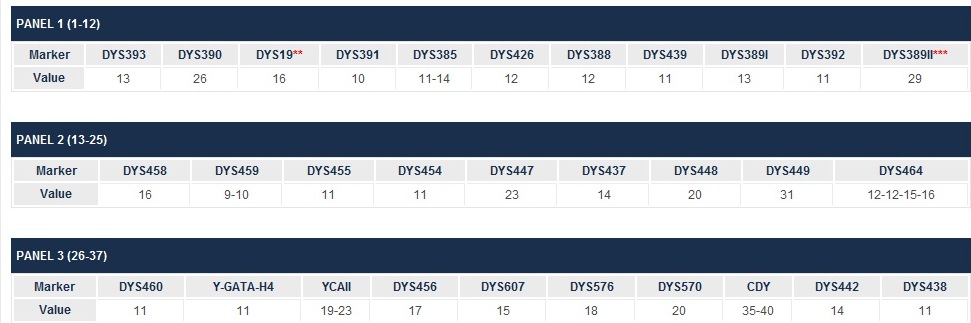
At Family Tree DNA and at Ancestry, marker results are displayed for the person who tested.  Ancestry tests either 33 or 46 markers. Family Tree DNA tests 12, 25, 37, 67 or 111 markers.

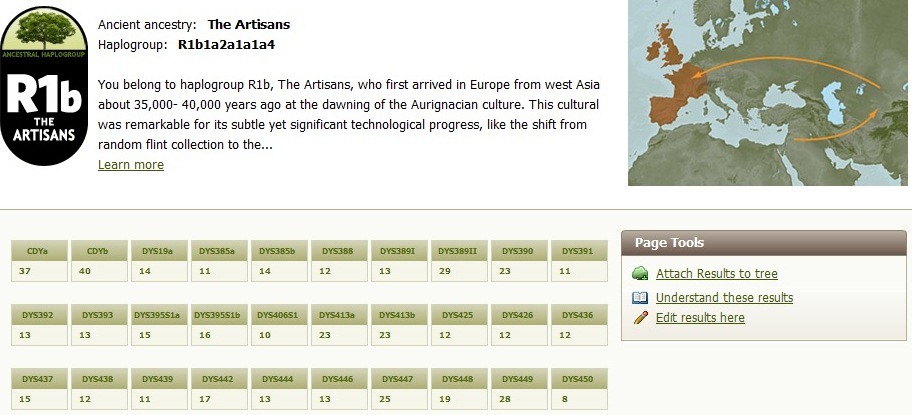
Family Tree DNA results are above.  Ancestry, below.

Haplogroup Maps

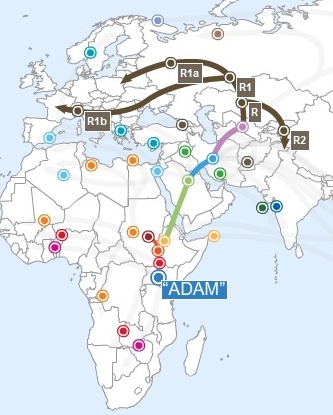
At Ancestry, the map, haplogroup description and results are all on one page, shown above, while at Family Tree DNA, they are displayed on separate pages.  At Family Tree DNA, the map is interactive.

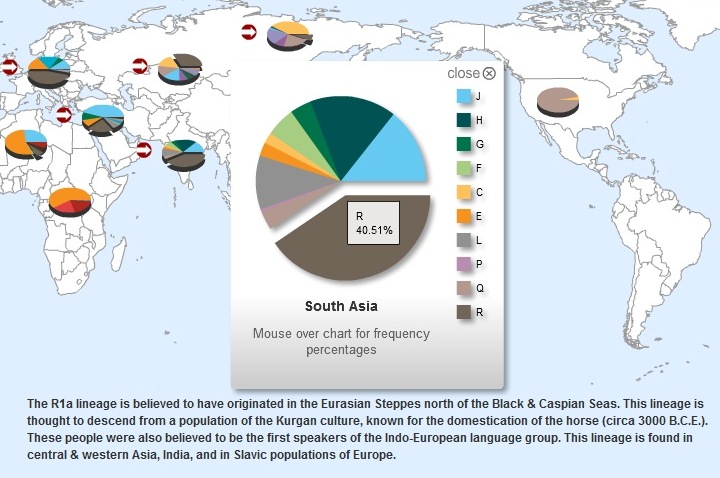
A second Haplogroup tab at Family Tree DNA also provides frequencies worldwide for the haplogroup.  Ancestry doesn’t provide anything similar.

Frequency Map

Matches

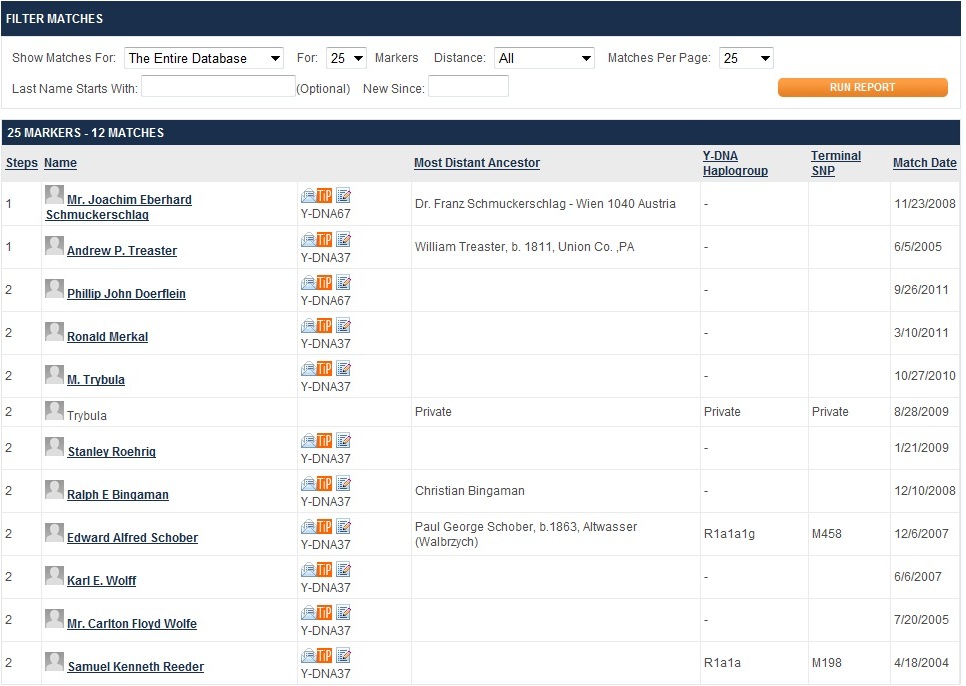
Both companies, of course, provide a list of matches.

At Family Tree DNA, above, your matches have real e-mail addresses that you access by clicking on the little envelope.  You don’t have to contact them through a messaging system.  The TIP calculations provide time to the Most Recent Common Ancestor and allows you to modify that calculation with known genealogical information. We discussed the MRCA function and compared the calculations between Family Tree DNA and Ancestry in the blog posting, “What Does MCRA Really Mean?”.

One of the must useful features is the Most Distant Ancestor field, which allows you to see at a glance if any of these matches share an ancestor with you, or in the geography of your ancestors.

Family Tree DNA has a privacy option, which allows your match to be shown, but no details.  You can directly attach a Gedcom file that is available only to your matches.

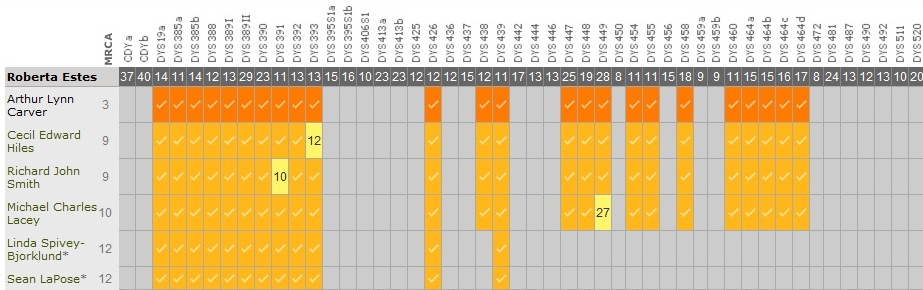
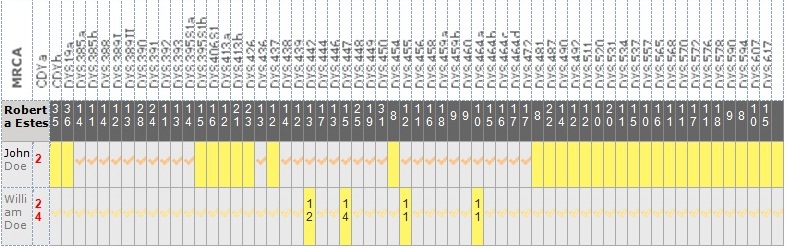
At Ancestry, your actual marker values are displayed compared with people you match, so you can see which markers you do and don’t match.  Non-matches are highlighted.  However, not all markers are displayed on the page.  You have to scroll right at the bottom of the page to see the rest. All people at Ancestry are encouraged to upload thier family tree, and attach their results to the tree.  That tree then becomes a part of Ancestry.com, although you can make it private.

Haplogroups are not displayed and neither are SNPs because Ancestry doesn’t test SNPs.  This means that they estimate all of their haplogroups, and occasionally incorrectly.  Complex haplogroup names, such as R1b1a2a1a1a4, mean those results have been hand entered by someone who tested elsewhere.  Ancestry can’t estimate to that level.

Manual Entry Issues at Ancestry

Furthermore, the results displayed, when entered by hand by people who tested at other companies often contain “clerical mutations,” otherwise known at typos.  This is the old GIGO concept – Garbage In, Garbage Out.  People identified with an asterisk have entered their results by hand, including a haplogroup name.

There are 4 markers that must be adjusted at Ancestry for Family Tree DNA results to be equivalent to the same markers at Ancestry.  In other words, the two companies “score” these markers differently.  Initially, you had to know this and compensate.  Then, Ancestry changed and began to do the compensation for you when you enter the results.  That was a definite improvement, but the result is that you have no idea if the results you are looking at are equalized or not.  The message here is that if you see an “*”, know to beware.

Furthermore, you can only have one set of results attached to your account, at least if you hand enter, and therefore if you want to check on matches for different relatives in your family, you need to edit the results from one person’s results to another.  In this case, you must do the compensation math on the markers yourself.  Fortunately, the list of markers is on the edit page, assuming people read, understand what to do and remember to adjust those values.

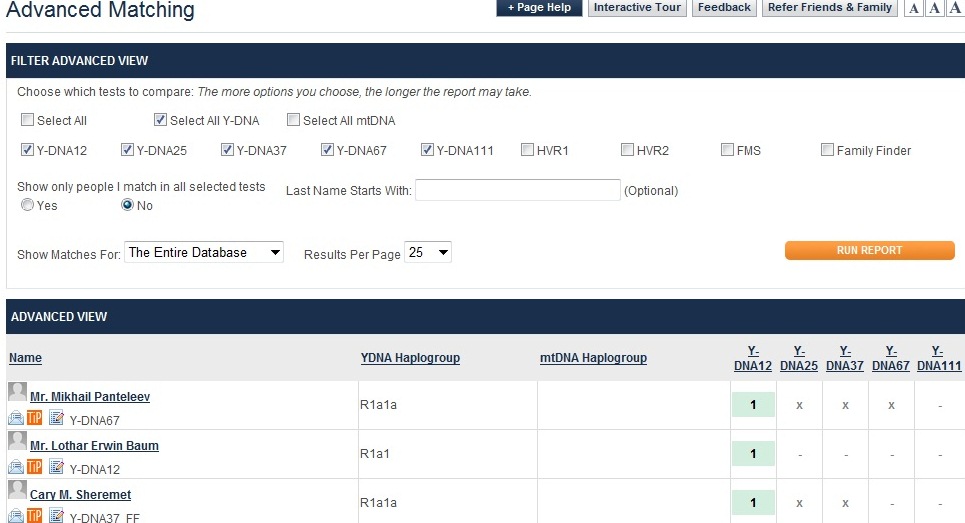
Advanced Matching

Family Tree DNA, in their last major update, added an advanced matching feature across their products that includes surname, partial name, project and combined tests matching.  This is an extremely powerful tool.  Ancestry has nothing similar.

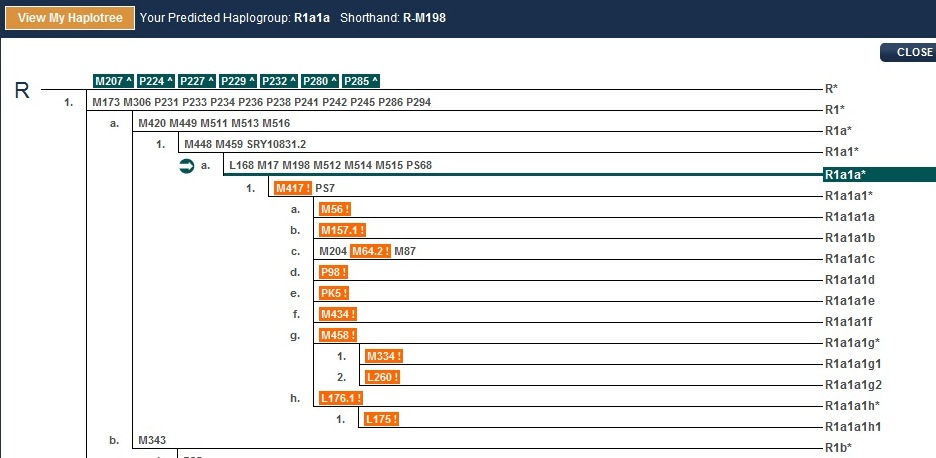
Haplotrees

Family Tree DNA provides a haplotree.  Ancestry doesn’t test SNPs, so they have nothing to put on a haplotree. Family Tree DNA guarantees that if they can’t predict your haplogroup by an exact match at 12 markers to another individual who has been SNP tested, that they will SNP test, for free, until they can successfully tell you at least which base haplogroup you are a member of.  This test is called the Backbone test.  They seldom need to do this anymore, but I do still occasionally see the Backbone test where the individual’s marker values are very unusual.

You can tell that Ancestry has spent a lot of time making their user interface very friendly, and it is.  Some would refer to this as “dumbed down,” but regardless, haplotrees, SNPs, changing haplogroup names and all of that tends to be confusing, certainly to the novice.  Most of Ancestry’s customers fall into the novice category.  Ancestry’s marketing is directed at the impulse “feel good” purchase.  They do a good job catering to that marketspace and that group of consumers doesn’t have any idea what a SNP is, or that there is anything more than what Ancestry provides them.

Ancestry doesn’t have a haplotree and their customers don’t miss it, at least not until someone who has tested at Family Tree DNA gets ahold of them, they need something more or want to join a project at Family Tree DNA.  Fortunately, now Family Tree DNA does provide an option for Ancestry customers to “transfer in” for a reduced fee.

Haplogroup Origins

Haplogroup Origins is very powerful tool provided by Family Tree DNA and often overlooked.  Haplogroup origins are haplogroup matches, based on STR markers, that point the direction to where your ancestors lived before surnames.  This is invaluable in determining general locations for people trying to find their ancestors in Europe.

Ancestral Origins

Ancestral Origins is another extremely powerful tool provided by Family Tree DNA that is similar to haplogroup origins, but brings the match time closer to the present.  These are the locations of the oldest ancestors of people that match you on STR markers, not based on your haplogroup.  Again, extremely useful for people trying to find their ancestor’s location overseas and/or trying to verify a particular ethnicity, such as Jewish.

Matches Maps

Both Ancestry and Family Tree DNA offer a map of matches, but they are significantly different.

At Ancestry, the matches shown on the map are the current addresses of the people who tested, NOT their oldest ancestor.  Personally, I find this a bit creepy, as I really don’t want someone knowing where I live.  Having said that, it’s a wonderful tool for adoptees and I use this feature constantly looking for location matches for my adoptee clients.  Most recently, I found someone’s closest match genetically in the city where they were born.  That’s a big clue.  Matches are sorted in closest to furthest order and you can click on either the person icon or the name and see additional information on the map, such as the location, the name and how close the match is.

At Family Tree DNA, the matches shown are the locations of the oldest ancestors of the people you match.  This is really much more relevant to genealogists in general.  In addition, a match list can be displayed, and by clicking on either the person’s name, or a balloon, additional information is displayed including an e-mail option.  This is an extremely powerful tool for someone looking for geographic matches or trying to determine which matches to contact.

SNP Map

Family Tree DNA has a new SNP mapping feature.  Of course, Ancestry doesn’t have this, because they don’t test SNPs.  This new mapping feature allows you to map clusters of SNPS.  I selected clusters of 10 of R1a1-M198 just as an example.

This can be beneficial in tracking groups of haplogroup ancestors.  As haplogroups connect with more modern times, this tool will become more powerful and useful to the typical genealogist.

Print Certificates and Maps

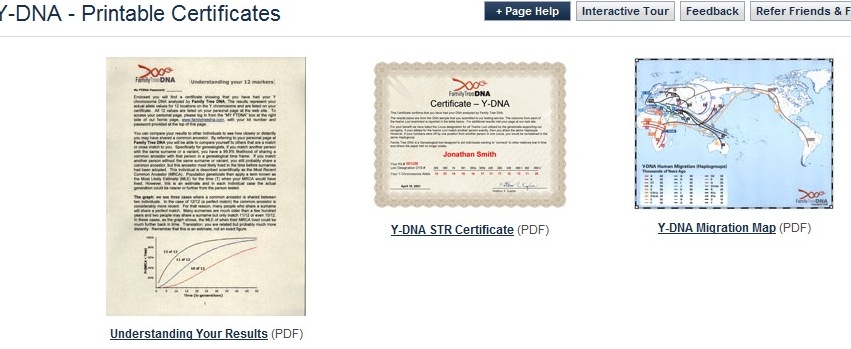
Family Tree DNA has a print option for certificates and maps.  While this isn’t particularly important to me, it is to many.

Projects

At Family Tree DNA, aside from personal matches, much of the power of matching comes through projects.  Volunteer administrators lovingly manage these and many, many discoveries have been made through projects.

Family Tree DNA provides oversight so that projects aren’t created willy-nilly, and projects fall into 3 main categories, surname, haplogroup and geographic projects.

Surname projects are obvious, as are haplogroup projects.  Occasionally there are multiples in these categories.  For example, there is a Miller project and then I have a Miller-Brethren project for the Miller families who were of the Brethren faith.

Haplogroup projects often have subgroups studying particular SNPs or large subgroups, such as haplogroup E1b1a (Sub-Saharan Africa) and E1b1b (North Africa/Mediterranean), which are different projects.

Geographic projects are pretty much anything else.  My Cumberland Gap projects are there, both y-line and mitochondrial DNA, the Lost Colony projects, the Acadian project, Native American projects, the Bahamas and Puerto Rican projects, and many more.  Many times academic researchers and population geneticists work with these project administrators.

Projects are absolutely wonderful resources providing the opportunity to work with others who have similar interests to learn more about the people within your group.  For example, the Cumberland Gap group has provided a venue for genetic matching within the region, but we also offer a Yahoo group for project members where we share cultural and historical aspects of the Cumberland Gap area as well as genealogy.

While it is beyond the scope of this Y DNA comparison, Family Tree DNA also provides many tools to project administrators.

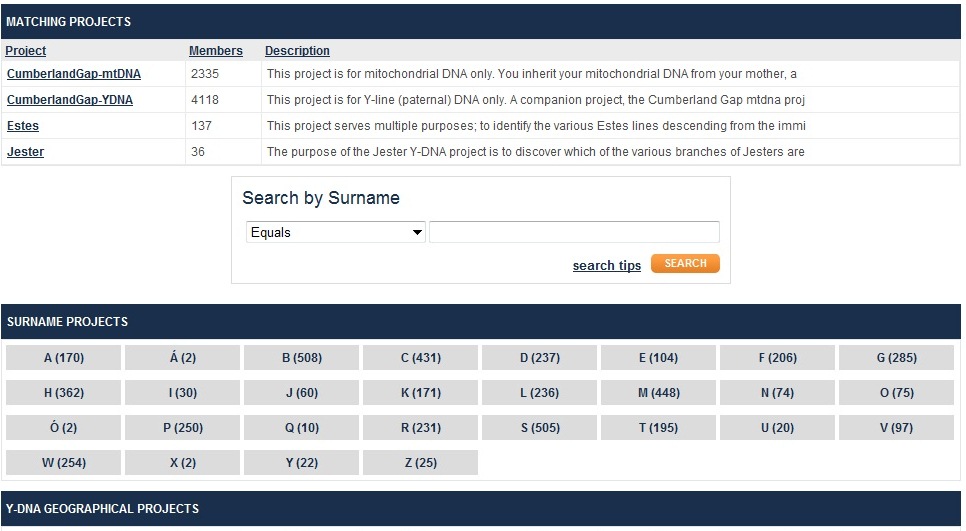
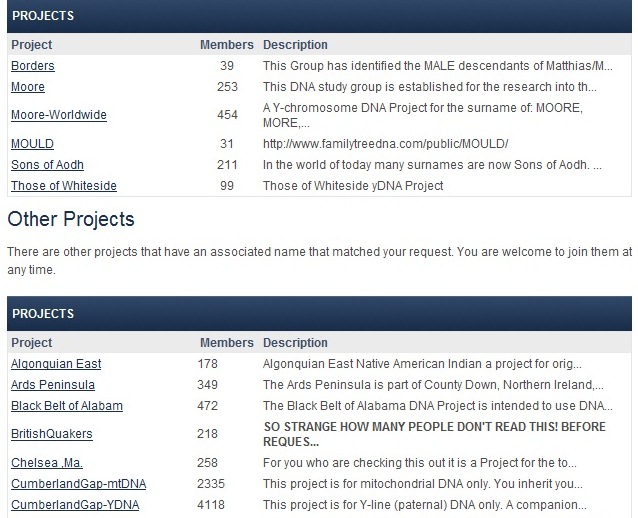
Family Tree DNA provides a search feature for projects that includes key words and surnames, plus an alphabetical browse, by category, shown above.  They also display a list of projects that include the surname of the person who is signed on and doing the search.  I was signed on when I did the above search, and you can see that there are 4 projects that include the surname Estes in their project profile, Estes, Jester and the Cumberland Gap Y-line and mitochondrial DNA projects.

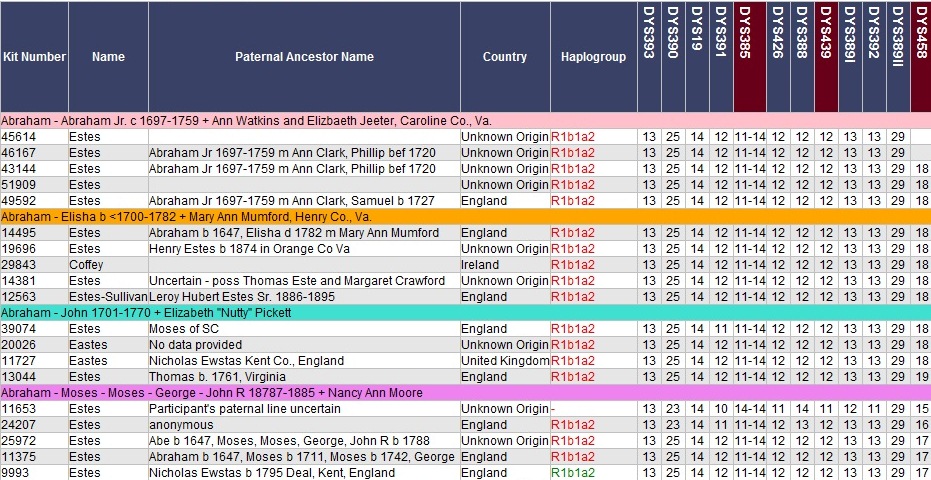
In addition, Family Tree DNA provides a public webpage for every project that includes participant grouping capabilities, shown below, colorized matches within groups, and mapping.

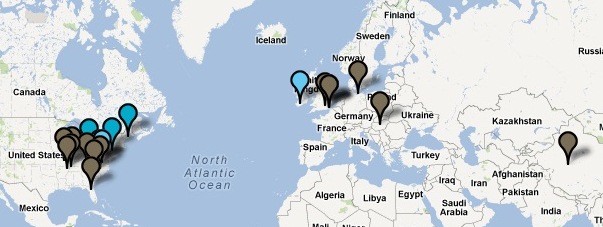
Project maps can display the oldest ancestor location of an entire project or of any selected subgroup.

This is a very powerful tool, especially in relation to haplogroup maps.

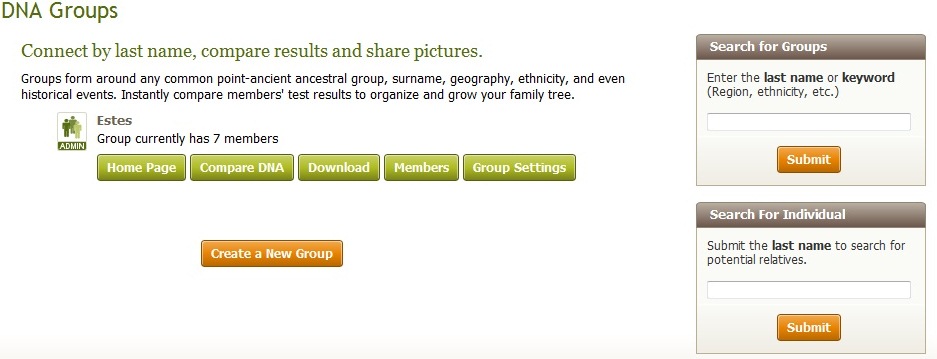
At Ancestry, shown below, you can search for either groups or individual surnames.  The surname search is a useful tool.  I searched for Estes.  I can see that people by that surname have tested and their haplogroup, but I can’t see their results.  Of course, if I enter Estes marker results, by process of elimination, I can figure out who I do and don’t match from this list. To contact these people, I have to go through Ancestry’s message service.  My experience has been that few Ancestry contact requests are successful.

Unfortunately, at Ancestry, everyone is encouraged to “create a group.”  Anyone can join whether they have DNA tested or not.  It doesn’t matter if their DNA test is for a genealogy line relevant to the project, meaning paternal or direct maternal, and there is no oversight ability or control.  In essence, these are individual or family study groups, not DNA projects, per se.

I entered the surname Moore, one of my brick walls.  The number of “Moore” groups was overwhelming.  It’s clear from looking at these that many people have created what I would term personal family study groups, but sorting through them and trying to find something useful is overwhelming.  There were 25 groups including several who were listed as the Moore Paternal surname group, with 1, 2 or 3 participants in each.  The oversight provided at Family Tree DNA avoids this type of mess.

Compare this to the projects at Family Tree DNA that list the surname Moore.  Additionally, Family Tree DNA tells me that 824 people with the surname of Moore have tested.  Of those, 454 are in the Moore Worldwide project.  Yep, if I’m a male Moore, that’s where I’d want to be – where I can compare to other Moore lines.

Other Resources

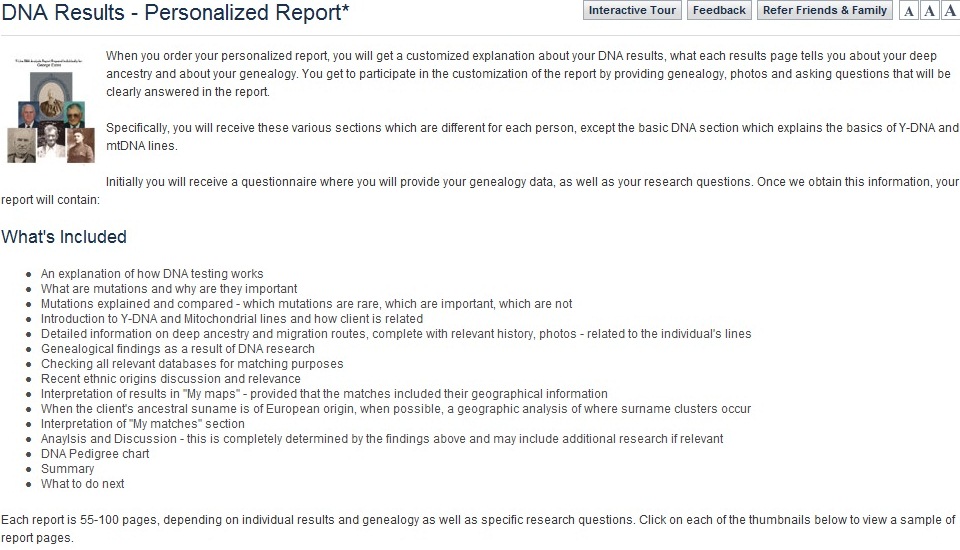
On the Other Resources tab, Family Tree DNA has a list of several other resources, all free.  In addition, you can download a free e-book about how to interpret your results, or you can order a customized Personal DNA Report.  None of these additional items are available at Ancestry.

Populating DNA up Trees

One feature that Ancestry has that Family Tree DNA does not is the ability to populate the DNA up a tree.  Obvious pitfalls are twofold.  First, the DNA may not be relevant to people up the tree if a nonparental event has occurred, also known as an undocumented adoption.

Second, the genealogy may not be correct and you’ve just genetically populated the wrong people.  Not everyone views this “tree population” as a positive feature.  Many view this with a very high level of trepidation, understanding that the many incorrect trees at Ancestry will eventually also have incorrect genetic information as part of that family record.  There is also concern that in time, this will actually discourage DNA testing because people will find these DNA populated trees and believe that their line has already been tested, so they will think they don’t need to test.

Comparison Chart

As an easy comparison, I’ve created the following chart to compare the Y-line DNA testing and products.

Feature Family Tree DNA Ancestry
Marker Results Yes, 12, 25, 36, 67 or 111 markers Yes, 33 or 46 markers
Migration Map Yes – interactive Yes
Haplogroup Description Yes Yes
Haplogroup Frequency Map Yes No
SNP testing Yes, Individual SNPs, Deep Clade and Geno 2.0 No
Matching Yes, most distant ancestor listed, direct e-mail Yes, marker comparison provided
Haplotree Yes, includes free SNP Backbone test if haplogroup cannot be predicted No
Advanced Matching Yes, by surname, partial name, project and varying test combinations No, but does have general surname search for participants
Ancestral Origins Yes No
Haplogroup Origins Yes No
Matches Map Yes, location of oldest ancestors Yes, location of person who took the test
SNP Map Yes No
Print Certificates and Maps Yes No
Projects Yes, tools and oversight provided, surname, haplogroup and geographic, includes web page, groups and maps Yes, encourages everyone to create project, lack of organization and tools
Additional Resources Personal DNA Reports, free e-book, Multiple FAQs, Forum, Newsletter, Genographic Project, Glossary, Ysearch, Mitosearch, News, Release Notes, Academic papers, Annual Administrator’s  Conference, Mitochondrial DNA testing (full sequence), Autosomal DNA testing (with data download), Walk the Y (WTY) General FAQ, Mitochondrial DNA testing (no full sequence), Autosomal DNA testing (no data download), normal Ancestry subscription services, “ability” to populate DNA up trees


______________________________________________________________

Disclosure

I receive a small contribution when you click on some of the links to vendors in my articles. This does NOT increase the price you pay but helps me to keep the lights on and this informational blog free for everyone. Please click on the links in the articles or to the vendors below if you are purchasing products or DNA testing.

Thank you so much.

DNA Purchases and Free Transfers

Genealogy Services

Genealogy Research

To SNP or not to SNP??

I received an e-mail the other day from someone who had been asked to take a SNP test by their project administrator.  What they asked me was, “Why would I want to do this and what’s in it for me?”  Seems like a simple enough question, but not exactly.

The quick answers are twofold:

  1. It further defines your haplogroup and…
  2. You can participate in science research.

Unfortunately, this just leads to the next question, “Why do I care?”

So here’s the longer but more accurate answer….and by the way…when you’re done reading this, you’ll understand why it matters, personally, to you.  And you’ll probably want to order a SNP test or two.

I’m going to use the haplogroup E project for an example.  I’m a co-administrator of the project, along with two other individuals, one of which is a population geneticist.  I am very, very grateful for Aaron’s interest in the project.

As project administrators, we feel that it’s our responsibility to group people within the project in a way that is both helpful to them and to scientific research.  Fortunately, these goals do not conflict and are one and the same.

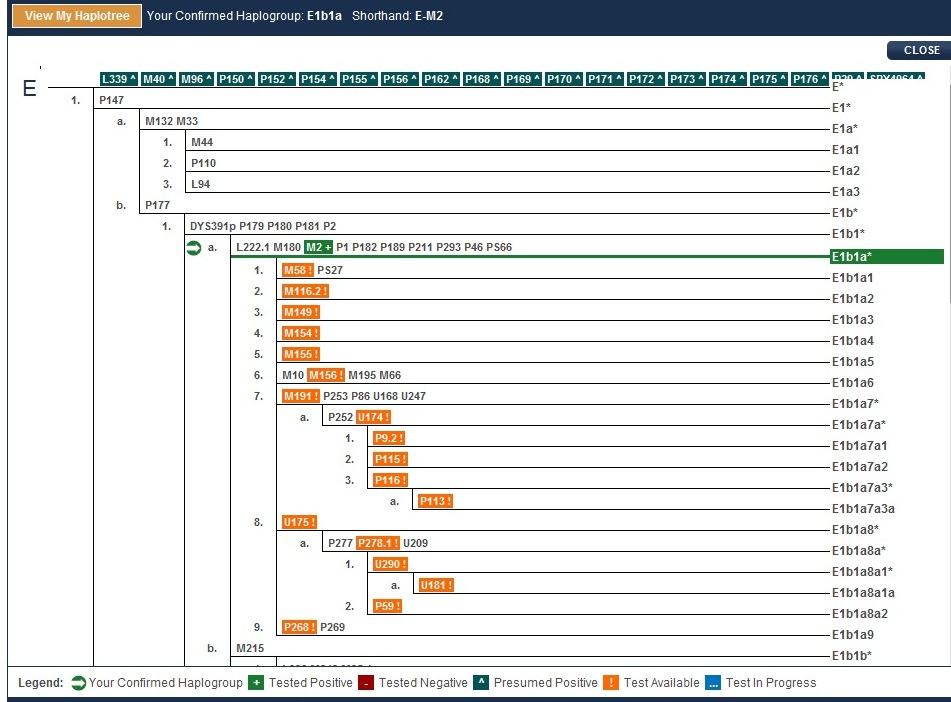
The haplogroup E1b1a, which is the core haplogroup of this project, as opposed to brother haplogroup E1b1b, is defined by a series of SNPs.  Each letter and number after the initial E is defined by a SNP.  So each additional letter or number makes the resulting haplogroup more specific.  More specific means more granular in both geography and time when the haplogroup, and subgroups, were born.

  • Haplogroup E, itself, is defined by L339 and 10 more “equivalent” SNPS
  • E1 is defined by P147
  • E1b is defined by P177
  • E1b1 is defined by P179 and 4 more equivalent SNPs
  • E1b1a is defined by M2 and 9 more equivalent SNPs

In the haplotree, there was a big split between E1b1a, which is Sub-Saharan African and E1b1b, which is North African/Mediterranean, known colloquially as the Berber haplogroup.  Therefore, two separate projects make sense.

The project is officially known as the E1b1a-M2 project.  M2 is what is known at the “terminal SNP,” meaning the one furthest down the tree that defines E1b1a.

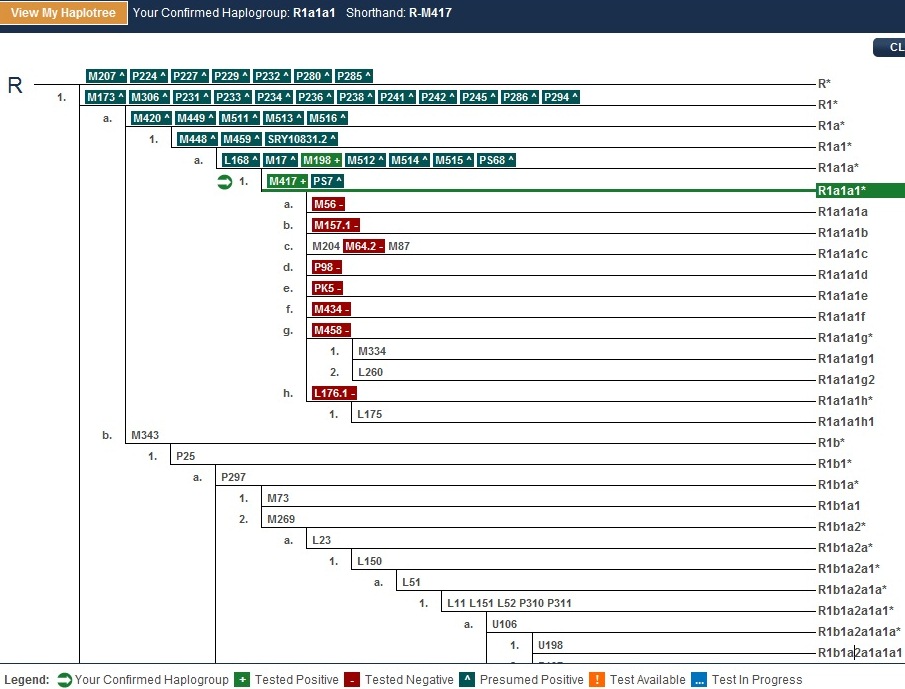
On the haplotree above, you can see the lighter green M2+ SNP that was tested to confirm that this person was indeed in haplogroup E1b1a.  The plus means that they have the SNP.  If they didn’t have this SNP, then they would not be in this subgroup of haplogroup E1b1.

The orange SNPs listed below the E1b1a branch, on the haplotree above, are all of the SNPs available to be tested to see if you are in those haplogroup subgroups.  Want to know which branch is yours?  If so, then now you know why you’d want to test.

Let’s look at the project map to see why you might want to determine a subhaplogroup.

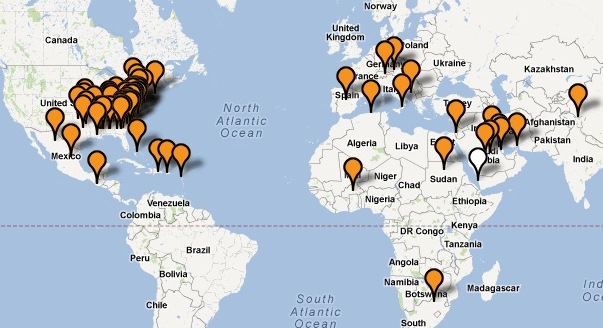
The map below shows the entire E1b1a project with all of the participants.

Do you see all of those people in the Americas?  Well, those are participants who are people of African heritage who very much would like to see their balloon in the African continent, not on the shores of the Americas.  The only way to determine where these people originated in Africa is to do the research that will connect the dots genetically, because we can’t do it via paper records, to where their ancestors lived in Africa.

In order to do this, people need to take SNP tests for specific markers so that their results can be correlated with African groups.  Tests for individual SNPs are only $29 each, so really quite inexpensive for the benefit you, and science, receive.

Aaron, the haplogroup E1b1a geneticist, has divided the participants into groups, and using his expertise, has determined which individual SNPs are the most beneficial.  A Deep Clade test is $139, but generally, Aaron can tell which subgroup people are likely to fall into, so he requests just a SNP or two.  You can test a lot of individual SNPS for $139.  Additionally, sometimes Family Tree DNA makes SNPs available for research testing that are not on the price list yet, and the only way to get these tested is via what is called “boutique testing,” where you order one at a time, through the haplogroup administrator.

When Aaron sees someone who would benefit from this kind of test, he e-mails the person and asks them if they will take the specific SNP test.

Let’s look at an example.

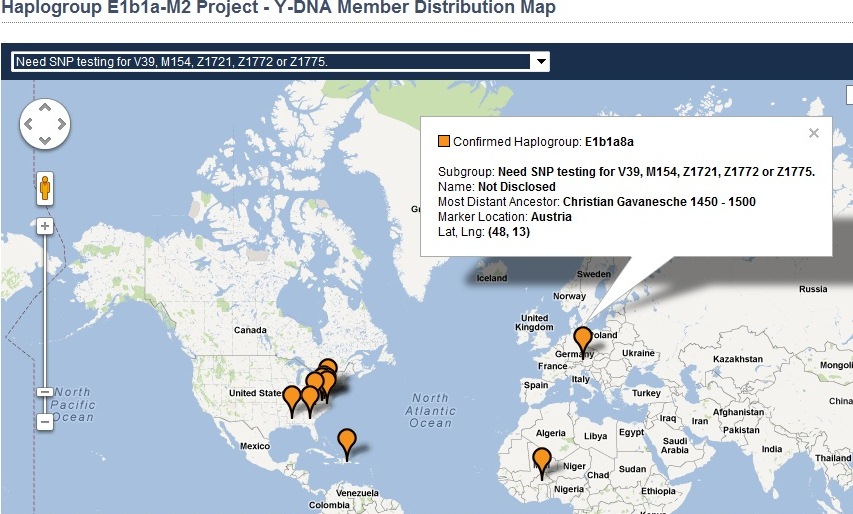
We have a very, very interesting situation where we have a man whose ancestral line is confirmed to be from Austria.  This is highly unusual, as E1b1a is very clearly African and is seldom to never found in Europe ancestrally.  However, this genealogy is well documented.

You can see on the above map that Aaron has grouped a number of people together whose DNA has similar characteristics, meaning groups and values of markers.  He wants all of these people to take specific SNP tests, which you can see on the drop down box as the title of the group.  This is standard practice for haplogroup project administrators.

On the map, you can see where these participants’ oldest ancestors are found. One in Austria, one in Africa and the rest in the Americas who are brick walled.

This map shows project participants.  In order to look at where the research papers place these people ancestrally using genetic information, we need to use a different tool.

We don’t know the African location origins of this particular group of people, which is why these SNP tests are so critically important.  We need to match them in research data bases with other people who have these same SNPs.

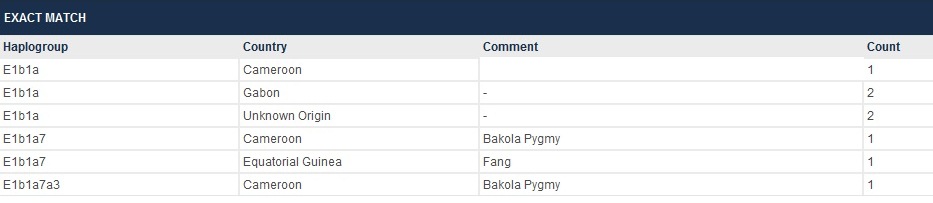
Let’s look at the haplogroup origins of someone within a different subgroup of E1b1a who is also brickwalled in the US. Shown below is the Haplgroup Origins chart from their personal page, showing their matches.

You can see that several haplogroup matches, progressively more detailed (E1b1a to E1b1a7 to E1b1a7a3), have origins in Africa.  The more detailed your SNP test, the more detailed your haplogroup, the more detailed and specific your location can and will be, if not today, then eventually.

You can see above that this person, who has only tested to the E1b1a level, matches an E1b1a7a3 individual who is from the Bakola Pygmy tribe in Cameroon.   If this person were to take the SNP tests, they would know if they too are haplogroup E1b1a7a3.  If so, there is a very good possibility they too are a descendant of the Bakola Pygmy tribe in Cameroon. This is extremely powerful information for someone searching for their roots – the Holy Grail of genetic genealogy.  But they will never know if they don’t SNP test, either by individual SNPs ($29 or $39 each) or the Geno 2.0 test ($199).

If you’re lucky, the research on your particular SNP location in Africa has already been done.  But you’re never too late to this party, because as new SNPs are discovered, there are always new opportunities to test.  That’s the ying and the yang of pushing the frontiers of science.

We are REALLY fortunate, because we live in a time where we can be participants in scientific discovery that not only helps us find your our own ancestors, but helps many others who are brick walled with no other hope of finding their ancestral homeland.  This doesn’t just apply to the African haplogroups, but to all haplogroups.  This is exactly how the revolutionary discoveries of the past few months and years that led to the new Geno 2.0 test came about.  One person and one SNP test at a time.

Want to find your ancestors AND make science happen???  SNP test!

This is a companion article to Where is my Haplogroup From?

______________________________________________________________

Disclosure

I receive a small contribution when you click on some of the links to vendors in my articles. This does NOT increase the price you pay but helps me to keep the lights on and this informational blog free for everyone. Please click on the links in the articles or to the vendors below if you are purchasing products or DNA testing.

Thank you so much.

DNA Purchases and Free Transfers

Genealogy Services

Genealogy Research

Applying DNA Studies to Family History: The Melungeon Mystery Solved

Wayne Winkler, Jack Goins (pictured above) and Roberta Estes were honored to be able to present and record the first, and possibly the only, comprehensive Melungeon-focused series that includes an introduction to Melungeons, their history and heritage, their migrations and the results of the landmark DNA study, Melungeons, A Multi-Ethnic Population.

The Allen County Public Library, in Fort Wayne, Indiana is a leader in genealogical research and also in the preservation of history.  Their facility includes a state-of-the art auditorium and television studio.  They tape many shows there and now, we’re proud to say, our series will be added to their catalog of free videos available online.  We will provide the links when they become available.

These presentations were really the culmination of decades of work.  The icing on the cake is the DNA study that has clarified the history of the Melungeon people and the core families.

Roberta began the day with an Intro to DNA and Genetic Genealogy explaining how DNA for genealogy works.  This session is always popular, and this event was no exception.  Roberta uses her own family pedigree chart as an example and nearly always meets a new cousin or two.  There are lots of DNA tools in the genealogists tool box, more now than ever.

Wayne Winkler’s presentation, The Melungeons: Sons and Daughters of the Legend provided an overview of the mysterious mixed-ethnic population first documented in northeast Tennessee and southwest Virginia in the early 19th century.  Wayne is extremely well-spoken, and even though I’ve heard him before, I’m always caught up in the spell he weaves.  Wayne’s book, Walking Toward the Sunset, The Melungeons of Appalachia goes a bit deeper than his presentation, so I would encourage everyone interested in an accurate overview of this topic to read his book.

Jack Goins’ session began the afternoon.  How fitting that Jack is the Hawkins County, Tennessee archivist.  His presentation, Examining our Melungeon Neighborhood and Migrations, tracked the original Hawkins County Melungeon families backwards in time, through the New River area, through the Flat River area and back into Louisa County in the mid-1700s.  Indeed, this core group was there, together, before migrating in steps towards Newman’s Ridge.  Jack’s photos of the actual locations bring them to life.  Jack’s most recent book, Melungeons: Footprints from the Past was published in 2009 and details the history, with source documentation, of the Melungeons, beginning in Hancock and Hawkins Counties in Tennessee.  This is a must read for anyone researching Melungeon families.

The final presentation of the day was given by Roberta Estes, taken from the academic paper recently published in the Journal of Genetic Genealogy, Melungeons, A Multi-Ethnic Population. Roberta, Jack Goins, Janet Crain and Penny Ferguson co-authored the paper.  This paper uses the genetic genealogy information from participants in the Melungeon DNA projects to paint a fuller picture of the Melungeon core families, and therefore, of the Melungeon population as a whole.  The Melungeon core families, as identified by their paternal (surname) lines include European and African progenitors, about half and half.  All maternal lines tested have been European.  There was no direct paternal or maternal Native American heritage found, as had been expected, but there are two lines that are ancestors to the Melungeon families that include Native lines. It’s also of interest that all of the African lines, except one, are found together in Louisa County, Virginia, but the Native lines don’t enter the pedigree chart until later, on subsequent steps of the migration to Tennessee.

Roberta and Jack would like to stress that the DNA project is ongoing and people connected to these families are encouraged to join.  Questions? – Contact Jack at jgoins@usit.net.

Following the presentations, the speakers answered questions and had a book signing.

Several people had questions about DNA and how to use their results to discern things like ethnicity.  One very nice gentleman, Gary, offered to be a guinea pig, so indeed Roberta took him up on his offer and performed a somewhat impromptu DNA analysis.  This gentleman had an African paternal line from Cameroon, but a quite rare maternal European line.  Both his paternal and maternal lines had been enslaved, so indeed, the European maternal heritage was a very unexpected result.  His autosomal test results showed that he was about half European and about half African.  Roberta’s business, DNAexplain, includes writing Personalized DNA Reports for customers.

Following the sessions, each speaker was asked what they believe were the salient points of the sessions and the project as a whole.

Wayne said that he “thinks the most important aspect of the presentations was that we now have data giving us a piece of the genetic portrait of the “core” group that settled in Hawkins/Hancock County in the early 19th century. It’s not the whole story, not the “final” word on the subject. In fact, it’s really the FIRST solid genetic data we have on these folks. Too many people think that the genetic profile of the Melungeons has already been documented, but that’s not the case. Thanks to the seven-year effort by Roberta, Jack, Janet, and Penny, we now have dependable, factual information about who our ancestors were.”

Jack said, “what is very important or noticeable to me is examining events in our history like the illegal voting trials for this example.  All of the Melungeon men tried had African paternal heritage, except possibly one who took his mother’s surname.  Three of the Collins were brothers, sons of old Benjamin and Zachariah and his brother Lewis.”  Jack told me that when he saw the record, in the archives, that Vardy Collins had paid the fine for illegal voting, instead of fighting the allegation, he knew in his heart that we would likely find African heritage.

I know that the results of the DNA study have disappointed a few people who were hoping for Native American results.  Some of the news reporting has, unfortunately, fanned those flames by what I would characterize as “race baiting.”  As authors and interviewees, we are not afforded the opportunity of reviewing the articles or interviews before they are either published or broadcast.

The Melungeon study and the study of genetic genealogy isn’t about race – it’s about heritage.  It’s about allowing your ancestors to reach forward in time to you with the truth that only their DNA can reveal.  Allow yourself to hear their whispers.  It’s their gift to you.  It’s about honoring those ancestors, the experiences they had, the trials they endured, all of which, combine to make you who you are today.  It’s about using DNA as the tool to raise the veil that covers the distant past.  To want them to be something they were not is to dishonor who they were.

We would like to thank the Allen County Public Library for their hospitality.  I would like to thank the other two speakers for volunteering to do this presentation.  It means a full day’s drive for both Wayne and Jack, each way.  We all volunteered our time so that this important information can be preserved for future generations.  We also want to thank all of the Melungeon descendants who have joined the projects and contributed their genealogy information.

______________________________________________________________

Disclosure

I receive a small contribution when you click on some of the links to vendors in my articles. This does NOT increase the price you pay but helps me to keep the lights on and this informational blog free for everyone. Please click on the links in the articles or to the vendors below if you are purchasing products or DNA testing.

Thank you so much.

DNA Purchases and Free Transfers

Genealogy Services

Genealogy Research

Where is my Haplogroup From?

This is a very common question.  The answer can be as simple as a Wiki search, or a little more complex, but offering a much more personal answer.

First, if you have not joined a haplogroup project relevant to your haplogroup, do so.  This applies to both Y-line and mitochondrial results.

We discussed how to do this in the “What Project do I Join?” post.

Joining haplogroup projects does two things.  First, it provides you with a group of “like people,” who have common ancestors with yours.  Second, it provides the project administrators with DNA sequences to work with.  It’s that “working with” part that will play an important part in the answer to this question.

If you’ve already looked at Wiki, and you’re ready for more, you can take a look at your personal page.  At Family Tree DNA, both the Y-line and mtDNA have a haplogroup Migration Map option.

Clicking on this option shows you the migration map for your haplogroup.

Clicking on the Haplotree option, and scrolling to the bottom, you’ll see a link for the Haplogroup FAQ, right under the “about my haplogroup” verbiage.  The FAQ holds lots of information about haplogroups, how they are determined and such.

For Ancestry customers, your haplogroup description is at the top of the “View Results” page.

Clicking on the “learn more” provides you with an additional paragraph or so.

Note: Ancestry no longer has Y or mitochondrial DNA testing at all.

Ancestry does not have haplogroup projects, SNP testing, or additional haplogroup tools, so the rest of this will refer only to Family Tree DNA clients.

Let’s now turn to the haplogroup projects.  The most personal answer to the question, “where did my haplogroup come from” will come from within haplogroup projects.

How haplogroup administrators handle projects varies, based on their level of involvement, interest and experience of the administrator or administrators.  And remember, we are all volunteers.  Having said that, these people do an amazing and incredible job.

Family Tree DNA provides a mapping function, for free, along with their other project administration tools, for haplogroup projects.  If a project doesn’t have a map available, then it’s because the administrator chose not to opt for the map when setting up the project.

I’m using the haplogroup R1a1a project as an example.  It’s well organized, grouped by haplogroup and many people fall into this haplogroup.   The various options for viewing haplogroup projects are listed on the top bar within the project.

Clicking on the “classic” options shows you the various groups that the administrator has created, and how they have grouped individuals within the project.

By searching for you kit number, you can find the group you’ve been assigned to.  Note that if the project extends over more than one display page, you may need to search on subsequent pages as well. You can also change the number of results displayed per page in the “page size” box at the top.

Depending on the project, administrators group participants differently.  Some projects group people by geographic location.  Most Y-line projects group them by haplogroup subgroup, or SNP, plus groups of STR markers within SNP groups.  The SNP (single nucleotide polymorphism) is the location that is tested to see if you are a member of a haplogroup, or haplogroup subgroup.  Your terminal SNP is the one furthest down on the tree that provides you with the most resolution as to where your ancestors were located.  Your individual markers further refine SNP groupings.

Let’s look at the maps.

Projects have the option of displaying the location of the oldest ancestor.  Of course, this means that each participant will need to have entered the geographic location of their oldest ancestor on the Migrations Maps tab on their personal page.  This is critically important for haplogroup project mapping, because without the locations of oldest ancestors, there is no way for your results to appear on the map.

To see all of the project participants on a map, click on “Map” and then in the dropdown box, select “all.”

In the R1a1a project, the “all” selection shows the following map.  This is the answer to the question “where did my haplogroup come from.”

However, a much more personal answer to that question lies in the subgroups.  The haplogroup R1a1a project has grouped participants by SNPs and has given the resulting clusters identification names.  Let’s assume that your kit is listed in the group A1 which they’ve defined as Z283+, M458+, L260+ and named the “West Slavic Subcluster ‘A’” – all listed in the group title for this subgroup on the map selection.  The numbers, Z283+ indicate the SNP name and the plus or minus indicates that the people in the group have tested that location, and if they have it (+) or not (-).  If the administrator does not clearly define how they’ve identified the subgroups, then you’ll have to contact them directly.  Every administrator runs their project differently.

The map for this subgroup clearly shows where these participants’ ancestors are found. If you are in this group, this means that these people share a common haplogroup ancestor with you, some hundreds to thousands of years ago, depending on the haplogroup subgroup age.  This is the personal level of the answer to the question “where did my haplogroup come from.”

I hope this has given you several different methods to answer the question, “where did my haplogroup come from?”

I also answer this question for clients, in context of their own ancestry and family history, when writing their Personal DNA Reports.

This is a companion article to “To SNP or not to SNP.”

______________________________________________________________

Disclosure

I receive a small contribution when you click on some of the links to vendors in my articles. This does NOT increase the price you pay but helps me to keep the lights on and this informational blog free for everyone. Please click on the links in the articles or to the vendors below if you are purchasing products or DNA testing.

Thank you so much.

DNA Purchases and Free Transfers

Genealogy Services

Genealogy Research

What Does MCRA (MRCA) Really Mean??

The MCRA or time to the Most Recent Common Ancestor is a calculation provided by both Family Tree DNA and Ancestry.com for their clients who have taken the Y-line DNA tests.  This is also written MRCA, Most Recent Common Ancestor, MCA and all of the above prefaced with a T meaning “time to”.  Regardless of which way you see this acronym, it means the same thing – the closest ancestor you share with someone in the DNA line being tested.

I have a great example of how this actually translates into reality using the results from both companies.

Often, I receive communications from people who say something like this:

“It says that I’m related to John Doe within 6 generations.  I have both of our genealogies to 6 generations, and I can’t find our common ancestor.  What is wrong?”

The answer to “What is wrong?” is easy.  The person doesn’t understand what the tool that estimates MCRA is telling them.  And, I’m betting they didn’t read the instructions and explanations either, that is if they tested at Family Tree DNA who provides such.

Family Tree DNA provides a great deal more information and a far more robust tool than Ancestry.  Family Tree DNA begins with this information:

“The probability that John Doe and William Doe shared a common ancestor within the last X generations…”  The number of generations and the percentage probability are shown below.

You can also change the generational display.  I changed mine to “every generation.”

This is followed by an explanation and instructions for how to refine the calculations:

Refine your results with paper trail input

However, these results can be refined if their paper trail indicates that no common ancestor between John Doe and William Doe could have lived in a certain number of past generations.

If you don’t know this information for a fact, do not change the “1” in the box in the next paragraph. However, if you have the information, please enter in the box and click on the recalculate button.

John Doe and William Doe did not share a common ancestor more recently than 1 generation(s). (Because the important factor in calculating the time to the Most Recent Common Ancestor is the number of generations between which mutations could take place, the number of years per generation is irrelevant in FTDNATiP™ calculations).

After that, additional explanation and a reference to a FAQ sheet:

* The FTDNATiP™ results are based on the mutation rate study presented during the 1st International Conference on Genetic Genealogy, on Oct. 30, 2004. The above probabilities take into consideration the mutation rates for each individual marker being compared.

Since each marker has a different mutation rate, identical Genetic Distances will not necessarily yield the same probabilities. In other words, even though John Doe has a Genetic Distance‡ of 4 from William Doe, someone else with the same Genetic Distance may have different probabilities, because the distance of 4 was prompted by mutations in different markers, with different mutation rates.

‡Note: The Genetic Distance is the count of the total difference between two individuals. For example, if a marker differs by 2, then the Genetic Distance will count this as a distance of 2.

More questions? Please refer to the FTDNATiP™ FAQ page.

This is a huge difference compared to Ancestry who only gives you a number with absolutely no explanation at all:

The MCRA is the small number beside the name – so John Doe is an MCRA of 2 and William is 24.  I have highlighted these in red below so that you can see them.

Here is the explanation the Ancestry which is followed by the match table.

“You could be close to a meaningful family connection! The list below is sorted by how close your DNA matches (MRCA). The closest matches are at the top.”

Real Life Example

Ok, but what does all this really mean, in real life, to me?

Fortunately, I have a client who has tested at both locations, and has another man who he matches both at Ancestry and at Family Tree DNA.  In addition, we know who their common ancestor is, and we can use this information to compare the accuracy and usefulness of the MCRA calculations.

At Ancestry, these men have tested 34 markers in common and have 4 mutations difference.  Ancestry calls this relationship a distant match at 24 generations to the most common recent ancestor (MCRA).

At Family Tree DNA, they have tested 37 markers in common and have 4 mutations.  Family Tree DNA, without refining the MCRA with the paper trail, calls this as the 50th percentile at 11 generations.  This means that there is a 50% chance that you have a common ancestor within 11 generations.  I use the 50th percentile number because that is the “most likely” spot – meaning that it’s equally likely that your ancestor was closer generationally or further away.

We know that these men are at 8 generations to a common ancestor for one man and 7 generations for the other.

Checking Family Tree DNA’s chart for 7 and 8 generations, that percentage or probability is 20% and 27% respectively.

Interestingly enough, Family Tree DNA says that at 24 generations, which was Ancestry’s estimated number of generations, there is a 97+% likihood that indeed they have a common ancestor.

So what we’ve learned is that Ancestry, aside from providing no tools or explanation, is very, very conservative.  In this case, the number they give you is more likely their 100% sure number, not their “most likely” 50th percentile number.  In fact, if we divide their number in half, it’s still high.

We’ve learned that Family Tree DNA’s 50th percentile is much closer to reality, even without any tweaking that you can do based on known pedigree charts.

______________________________________________________________

Disclosure

I receive a small contribution when you click on some of the links to vendors in my articles. This does NOT increase the price you pay but helps me to keep the lights on and this informational blog free for everyone. Please click on the links in the articles or to the vendors below if you are purchasing products or DNA testing.

Thank you so much.

DNA Purchases and Free Transfers

Genealogy Services

Genealogy Research

Jewish Voice Interview with Bennett Greenspan

Bennett Greenspan recently appeared on Jewish Voice.  He gave a wonderful interview that addressed far more than Jewish interests.  He speaks about Jewish ancestry and testing, population genetics, autosomal DNA testing and sample populations.  There are also great shots of sequencing equipment and other DNA test paraphernalia.  And love the tie:)

This is an excellent basics primer that everyone can understand.  The consummate “elevator pitch.”  Genetic genealogy isn’t that easy to explain, but he did a great job.  Granted, he did have a little more time than an elevator ride.

Always the businessman, Bennett brought the host, Rabbi Jonathan Bernis, a test kit and he swabbed on the show as well!  Enjoy!

http://www.itbn.org/index/detail/lib/Networks/sublib/TBN/ec/VsYWNlNTrw98zu18Se-C_nktOBEq4fVY

______________________________________________________________

Disclosure

I receive a small contribution when you click on some of the links to vendors in my articles. This does NOT increase the price you pay but helps me to keep the lights on and this informational blog free for everyone. Please click on the links in the articles or to the vendors below if you are purchasing products or DNA testing.

Thank you so much.

DNA Purchases and Free Transfers

Genealogy Services

Genealogy Research

What the Heck is WTY?

Update: The WTY has been superceded by the Big Y test, but I’m leaving this article for historical continuity.

What the heck is WTY….and why do I care?

One of the reasons I started a blog is to continue what I do for my clients when I write their DNA reports. I make DNA understandable and fun for the normal air-breathing genealogist.

The past few days has been a whirlwind of information and announcements, some which tend to leave folks who don’t have a lot of experience in the dust.

For that, I do apologize.  However, I’d like to tackle a much easier topic now, and that’s the WTY test.  What is it and why is it so important?

WTY is short for Walk the Y, as in walk down the Y chromosome.

The tests we all order and love, at Family Tree DNA, that would be the 12, 25, 37, 67 and 111 marker tests, tell us about genealogy – who we are related to in the past several hundred years.

Deeper ancestry, anthropological in nature, a line I draw about the time when surnames were being adopted, is different and little information of that nature is exposed by the STR (short tandem repeat) genealogy markers.

By the way, short tandem repeat means those locations in our DNA that are prone to develop repeated sequences.  Think of them as genetic stutters.  They are important to us as genealogists, because on the Y chromosome, we count the number of those stutters and that is the marker value reported.

For example, below, we see that for marker 393, we have a value of 13.  That means there were 13 repeats of the same sequence.  Obviously, combining all of these sequences, or marker values, together creates our own genealogical genetic profile or fingerprint.  This, of course, is what we use to compare to others to see whom we match.

However, deep ancestry, identified by our haplogroup, is determined by a different kind of mutation, called a SNP, a single nucleotide polymorphism.

These are mutations that happen in only one location, and they are considered to be once in the lifetime of man mutations.  In actuality, these mutations sometimes happen independently in different haplogroups, but the cumulative sequence of SNP mutations defines our haplogroup.

You can see, for example, below, a haplotree from a Family Tree DNA client’s results page.

This person tested positive for the light green SNP, M417.  The plus means that they have this specific mutation.  In his case, this is his terminal SNP, meaning the one furthest down the tree that defines his haplogroup, as we know it today.  That would be R1a1a1.

The SNPs shown in red, below M417 are ones that he has also been tested for, but does not have, so he knows he is not a member of those haplogroups.  These are shown with a minus sign, such as M56-.

Now for the problem that WTY has been helping to solve.

If your STR markers take you back about 500 years, in round numbers, and your haplogroup tells you where your ancestors were between 3000 and 4500 years ago, in this case, where were they in-between?  What were they doing?  Where did they live and how did they get from where they were 4500 years ago to where you find them 300 or 400 years ago, if you’re a lucky genealogist and can go back that far?

There is a significant gap in the timeframe between STR genealogy markers and haplogroup SNP markers.  Finding additional SNPs will eventually close the gap between STR genealogy markers and haplogroups.  We will have a complete timeline of our ancestors.  In some cases, we’re even finding family-specific SNPs, known as “personal SNPs.”  How cool is that?  A new haplogroup is born in your family!

Did you notice on the tree above that some of the SNP markers begin with L?  Every SNP discovered is prefaced with a letter that tells people which lab or university discovered the SNP.  The L SNPs have all been discovered at Family Tree DNA’s Genomics Lab in Houston, Texas, run by Thomas Krahn.  They are the product of the WTY discovery process.

When there is reason to believe that a SNP might be lurking undiscovered in the DNA of a person or a group, then the WTY becomes an option.  Generally, the clue would be STR markers that are significantly different than any previously seen, or part of a small and quite unusual cluster.

Today, we test all of the known downstream SNPS, the ones in red above, and then if none are found, we would apply to Family Tree DNA to do a WTY test.  This test is quite labor intensive.  In essence, they manually look at between 450,000 and 500,000 positions to see if they spy any new mutations.

If they do, they begin the SNP naming process and the process of getting the SNP officially added onto the tree.  You can see the most current haplotree (Y SNP tree) at the ISOGG site.  Because of the long naming and authentication process, sometimes trees at different locations aren’t quite in sync.  The ISOGG tree, maintained by volunteer genetic genealogists, has become what most people look to and use as the gold standard today.

In any case, this process is how new SNPs are discovered.  The Geno 2.0 project includes 12,000 SNPs for the Y chromosome, an exponential growth from the current 862, or so.  At least some of these SNPs were discovered at Family Tree DNA, as a result of savvy project administrators and others who are familiar enough with DNA results to suspect that a new SNP might exist, and who advocated with the tester and Family Tree DNA for WTY testing.

Hopefully, you now understand better about the WTY and why WTY tests are so critically important.

How might you know if you or a family member is a good candidate?

If you have tested to 67 or more markers and have no matches, you may be a candidate.  You would need to do a deep clade test, which tests all relevant downstream SNPS at this point.  In the past this has been the Deep Clade test, but today it would be the Geno 2.0 test.  If you think you might be a candidate, you’ll want to work with your haplogroup administrator to see if there are any experimental SNPS to test for after the deep clade/Geno 2.0 is completed.

The WTY is the perfect example of collaborative citizen science.  Participants fund part of the testing, haplogroup administrators identify good candidates, Family Tree DNA underwrites part of the testing fee and of course performs the test, and everyone benefits.  Before you know it, you’ve got 12,000 new SNPs combined with new technology that promises to do more than we’ve ever dared dream before!!!

______________________________________________________________

Disclosure

I receive a small contribution when you click on some of the links to vendors in my articles. This does NOT increase the price you pay but helps me to keep the lights on and this informational blog free for everyone. Please click on the links in the articles or to the vendors below if you are purchasing products or DNA testing.

Thank you so much.

DNA Purchases and Free Transfers

Genealogy Services

Genealogy Research